The Vox AC/15 - late 1961-1963
Single speaker amplifiers and Twins - copper control panels
Serial numbers 4500 into the 5000s

A detail of a single speaker AC15 on stage at the NME Poll Winners concert, April 1962.
Assembly
Hand in hand with the introduction of the copper-coloured control panel in late 1961 came the contracting out of the assembly of AC10 and AC15 chassis to Westrex in North London (Willesden). Assembly of the AC30 had been placed with the company some months earlier. Finished chassis (fully working and tested) were sent in batches to Dartford Road, where they were stored until the time came for amplifiers to be ready for sale. The chassis were provided with a cabinet with serial number plate, whatever speaker or speakers had been designated for the model, a cover, and the relevant paperwork and tags.
Westrex chassis are identifiable by two characteristics - the presence of red checker's dye (though that is not always conclusive on its own), and the use of cage nuts for the slider board mounting screws rather than simple holes (or occasionally nuts welded onto the lips of the plinth).
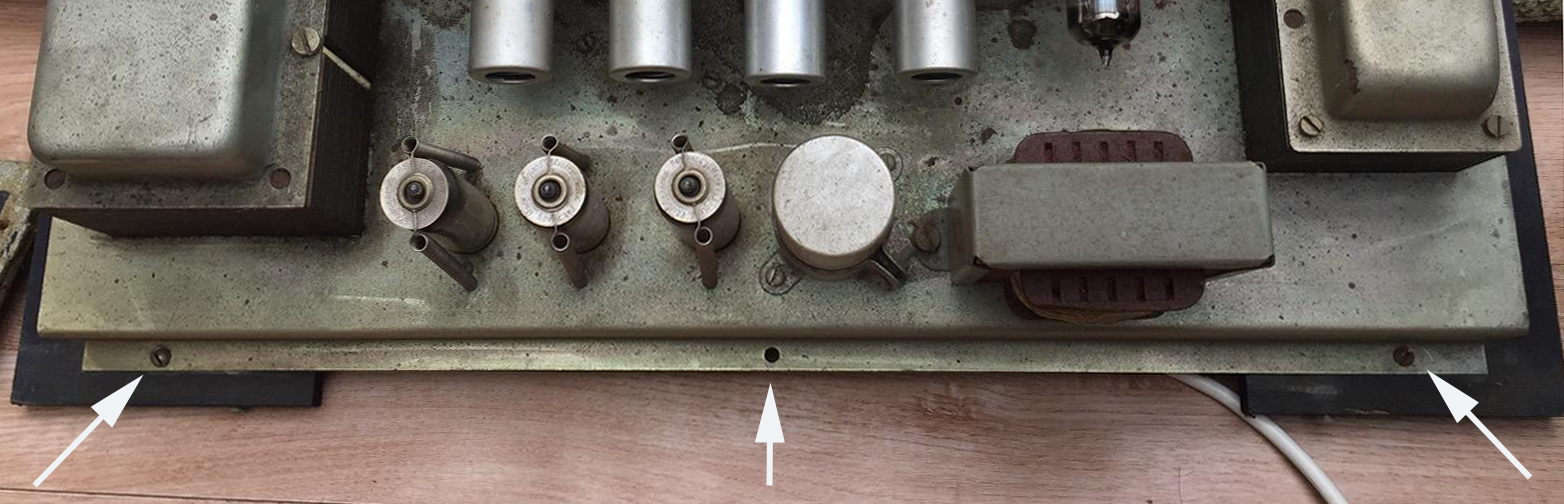
A detail of the chassis of a black panel amp from early 1961 - simple holes (on the preamp side of the plinth too) for the slider board screws.
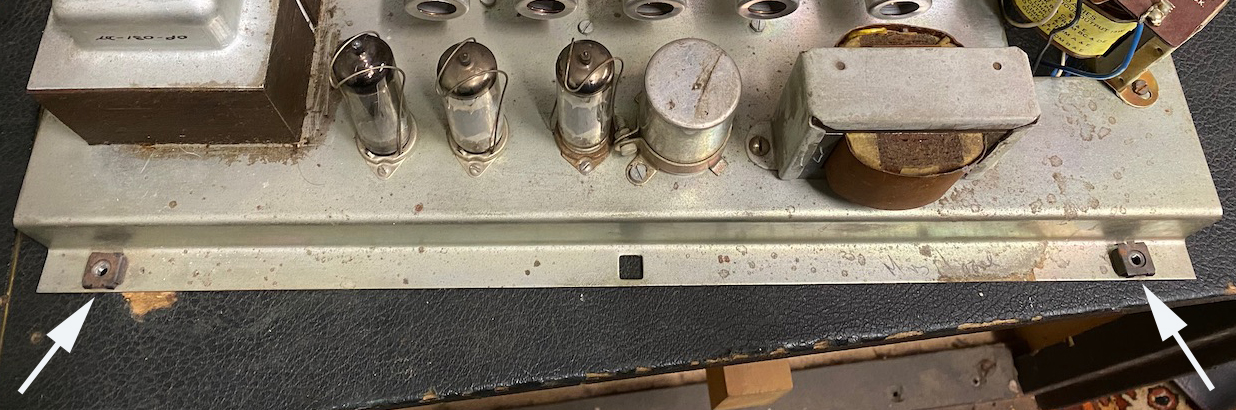
A detail of an AC15 chassis made by Westrex (copper panel, serial number in the 4000s), cage nuts in place in their square cut-outs.
In 1962 certainly, and for most (if not all) of 1963, Westrex was the sole assembler of AC15 chassis. Burndept was kept busy with other things.
The circuit
As in 1961, the AC15 was built according to the circuit laid out in OA31, dated 29 April 1960. Also as before, two versions were offered: "Normal" and "Bass" - generally designated on the serial number plate "N" or "B".

In this instance the "B" is in the upper compartment of the plate. The voicing was normally stamped after the serial number.
The (alternative) components required for bass voicing - coupling capacitors of a higher capacitance - were marked on the circuit diagram with asterisks.

Detail of the JMI sheet, which was not redrawn in later years.
In 1965, the Thomas Organ Company, the distributor of Vox amplifiers and guitars in the United States, drew up its own circuit diagram for the AC15 (called the "V-1-5" in the Thomas catalogue of the time) in a cleaner and perhaps more logical way. Components were numbered differently however, so some scope for confusion there.

Detail of the Thomas sheet, part of the "Vox Amplifiers Service Manual" (first edition).
"Normal" voicing alone was delineated in the Thomas diagram, no provision made for bass. Indeed, it may be the case that JMI did not ship AC15 Bass models to the States. More on this on a forthcoming page.
Transformers
The mains transformers of serial numbers 4786, 4848 and 5049 have the same hand-written part number: "OF-031-DT". "31", perhaps coincidentally, is the number of the JMI circuit diagram. The manufacturer is likely to have been Albion. Albion's transformers for the AC30 were coded "OH 114/DT" (mains) and "OH 083/DT" (output).
Speakers
For the single speaker AC15, Celestion blues. For the Twin, a variety of types were evidently fitted: (1) Goodmans Audiom 50 apparently sprayed Jennings blue - serial number 4559; (2) Goodmans fan-frame speakers (grey finish) - serial number 4786 and two amps serial numbers unknown; (3) Goodmans with a six spoke frame (also grey finish) - one (possibly two) Twins serial numbers unknown; and (4) perhaps at the end of 1963, certainly in early 1964, Fane 122s, sometimes sprayed blue, sometimes plain grey hammerite.
A lot of fuss has been made about Goodmans speakers, largely because John Lennon had an AC15 Twin (in August 1962) containing a pair. See the picture below, serial number 4583. Only the end bells are visible:
.
Abbey Road, September 1962.
First to say that neither of the two main types of Goodmans speaker fitted in AC15 Twins - six spoke and fan frame - were part of the Goodmans "Economax" range (as has sometimes been suggested). Economax speakers, designed primarily for hifi applications, had two cones, the smaller secondary one serving as a "tweeter".
Nor do the drivers used in AC15 Twins have "Economax frames". If anything, the speaker with six spokes has a species of "241" frame, possibly a "211". Goodmans had various numerical distinctions for type and weight.
It is evident from the pictures below that the Goodmans six-spoke speaker had an impedance of 8 ohms, two wired in series for a total of 15. The fan-framed speaker on the other hand was 15 ohms, two wired in parallel for a total of 8.
The cone code of the six-spoke speaker is "12781", the "12" designating diameter.

Goodmans six-spoke drivers in an AC15 Twin, serial number unknown, component date codes May and late June 1962, probably ready for sale in the late autumn.. Two speakers wired in series for a total of 15 ohms. The speaker's type, following the standard Goodmans system - frame weight/cone type/impedance - would be something like: 211/12781/8.

An AC15 Twin cab without chassis and back boards. The Goodmans fan-frame speakers, 15 ohms apiece, are wired in parallel for a total of 8 ohms.
Fan-frame drivers, as has been mentioned on the speakers page, are also the preserve of portable enclosures made for film projector sound systems:


Above, Goodmans fan-frame speakers from Bell and Howell metal- and plastic-clad portable speaker enclosures. Others were exported to the USA (and rebranded "Lafayette" or "Jensen").
At any rate, the point to make is that the frequency range of both types of speaker was limited, especially in terms of bass response. But where being "Beatle correct" is concerned, that is probably irrelevant.
Cabinets
Single speaker cabinets for the most part "thin-edged" or "thin-lipped" - finger-jointed 3/8" ply sides and bottom, part 3/8" and 3/4" at top. Likely to have been made for JMI by P.A. Glock and Gla-Rev.

Detail of the top of a single speaker AC15 cabinet. 3/8" and 3/4" lap-jointed ply.
It is clear from various sources that when JMI ceased trading in April 1968, a number of single-speaker AC15 cabinets remained unused and unsold. These were bought in by at least two sellers from the liquidation sales of late 1967 and autumn 1968. Below, a detail from "Exchange and Mart" magazine, October 1968. Although the precise nature of these cabs is unknown, it is likely that they were later rather than earlier (ie. "thin-lip").

"Exchange and Mart" magazine, October 1968.
Accordions
It is well worth mentioning that JMI continued to recommend the single-speaker AC15 to accordionists in the early 1960s - indeed through to the end of 1964. The unspoken rule among players in the 1950s and 1960s seems to have been that 10-15 watts was ample, anything more verging on the undignified.

July 1961. In June 1961 the output of the split-front single speaker AC15 was said to be 15/17 watts. Price: 70 guineas (£73 and 10 shillings).
Surviving amplifiers
This picks up from the previous page - AC15, third circuit, 1960 to late 1961. The serial numbers below are in the range c. 4500 into the 5000s, all copper panel. A forthcoming page will pick up from where this one leaves off.
If you know of further amps that should be incorporated here, do let me know.
Copper panels and the new AC15 TWIN - late autumn 1961

Vox prices at 23rd September, 1961. This is the earliest mention of the AC15 Twin.
Late 1961 and 1962
Serial number 4526 N


A single speaker AC15. Currently in the UK, illustrated in a Music Radar article on this page. At present, this is the lowest serial known for an AC15 with a copper panel.
Serial number 4543 B


Serial number 4549 N

Apparently had or has a Goodmans speaker.
Serial number 4558 N

An AC15 Twin, cabinet well worn, but chassis in good order. Original Albion transformers in place, and in the preamp still some black Tropydur WIMA capacitors with late 1961 date codes. One of the pots has the date code "CJ" = March 1962; and one of the TCC filter caps "WTH" = 14th week of '62.
Serial number 4559


The earliest AC15 Twin currently known. Illustrated by Jim Elyea. Speakers are Goodman Audiom 50s, 10 watts handling, 15 ohms apiece, wired in parallel for a total impedance of 8 ohms. This amp is also illustrated (Elyea, p. 573) with a pair of grey Goodmans with six spoke frame. Probably some more to come on this.
Serial number 4567 N
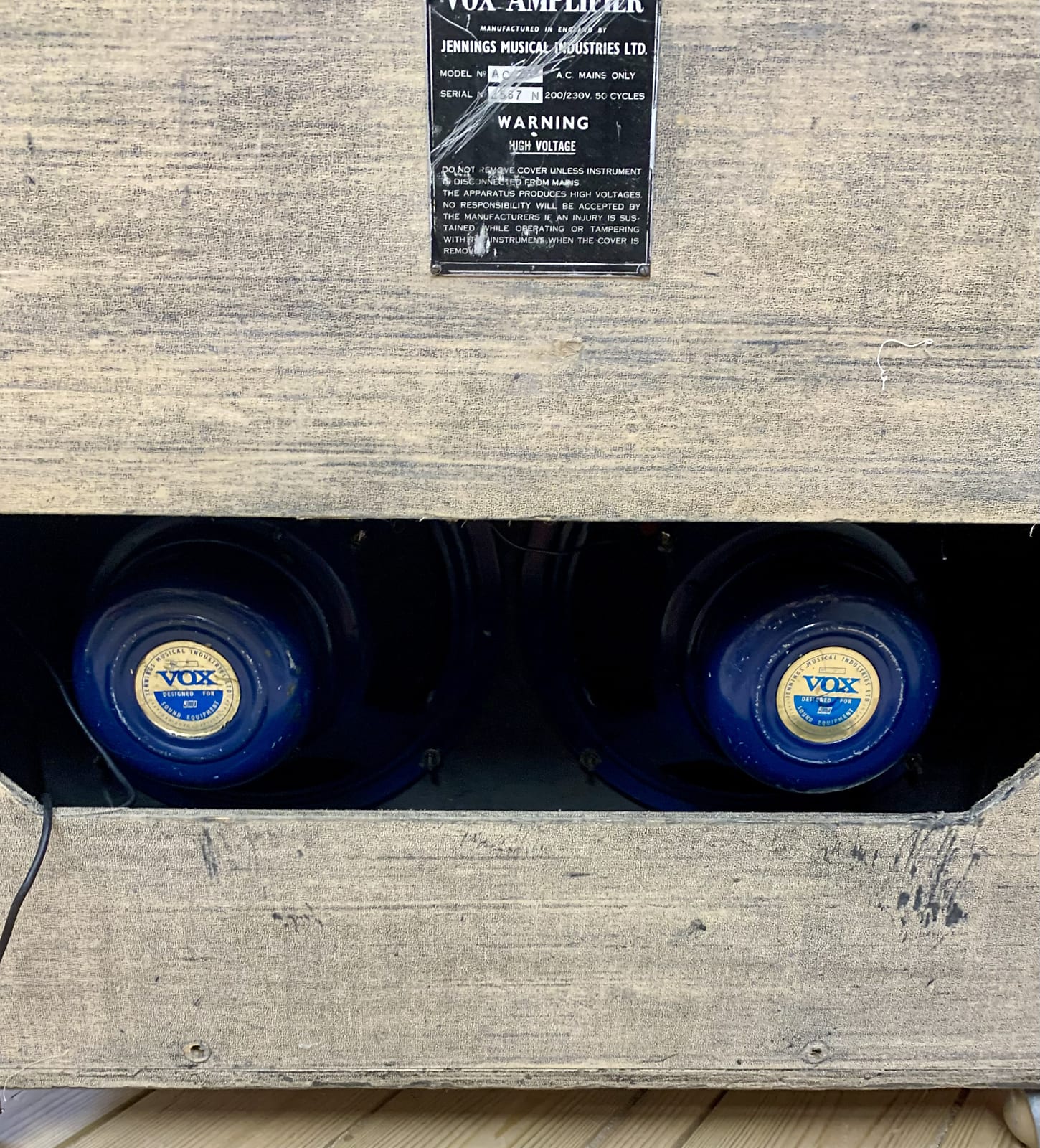
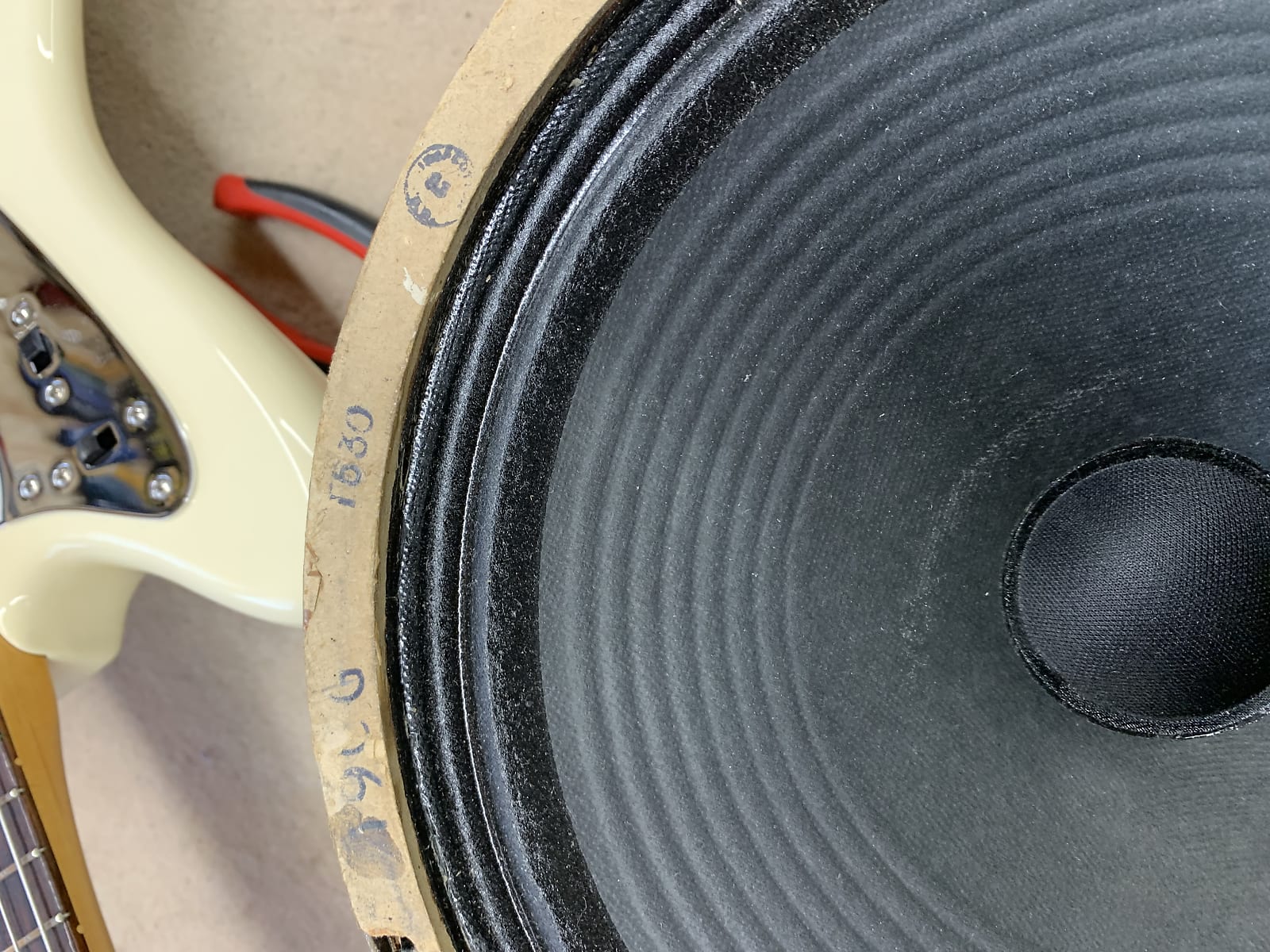
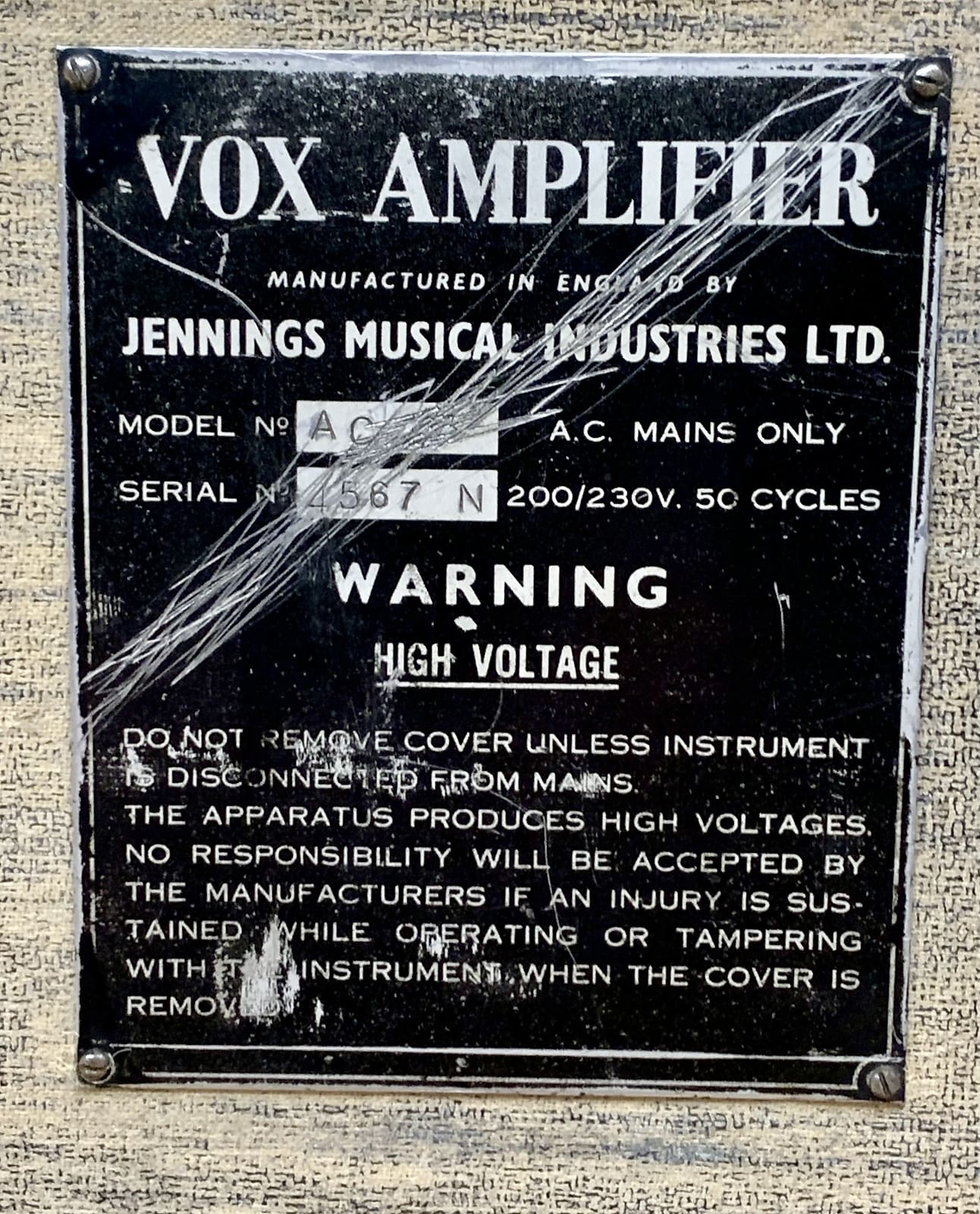
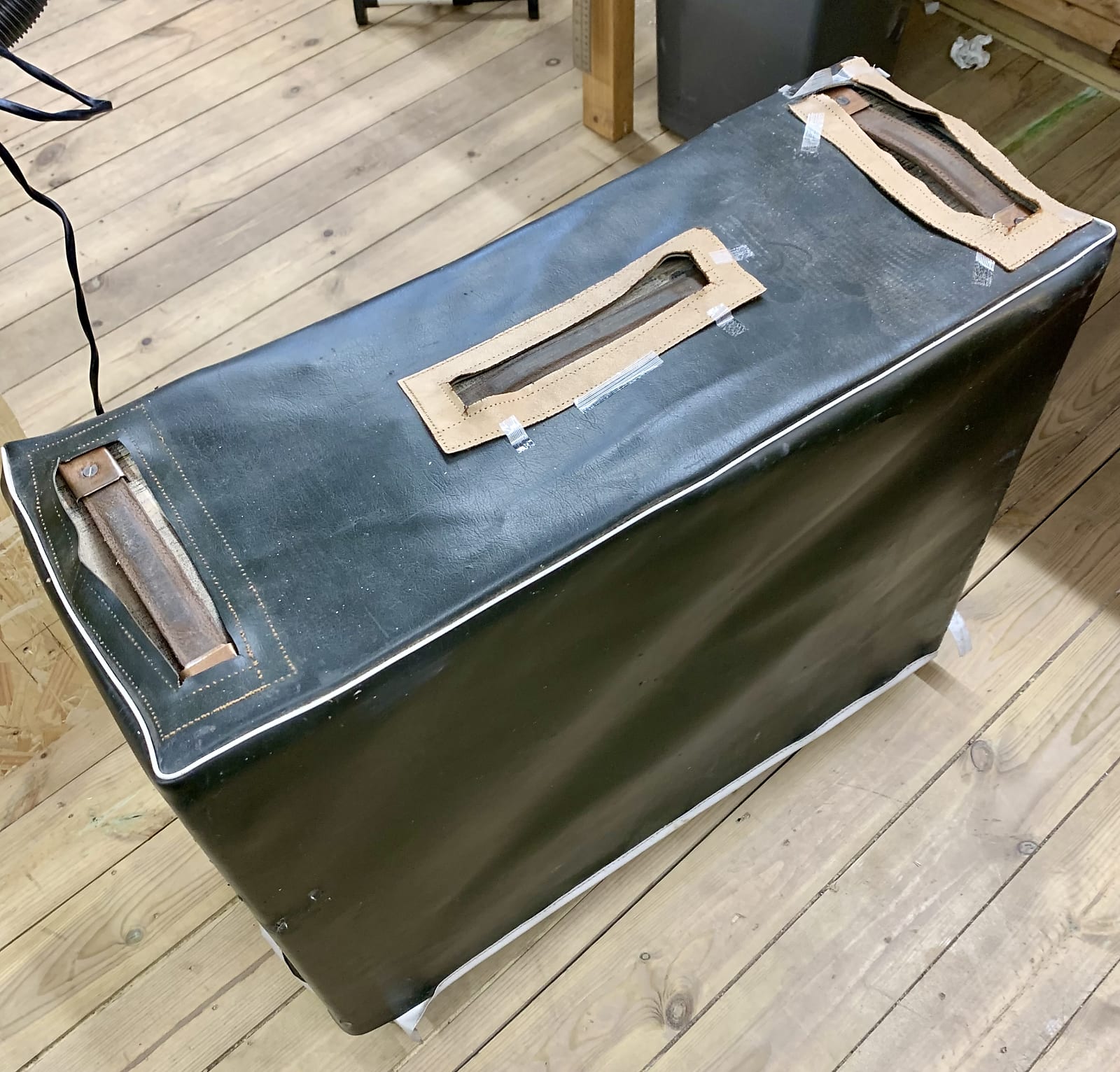
A Twin, beige vinyl, later black paint mostly cleaned and abraded away. Serial number plate of the same type as number 4558 above. Two of the Hunts capacitors have the date code "YAH" = 9th week of 1962. In the speaker compartment, two Celestion blues, one dated "19CG" = 19th March, 1962. Original cover and footswitch present.
Serial number 4583
John Lennon's AC15 Twin. Hire purchase agreement dated 27th July 1962. Seen in photos taken at The Cavern Club, Liverpool, in August 1962 (rehearsals), and at Abbey Road later in the year.

Picture from the Savage Young Beatles site. Various suggestions have been made as to the model name of these Goodmans speakers. None so far is sustainable.
An amp auctioned on 5th December 2023: Real questions surround the serial number plate currently on the back of this amp, esp. in terms of layout and stamping. Whether the chassis is original to the cabinet is not known. The chassis and cabs of Vox amps, which are generally interchangeable within model, have certainly been prone - let's say - to being swapped around over the years. Plates are easily swapped around too.


Above, the amp that appeared at auction in 2023.
Serial number 4633 N

A single speaker AC15. Chassis assembled by Westrex. The original Celestion blue still in place. Click for a larger image.
Serial number 4641 B


Still in superb condition. Chassis assembled by Westrex. The original Celestion blues are in place. The footswitch probably comes from another source. Thanks to Colin for the pictures.
Serial number 4665
A Twin, still in superb condition,. In the preamp a number of the black WIMA Tropydur capacitors remain, one with the date code "111" = November 1961 for its manufacture in Germany. Speakers are fan-framed Goodmans.
Serial number 4673 N (?)
A Twin. Cabinet covered in finely dimpled black vinyl, grille cloth renewed. Plastic VOX handles now replacing the original leather. On the serial number plate, the model name has been hammered out - ten heavy blows with a punch and a number of deep scratches. "AC15" is scratched to the right of the panels. Was this cabinet and plate originally for AC30 number 4673?
The AC15 chassis has two sets of fixing holes (for the back panel) on its (thin) aluminium lip - a pair widely-spaced (for the current back board), and a pair more narrowly spaced (standard AC15 Twin spacing). The control panel is unusually orange in colour. Generally speaking, the chassis - probably from an older AC15 - looks to be in good electronic order. The speakers are now later Celestion T1221s.
By this point the new casting of the footswitch introduced
The new footswitch has a plainer domical profile. The older version of the footswitch had a compound (two-part) profile.
Serial number 4703 N
Cabinet and serial number plate only.
Serial number 4755 B
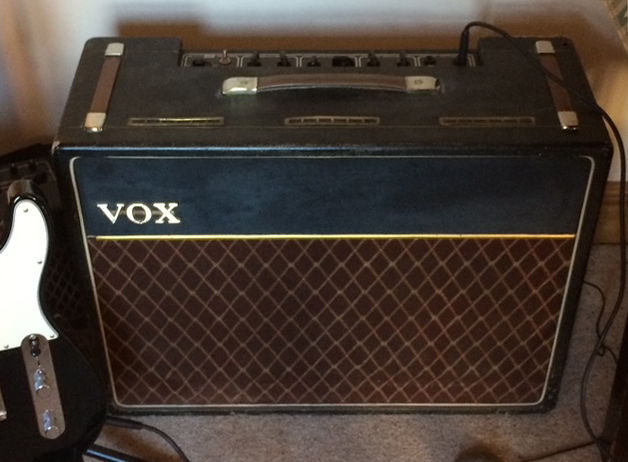

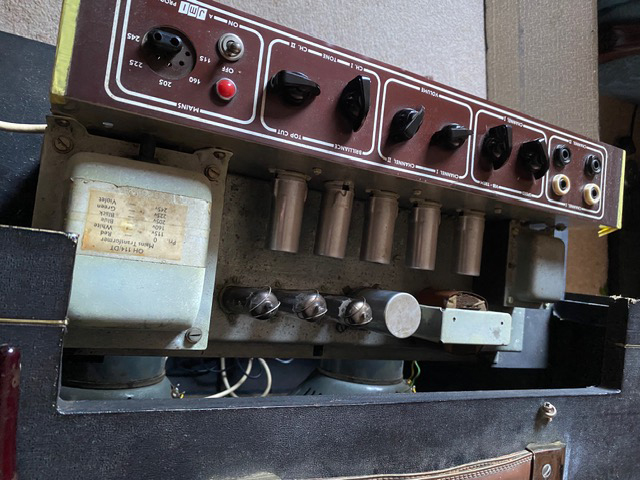
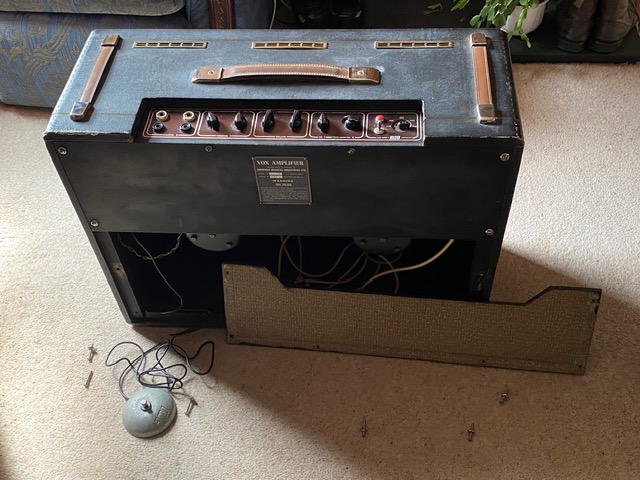
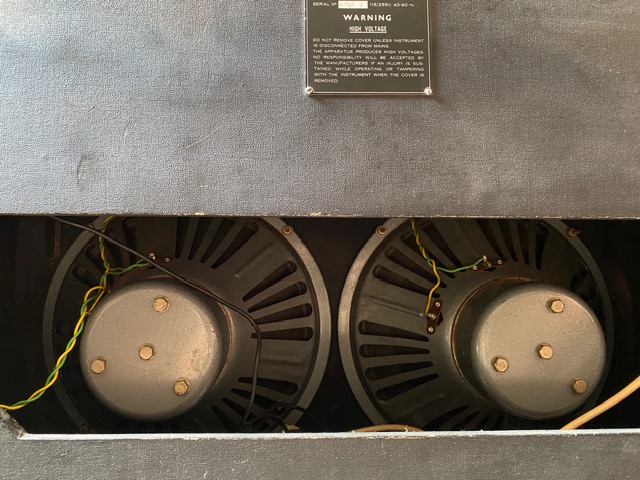

Bought second-hand c. 1963 and subsequently painted black. Note that the shroud of the Albion mains transformer still has its label. Speakers are the original Goodmans fan frame Alcomax, wiring untouched. The original new-style dome footswitch is present too. Thanks to Bob for the pictures.
Serial number 4757 N


An AC15 Twin, beige vinyl, copper control panel. The speakers are Goodmans with fan frames. Their name/model number is not known at present.
Serial number 4758 N
Good condition externally; outer leather handles replaced. One of the Hunts capacitors has the date code "WIH" = 13th week of 1962 for its manufacture. The Celestion blues have the date code "08HH" = 8th August '63. Speaker wiring appears to be later too.
Serial number unknown


An AC15 twin with fan framed Goodmans. The control panel is of a non-standard type, at least where "copper" panels are concerned: etched and filled rather than anodised. The "top cut" pot has the date code "CJ" = March 1962. Thanks to Marc for the pictures.
Serial number 4786 B


An AC15 Twin, beige vinyl, copper control panel. Put up for sale some time ago and said, if recollection is correct, to have been owned by Mike Rutherford's tech - this to be verified when the text file decides to reveal itself. The speakers were only pictured incidentally at that time - there was no full shot of the back - but it is clear that they were Jennings blue, not grey or blue-grey. In one of the more recent pictures above, a pair of fan frame Goodmans can be seen now in place. The main filter capacitor (made by Hunts) in the preamp has the date code "HUH" = 26th week of 1962.
Serial number 4791
An AC15 Twin.
Serial number 4848 N
A single speaker AC15, beige vinyl, copper control panel. In the preamp, the main Hunts filter cap has "HUH" = 26th week 1962; one of the blue Hunts cathode bypass caps "YDH" = 8th week of '62; and the main cathode bypass capacitor (underchassis) has "WNH" = 17th week of '62. The date code of the Celestion blue speaker is "18KG" = October 1962.
Serial number 4879 N
Reported as having been bought new in March 1962, an interesting recollection in relation to dated components in serial numbers 4786 and 4848 (26th week of 1962 is June). Thanks to Amanda for the info.
Serial number 4851 N (now altered and fudged up)
A single speaker AC15, beige vinyl, originally copper control panel. Pictures from around October 2021 show the amp, a distinctive hole in its back panel, with its original chassis - perfectly in line with the serial number and point in production. In the preamp, a couple of Hunts capacitors have visible date codes, one "HUH" = 26th week of 1962, another "YDH" = 8th week of 62, both also in order for this point in production.

AC15 serial number 4851. Note the hole in the upper back board.

The preamp of the amp as it was.
A month or so later, serial number 4851 was sold, but with an entirely different chassis and speaker in the cabinet - note the distinctive hole.


AC15 serial number 4851 again. The Celestion blue (replacing the one in the earlier set of images) is from mid 1961. RIC cone codes changed every month or so. "RIC 1 YG" also appears on a pair of speakers (from AC30/6 serial number 4606) with date codes "16FF" and "29FF" = 16th and 29th June, 1961. See this page.
Serial number unknown


An AC15 Twin cabinet and speakers (fan-framed Goodmans) but no chassis. The brass vents remain, but the leather strap handles (note the holes) have gone.
Serial number unknown


Single speaker AC15, beige vinyl, copper panel. The white print Mullard EF86 valve has the paint code "EJ" = May 1962. The top cut pot has "FJ" = June 1962.
Serial number 4924 B
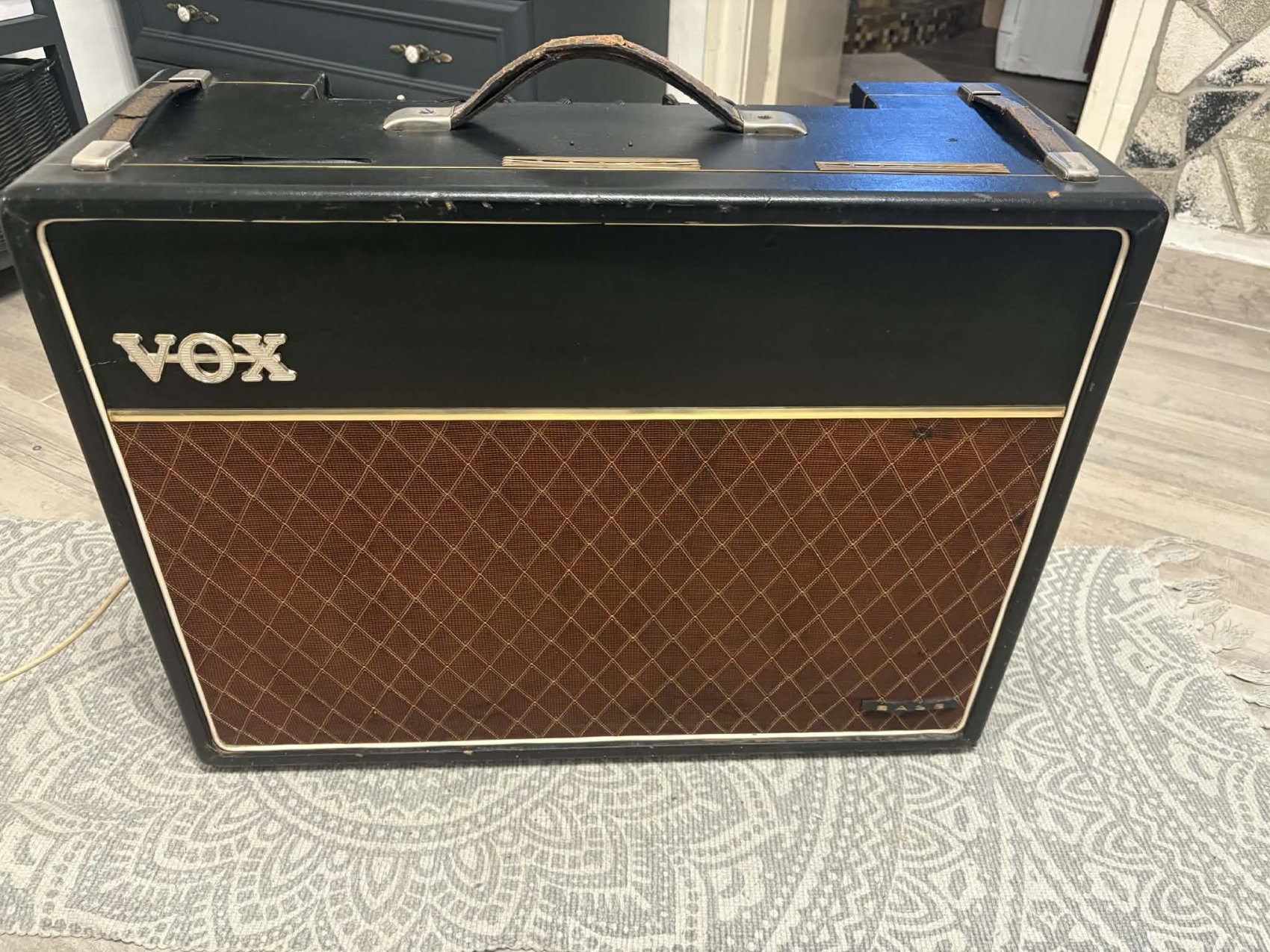
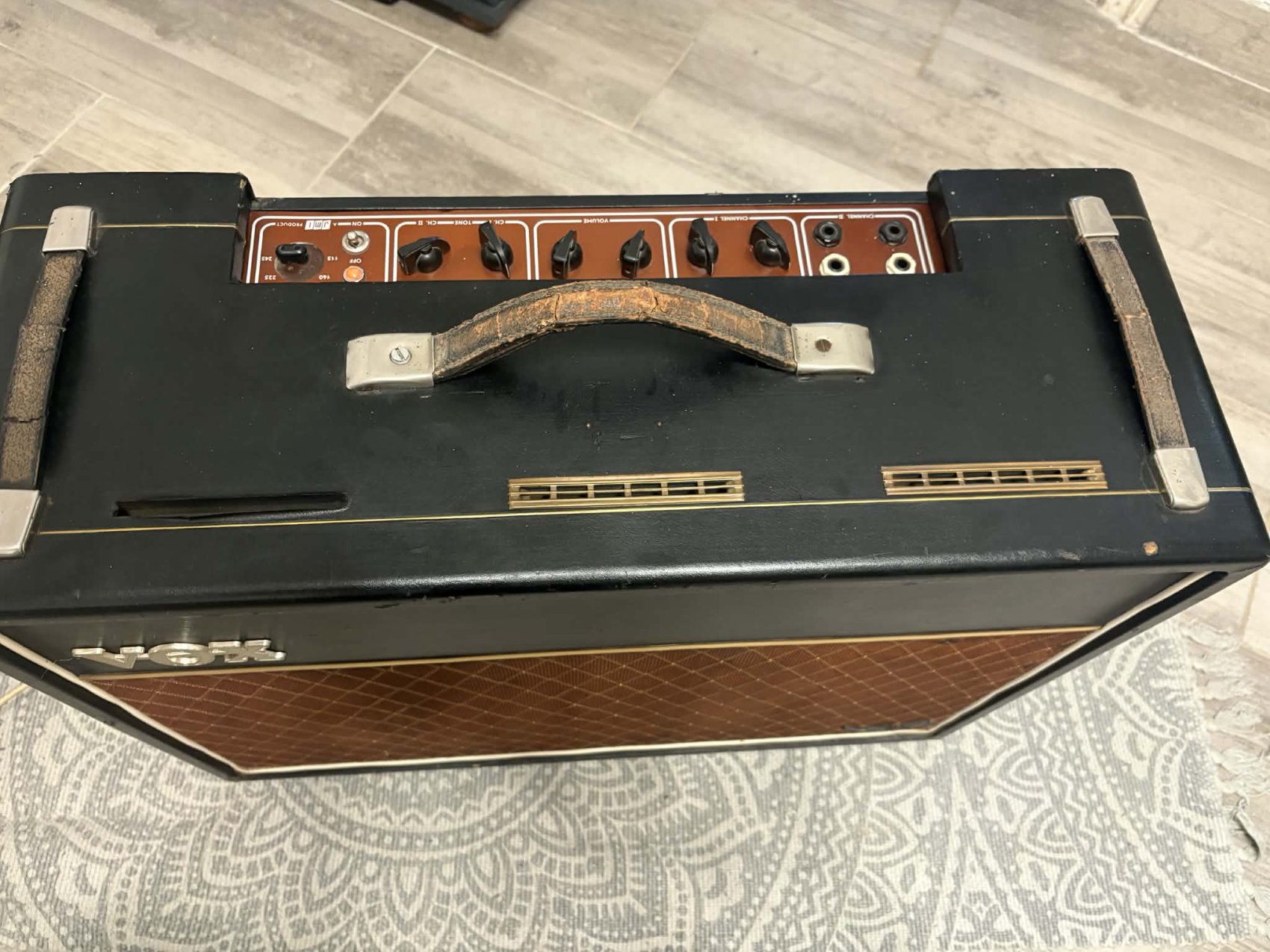
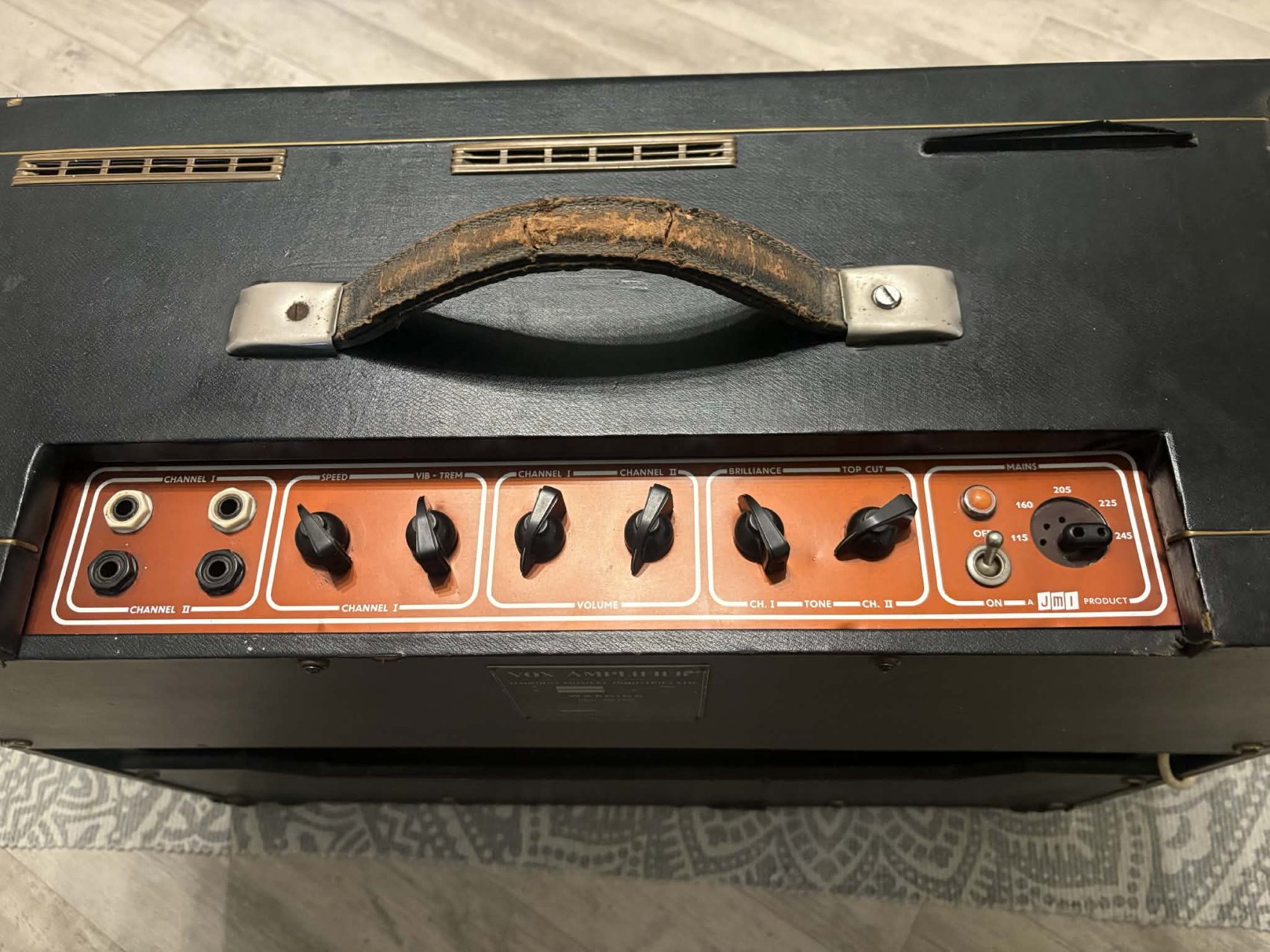
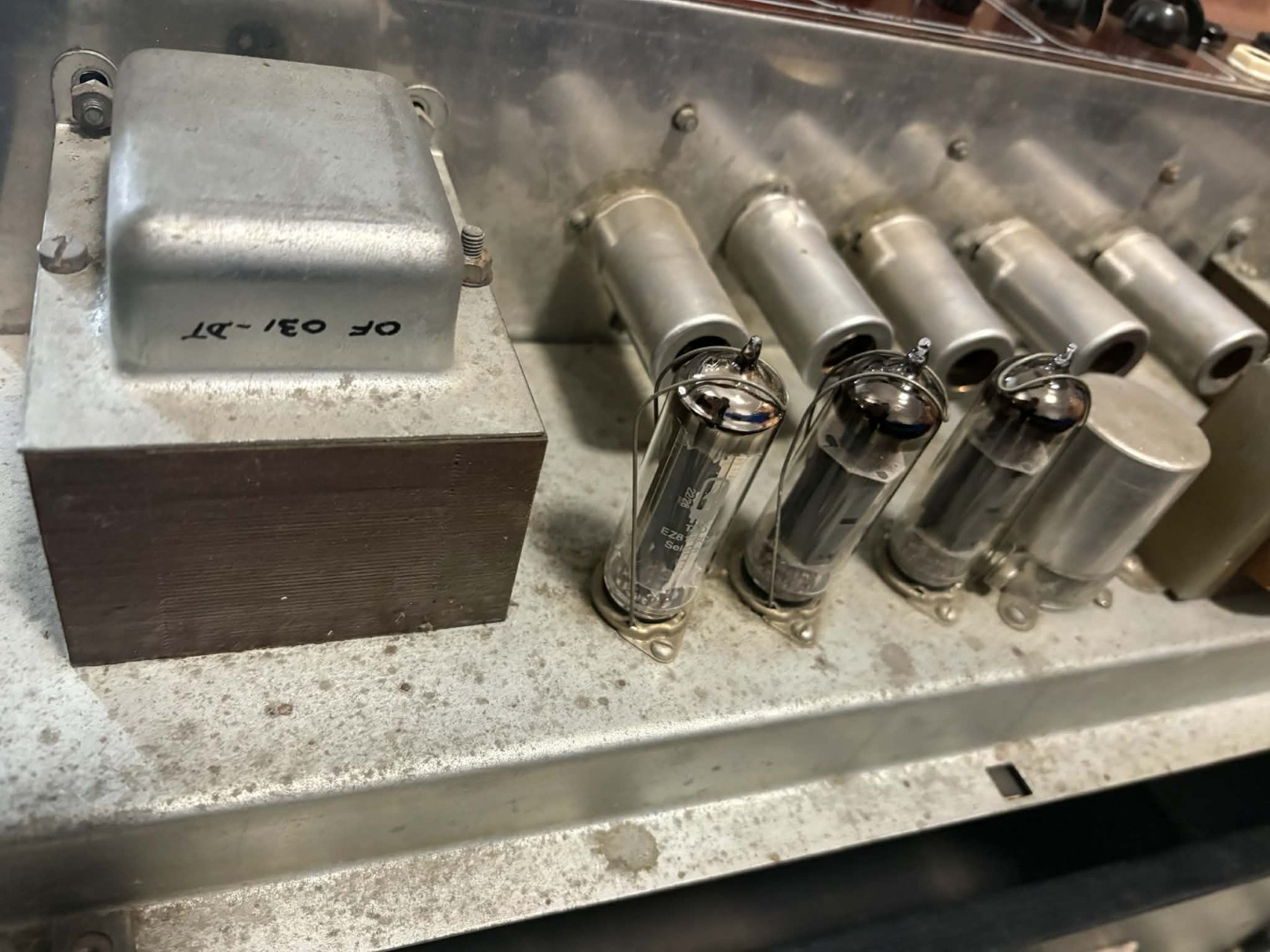
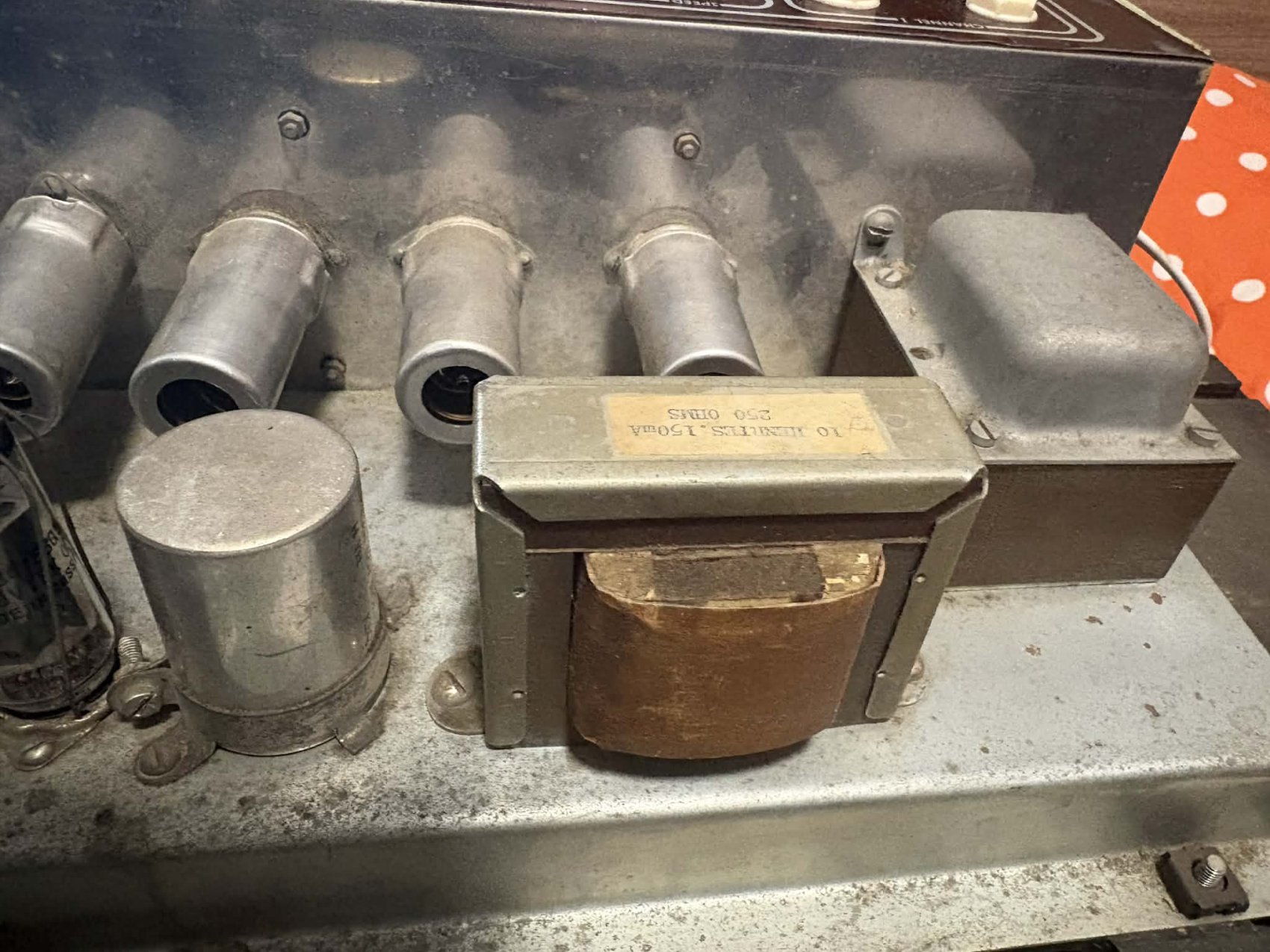
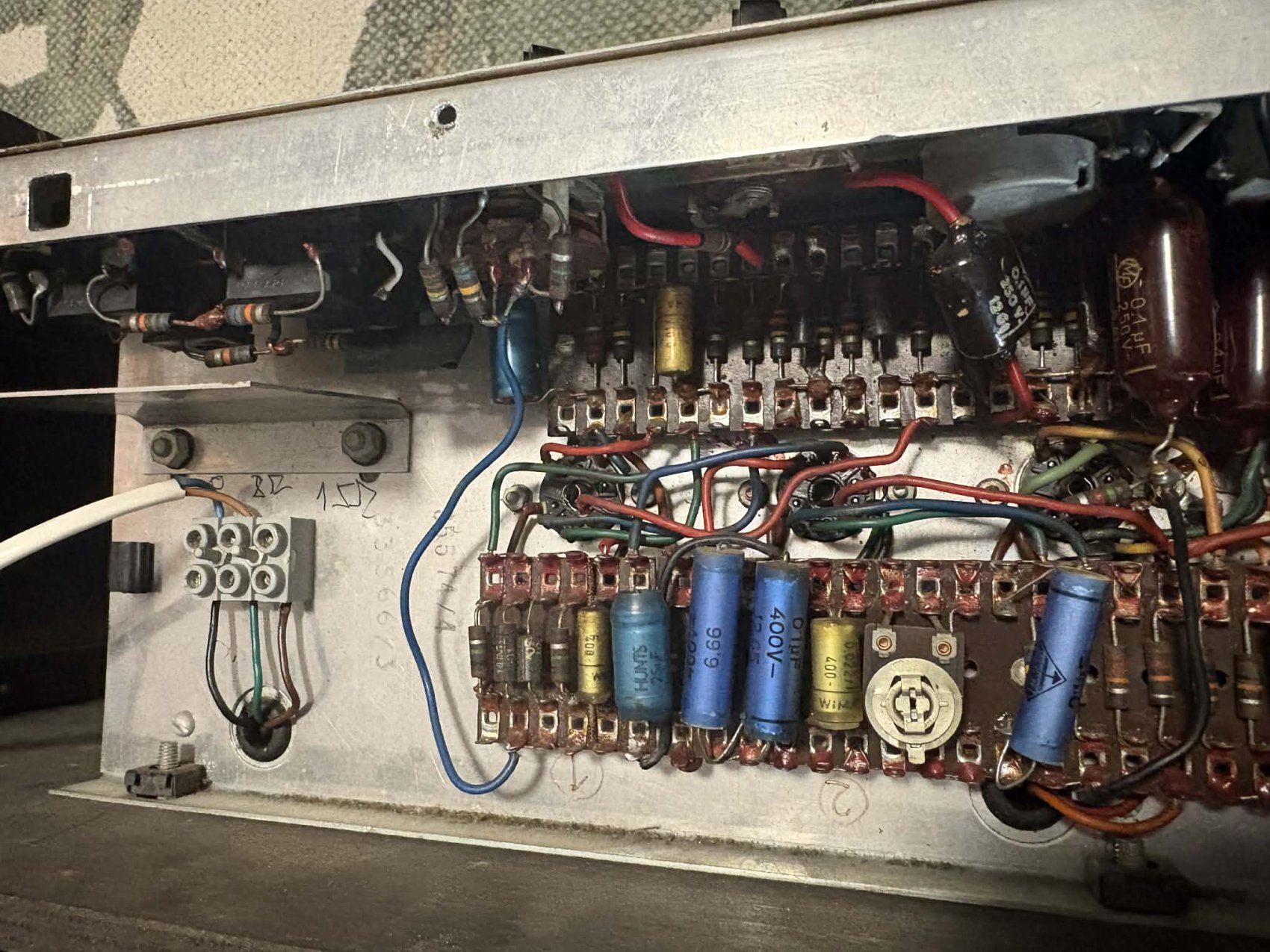
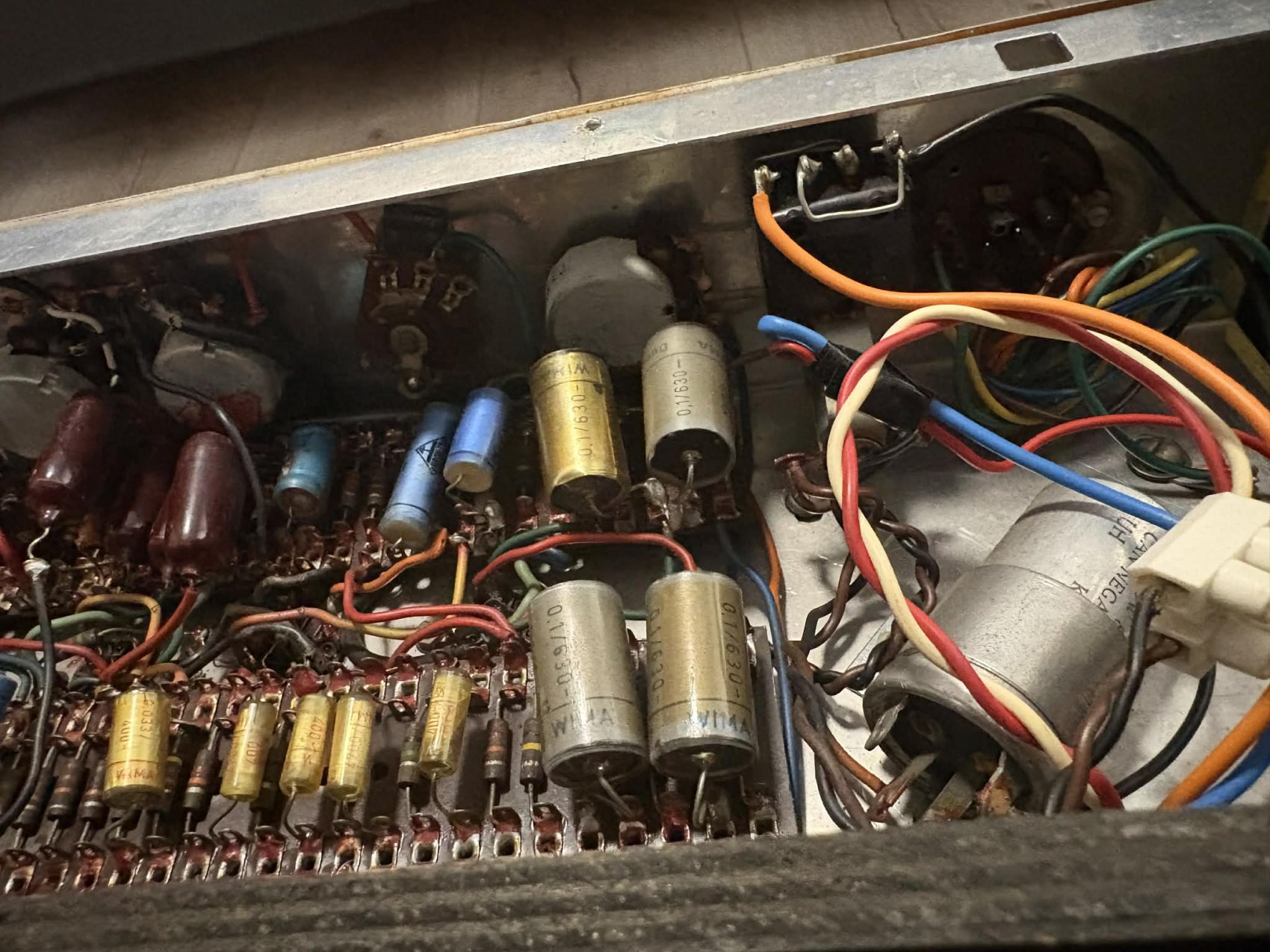
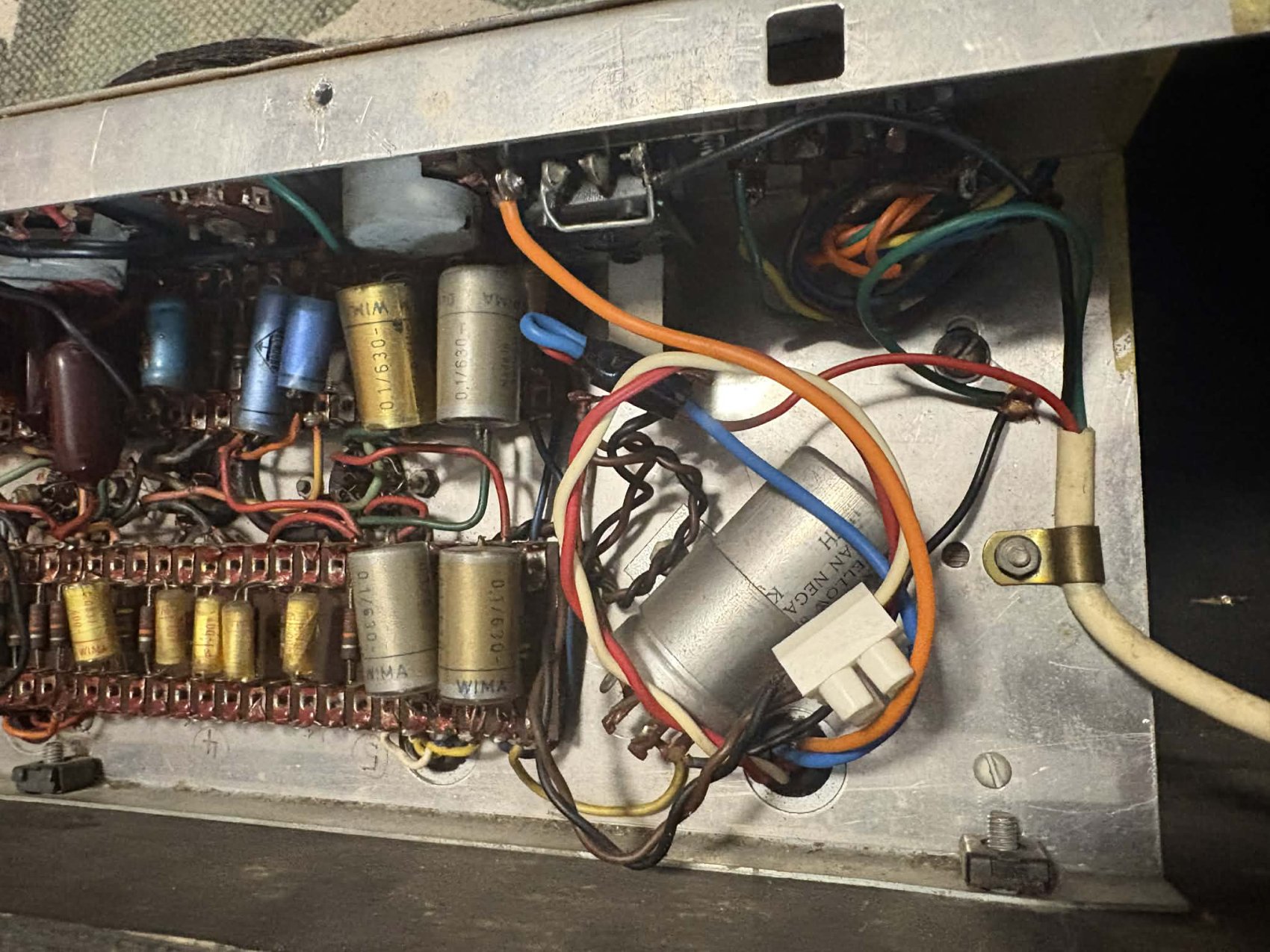
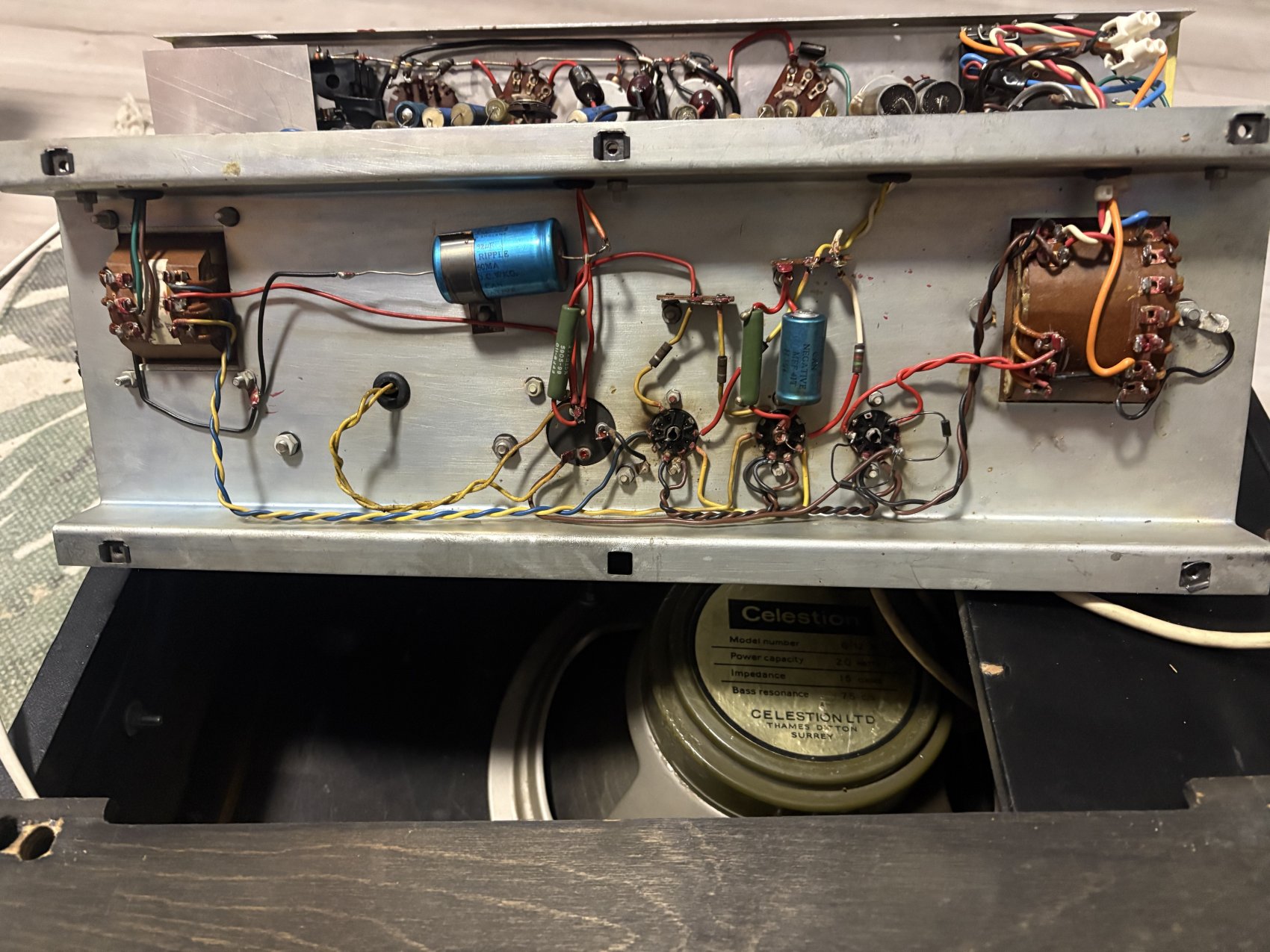
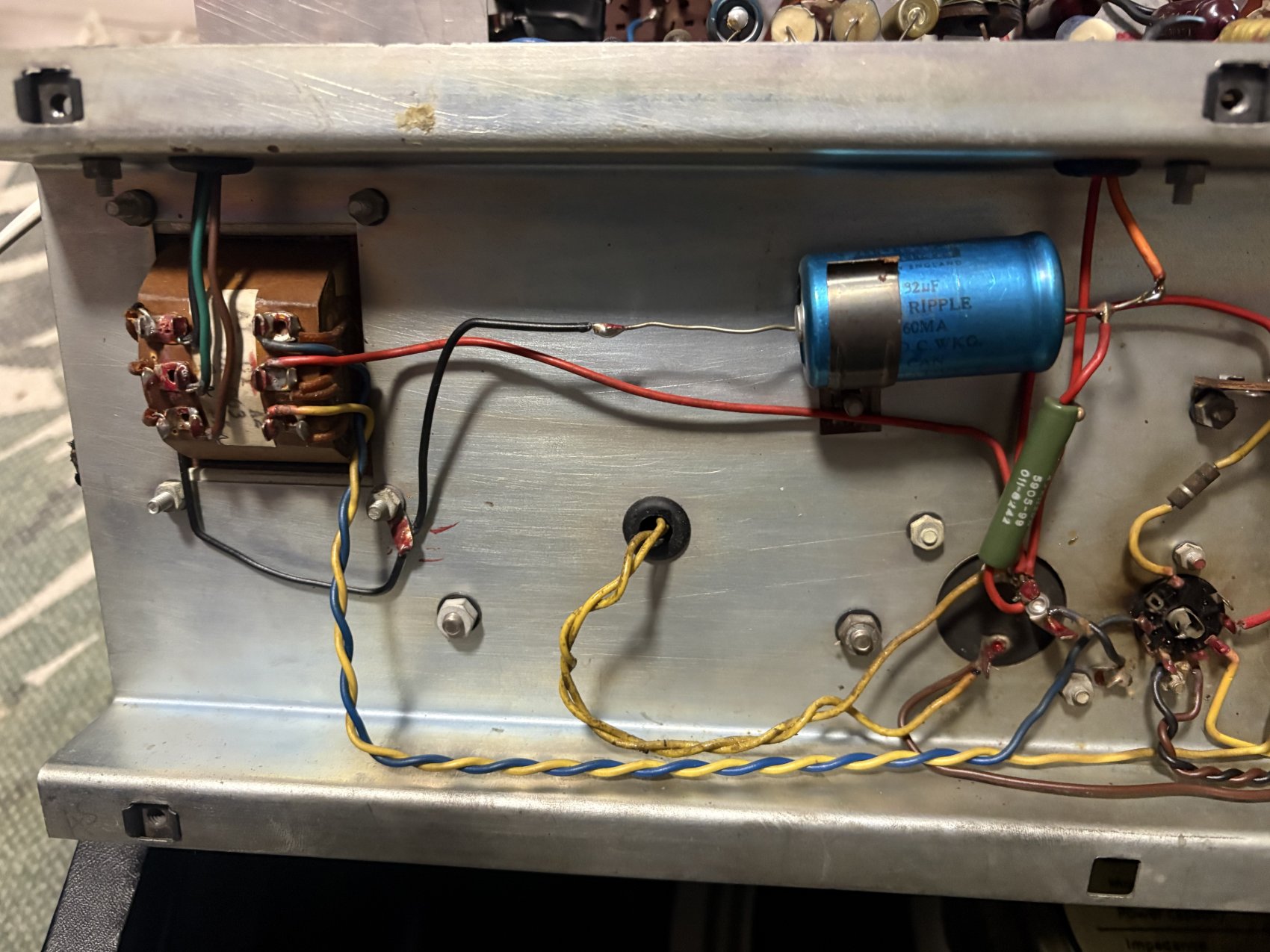
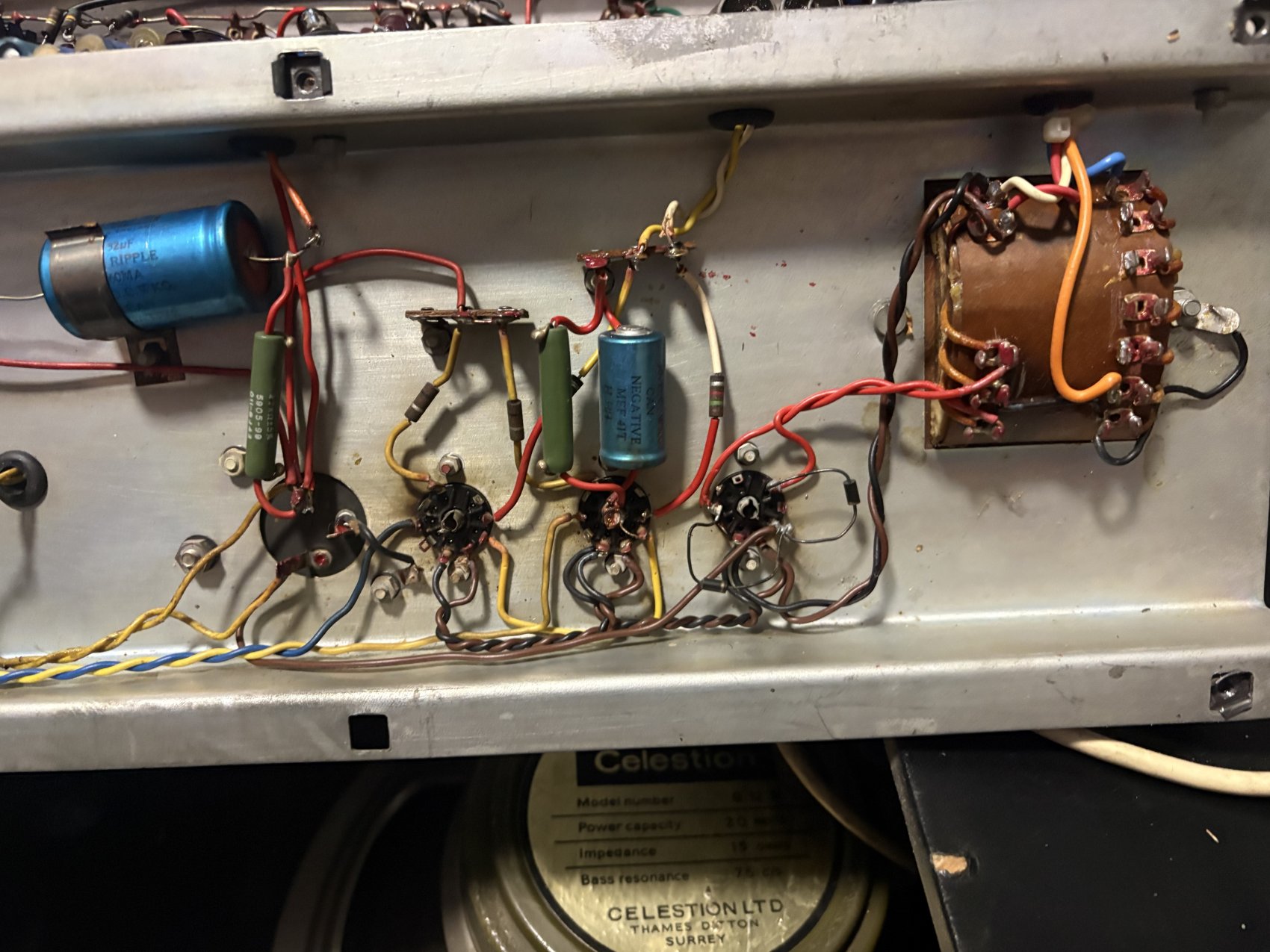
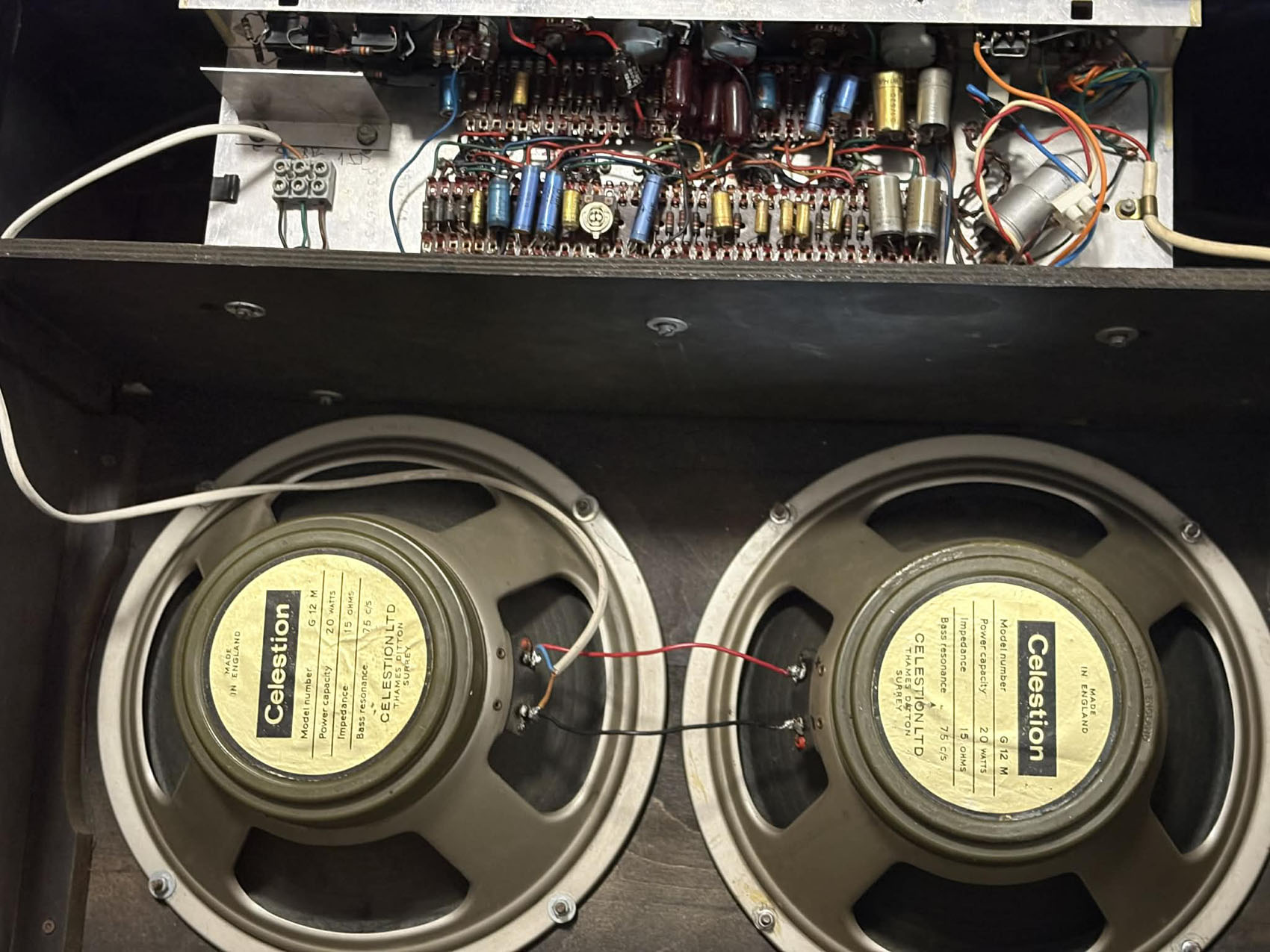
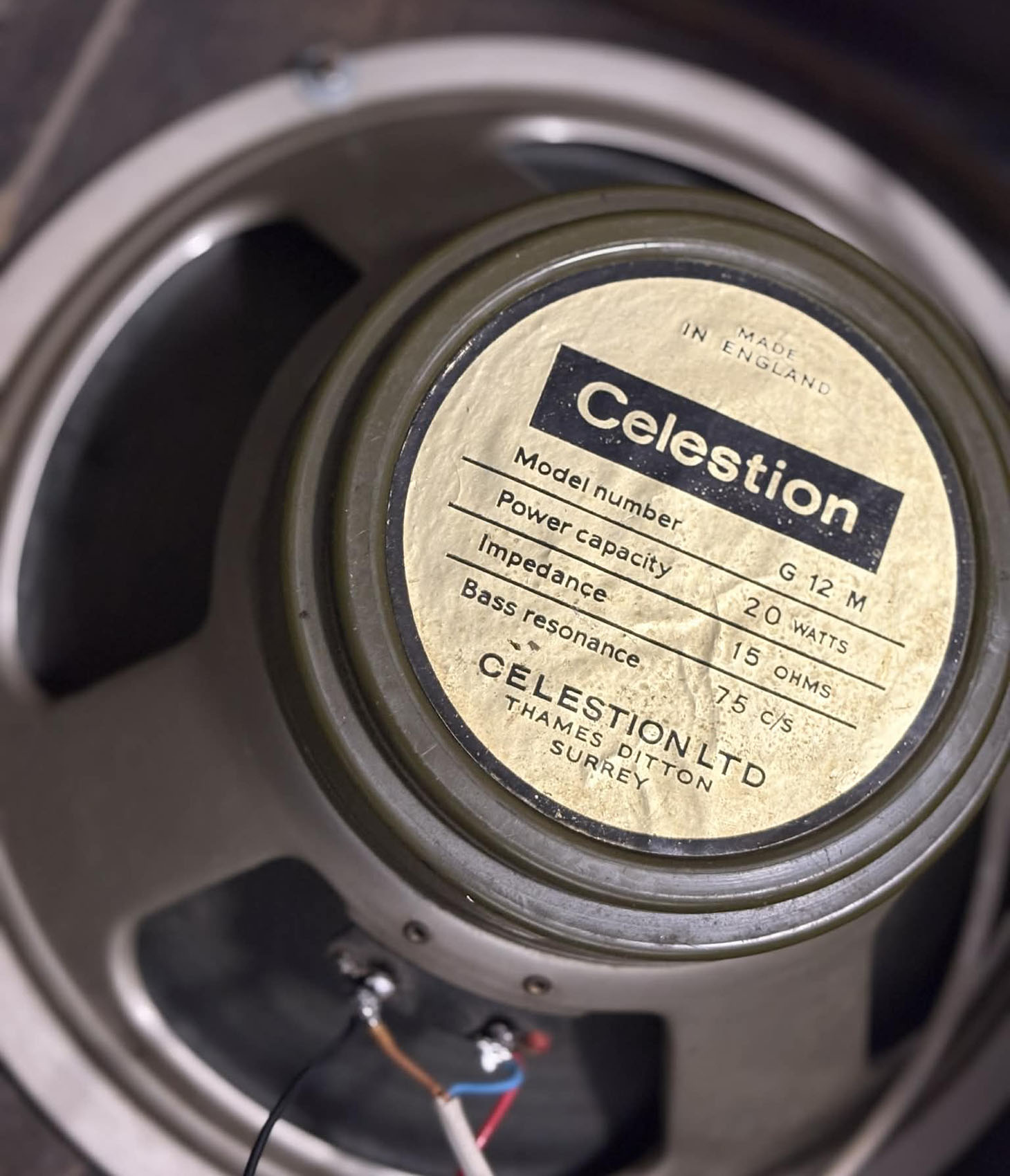
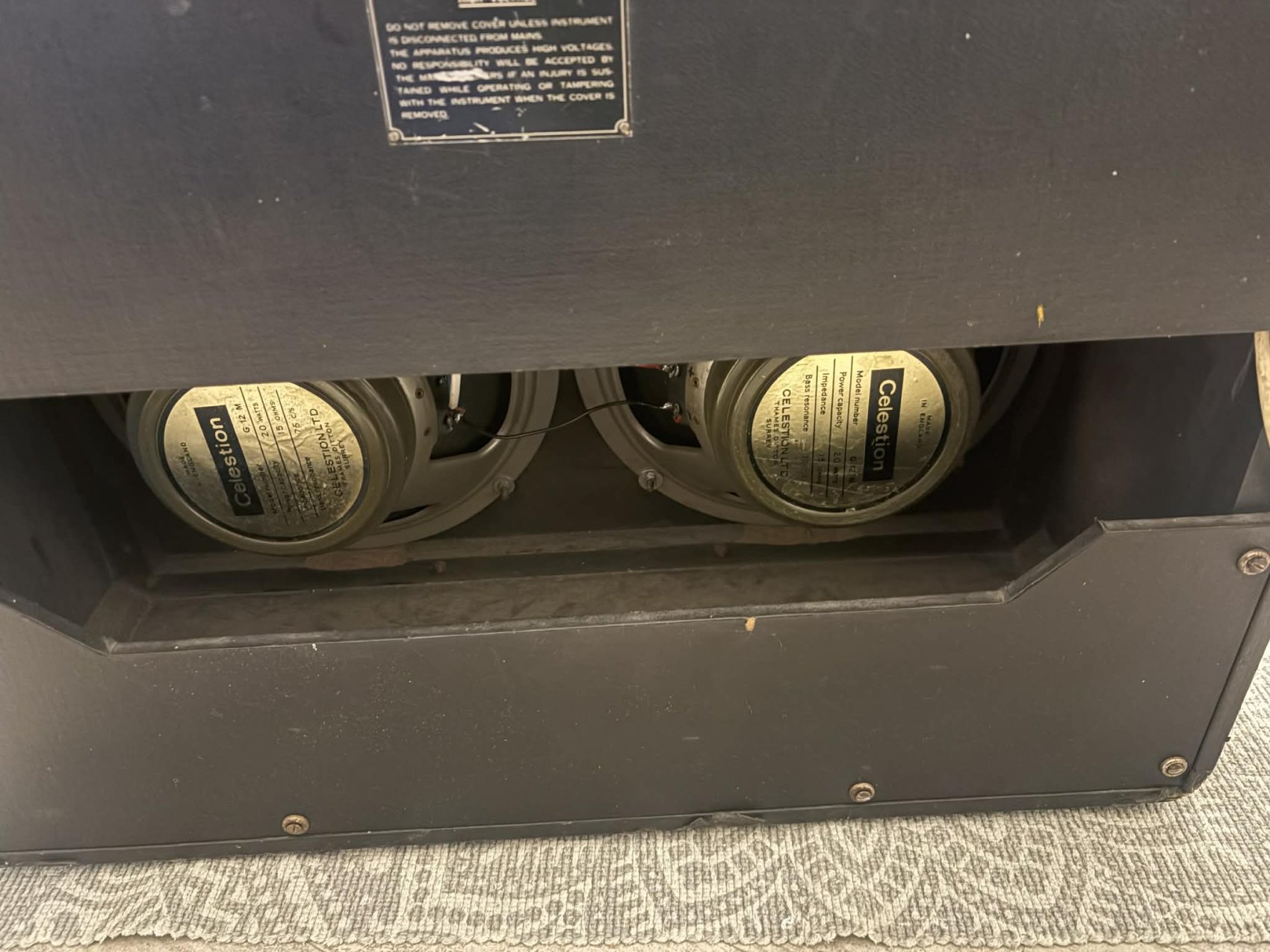
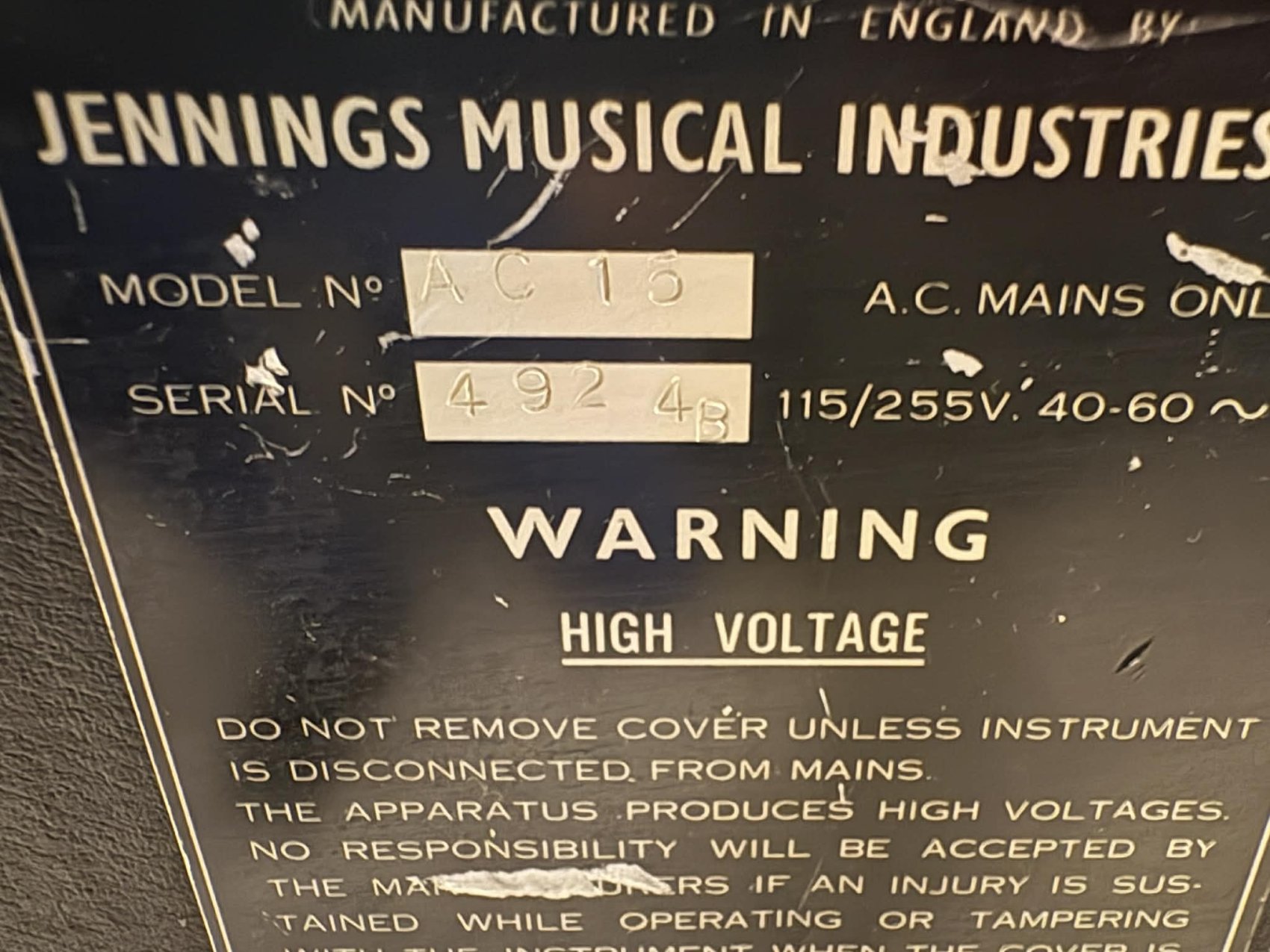

Good condition all round; Celestion (Thames Ditton) G12M greenbacks now in place. Cabinet covered in smooth finely textured black vinyl (as serial number 4930N). In the preamp, the tone pot has the date "EJ" = May 1962 for its manufacture. Blue Hunts electrolytic caps have late May and June '62 date codes. On the aluminium upright, some interesting stamps: "35574/4" and "33566/3". Thanks to László for the pictures.
Serial number 4930 N
Exterior shots only. Cabinet covered in smooth black vinyl; leather handle. Speaker now a Celestion G12T-75.
1963
Serial number 4985 (or 4965) N
Below, serial number 4985N, one of at least three produced in blue and oatmeal by JMI in late 1962 / early 1963. In November 1964, Pan Music, which seems to have struck a deal with JMI to sell surplus stock, advertised a blue AC15 Twin ("as brand new") - possibly one of the promotional amps in view.

AC15 Twin serial number 4985N.

A detail from a shot of Adam Faith on stage, NME Poll Winners Concert, 21st April 1963. Photo by Harry Hammond.

November 1964.
Serial number 4999 N
In the preamp, black and red print WIMA caps, along with one black WIMA Tropydur. Leather handle on the cabinet. The original Celestion blue looks to be in place.
From around this point, new plastic handles
Serial number 5023 N

Pictures only of the exterior for the time being.
Serial number 5049 B


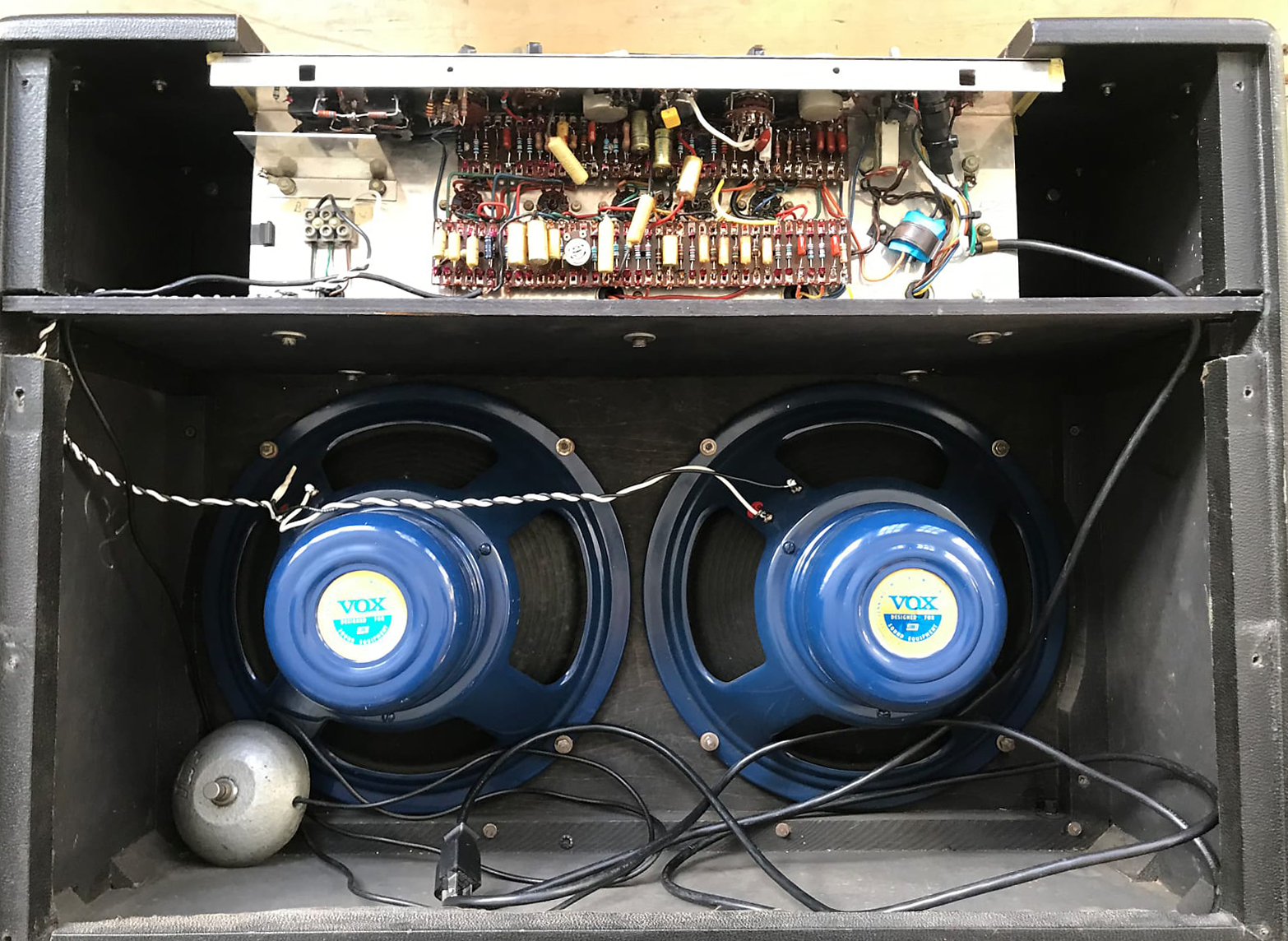


An AC15 Twin, brown grille cloth, dark grey/black dimpled vinyl. Chassis assembled by Westrex. The Albion mains transformer has the code "OF-031-DT". The Mullard mustard capacitors in the preamp are later additions ("A3S" and "B3S" indicate first and second quarters of 1963, but "S" is the factory in Barcelona). The Celestion blues, which have date codes "21BJ" = 21st February 1964, are likely to come from another source.
From around this point, cabinet back boards have rounded corners.
Serial number 5066

A single speaker AC15, brown grille cloth, dimpled dark grey/black vinyl. Copper control panel, Celestion blue speaker.
Serial number 5073
A Twin. Dimpled black vinyl. No original component date codes known at present. WIMA red-print signal capacitors in the preamp. Speakers are Goodmans fan frame - the original wiring is not present.
Serial number 5102 B


An AC15 Twin. Smooth heavy black vinyl with dimpled pattern. New-style plastic handles on the cab. One original Goodmans driver remains, six-spoke frame, silver-grey finish. Difficult to tell for certain, but perhaps still square corners to the back boards.
Serial number 5115 B


A single speaker AC15, brown grille cloth, dimpled dark grey/black vinyl. Copper control panel, Celestion blue speaker. Sold by Servaas, The Hague.
Serial number 5158 N
Exterior shots only for the time being. Finely-dimpled black vinyl, brown grille cloth. The original Celestion blue (and wiring) look to be in place.)
Serial number 5193 B

A single speaker AC15, brown grille cloth, dimpled dark grey/black vinyl. Copper control panel, Celestion blue speaker. One of the gold-coloured TCC preamp valve cathode bypass caps has the date code "UC" = March 1963.
Serial number 5220 N

A single speaker AC15, excellent condition. Dimpled dark grey vinyl. Rounded corners to the back-boards. Original Celestion blue speaker still in place.
From this point basketweave vinyl
Serial number 5230 N


A single speaker AC15, excellent condition. Basketweave vinyl. In the preamp, one of the gold-coloured TCC capacitors has the date code "UB" = February 1963 for its manufacture. The Top Cut potentiometer has "EK" = May 1963. Original Celestion blue speaker still in place. Thanks to Garry for the photos.
Serial number 5245 N
Originally a single speaker AC15, the cabinet cut down to form a box for the chassis, no speaker. Recovered in basketweave.
Serial number 5283 N


An AC15 Twin. Chassis assembled by Westrex. One of the gold-coloured TCC caps has the date code "UF" = June 1963; one of the pots "EK" = May 1963. Basketweave vinyl; brass vents; plastic handles; Fane speakers (light magnets) in Jennings blue.
Serial number 5293 N
An AC15 Twin. Basketweave vinyl; brass vents; plastic handles. The speakers are now Goodmans Audiom 60s.
On to the page on the AC15, 1964-1968.
Back to the page on the AC15, third circuit, 1960 to late 1961.
A selection of material relevant to the AC15 in the 1950s and early 1960s is being gathered together here.