
The Vox Mystery amp
Made of surplus parts, late 1967 / 1968


The normal line taken by sellers of these amps is that they were made by JMI and sold somewhere in the period 1963 to 1965 - but without ever being advertised in catalogues or listed in pricelists (of any sort). This is highly implausible.
It seems most likely that they were put together from surplus parts bought in late 1967 or 1968 from one of the JMI liquidation sales. The cabinets are surplus solid state AC30 Lightweight cabs, and the chassis are surplus AC10 or Domino Super Twin Reverb chassis. The two are cleverly fitted together. An overview of Lightweights proper - fully transistorised, no reverb - can be found on this page.
The first appearance of the partsters

Bound "Exchange and Mart" (weekly) magazines, 1967 and 1968.
Below some material from "Exchange and Mart" magazine. 1967 is fairly quiet, mostly AC30s on offer, a few other models here and there, certainly no listings for an "AC30 Lightweight" of any sort. In late 1967 / early 1968 things change - a huge tide of Vox equipment sweeps in, most of it described as being "as new" or between one and three months old, the items in view doubtless having been picked up at the various surplus / liquidation sales at Dartford Road and the Vox Works in Erith. Three sellers appear to have bought a van load (amps, empty speaker cabs, etc.) each.
Notable among the listings in 1968 are numbers of "AC30 Lightweights". These in fact are the new partsters - or "lash-ups" if you like.

March 1968, the first "Lightweight" listed in "Exchange and Mart" for at least 15 months.

April 1968, word spreads. Farningham is in Kent.

August 1968. At least two different types of Goodmans are known in these amps. The seller was in Hainault, East London.

August 1968, a seller in Leytonstone, East London. Beneath his listing, a listing for a Guitar Organ by the seller in Hainault.

December 1968. A seller in Grays, Essex, with loose Domino Super Reverb Twin chassis, no speakers, no cabinets.
In 1969, listings of Vox equipment return pretty much to normal, i.e. much as they were in 1967, primarily AC30s, other models / types here and there.
Fittings
Grille cloth is almost always black (in a couple of cases faded to a dark muddy brown). Chassis normally have black control panels and white control knobs (ostensibly as on the Domino range of amplifiers, but see the foot of this page), and dome voltage selectors. One amp, however, recently sold in the UK has a copper panel and link selector.
In view of the fact that output transformers vary from amp to amp, it may be that the chassis were incomplete when purchased.
Killing to any argument that claims JMI production is that none has or ever had a serial number plate or a model designation.
But no matter who fudged these amps up, it has to be said that they sound superb. The AC10 / Domino Super Reverb Twin circuit is very special indeed.


AC30 Lightweight serial number 504. The tremolo circuit - controls in the back panel cut-out - is set out in JMI diagram OS/041.

AC30 Lightweight serial number 13939 - "L" for Lightweight. Serial numbers initially were in the sequence used for T60s as the amplifier embodied in the Lightweight was indeed a T60. Later Lightweights were given numbers in the main AC30 sequence. The plate of number 13939 is pictured below.
The cut-outs for the Lightweight tremolo - redundant in the case of the "Mystery Amp" - were covered with mesh.

Detail of the upper section of a "Mystery Amp".
Worth noting too are the openings for the amplifier sections - much wider in the case of the "Mystery Amp". With care and skill the basketweave covering of a finished Lightweight cabinet could perhaps have been peeled back and a new wooden cut-out section slipped in (the flap of original vinyl then re-applied). But there is nothing to suggest that the surplus Lightweight cabinets had any sort of covering at the time of their purchase. Remember that these cabs were indeed produced for the Lightweight amplifier, cut-outs for the tremolo controls in the back panel.

Lightweight Transistor 30.

"Mystery Amp". The speakers in these amps are normally Elacs (as in the Lightweights).
As for speakers, the people that assembled these amps normally fitted some species of Goodmans. Occasionally one finds baffles modified to take either a single 12" speaker or a pair. AC30 transistor Lightweight amps had three Elacs wired in series.
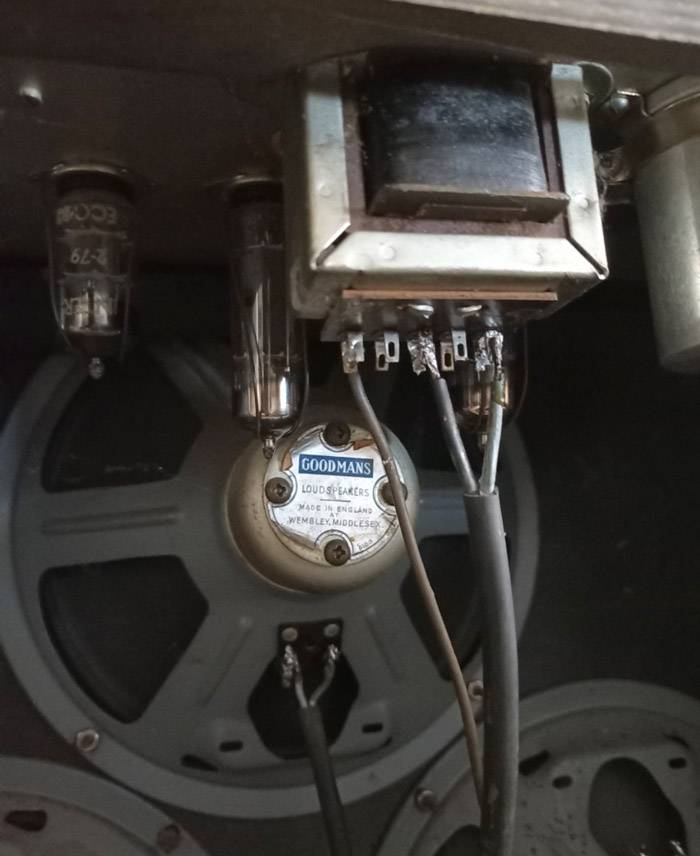
A "Mystery Amp" with a relatively tidy set of Goodmans 10" drivers with plain bells (magnet covers). At least three further amps have 10" Goodmans, but with red "tin can" style covers. All three are extremely scrappily wired.
Logos are of various types: gold letters; plastic trapezoid panels; or logos designed for the solid state range in late 1966.
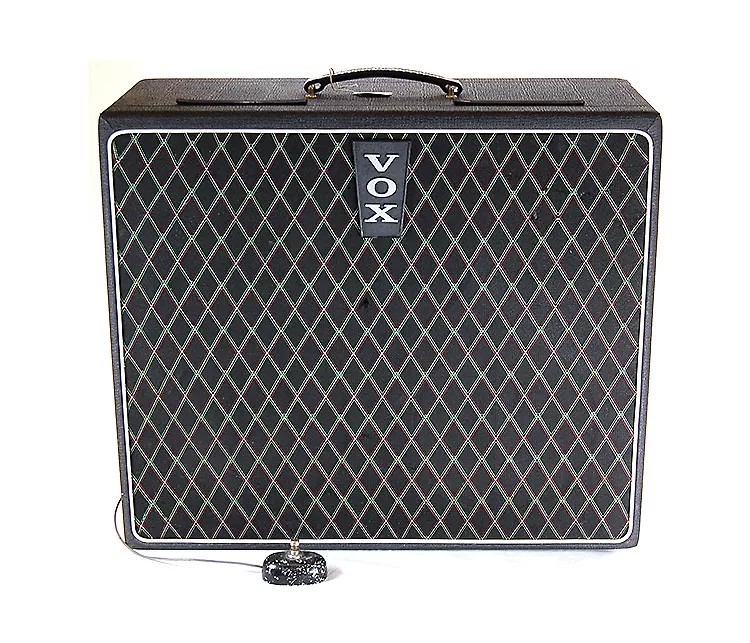
"Mystery Amp", solid state logo.
Electronics
The insides of these amps are not often illustrated. In the amp below, a later reverb pan has been used - of the type fitted to the Vox solid state amps of late 1966 / early 1967. The cut-out for the chassis on the slider board is professionally done.
The complement of valves is: in the power section an EZ81 rectifier and two EL84s; and in the preamp two ECC82s and ECC83s. Steer clear of JMI circuit diagram OS/071 - there is a colossal error on this. The sheet to use is OS/026. See the notes on this page, entries for 24th to 26th of June.

Detail of the first version of the service sheet OS/026, mid 1963. The circuit (and sheet) was later redrawn by Albert Hogben, JMI's main draughtsman for amplifier circuits, in early 1964. This later version (retaining OS/026 as its designation) is the one included in J. Elyea's "schematics" portfolio.


At least one of the Mullard mustard capacitors has the date code "D4N" = last quarter of 1964. There is an "H" in pencil on the chassis, which one often finds on amps assembled for JMI by Triumph Electronics. It is not clear what "A87C" signifies - perhaps one of JMI's mechanical (layout) drawings? These normally had "A" prefixes.
Below, another amp: the same general layout, but different output and reverb driver transformers. This one has no reverb pan.
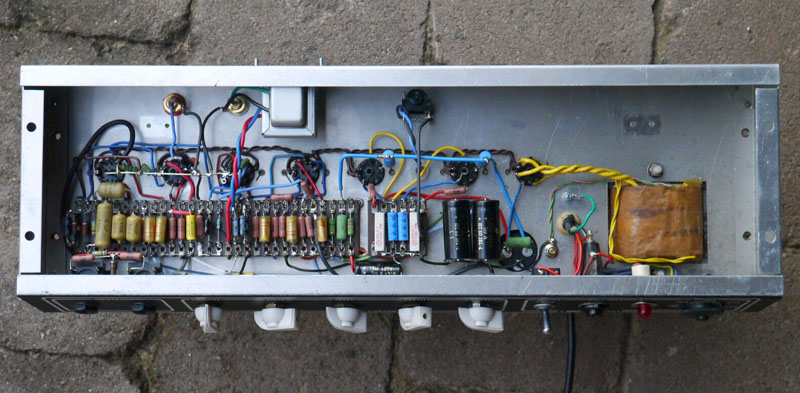
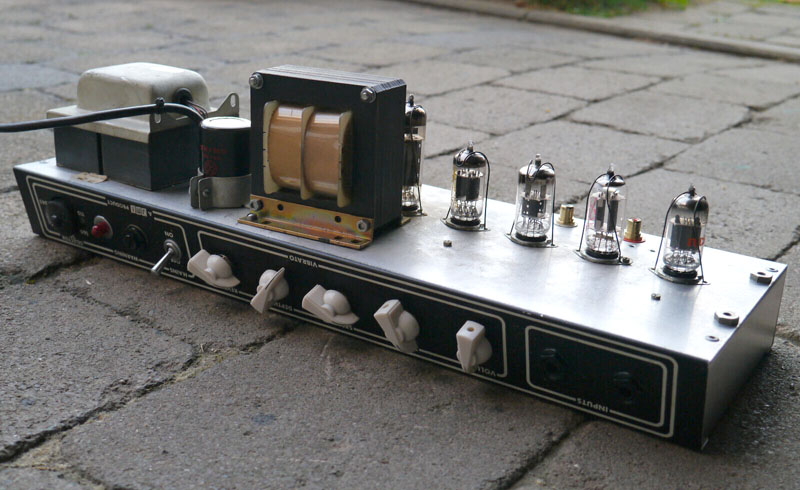
Quite who produced these amps is not certain - possibly a small business that was able to fly under the radar. The boys who bought up stocks of unfinished AC50s at the JMI liquidation sales and sold them on, once finished, as "VOX" amps were not quite so lucky. Their mischief and misdeeds were signalled in the music trade press in 1969 - see this page on the Vox AC50 website. It is probably no coincidence that in company with the "Mystery Amps" these wonky AC50s also have black control panels and white control knobs.