The Vox AC30 Twin - 1960
Stories
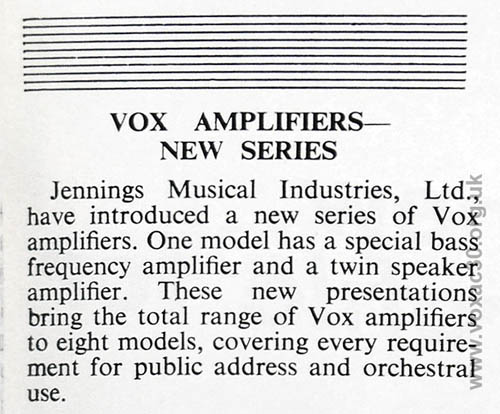
Music trade press, April 1960: - "a twin speaker amplifier...".
Accounts of the creation of the AC30 Twin - the twin-speaker version of the AC30 we all know and love - often begin with one of two things: an anachronistic graphic showing two AC15s and a split-front AC30 - "AC15 + AC15 = AC30"; or a story of some sort.
The stories are interesting, coming as they do from people close to "source". But there are puzzles, quite substantial ones: - sizeable gaps in the narrative, and evident contradictions, all to be expected perhaps of recollections decades after the event or events in questions.
Below, a brief synopsis of the principal stories together with brief notes and some key facts.
(1) Both Hank Marvin and Bruce Welch are clear that The Shadows asked Dick Denney for a bigger, louder amplifier (bigger and louder than the AC15).
(2) In an interview in "Guitarist Magazine" (October 2017) Hank related:
“I spoke to Dick Denney and asked him if it was possible to make the amps twice as loud; I said, ‘Can’t you put two of these together?’ and he said, ‘It doesn’t quite work like that!’ He went off and a little while later we had a call saying that he’d designed this new amplifier, an AC30, which was quite a lot louder than the AC15. So they knocked us up a couple and we started using those.”
(3) Rodney Angell, in an inverview for the "Vox Pop: How Dartford Powered The British Beat Boom" programme, broadcast on BBC 4 (30th January, 2012), stated that Dick asked Tom about making a new amp with two speakers. Tom said "No, No, No. Too heavy, too loud". [At this point the narrator comes in and says that Dick went ahead and made some anyway "...just to help out bands like The Shadows"]. Tom found out - spotting some [presumably tell-tale] items that Dick had ordered - and a huge row ensued. The upshot was that Dick was allowed to make 10 as a sort of trial - "on his head be it". Rodney worked for JMI first as an amp tester, then as a Research and Design engineer.
(4) Mike Ameson of MAJ Electronics recalls servicing a pair of TV Front AC30 Twins that both had two output transformers (one for each pair of EL84s).
(5) The circuit diagrams for the AC30/4 and AC30/6 - single output transformers envisaged for both models - are dated 29th April 1960. The first adverts for the AC30 Twin were issued in Spring 1960.
(6) From summer 1960 to late 1960 The Shadows used two-tone AC15s (second circuit). JMI provided the band with TV Front AC30 Twins shortly before Cliff Richard's third season of shows on ATV, December 1960.
The chief difficulty in all this (as it has always been) is making sense of the recollections in relation to known facts.
One possible picture of events is that Dick actually did make some amps very early on - in February/March 1960, say, without Tom's knowledge. These had doubled-up output transformers. Two of the amps quietly assembled by Dick were given to The Shadows, but the band did not like them and did not use them publicly, later deciding to move to new two-tone AC15s (second circuit).
Tom and Dick had their row, and following that a first run of ten redesigned AC30 Twins was agreed. These were advertised in April 1960 (see the piece at the head of this page). Thereafter production proper hegan. In late 1960, some way into production, The Shadows were issued with a set of three TV Front Twins in time for Cliff's television shows. The amps would be seen by millions of viewers.
That perhaps is all well and good as far as it goes. However:
(7) Derek Underdown (quoted by Jim Elyea, p. 379) recalls that the move to design the Twin came not from The Shadows, but dissatisfaction on his part and Dick's with the single speaker AC/30. As the process of design continued, it was Derek's idea - not Dick's or Hank's or anyone else's - to "double up" the EL84s to form the AC30. Jim suggests (p. 379) that the design process began in late 1959. Possible. The quotes from Reg Clark (pp. 379-380) tend to suggest early 1960 though.
(8) Throwing a spanner into the works of those who have assumed that the AC15 alone was used as a base point, Derek recalls "I believe that Dick liked the output stage shown in the Wurlitzer organ data..." It is perhaps worth noting that most Wurlitzer organs in the 1950s and early 1960s - the Spinette Model 44 and later derivatives - used 6L6 power valves. Hammond and Baldwin did employ EL84s though (6BQ5 being the American designation), as did the Wurlizter "Sideman", a primitive drum machine.
(9) Much the same "division of labour" prevailed also for the design of the AC50 and AC80/100 later on. Derek Underdown oversaw the power section, Dick Denney the preamp, though both naturally had a say in each other's work. Alan Harding, Derek's principal assisant in practical R&D matters, probably had some hand too.
Below, what may be a chassis assembled during the process of prototyping. It is not all plain sailing though. More questions than answers surround it.
As for the AC30/6 chassis embodied in the TV Front Twin with serial number plate 4290 added to its backboard, all bets are off. Unfortunately many of the early amps have been subject to numbers of "changes".
A prototype?
Notes on the "prototype" chassis published by Jim Elyea.
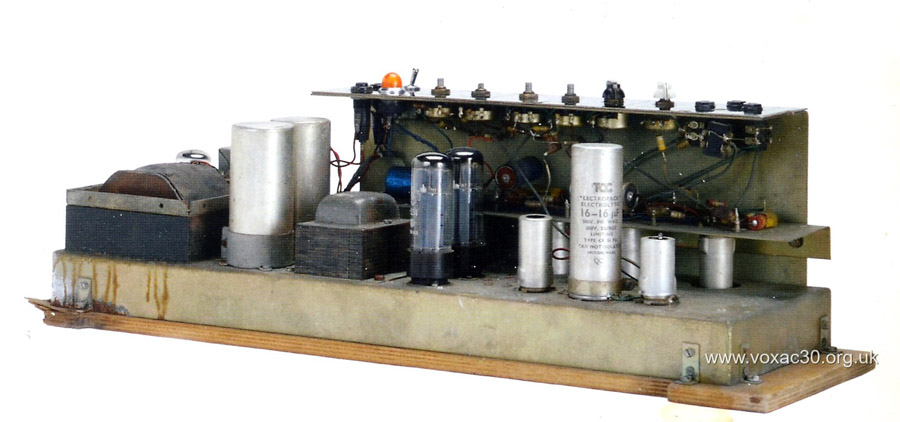
Picture from Jim Elyea's book, p. 381.
1) - the chassis has all the appearance of having been made by Triumph Electronics, one of JMI's principal contractors. The same sort of preamp "shelf" arrangement is also present in the first version of the Vox MC100/6, produced by the company for JMI in late 1964.
2) - insulated stand-offs (soldering points) are used throughout the preamp and power section, again typical of Triumph. One looks in vain for these in amps known to have been built at Dartford Road or by other JMI contractors (Burndept, Westrex, etc.).
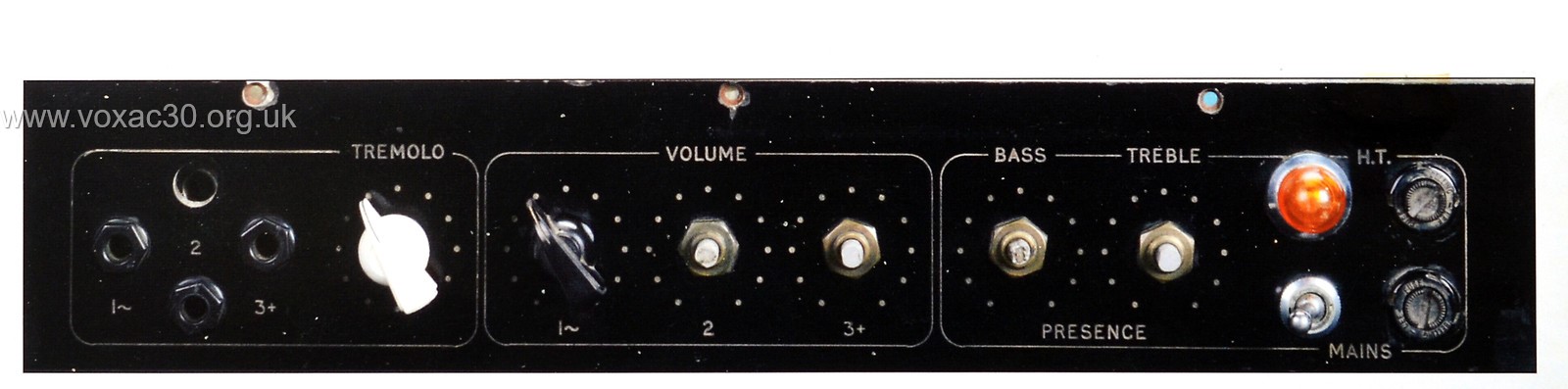
3) - there is no Vibravox, only Tremolo (a single control positioned before the volume controls).
4) - the Treble and Bass controls are labelled "Presence", a term not used by JMI.
5) - the arrangement of the preamp valves - facing downwards through holes in the chassis plinth - is just bonkers.
6) - there are hum balance potentiometers for the 6.3V lines in the preamp and power section.
7) - the metalwork of the chassis is clearly passivated (electro-dipped to hinder corrosion). The chassis of single speaker AC30s were plain untreated steel through to the summer of 1960.
8) - input jacks in diamond formation are only otherwise found in the Vox AC50 of late summer / autumn 1964, assembled for JMI by Triumph.
9) - a variety of makes and types of capacitor and resistor are used. The former have date codes ranging from the 1950s through to 1964, the latest being Mullard mustards with "A4N", which can only be first quarter of '64 or, not particularly likely, first quarter of 1974. Hunts electrolytics have "WDW" = 18th week of 1961 for their manufacture. There is absolutely nothing to suggest that these, or the Mullards, were "subbed in".
10) - the valves (probably EL34s) envisaged for the octal sockets were evidently to have been cathode biased. Each socket has its own cathode resistor and capacitor (values unknown at present). The valves in the picture above are 1970s Mullards.
11) - as things stand, the screen voltage supply comes directly from the output transformer, no screen grid resistors. The OT is likely to be a replacement however for whatever was there originally. The cut-out in the chassis was evidently made for a larger unit.
Was this really a try-out for the Twin? Why no Vibravox? Treble AND Bass controls on the panel? We will doubtless return to all this in the near future.
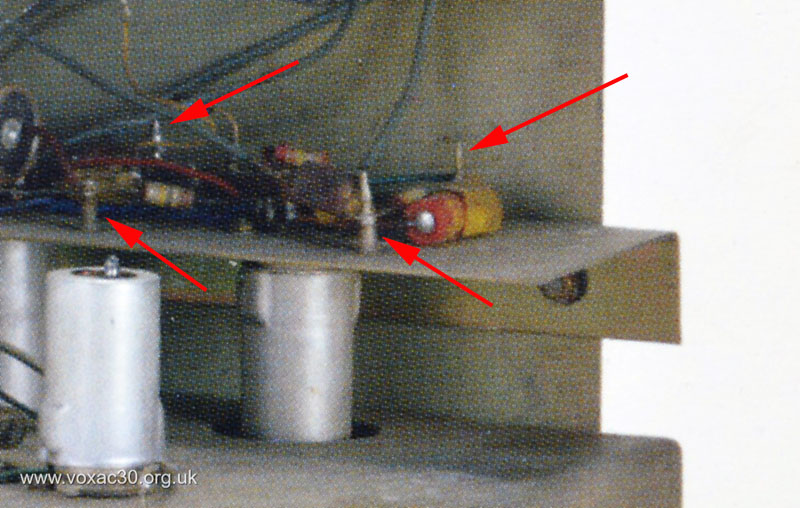
A detail of the preamp, which is "free-wired" (no tag board), the spurs / stand-offs indicated with arrows.