
A Vox Continental from mid 1963
The organ pictured below was bought second-hand on the Charing Cross Road c. 1966 (not c. 1969 as previously stated) and used by the keyboardist of the band "Nelson's Column", which opened for a number big names at university gigs in the late 1960s: Cream, The Yardbirds, Tyrannosaurus Rex, Chicken Shack, and so on. Thanks to Chris, the band's guitarist and custodian of the organ for many years, for the info.
At some point the original vinyl of the lower case became so badly scraped and torn - presumably from being pushed into and pulled out of vans - that it was redone in a white covering of the type sometimes used to line kitchen drawers. Serial number plate and model ID plate were either lost at the time of recovering or had already gone. The outer lid of the cabinet, though by no means pristine, did not suffer quite so badly in use and so was not redone - ie. retains its original vinyl. At no point were the electronics touched.
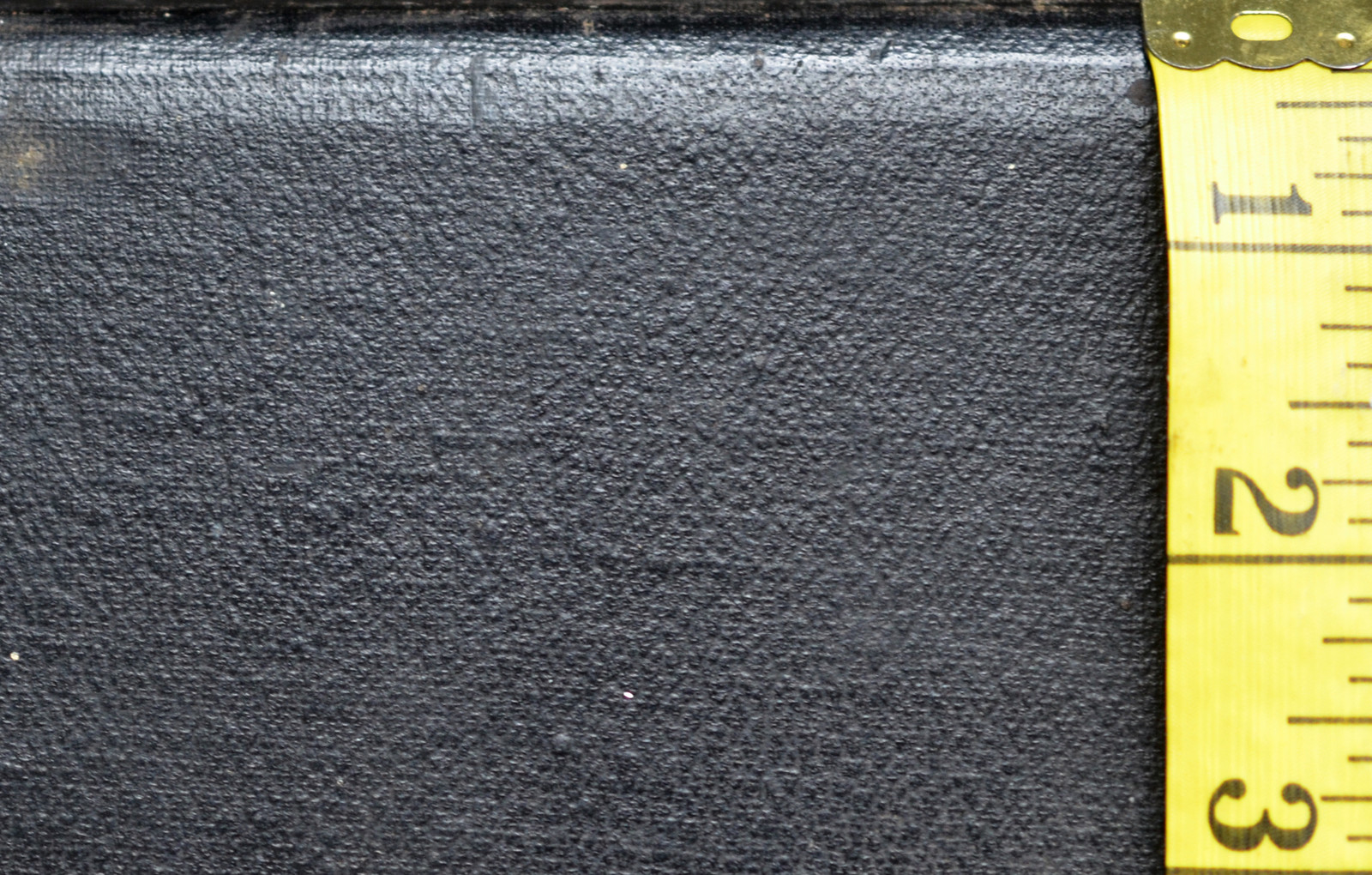
A detail of the vinyl of the lid.
A hand-written note inside the organ, directed at the person who was to cover it, states: "Continental Organ". "BLACK". In mid 1962, a similar vinyl - if not the same - was used for a short time on Vox AC30s.

A note stuck onto the wooden frame inside the organ.
The volume pedal, as can be seen below, is a standard Fender pedal modified by JMI with a "VOX" logo, and a resistor across the potentiometer to alter the "slope". Ron Lebar describes the process briefly on this page.
Notes and pictures of the electronics will be reserved for a separate page - just to say for the time being that the latest stamped date code on the assemblies is 8th May 1963, and that the vibrato board does not incorporate a change signalled on JMI circuit diagram OS/028, 21st May.
Outer dimensions of the wooden case are: 3 feet long; 22 inches deep at the deepest point; and 8 1/2" tall at back, the tallest point. The original handle was a leather or PVC strap handle - as used on AC30s - with fixing centres 9 1/2" apart and a metal clasp at the ends. Ron Lebar (link above) mentions the blacking of brown leather handles for certain units.
As the handle is attached to the lid, the side clasps and brackets (at rear) play a critical part in keeping the heavy lower section bound on. The Continental is quite a weight for an average person to lift by a single handle.
Just to say that the organ pictured below is certainly one of the first 75 Continentals produced, and probably one of the first 50, the serial sequence beginning at 1000. The main introductory page on Vox Continentals can be found here.
Photos


Yellow and burgundy drawbar ends. Later organs generally have ivory/white and burgundy. By serial number TC1549 the footings and voicings were marked on the drawbar ends themselves rather on a traffolyte panel on the inner lid.


Rotary switches, Radiospares indicator lamp, and legends on engraved traffolyte panels - a standard feature of the earliest Continentals. Later organs, from Spring 1964, have simple rocker switches and rectangular indicator lamps.

Note the "square" profile of the top - again a standard feature of early Continentals. Later the drawbar assembly was changed, allowing for a shallower top. The earliest batches of Continentals had lid catches on the front edge rather than on the sides. When catches on the sides were introduced, the horizontal side-bars of the Z-legs had to be shortened.

The Bulgin mains socket and output jack fitted directly to the back panel of the wooden case. On some early organs these were on the base. By serial number TC1094, and probably by number TC1076, the two sockets were attached to a rectangle of aluminium fixed behind a single large cut-out in the back panel.
Inner lid

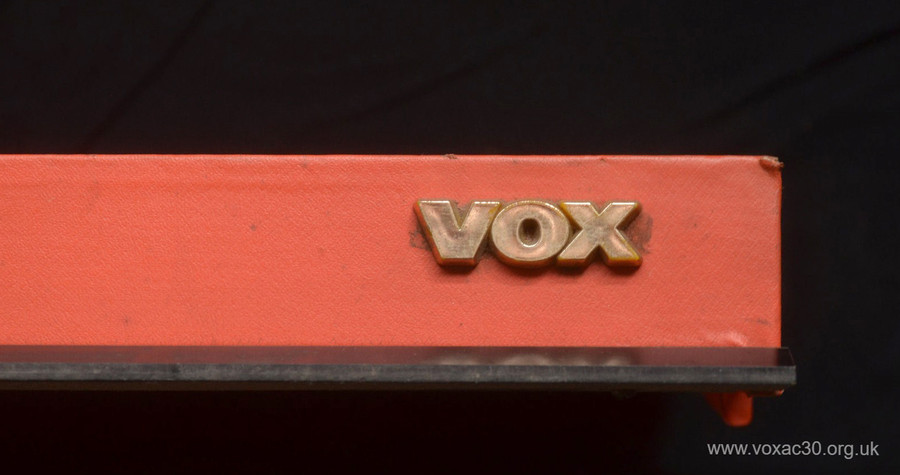
By serial number 1076, a strip of white trim (piping) had been added above the black lip of the lid.

Note the holes on the top for the perspex music stand - a feature of the earliest Continentals. Two stands are known to survive on early Continentals, one currently in France, the other in Italy.
The outer lid


Original holes for a long strap handle - either leather or ribbed PVC with metal end clasps - of the type used for the central handles on AC30s though to mid 1963.

The lid still with original vinyl. Note that there is no inset piping round it. Silver piping ("string") had certainly been introduced by serial number 1094, very probably by 1076.