
The Vox Domino range - introduction
Late 1963 to 1966
The Vox/Jennings Domino amplifiers were to all intents and purposes budget models - aimed at younger and amateur players and in many respects an adjunct to the AC4. The range was generally known as the "Domino Amplifiers", rarely (if at all in the 1960s) as "Vox Dominos". Serial number plates had "AMPLIFIER" at their head rather than "VOX AMPLIFIER". Now and again amplifier sections were given bronze "Jennings" badges, doubtless left-overs from the late 1950s.
Although precise beginnings are hard at present to pin down, official reports show that Tom moved to trade mark the name "Domino" in late September 1963 - "sound amplifiers for musical instruments", so certainly a new line (rather than a single model). Approval (registration) was slow in coming, however, not being granted until October 1965.

The line as a whole was evidently ready by the late autumn of 1963 as three of the four amps were illustrated in the "Precision in Sound" fold-out catalogue. Given their appearance in the catalogue, it seems likely that at least some (if not all four) were shown for the first time at the Russell Hotel Trade Fair of August 1963.
It is to be hoped that definitive information relating to the showing (or not) of the Dominos in August comes to light in the near future.

"Precision in Sound" fold-out catalogue of late 1963. These are the best catalogue illustrations issued by JMI. The ones embodied in the catalogue of 1964 are not nearly as sharp.
Intitially the combo without reverb was termed the "Domino Standard", as it is in the "Musicland" pricelist that was often bundled up with the "Precision in Sound" catalogue. Later the "Standard" came to be known as the "Normal".
Far and away the best seller was the Domino Bass - further details to follow on the page devoted to the model.

Detail from a "Musicland" pricelist, probably late 1963. These lists were widely circulated with "Precision in Sound" catalogue and "Vox People" brochure.

Detail from the JMI pricelist of Spring 1964.

An early Domino Bass amplifier section with compartment for stowing the mains cable.
Summer/Autumn 1964
In the summer of 1964, JMI updated the appearance of the Domino range, exhibiting the new livery at the Russell Hotel Trade Fair in August. Reports naturally varied in detail. One cast them as the "New Domino commercial range of Amplifiers", though of course they were not really new. Another - which can be seen here - indicated that the range had simply been updated: - "...the inexpensive Domino range with a new appearance".
The new cabinets were illustrated in "Precision in Sound" newspaper-format catalogue issued by JMI in September 1964, the range now being three models rather than four. The Domino Reverb combo was deleted, never having sold particularly well.

JMI Dominos, September 1964 - new design.

A Domino Bass amplifier section, probably early 1965, to illustrate the new design/format displayed in August 1964.
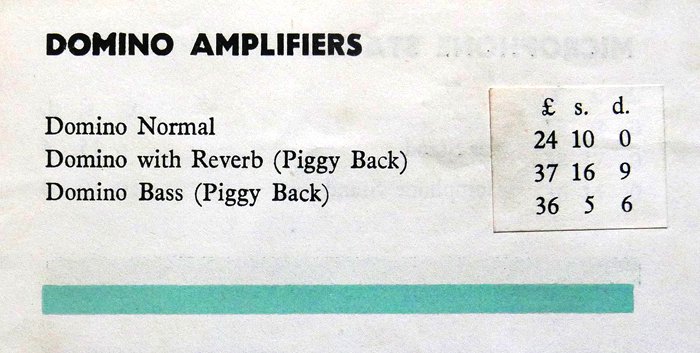
Detail from a "Musicland" pricelist, September 1964.
To accompany the revamping, a short brochure-cum-manual was drawn up, the printer's runner dated August 1964.

Domino manual.

Detail of the printer's runner, August 1964.
A detail from a photo taken in 115 Dartford Road in September 1964. The space was occupied for the most part by AC50 Foundation Bass sets destined for America - "V-1-14" was the Thomas Organ designation for the model - but among those piles, a Domino amp, destined for elsewhere.
The Domino range was never marketed in the USA. Occasionally one finds pieces in the press of the time that appear at first glance to imply that everything produced by Jennings would be distributed by Thomas - "all Jennings equipment" or words to that effect - but in actual fact it was simply "all products" encompassed (agreed) in the "Million Dollar Deal", ie. only a subset of Jennings's extensive ranges late in 1964.
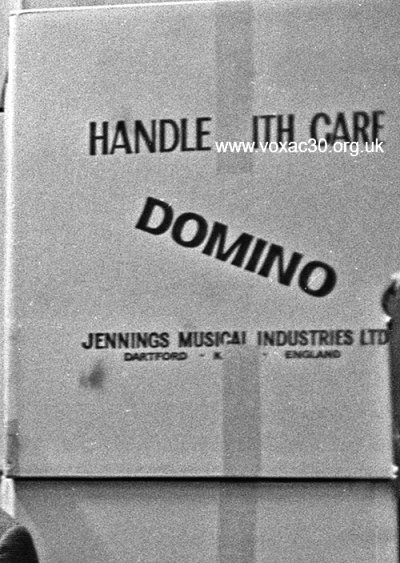
Detail from a shot taken in the JMI store of boxed up AC50s awaiting export to the USA. Off to one side, boxes of Dominos for the UK and European market.
The sheer size of the Thomas Organ orders meant that some of the areas normally used for assembly and checking in number 115 had to be taken over for despatch (which was normally confined to the sheds alongside the main building).
Below, an advert placed by JMI in the music trade press in November 1964, further promoting items displayed at the Russell Hotel in August. Included among the lines available, the Domino amplifiers - a rare mention outside catalogues and pricelistse.

November 1964.
Dominos remained in the JMI catalogue through to early 1966, after which time the range was deleted.

JMI pricelist, November 1965.
Assembly
Chassis were produced under contract for JMI by Triumph Electronics in Purley, which was already assembling chassis for the AC4. In many respects, the smaller Domino amps were simply flavours of AC4.
Taking the Domino Normal as an exemplar, control panels were blue initially, then engraved black and white trafolyte, followed by silk-screened black and white.

Control panel of serial number 1047.

Control panel of serial number 1049.

Control panel of serial number 1833.
Mains transformers for the range, along with units employed for AC10s and certain tape Echo machines, were sourced from "JD Electronics", based in Corsham in Wiltshire (registered office only in Birmingham). During the course of 1964, JMI (or perhaps Triumph) appears to have turned also to "Allen", a company about which little is known at present.

Detail from a later Domino Bass amplifier. Allen used the same logo - an electron orbit - on later (1960s) units too. Early Simms Watt and Sound City amps have Allen transformers but without logos on the stickers.
Allen also provided the mains transformers later on for the solid state Vox Traveller amplifier, early 1967 to late 1968. Travellers were assembled at Erith.
Below, details of a species of Domino Bass "piggy-back" (Super Twin) amplifier section. The model was issued in a variety of forms over a relatively short period. This one had a bronze Jennings plaque attached. The chassis was signed in pencil "DE" = Dave Earp, who worked for Triumph Electronics from c. 1964 to 1966. Dave signed off numerous AC50s (also assembled, initially at least, by Triumph).


Chassis, in this case simply a standard AC4 with tremolo circuitry omitted and two adjustments for bass voicing, signed off in pencil by Dave Earp.
As mentioned at the head of this page, Dominos generally had plates with "AMPLIFIER" rather than "VOX AMPLIFIER" at their head. An overview of the three types of plate can be found on this page.

The plate of a Domino Reverb combo amplifier.