
Vox volume pedals for organs
1950s-1960s
Initially this page was to have been dedicated solely to volume pedals for the Vox Continental (1962-1968), but as material accrued it seemed wrong to leave the earlier Jennings pedals out of account. Continental pedals therefore come into view around half-way down preceded by sections on the roller-control unit (1954-1957), and the "diving boot" (1957-1962).
Evidently in early 1963 something new was required for the new Vox Continental - what better than to use a Fender volume pedal, its logo replaced and a resistor introduced to control the taper of the potentiometer. This was far from the only piece of JMI naughtiness in relation to Fender. JMI had been a British agent for the company since 1960, selling guitars and amplifiers at the shop on Charing Cross Road. Quite how many pedals were re-adjusted in this way is unknown - probably no more than 100 or so though. As for early photos, Mike Smith of the Dave Clark Five is seen with one at the Tottenham Royal, late January 1964, photographed by various news agencies (and by a photographer sent by JMI), and filmed by Pathe, the newsreel people. See further below for a still from Pathe footage. The main page on the Continental is here.
At some point in 1964, JMI commissioned a special casting - with the VOX logo at front - of a type of pedal that Schaller had been producing since the late 1950s. Various other companies had done the same: Dynacord and Kent, for instance. At least three castings were made for JMI, in chronological order: (1) VOX in cursive script with a loop on the "X"; (2) a plain cursive logo; (3) "VOX" in block script. Examples of the three types can be seen below.
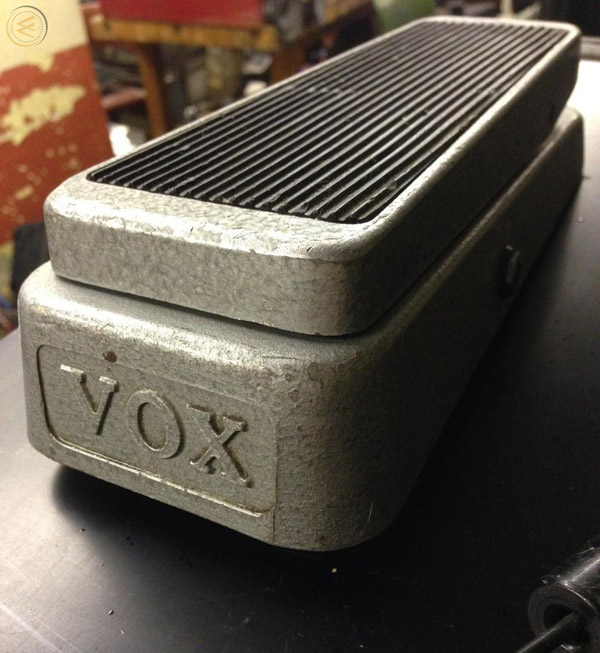
In 1966 (the date needs further precision) JMI went over to a more rectilinear rectangular case in grey hammmerite finish. This was also used for the Wah pedal introduced in early 1967.
1954 - 1957
Advertised in "Melody Maker" magazine in January 1954, and shown at the British Industries Fair at Olympia in May 1954. Note that this pedal is a "Registered" design, meaning that its appearance and mechanical elements were protected in law, but not its electronics. A similar pedal marketed by Selmer appeared at much the same time. The two companies often played "leapfrog" in the mid 1950s, a design by one emulated soon after by the other. An early endorser of the Jennings pedal was Don Fraser of the Ray Ellington Quartet.
As a side note, rotary action foot pedals were among the first things produced (in early 1968) by "Jennings Electronic Developments", the company started by Tom following his dismissal from JMI in September 1967.
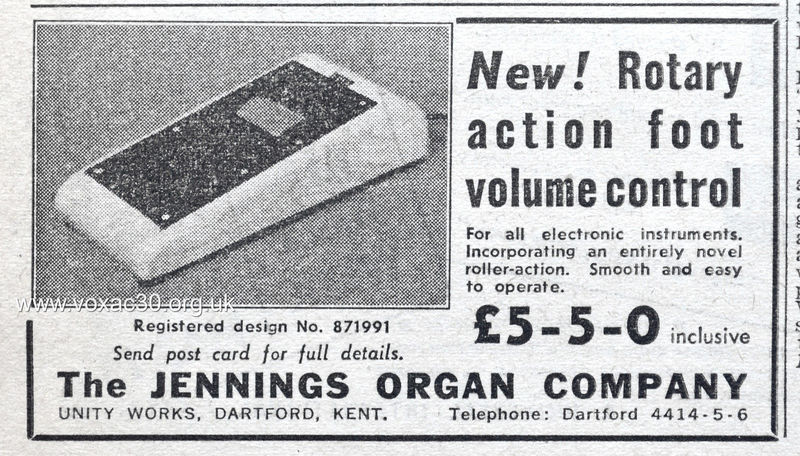
"Melody Maker" magazine, 2nd January, 1954.
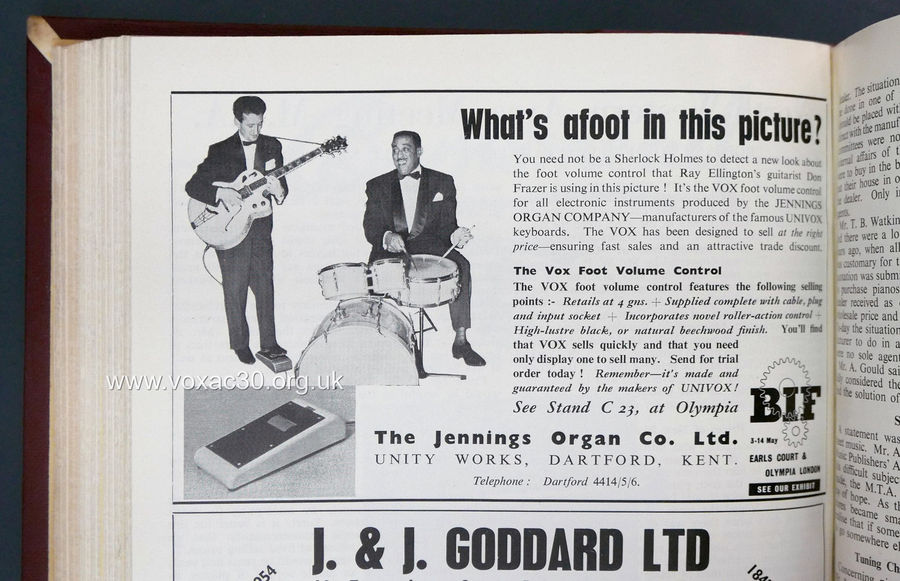
Music trade magazine, April 1954.
1957 - 1963
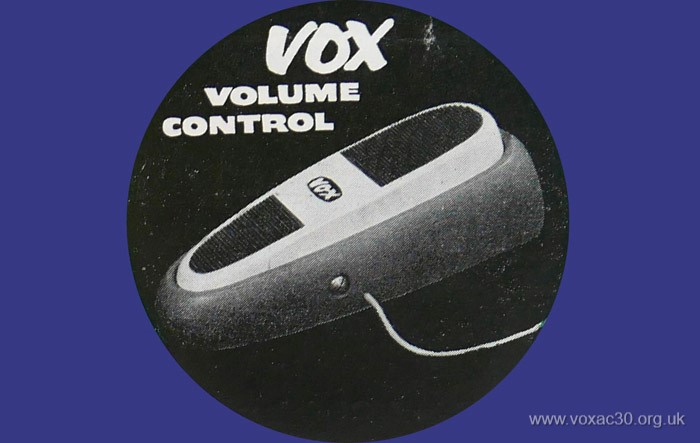
The "diving boot". It is not known at present who produced the casting (and possibly the pedal as a whole) for the Jennings Organ Company. Two examples are currently known to survive, pictured on this page, both in working order. It is likely that the general unwieldliness of design led to many being heaved into the bin in later decades.
The "boot" last figures in the "Choice of the Stars" catalogue of late 1962 - right up to the point that the Continental came into being.

"Accordion Times", December 1957 - the earliest securely dated source.
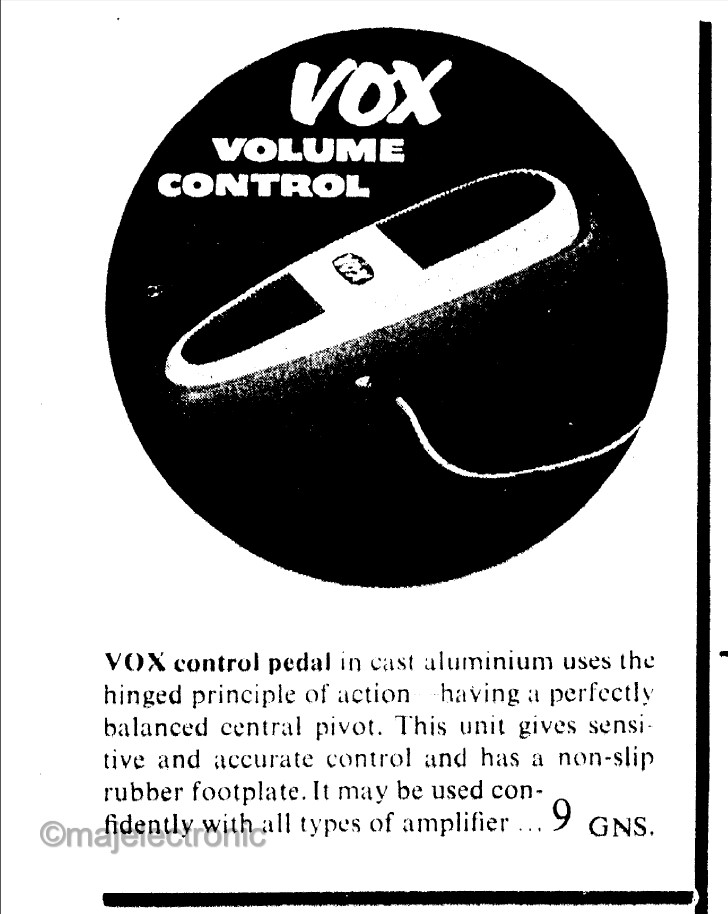
Detail from a JMI brochure issued in late 1957, probably earlier than the above, but not dated.
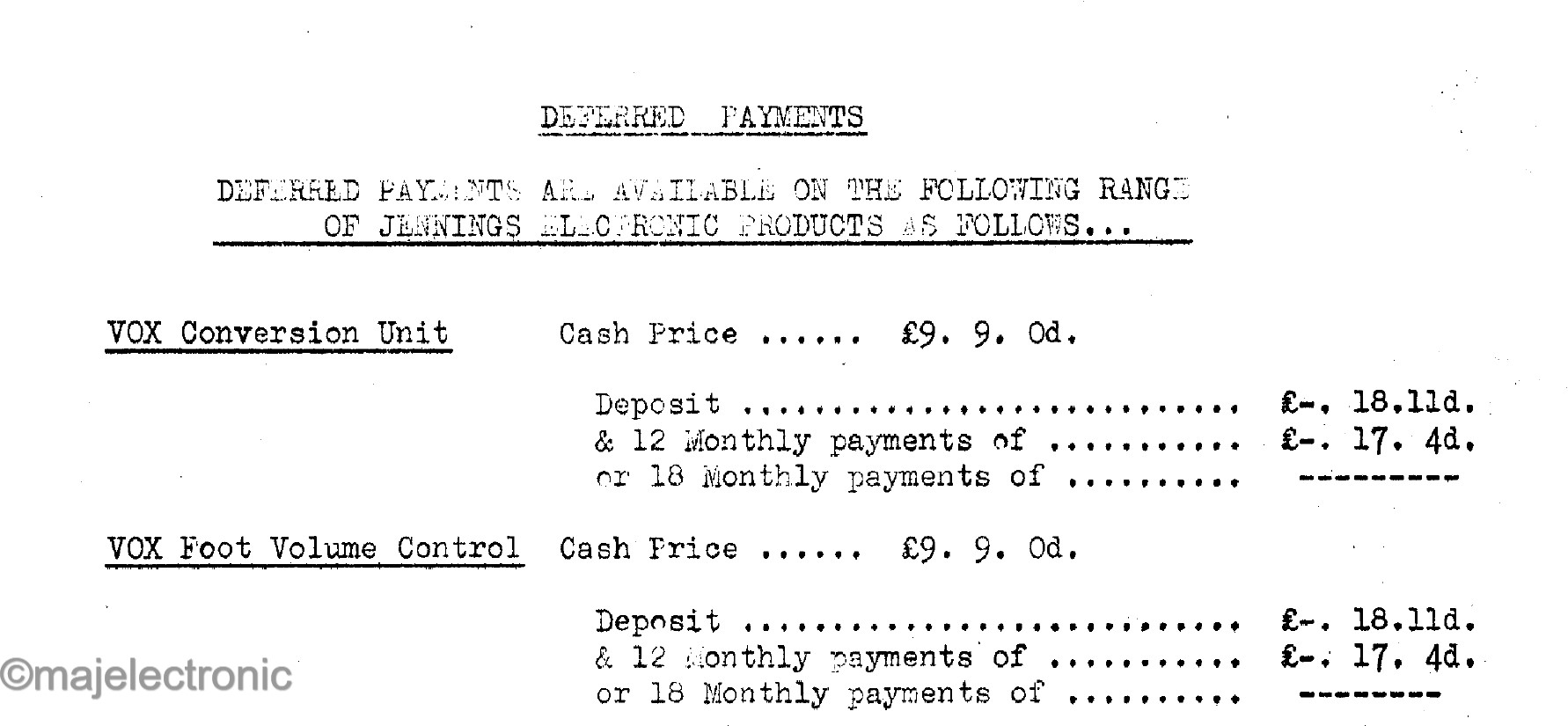
The pricelist accompanying the brochure, with hire purchase terms.
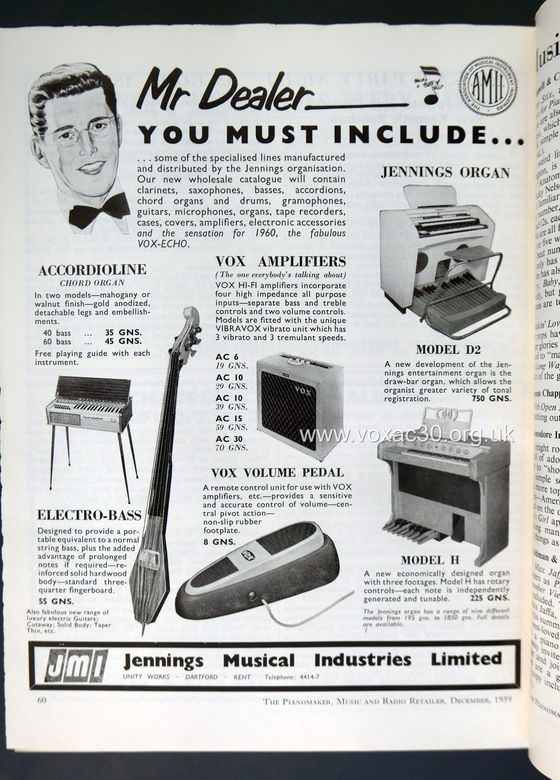
Music trade magazine, December 1959.
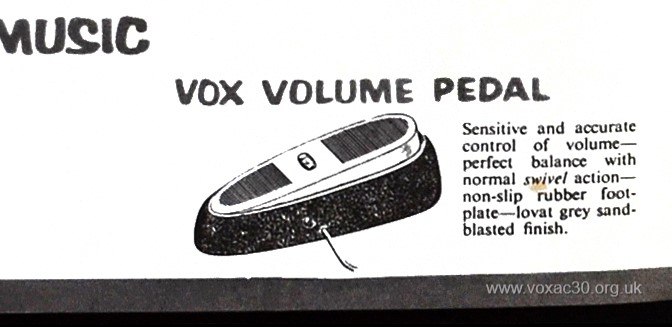
Detail from the JMI "Choice of the Stars" fold-out catalogue, late 1962, The new T60, which had been shown for the first time at the Russell Hotel Trade Fair in August '62 along with the pre-production Continental, is illustrated in prime position at the top of the fold-out sheet, but there is no sign yet of the Continental.
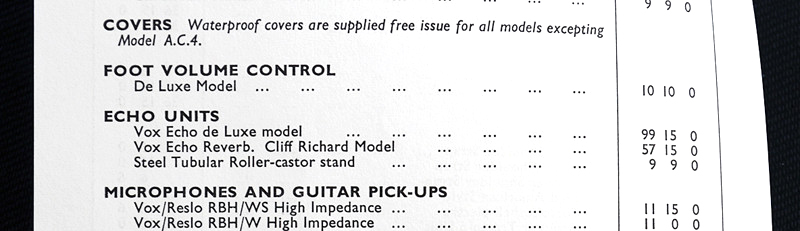
Pricelist attached to the copy of the "Choice of the Stars" catalogue. The foot pedal volume control (de luxe) is £10 10s.
From the V&A Archive, a shot of "The Overlanders" with an early square top Vox Continental. Note the presence of the old-style volume pedal.
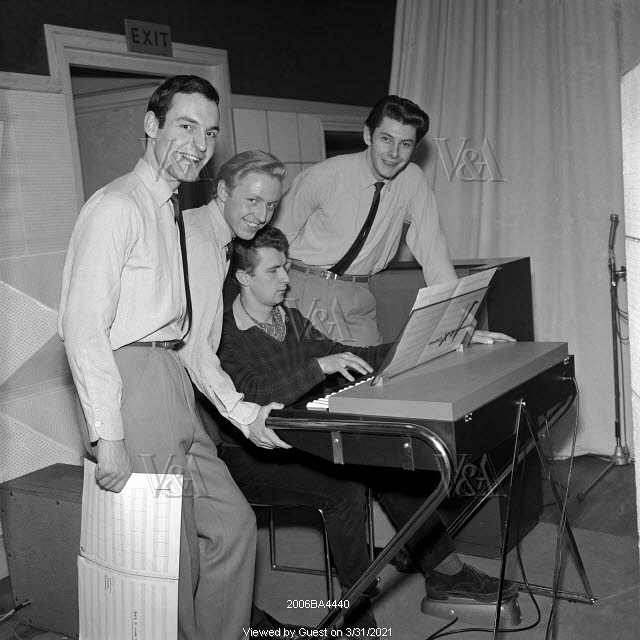
Photo by Harry Hammond.
Below, a pair of pedals five serial numbers apart, the one in silver hammerite fitted with a purple cable and rubber treads with transverse ribs, the one in dark grey hammerite with a green cable and treads with longitudinal ribs. The distinction in appearance somehow to reflect a distinction in envisaged use? There is no difference in operation however.
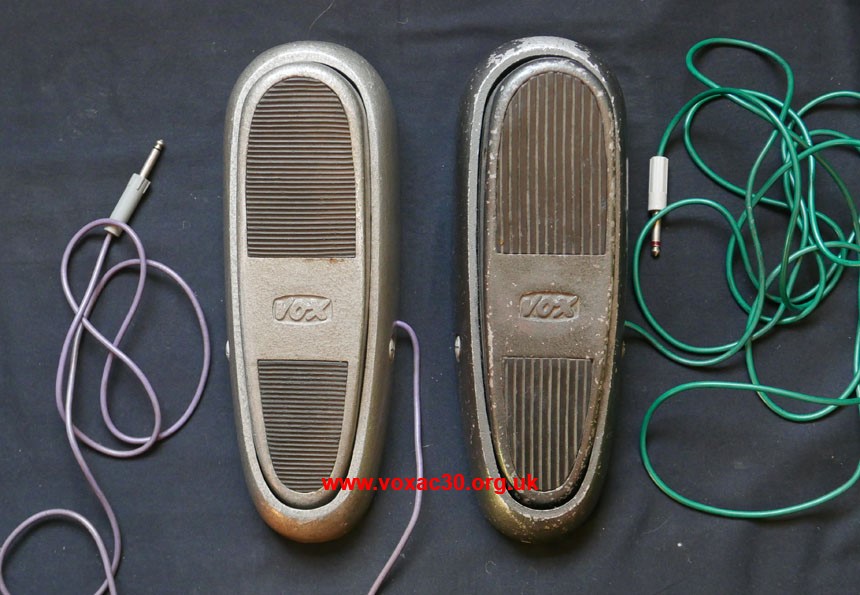
The main bodies of the pedals are 13 1/2" long and 4 3/4" wide at their widest point.
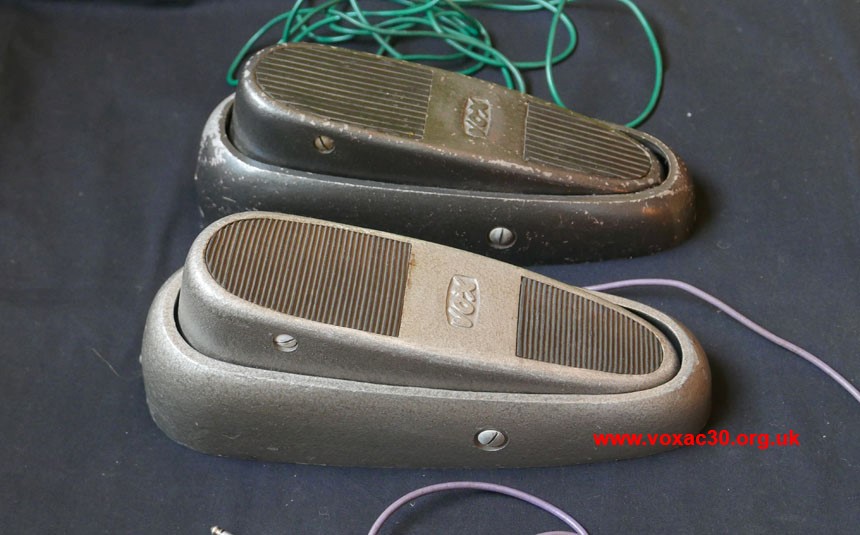
Base to top of pedal at front is 5".
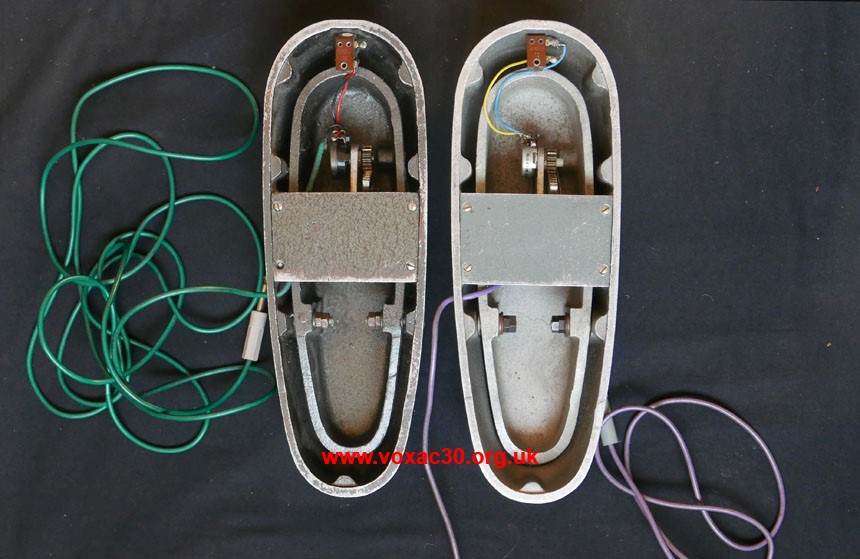
Further pics of the pedal in dark grey can be found on this page.
Vox Continental, 1963
The new Vox Continental pedal, "devised" in late 1962, or perhaps even in very early 1963, is actually a Fender pedal with the logo replaced and a resistor added to alter the taper of the pot. These changes were made at Dartford Road. This piece of JMI naughtiness was first noted by Ron Lebar on his Alpha Entek site.
It was clearly easier for JMI to re-purpose an existing unit than to design something appropriate to the new Continental from scratch. The "diving-boot" would doubtless have looked out of place.
Below, a rare example of one of the early Fender-Vox Continental pedals, never illustrated by JMI (so far as can be judged) in its promotional literature for understandable reasons:

The pedal came with a Continental from mid 1963 - latest date stamp on the tone generator modules, 8th May.
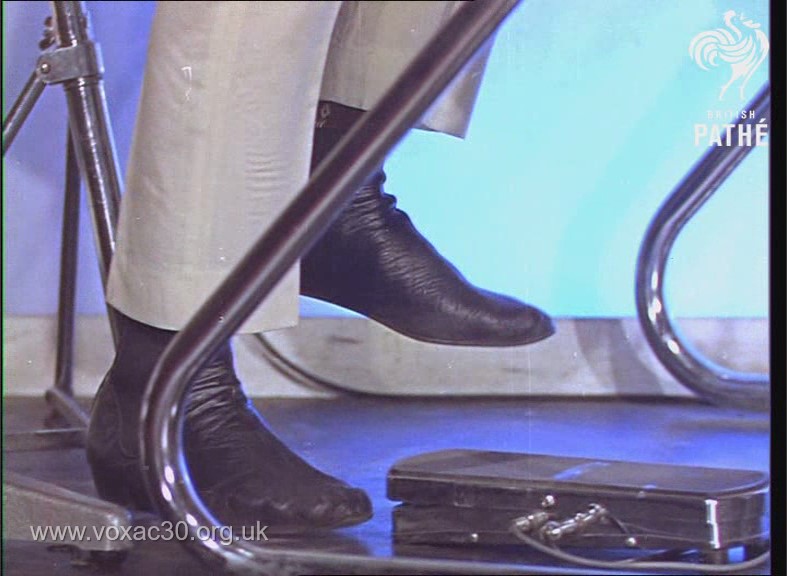
Mike Smith of the Dave Clark Five, Tottenham Royal, late January 1964 - still from un-broadcast Pathe newsreel footage of the show.
Vox Continental, 1964-1966
Pedals produced for JMI by Schaller. As indicated at the head of this page, there were three main castings, in chronological order: (1) VOX in cursive script with a loop on the "X"; (2) a plain cursive logo; (3) "VOX" in block script.
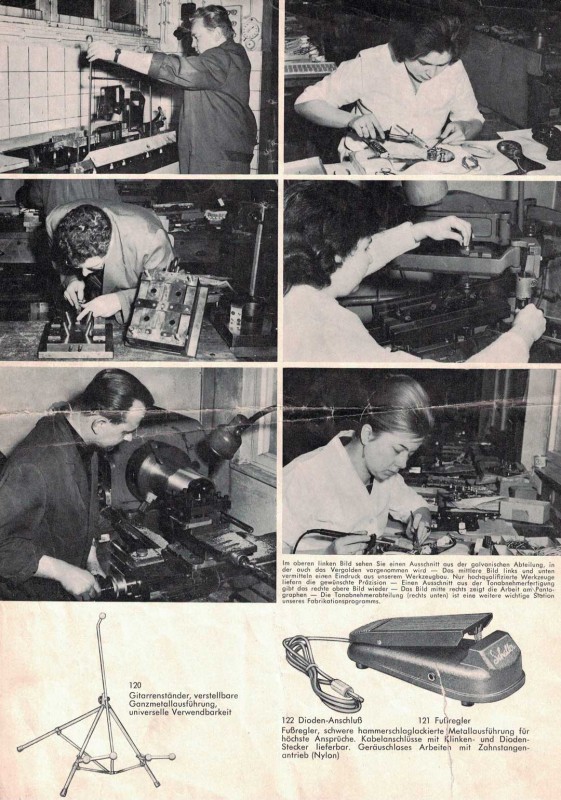
Page from a 1960s Schaller brochure from the Schaller website.
It is perhaps worth noting that Selmer stocked this type of pedal, branded DeArmand, in its shop on Charing Cross Road (a few doors down from the Jennings shop) from mid 1962. Selmer not only had its own range of organs at the time, but acted as agent for Lowrey and Farfisa.
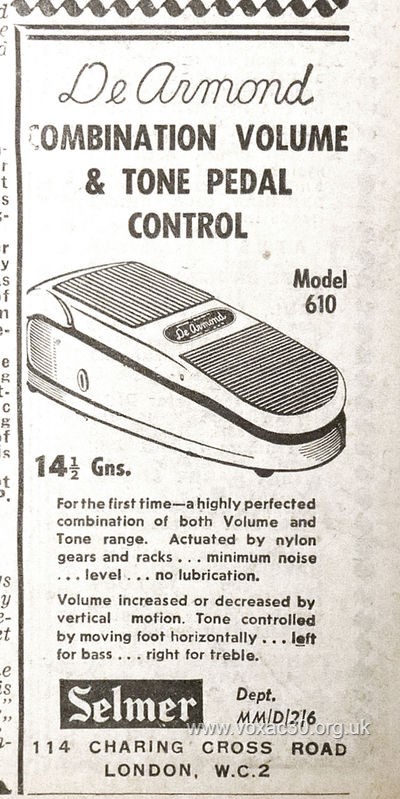
"Melody Maker", 9th June, 1962.
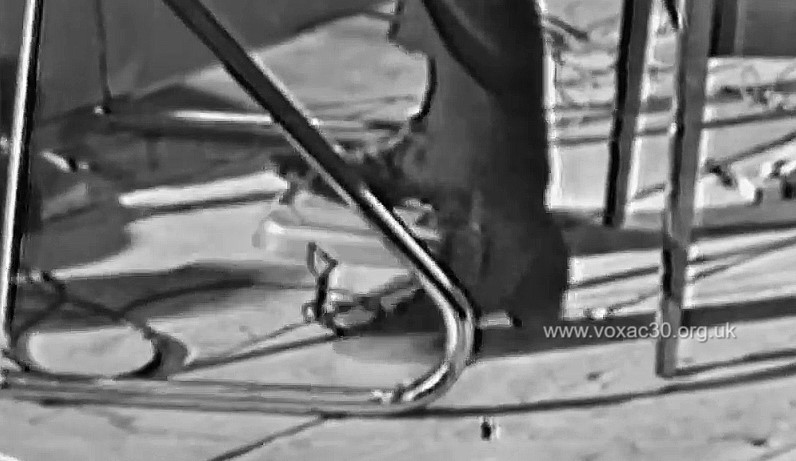
Alan Price, July 1964, Tyne Tees Studio in Newcastle. A still from a section of film. Although the capture is a little soft, the Schaller pedal is unmistakeable.

"Melody Maker" magazine, 1st August, 1964. A firmly dated instance.

A detail showing the Schaller-made pedal.
Casting type 1
10 3/8" long; 4 3/4" wide at its widest point; and 2 1/2" tall (without base and feet). Produced in relatively small numbers. Few survive.
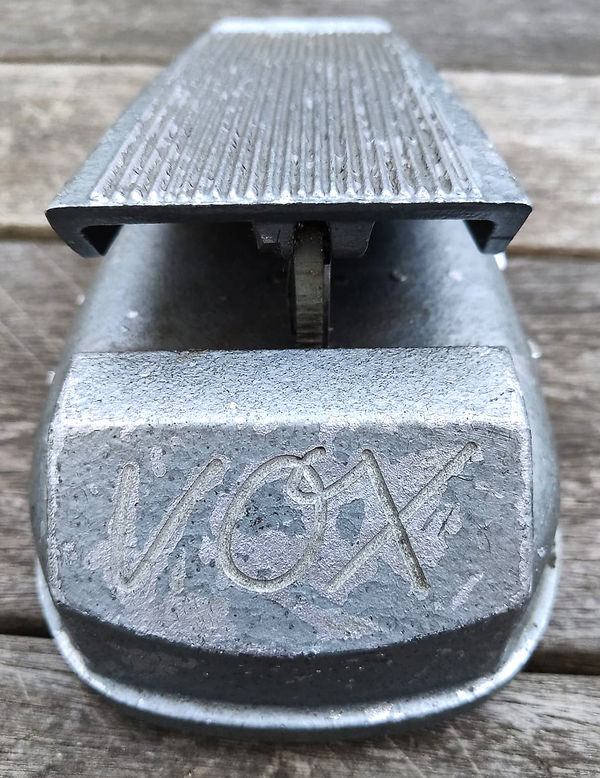
Casting type 2a and 2b
Casting type 2a has a body of the same size as casting type 1. Casting 2b, which followed 2a, has a body of the same size as casting type 3.
At least 140 examples of casting type 2a were produced by Schaller for JMI. 2b may have been made in slightly smaller quantities.

Casting 2b on the left; 2a on the right.

Casting 2a on the left; 2b on the right.

Casting 2a on the left; 2b on the right.
The larger of the two casings is 10 3/8" long; 4 3/4" wide at its widest point; and 2 1/2" tall (without base and feet). The number "140" is stamped inside.
The smaller is 9 7/8" long; 4 3/8" wide; and 2 3/8" tall. No number visible. The base however is stamped "Made in Germany". The pot has "H4", which may be August '64 (but by no means certainly).
Both are sprayed silver inside. All wiring is original. A number of units were fitted with black coaxial cable.

The "Made in Germany" stamp on the base of the smaller of the two units.
Casting type 3
9 7/8" long; 4 3/8" wide; and 2 3/8" tall. The upper face of the treadle has fewer parallel grooves than castings 1 and 2.

Note the wider ridges on the pad.
1966-1968
At least two different types were produced - (1) an earlier UK model, "VOX" in raised lettering on the front, a plain rubber pad; (2) Italian for the US market, "VOX" in sunken lettering, and "Vox" also on the rubber pad.
The design of the case was registered in London by JMI on 22nd July 1966 with a series of photographs, four of the five below.


Type 1 (made in England)
Back to the Vox Continental organ, 1962-1964.
Documents relating to Jennings (Vox) guitar amplifiers, 1963.