
Jennings Organs, overview of models (1954-1959)
The Models below are presented as far as possible in chronological order. As further information comes to hand it will probably be necessary to revise some of the entries, so do check back from time to time. Jennings changed names and specifications as occasion demanded - the "Model D" for instance becoming fairly quickly the "Model D1". Sometimes individual models drop out of public view for months only to reappear later in new promotions and so on.
The dates given below are derived from known printed matter.
Overview pages on 1953-1965 can be found here. These are regularly updated. A sequence of pages on guitar amplifiers, beginning with 1957, starts here.
Jennings Organ Models, 1953-1955
Models appeared initially simply with "J" prefix and number. Revisions had a "B" suffix (e.g. J50B), and second revisions had a "C" (J50C). The range came to be known as the "B" series. Circuit diagrams survive for the power sections of the "B" units.

Jennings J50B
J50 - By May 1954. A Home Organ. Single manual. Probably first exhibited at the "British Industries Fair", May 1953.
J50B - Later 1954 (?). - Described: "Two independently voice treble manuals of 48 notes each - built-in heavy duty speaker unit - 13 note pedal board - crisp attack - 24 tone controls - adjustable vibrato and amplitude controls - maximum stability and long life - completely self contained - fully polyphonic. £350."
J50C - By December 1954. - "For Home, Entertainment or Church use. Two 4-octave manuals, independently voiced, 24 tone selector tabs. Frequency and amplitude controlled vibrato. 13-note pedal board. Console, polished wood or cream finish. 2 swell controls. 3 built-in loudspeakers. 16,8 and 4 foot pitch. Output 20-25 watts. £395."
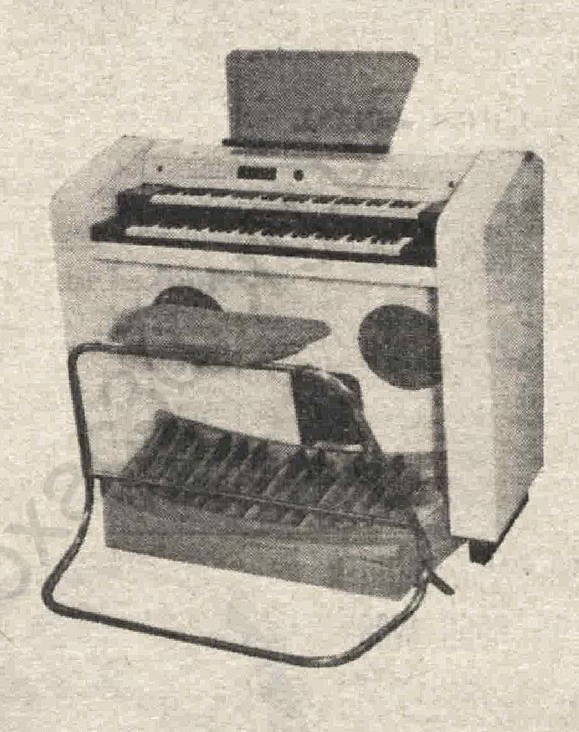
Jennings J51
J51 - By May 1953*. - A Professional Entertainment Organ. Two-manual. First exhibited at the "British Industries Fair", May 1953.
J51B - By April 1955. - "Two five octave manuals with 24-note pedal board, 30 stops, attenuator, and six degrees of vibrato. £525." A further description: "Built with a fine range of tonal perfection from soft mellow smoothness to rich fine brilliance. It features two five-octave manuals, voiced independently, twenty-seven selector tabs, plus TONE-CHANGE controls. Frequency and amplitude controlled vibrato (six degrees). Twenty-four note pedalboard of radiating and concave design. Two swell controls. Sixteen, eight and four foot pitch. Twenty-five to thirty watts output. Two balanced speakers housed in consoles. £525 complete.
J51C - By May 1955. "Completely self-contained and built for easy transport, the Jennings J.51.C. Entertainment Organ has ample power output and tonal perfection from soft mellow smoothness to rich fine brilliance. It incorporates the exact amount of attack necessary for modern music, plus 'TONE-ARAMA', the novel rapid multi-tone control. Despite this staggering specification, the J.51.C costs only £525 complete."

Jennings J52B
J52 - By May 1954. - A Church Organ. Two-manual. Separate tone cabinets available. First exhibited at the "British Industries Fair", May 1954.
J52B - By May 1955 - "Two five-octave manuals, 30 note pedal board. 36 stops and tremulant. RCO [Royal College of Organists] specification throughout. £625.

Jennings J48
J48 - By May 1955. - A portable, possibly fully solid state, accompanied by a separate amplifier and speaker unit. Shown at the British Industries Fair, 1955. "Here is the organ that is truly portable. 14 stops and vibrato controls. Keyboard and console covered with leather cloth and fitted with carrying handle. Amplifier and speaker housed in separate carrying case. £195." The J48 disappears from view after 1955.
1956-1959
In mid 1956, a new range was introduced by Jennings - the "V series". Organs were assigned letters of the alphabet - the "Model A", "Model C", and so on. Prices initially ranged from 450 guineas (Model C) to 875 guineas (Model E). Later in the year the Model G was announced.
Naturally if one finds a reference in an undated advert, brochure or catalogue to an organ described as a "Model" with a letter assigned, then the document in question must be from 1956 or later. Circuit diagrams survive for the power sections of the "V series".
Model A - By February 1956. - 725 guineas. Two-manual Church Organ, its case much as the J50. The specification can be found on this page.
Model B - By Febuary 1956. - This is the J51 renamed. "Model B Theatre Organ, 575 guineas complete. Contrasting brilliance and crisp attack with soft, mellow roundness of tone. Transportable and reliable. Self-contained. "Plug-in" performer. Detachable pedal-board units. Output from 30-100 watts. Consumption 2 amps. A junior version of this model will shortly be available at 250 guineas complete." The junior version is probably the "Model D", below.
Model C - By February 1956. - 525 guineas. Two-manual Church Organ. Its case much as the J50C. Specifications can be found on this page.
Model D - By July 1957. "350 guineas. For Home, Hotel, Theatre and Night Club. Simple drawbar action gives wide harmonic selection. Unlimited variety of tonal effects. Six pre-set tone keys fitted to keyboard. Easily mastered by any pianist. High gloss ivory finish: other shades to order."
Model DS - By August 1958. - "375 guineas. A single-manual Church Organ with conventional registration controlling eight stops and tremulant (pedals optional).
Model D1 - By late January 1958. Single-manual Entertainment Organ. The "Model D" renamed. "375 guineas. Harmonic drawbar system protected by patent 34054/57. Registered design 886591. TONE-COLOUR BLENDING. The draw-bar action produces unlimited tones and harmonics and is easily mastered by any pianist. The ideal medium for dance band, theatre, and night club, this single manual organ is simplicity itself to transport. Model D1 has two sets of 7 draw-bars plus 7 pre-set keys." The headpiece of the patent can be seen on this page.
Model D2 - By June 1958. Two-manual Entertainment Organ. A new version of the Model B. "655 guineas. Model D2 also [along with the D1] features draw-bar registration, similar to that on the Hammond Organ. With two manuals, this organ has four sets of 8 draw-bars plus 14 pre-set keys."
Model E - By February 1956. Two-manual Church Organ. "925 guineas. A two-manual organ with 32-note pedal-board. Two balanced expression pedals; two sets of combination pistons; four couplers; 39 stops and tremulant."
Model F - Probably no "Model F".
Model G (version 1) - By late 1956. 1500 guineas. Three-manual Church Organ.
Model G (version 2) - Early 1958. Three-manual Church Organ. "A three-manual and pedal Organ of advanced design with special reed voicing; traditional draw-stops; four combination pistsons per manual; complete manual and pedal coupling; 48 stops; independent tremulant to Choir and Swell." Initially 1700 guineas, rising to 1850 guineas in later 1958.
Model H - By February 1958. New at that time, an advert describing among other things its built-in 12" Goodmans Audiom speaker, and 10 watt power output. Single-manual All Purpose Organ. "195 guineas. Particularly suitable for the home, small church or club room. Four-octave keyboard (49 notes C-C"). 3 footages - 16, 8 and 4 - each with an "off" position and 3 degrees of volume giving greater variety of tone. Easy installation - simply "plug-in" to mains. 4 tones - flute, diapason, string and reed - each selector providing a "half" and a "full" balanced position. Each note independently generated and playable in any chord combination. Vibrato with variable amplitude. Balanced swell pedal giving wide dynamic range. 10-watt output - where extra volume is required, booster units are available. 13-note pedal-board and bench are optional extras." A booster unit was available - two Goodmans speakers housed in acoustic horns - giving a further 50 watts of power.
Model K - By October 1958. Two-manual Church Organ. Not listed in August. "1,250 guineas. A two-manual organ with 32 note pedal-board. Two balanced expression pedals; two sets of combination pistons; special reed voicing; four couplers; and tremulant."
Documents relating to Jennings (Vox) guitar amplifiers, 1957