
The Vox AC1/15 - documents, 1957-1959
TV Front, 15 watts, two channels (normal and vibravox)
In progress: 3rd August 2021
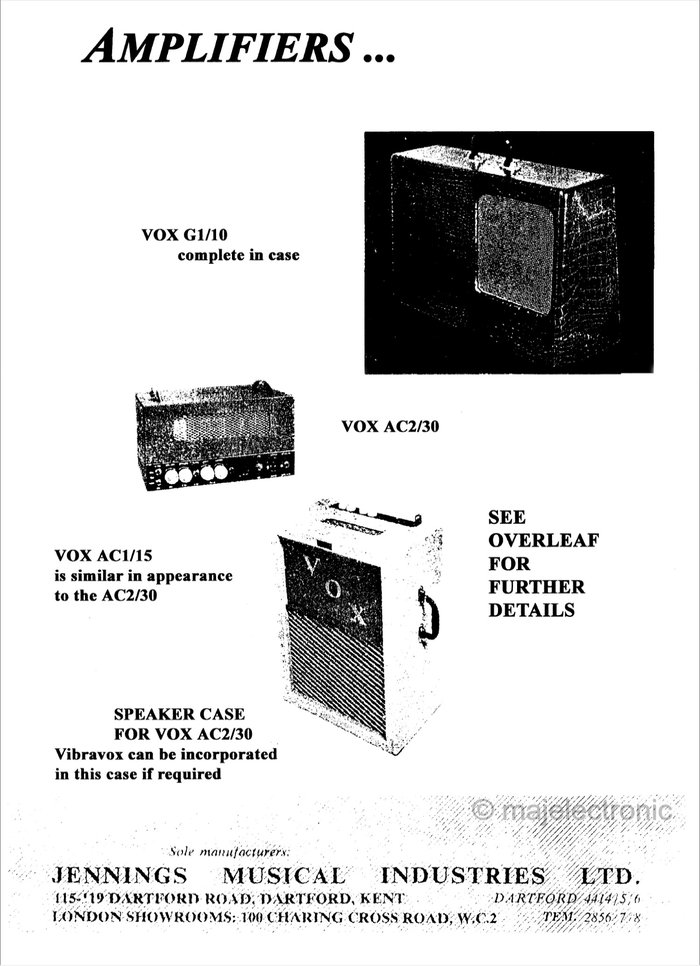
Dick Denney's AC1/15. Below, sections from a Jennings catalogue of late autumn 1957. The scans come from a photocopy of the original made in the 1990s. Thanks to Mike. On the main page, feint text has been renewed.
It seems that at this stage the AC1/15 was to be fitted into a tall case, much as AC2/30 - a "modular" design initially. When it came to production, the AC1/15 appeared in a square "TV Front" cabinet (see below), its familiar form through to 1960.

Entry in the main body of the catalogue.

Detail from a typescript flyer. The paragraph above this describes the AC2/30.

Typescript pricelist accompanying the catalogue - "Deferred Payments" (hire purchase).
Most of the documents in the sections below are registered also on the documents 1957 and documents 1958 pages.
1957

"Accordion Times", December 1957, detail. The price of the AC1/15 is given as 42 guineas (£44 and 2 shillings,as the pricelist above). It is telling that the amplifier is not pictured. Its final form had probably still not been determined when the advert was sent to press.
1958
In late 1957 / early 1958, a new "TV front" cabinet was developed to accommodate the AC1/15 chassis, The tall case of the AC2/30 was evidently too narrow for Dick and Derek's final design. In September 1957 a review article gave the size of the AC2/30 box: 24" tall, 14" wide, 12" deep. The TV Front AC1/15 cabinet measures 20 3/4" x 20 3/4" and 10 1/2" deep.

A detail of a Jennings advert, March 1958.

"Melody Maker" magazine, 8th March 1958.

Detail from a Jennings catalogue, around March 1958.

"Accordion Times", April 1958. Detail of prices: the G1/10, AC1/15 and AC2/30 amplifiers; and the Vibravox unit.
The Cafe Royal Trade Fair, 1st-4th September, 1958
In early September 1958 Jennings took part for the first time in the "Associated Musical Instrument Industries" Fair, held at the Cafe Royal, a new venue for the show. Stars of the Jennings stand were the Model G organ, the sole three-manual organ (besides the unique example pictured in yesterday's entry) produced by the company, and the Vox AC1/15 amplifier. Jennings reported in the music trade press that orders for the amplifier had been taken from America. AC1/15s in the USA in 1958! The circuit diagram dated March 1958 shows the standard voltage taps: 110v, 130v, 200v, 225v, and 250v, so no modifications will have been needed for export.

Advert placed in the music trade press in advance of the show, July 1958, repeated in August. The AC1/15 is at centre.

Music trade press, September 1958. On the right, the Model G; left background, an AC1/15 and a life-size photo of Bert Weedon using one.

Jennings's report on the show.

Detail from the first circuit diagram for the AC1/15.

September 1958. Martin Lukins with two AC1/15s.
Colin Hicks, brother of Tommy Steele and mentioned as a Vox user in September 1958, with AC1/15s in the film "Europa di notte", released in early 1959, the various sequences having been filmed in London, Paris, Rome, Vienna and Madrid, in late 1958. This is probably the earliest appearance of Vox amplifiers on film.


Clip from the film
1959
The advert immediately below is a useful reminder that a good part of Jennings's business still, in 1959, centred around accordions. "Bass" model amplifiers were designed specially for them.

"Accordion Times", February 1959.

"Banjo, Mandolin, and Guitar" magazine, February 1959.
Below, the second of four versions of the AC15 flyer issued by JMI from early 1958 to early 1960. This version - from 1959 - is almost-tissue paper thin.


A slightly murky shot of the, reverse. The AC/30 and AC/10, various accessories below.