
Vox AC30: trademarks
1951-1963
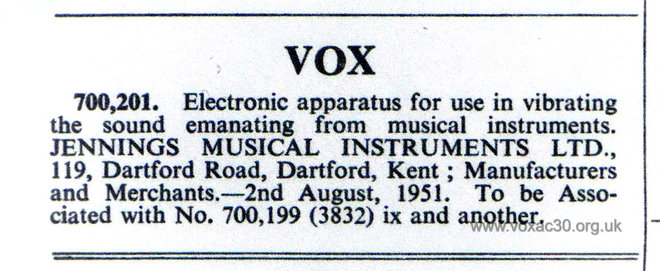
Application 2nd August 1951; formally registered 8th October 1952.
In August 1951, Tom Jennings applied for his first trade marks - four in total: "Univox", "Vox", "Unitone Products" and "Vibratone". The process was effectively a three-fold one: (1) application to the Patent Office; (2) formal publication (advertisement) of the application so that any objection might be placed; (3) registration (formal recognition in law).
The Patent Office had a system of "classes" for objects or entities being trade-marked. The two regularly used by Jennings were:
Class 9: Photographic/Cinematographic/Sound Reproducers/Sound Recorders/Wireless etc.
Class 15: Musical Instruments.
From 1951-1959 Jennings trade mark properties were registered and held under the name "Jennings Musical Instruments Limited", the company that Tom had created in 1949 - see this page. In the Spring of 1959 they were re-registered under "Jennings Musical Industries Limited". All new ones were held under the new JMI from that point too.
The Patent agent normally used by Tom was Marks and Clerk (Chancery Lane), still active today. In early days, he may have put his own applications in though. The general rule was that only the proprietor of a company or a designated agent could submit, amend or cancel submissions - a precaution against fraud and mischief.
The dates noted below are of the initial application and its registration. Some things moved relatively quickly, others not. In the days before computers, setting up the trade mark journals, which were issued on a weekly basis, was a time-consuming process. Text and images had to be laid out by hand. Once formulated, the layouts were then passed to the printers for typesetting (manually) in galleys. Proofs were printed off and sent to the Patent Office for checking. Any errors were then marked up and relayed to the printers for correcting, and once that had been done, the pages were run off for binding. The gap between application and registration could be anywhere from a week (in some exceptional cases) and two years.
One often finds in the trade mark applications a sort of virtual hierarchy. Records are generally "associated" either with "Vox" or an item that is in some way related. A few however have no association at all. Presumably the trade-marking of the name itself was felt to be enough.
1951-1960
Two of Tom's first applications: for the Univox and for "Vox". The entry for "Vox" was adjusted at various points over the years to reflect JMI's changing catalogue. A new record - with its own number - was assigned to eachf adjustment. However, even in 1967, the 1951 record - 700,201 - was sometimes referenced as an association.
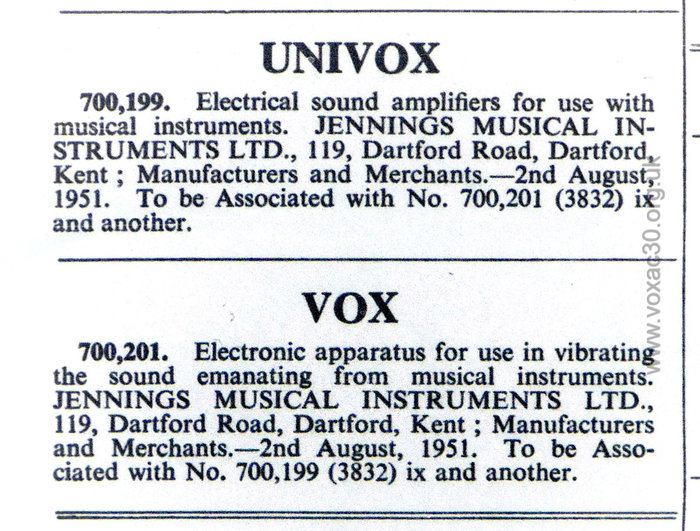
"Univox" and "Vox" went through together. Applicationa 2nd August 1951; formally registered 8th October 1952.
The phraseology of 700,201 is deliberately unspecific: "{any} electronic apparatus for use in vibrating the sound....", which would allow for amplifiers, microphones, speakers, footpedals and the like. An early instance of the use of "Vox", as Jim Elyea indicated, is the rotary action footpedal - the "VOX foot volume control" - of 1954. See this page. But it is entirely possible that something prior to that will come to light in time.
A note on the six early Trade Marks taken out by Tom in the period 1951-1953:
700,198: UNITONE PRODUCTS. 2nd August 1951. Electrical sound amplifiers... Registered 13th February 1952.
700,199: UNIVOX. 2nd August 1951. Electrical sound amplifiers... Registered 8th October 1952.
700,201: VIBRATONE. 2nd August 1951. Electrical sound amplifiers. Registered 16th January 1952.
700,201: VOX. 2nd August 1951. Electronic apparatus for use in vibrating the sound.... Registered 8th October 1952.
705,032: UNIVOX. 19th February 1952. Musical instruments (other than talking machines and wireless apparatus). Registered 4th June 1953.
705,032: VIBRAVOX. 13th June 1953. Electronic apparatus for use in vibrating the sound.... Registered 6th January 1954.

"Vibravox" was formally registered a trade mark on 6th January 1954.
All but the second UNIVOX Trade Mark have associations with other records. The relationship is:

The Univox is obviously a known quantity, and the Vibravox (circuit and unit) was certainly in marketable form by the end of 1957. Nothing is known of Unitone Products and Vibratone, both of which are classed as "Electrical sound amplifiers...". Vibravox was associated by Tom with the latter. The question is whether, from 1954 to 1957, it was more than just a Trade Name awaiting a potential use - in other words, was there a Vibravox circuit at this point in a Jennings Vibratone amplifier?
1961
Below, the record of Tom's application to the Patent Office for the trade mark "Vox Supertwin" on 25th September, 1961, the name having been formulated at some point after July 1961. See the general introduction to Super Twins on this page.
It took the Patent Office around two years to register it formally - a relatively long, though not uncommon, span of time. Unfortunately most of the paper records relating to applications were destroyed in line with one of the more draconian Public Records Acts, so it is not possible to see or know why some moved more quickly than others.

Published on 23rd January 1963, registered on the 19th of June.
The preamble relating to "Class 9" embodies text newly devised (and registered) in March 1961. Trade Marks 700,201 and 786,137 were for "Vox".
1963
In late February 1963, Tom began the process of obtaining legal protection for designs and names embodied in and attached to the range of Vox amplifiers then in production, the AC30 in particular. His first step: the trade-marking of the grille cloth, the application (as published in the picture below) submitted on the 22nd.

22nd February, 1963.
Next came the application to protect the AC30's full name - the "Vox Twin 30". Quite why he decided against trade-marking "Vox AC30" is not clear. None of the correspondence with Marks and Clerk, JMI's Patent Agents, survives unfortunately.

28th March, 1963.
His third step was to apply, on 28th June '63, for protection for the design - the outward appearance - of the AC30 itself.

Two of five photos submitted to the Patent Office on 28th June 1963.
Last, the trade-marking of the repeating diamond pattern of the cloth, the submission made on 27th September 1963.

27th September 1963.
The over-arching question in relation to the AC30 in particular is why Tom acted when he did. Perhaps something he had sensed at the Frankfurt Trade Fair in February '63? Or simply a growing feeling that his best-selling and most "visible" amp ought to have some measure of protection against rivals and imitators? Trade-marking the Vox grille cloth of course protected the range as a whole (echo and reverberation units included).
It seemed worth bringing this entry on Tom's trade-marking of "VOX" in the USA (in 1963) over from the Vox AC100 website. This was by no means his first American trade mark. "UNIVOX" had been applied for and approved as far back as August 1952.
In October 1963, having attended the NAMM show for the first time four months earlier, Tom Jennings applied to trade-mark the name "VOX" in the USA, an application subsequently granted. Whether his decision stemmed on the one hand simply from prescience or on the other the concrete need to secure the name following a distribution deal is not known at present. Tom certainly had at least one distributor - probably in the shape of Zeb Billings in Milwaukee - by the time of the NAMM show of '64.
At any rate, when the deal with Thomas Organ came to be sealed in late August 1964, one of the conditions placed upon JMI was that pre-existing arrangements should be wound up. Thomas became "exclusive" distributor, later gaining its own rights to "VOX" as a trade name in the USA. More on that to come.
One of the peculiar consequences of Thomas's "ownership" of the name was that "Vox Sound Equipment Limited", the company formed by Cyril Windiate and Reg Clark in the summer of 1968 after the collapse of JMI, could not exhibit English Vox equipment in America (whether it wanted to or not). Thomas's deal had been with JMI.
This did not deter VSEL's successor though. "Vox Sound Limited" the new incarnation of "Vox" went to the NAMM show in 1971 as the "English Organ Company Limited". A pretty neat workaround.

Detail from the published US Patent records - application filed on 11th October 1963.