
The Vox Domino Bass
Late 1963 to 1965
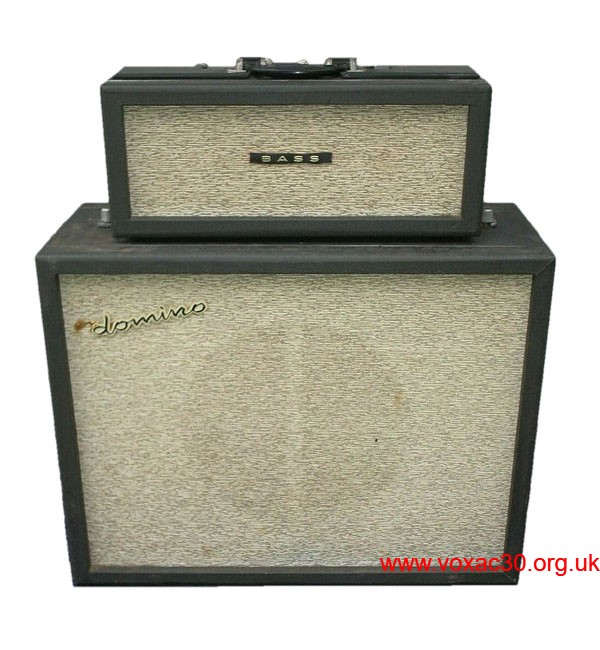
The Vox/Jennings Domino amplifiers were effectively a budget range aimed at non-professional and younger players. There were many competitors in this field: Ampleco, Fenton-Weill, Selmer, Watkins, and Dallas Arbiter.
Of the four Domino amplifiers, the Bass was the most popular by far. An overview of the range and notes on contemporary prices can be found here. Domino Echo units it should be said also sold well - a page on those to come.
Below, a detail from one of the first adverts for the Domino range, late 1963. The amps were "unveiled" at the Russell Hotel Trade Fair at the end of August '63. The amplifier section of the Bass model was shown "back to front" - presumably to provide a more interesting view.

Detail from the "Precision in Sound" fold-out catalogue from the autumn of 1963.
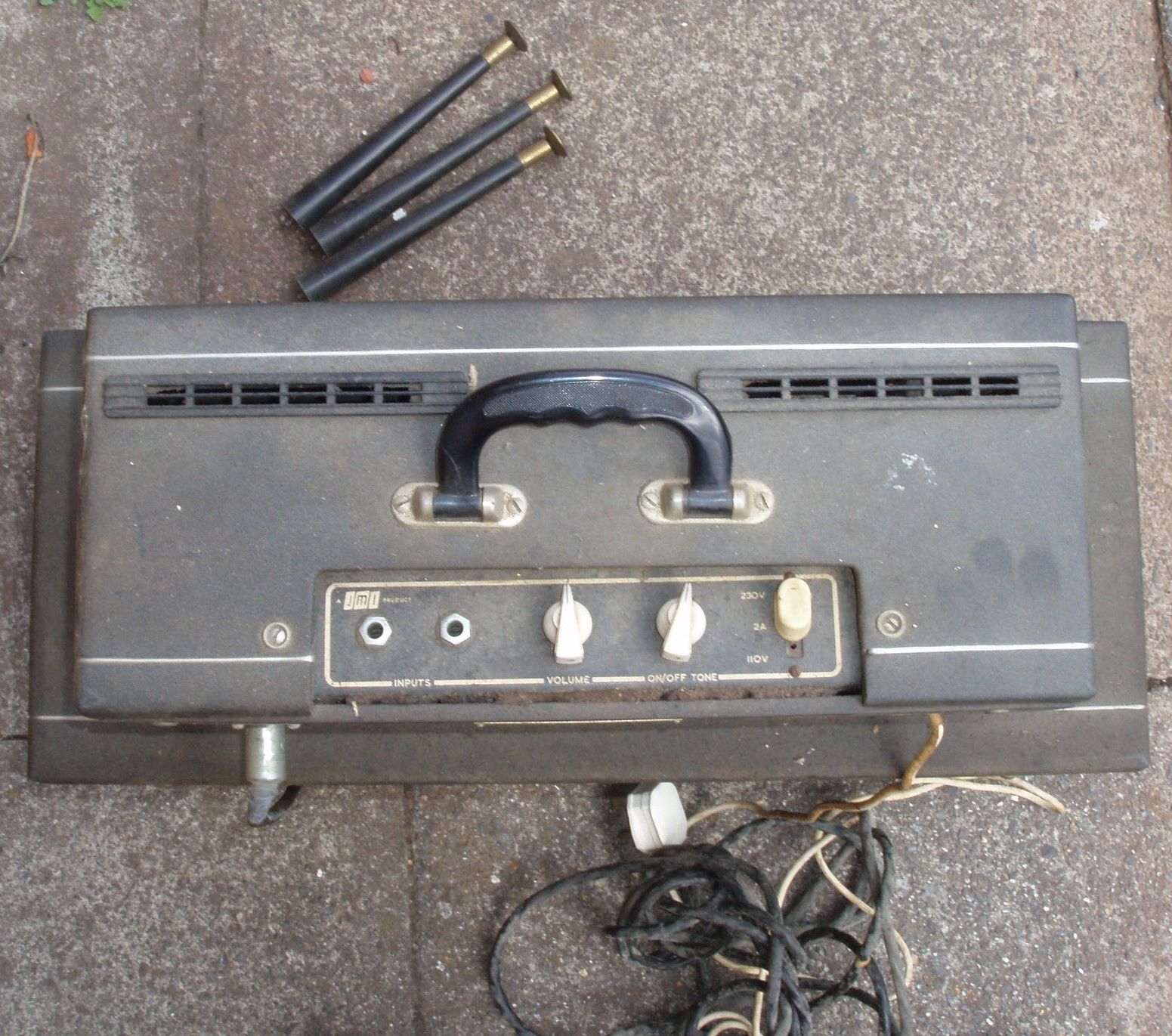
The circuit of the Domino Bass was effectively that of the AC4 (single channel, two inputs), but with the tremolo circuitry omitted, an adjusted vocing for "bass", and an output transformer designed for a speaker with an impedance of 15 rather than 3 ohms. The two controls are: volume, and combined on/off and tone. Three valves (rather than four) were employed: EZ80 rectifier, EF86 preamp gain, EL84 power valve. The mains tranformer allowed for operation at 110V and 230V, indicating that sales to America were, early on, an intention, or at least hope. The circuit diagram is OS/043, drawn by Mike Turner on 20th December, 1963. A single copy only is known to survive.
As in the case of the AC4, chassis were assembled by Triumph Electronics in Purley. Alan Griffin, who worked at Triumph from 1963 to early 1965, remembers fitting the black panels and white control knobs.

Below, a detail from the early promotional picture from the autumn of 1963, the amp's input sockets with white surrounds. These do not appear to have been used in production - perhaps a statement to be proved wrong at a later date.

The speaker sockets were made by Geloso. JMI also used these on early AC30 Super Twin cabinets among other things.
Speaker cabinets
Speaker cabinets were generally fitted with a single 12" Fane 122/10 or 122/12, both ceramic magnet, 20 watts output, 15 ohm impedance. Fanes were a reliable cost-effective choice. Occasionally one finds a Fane 122/14, 22 watts handling, 15 ohm impedance.
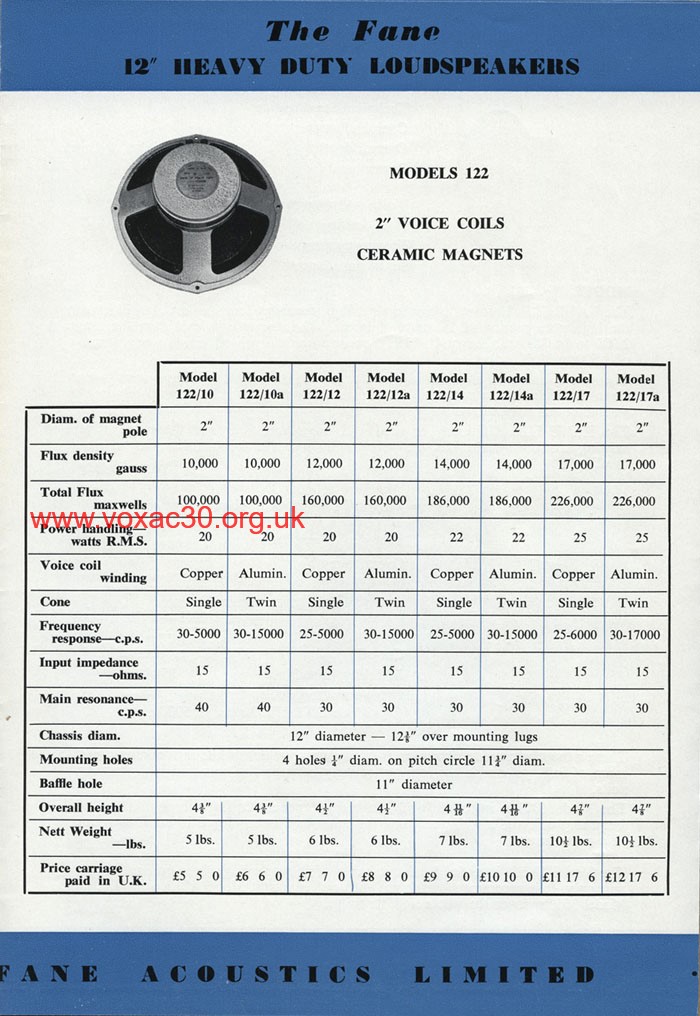
Page from a mid 1960s Fane brochure.
The method of securing the amplifier section to the cabinet - with chrome-plated brackets and thumb-screws - was copied by JMI from Fender. JMI had been Fender's main distributor in the UK from early 1961 to the autumn of 1962.


As mentioned above, speaker sockets on the amplifier and cabinet (and accompanying cable connectors) were generally Italian-made Gelosos:
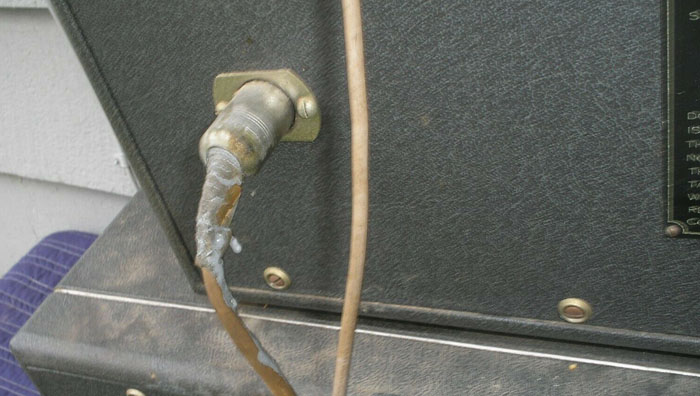
Geloso socket and connector, Domino Bass, serial number 2392.
Further details can be seen on this page.
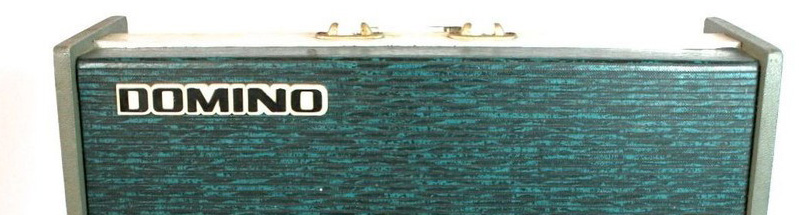
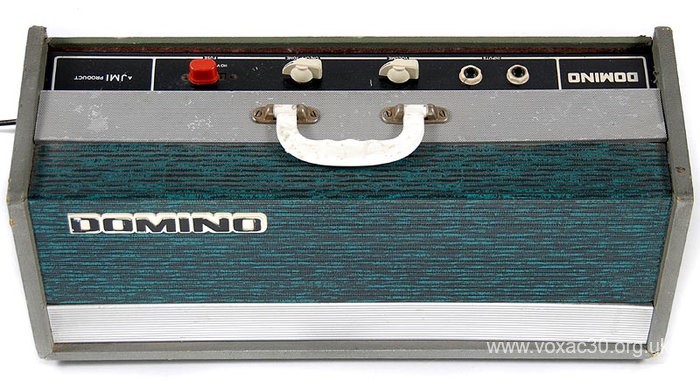
At the Russell Hotel Trade Fair in late 1964 a new green livery was introduced along with a substantially larger format for the amplifier section cabinet. The former does not seem to have lasted long though. Expense is likely to have been key in the return to simpler styles of covering. The wider format amplifier section was by and large retained, though it is clear that some older cases were brought into use again.
Old-style amplifier cases measure 16" x 6" x 6", the new ones 20 1/2" x 8 1/2" x 7 1/2".
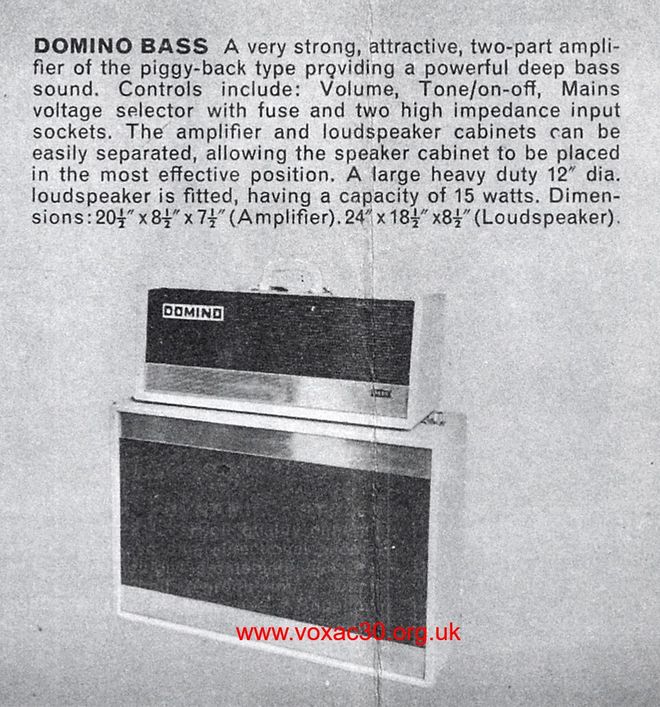
Late 1964 "Precision in Sound" newspaper format catalogue (UK issue only).
Surviving amps
Below, pictures of a cross-section of surviving amps. It seems that all Domino amplifiers shared a single serial number sequence starting at 1000. Serial number plates have "AMPLIFIER" at their head rather than "VOX AMPLIFIER". The three main types that were used can be seen on this page. Now and again amplifier sections were given bronze "Jennings" badges, doubtless left-overs from the late 1950s.
Serial number 1280


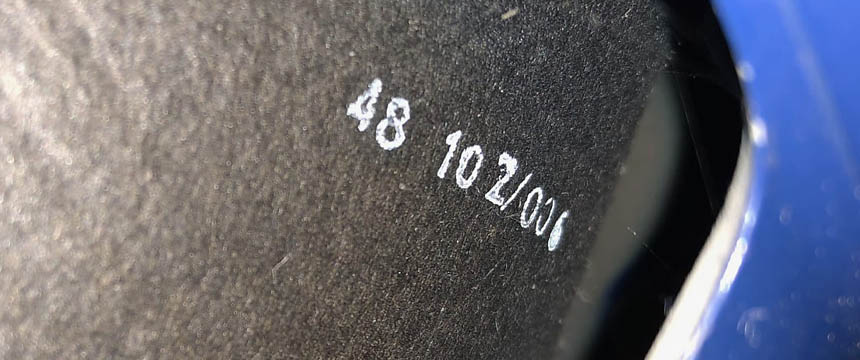
The speaker cabinet has its original Fane ceramic driver, the frame in Jennings blue, the Pulsonic cone code "48/102/006". The week number "48" has not turned up so far on cones made for the Celestion blue - there is a large gap between 42H1777 and 52H1777 in early 1964. "48" would seem to fit well at some point in late December 1963 / January '64 though. The overview of Pulsonic cones in Celestion blues and silvers can be found on this page. In the amplifier, Mullard mustard capacitors with the date code "B3N" = second quarter of 1963; and a cement resistor with "UK" = September or October 1963. The EZ80 rectifier valve has the paint code "KJ" = October '63, and the EL84 has "KK" = November 1963.
Serial number unknown
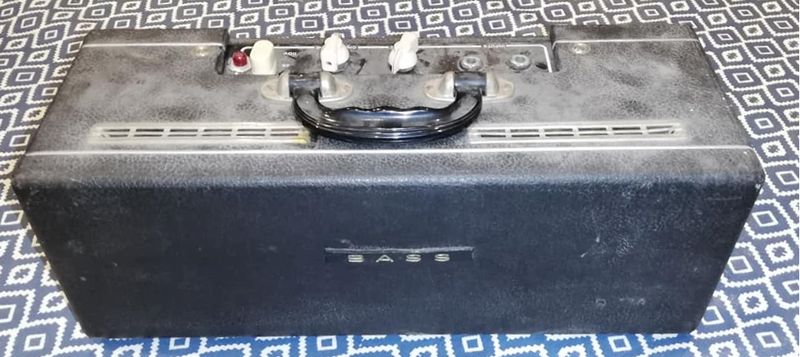
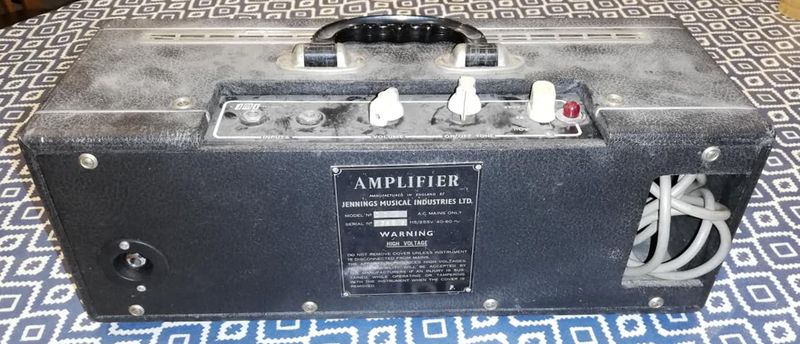
Probably an early one to judge by the serial number plate with short panels. No grille cloth at front, only vinyl (presumably over Baltic ply). The control panel is black.
NEW
Serial number 1363
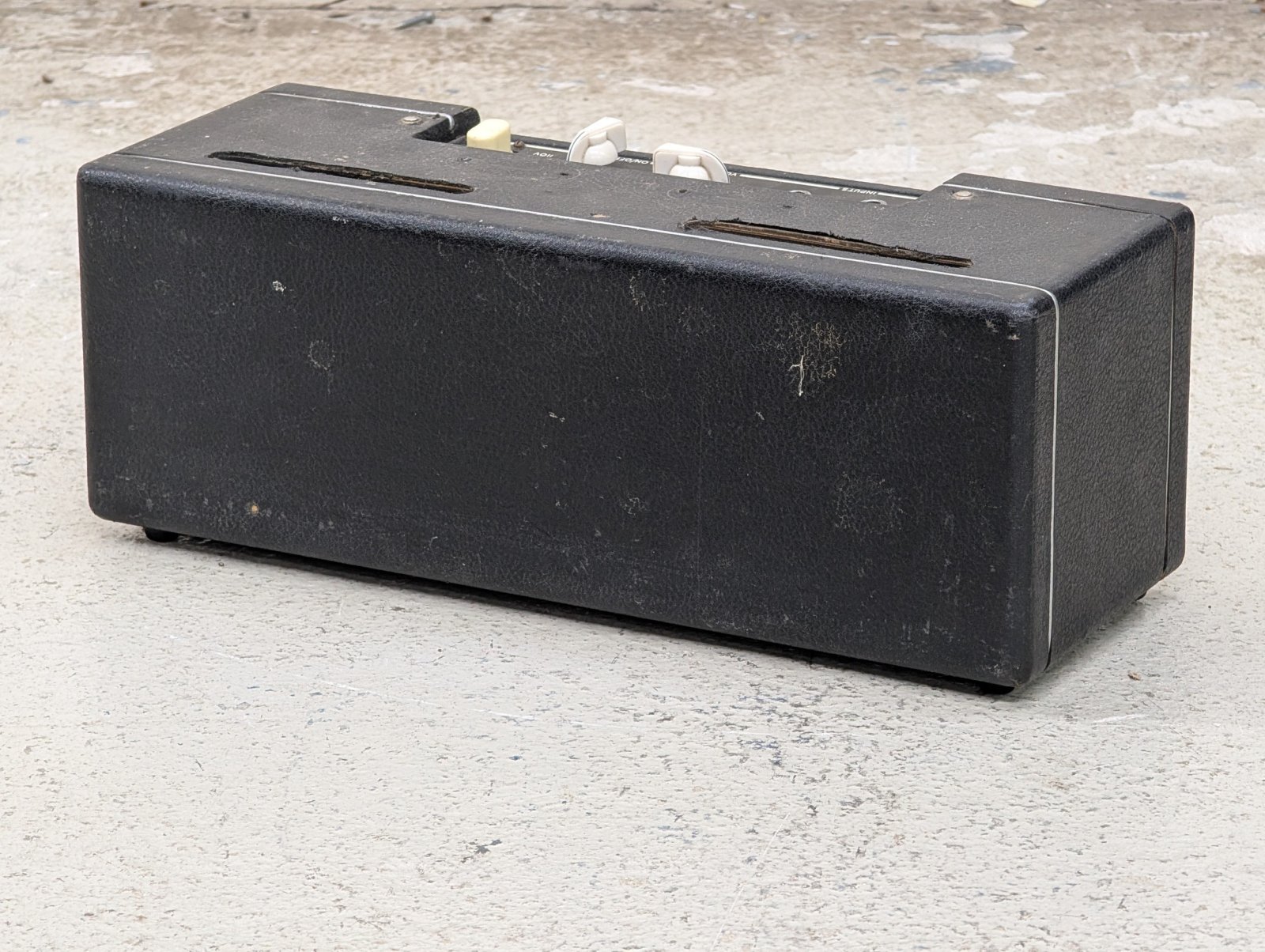
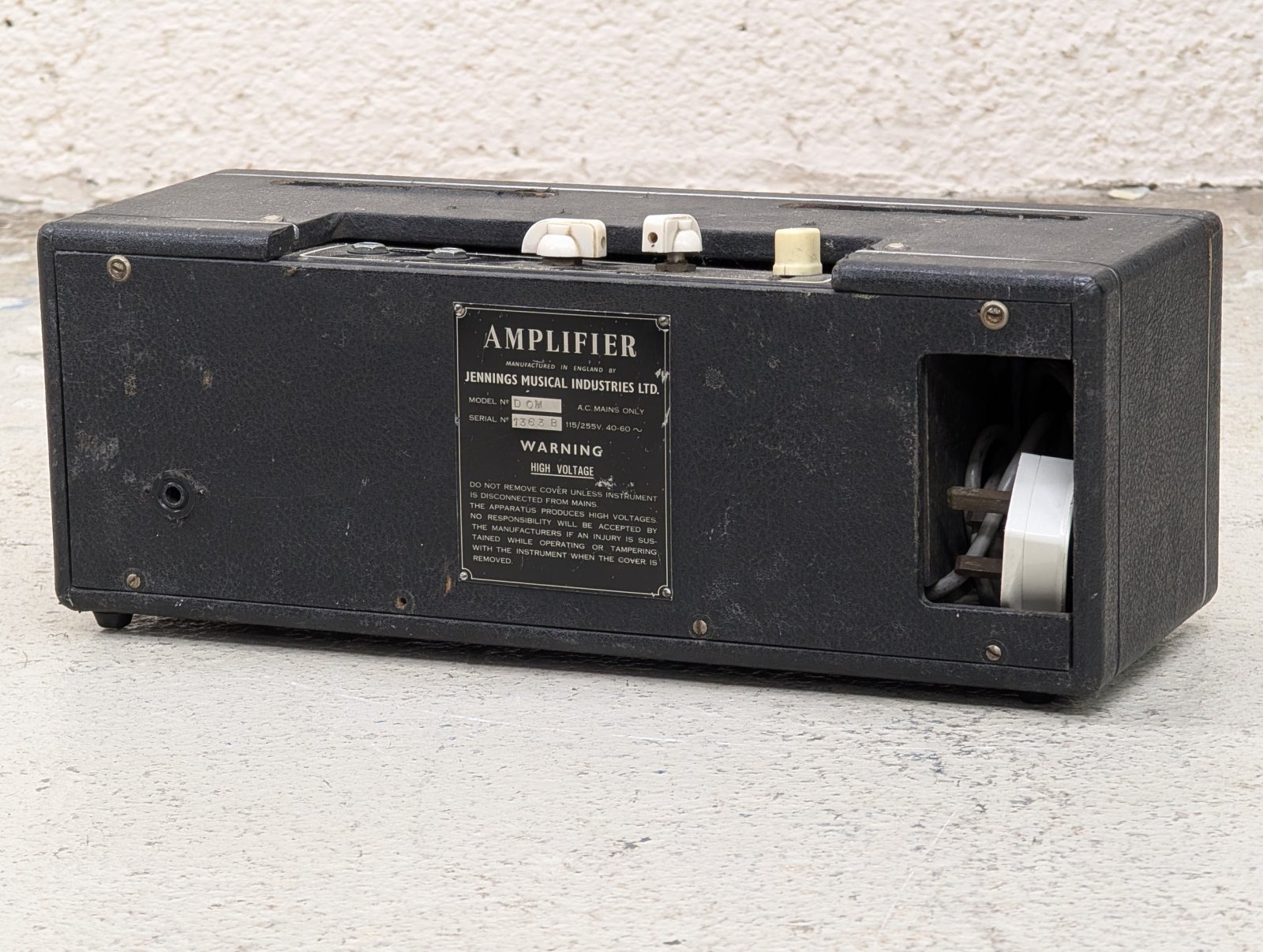
Amplifier section recently (September 2026) sold in the UK. As serial number 1280, solid front covered in black vinyl; black control panel; white control knobs. No BASS logo present.
Serial number 1451

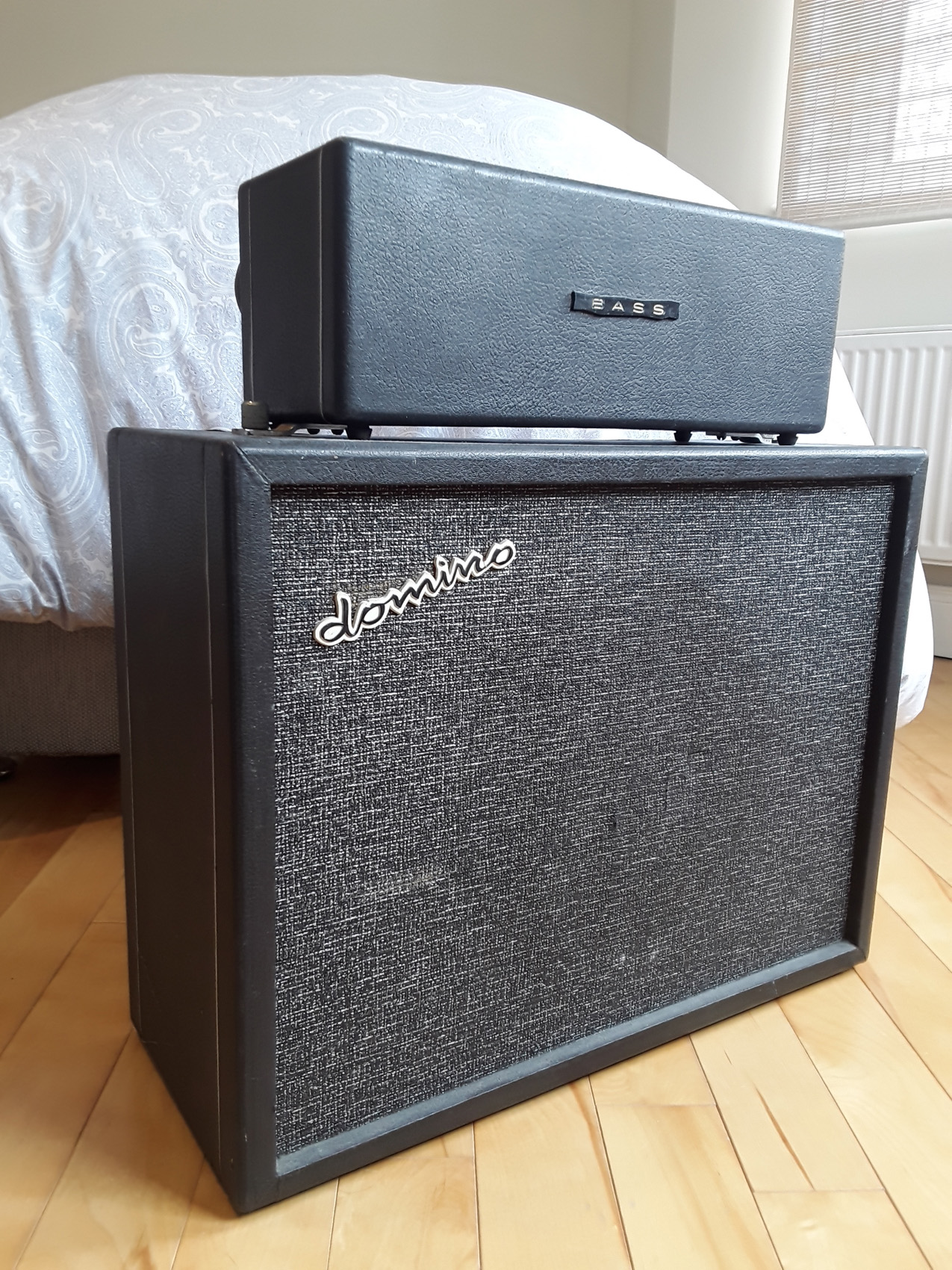
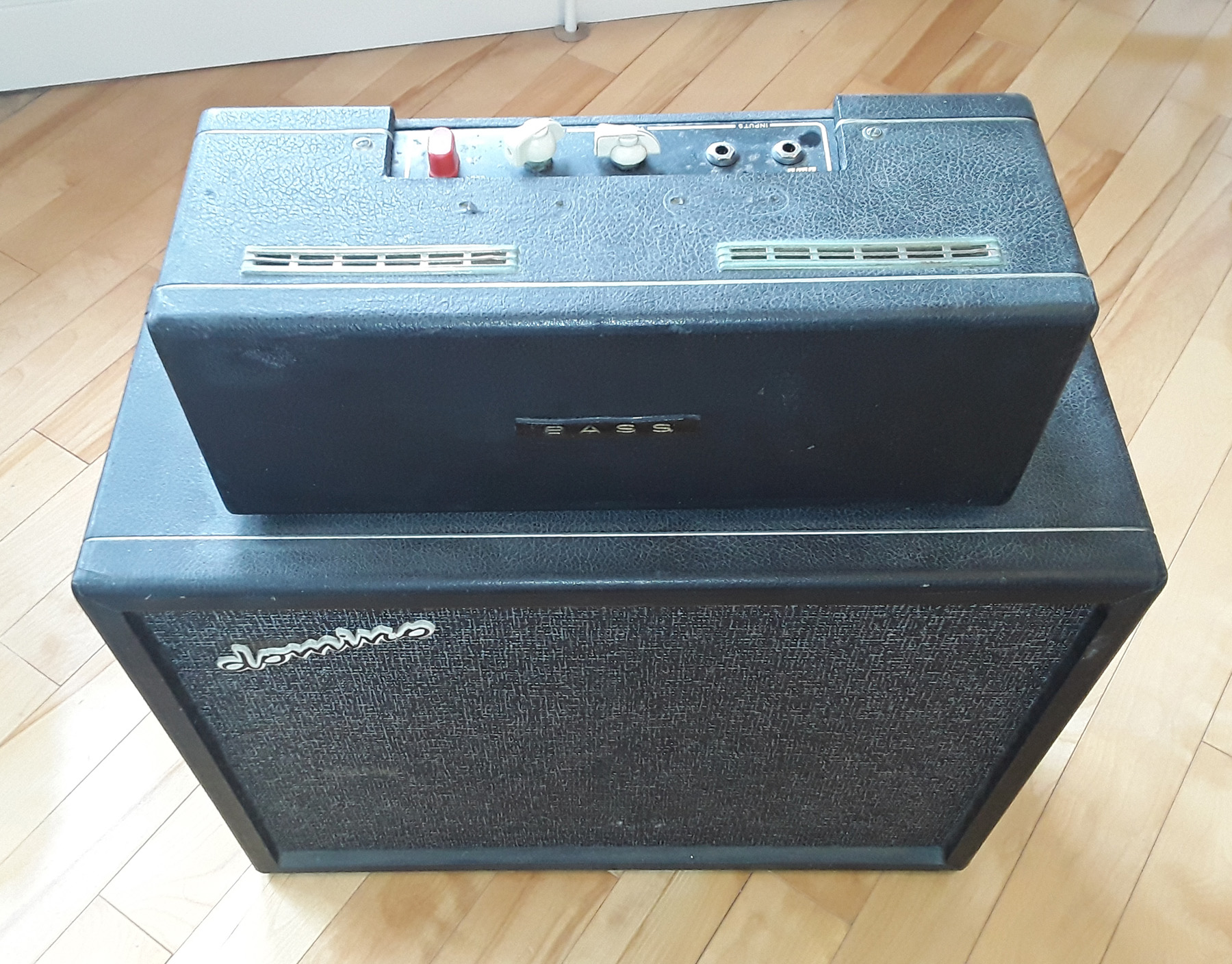

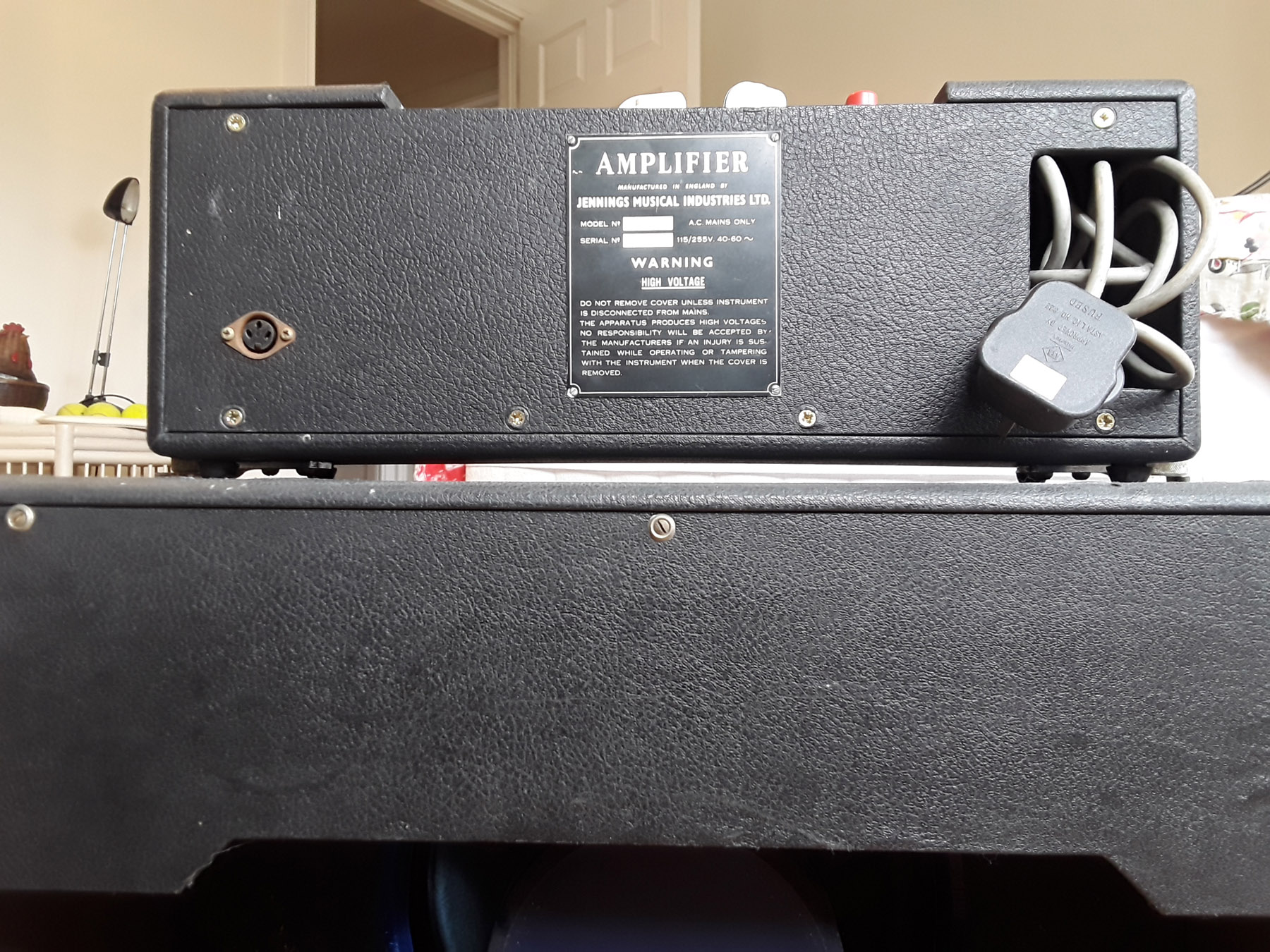
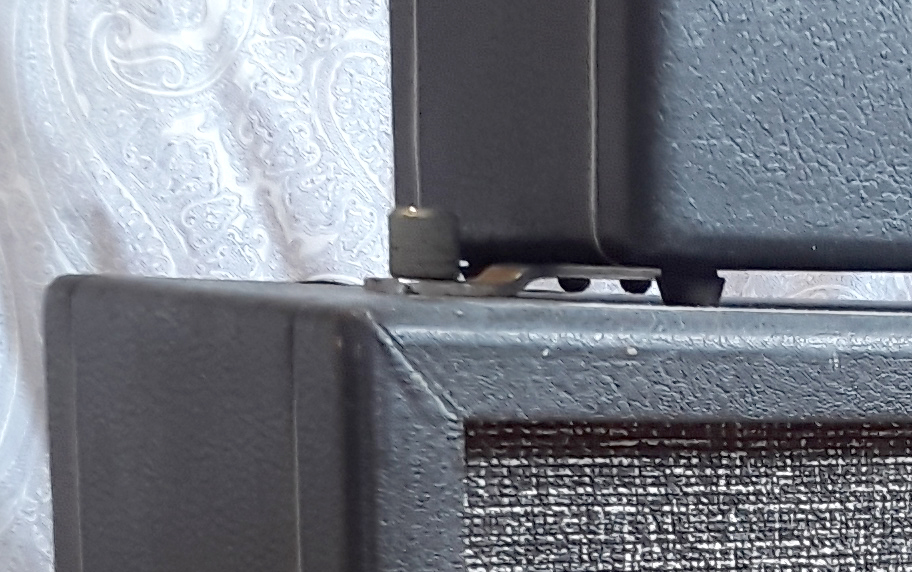


Vinyl front to the amplifier cabinet; grey cloth flecked with white (as pictured also in the Jennings flyer towards the top of this page) on the speaker cab. The speaker is a Fane, sprayed Jennings blue. Original amplifier mounting hardware still present. Thanks to Stephen for the pictures.
From this point amplifier sections have cloth fronts
The cloth for both amplifier and cabinet is normally Radiospares "Vynair" fabric - rough-woven white flecked with grey.
Serial number 1943
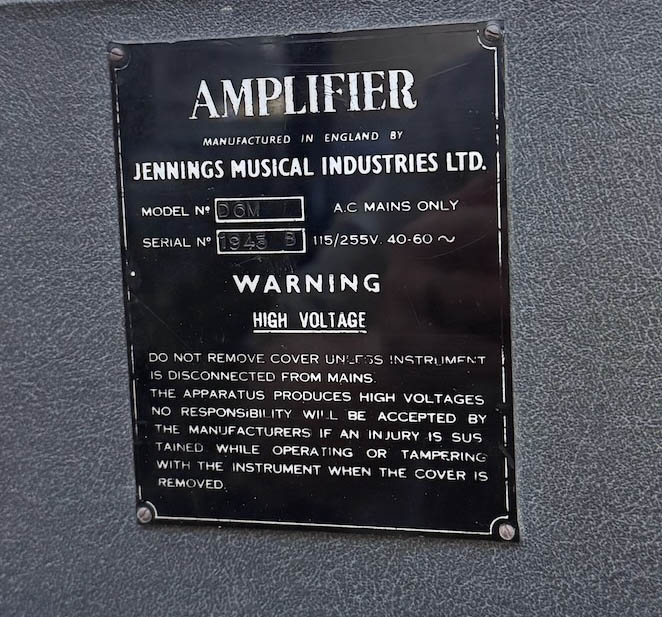
An amplifier and speaker cabinet set. Cosmetics as number 2106 below, white/grey flecked cloth for both sections, finely textured dark grey vinyl. Main filter capacitor replaced, but otherwise the electronics look to be original. The serial number plate is of the black plastic variety, the speaker a Fane sprayed blue.
Serial number 1948
As above, an amplifier and speaker cabinet set, white/grey flecked cloth for both sections, finely textured dark grey vinyl. In the preamp, Mullard mustards with "A4N" = first quarter of 1964 for their manufacture. The original mounting hardware survives, as do the Geloso XLR sockets; Fane speaker in Jennings blue.
Serial number 2021
Details to come.
Serial number 2106
Serial number 2392
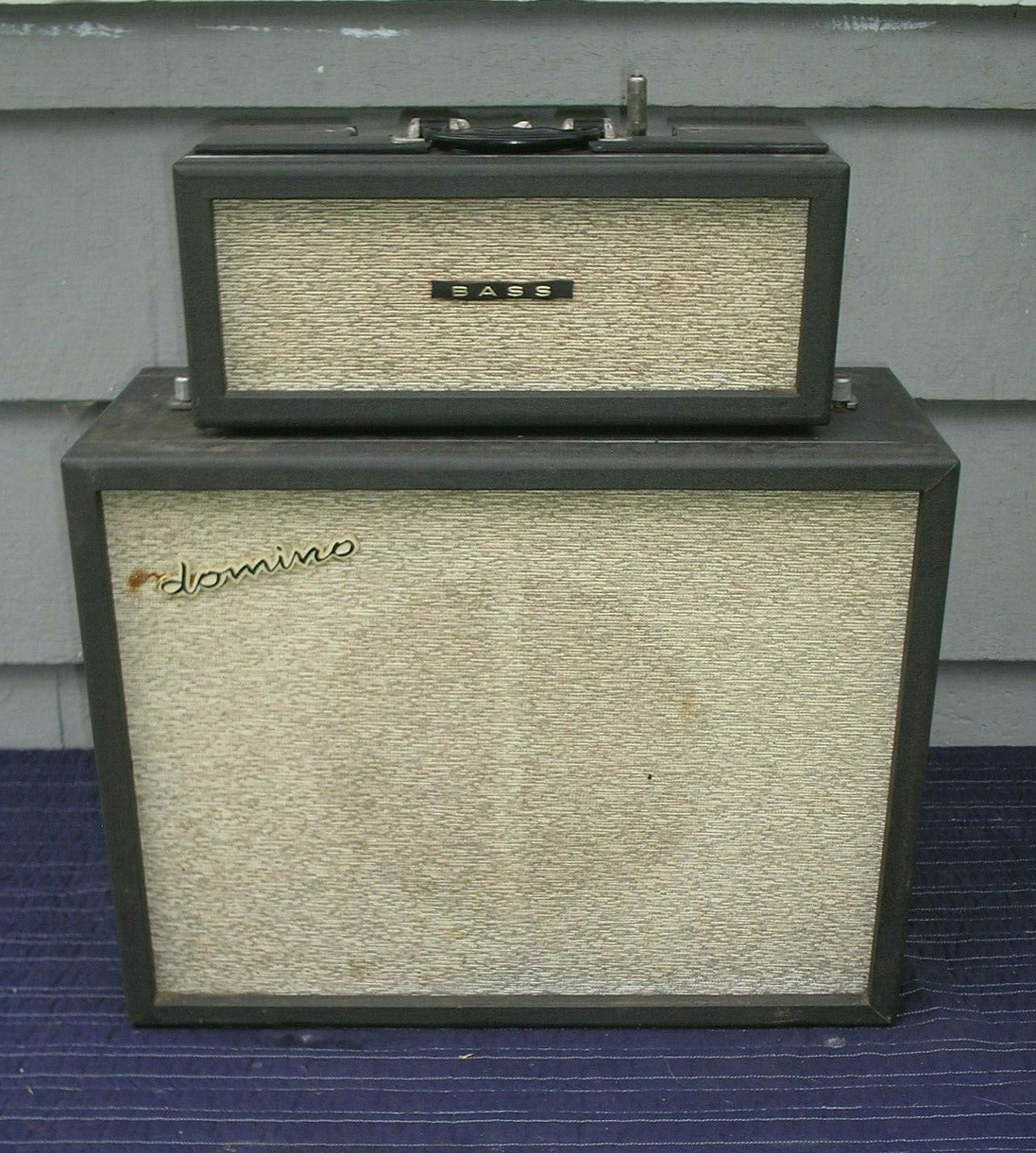
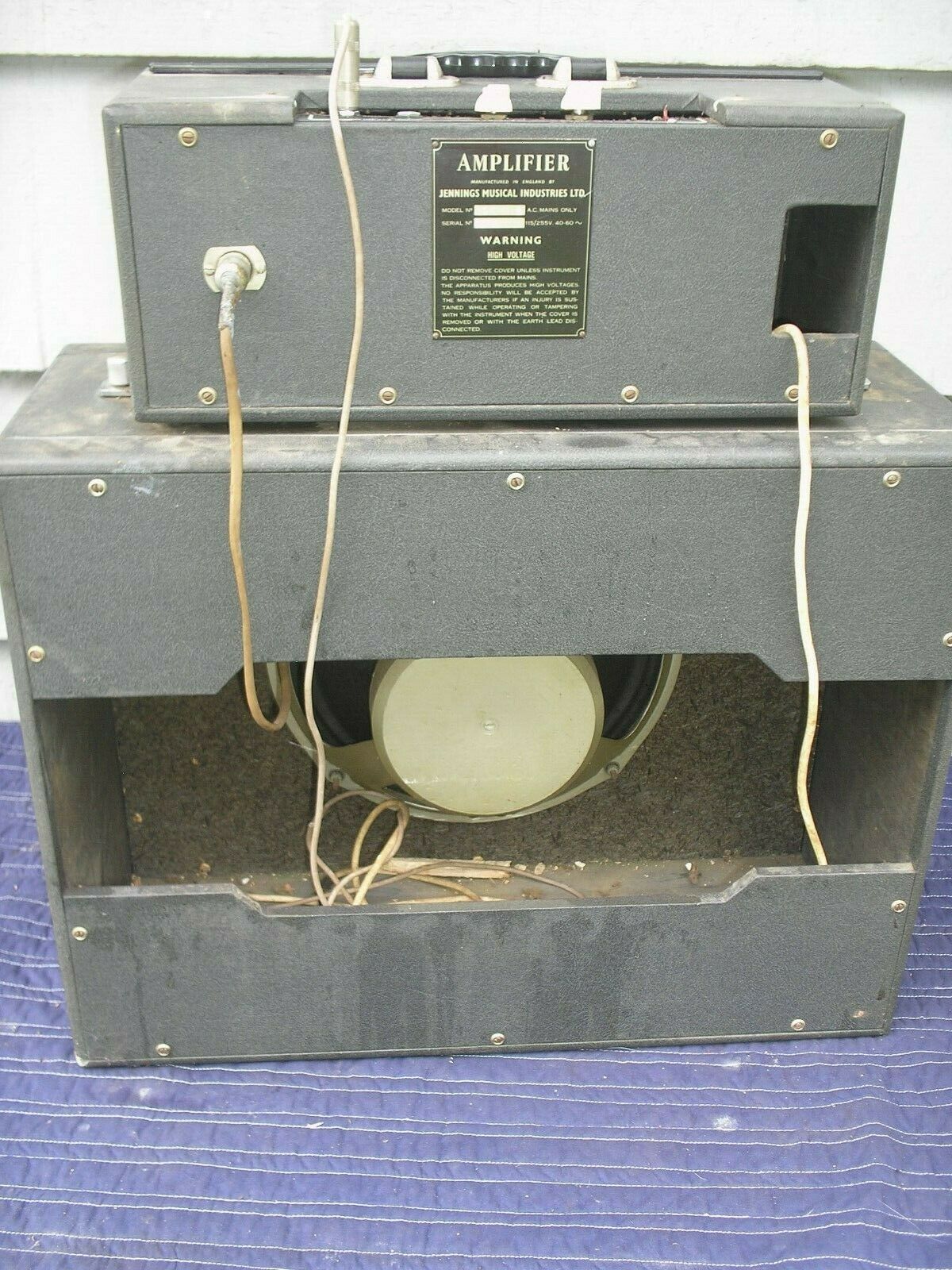
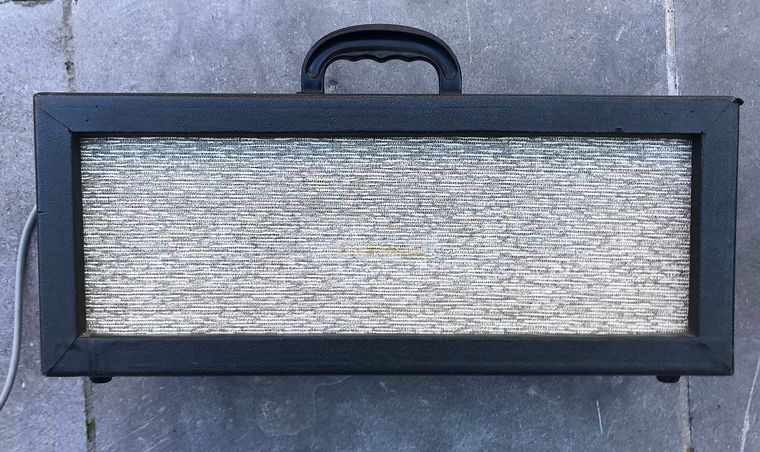
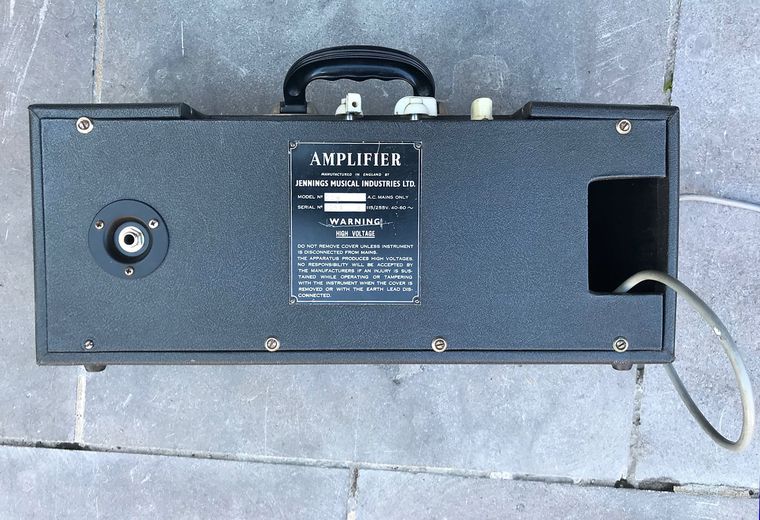
White/grey flecked cloth for both sections, finely textured dark grey vinyl, as above and below. The speaker is a Fane, frame unsprayed. The original fixing hardware - to secure the amplifier to the speaker cabinet - survives.
Serial number 2627
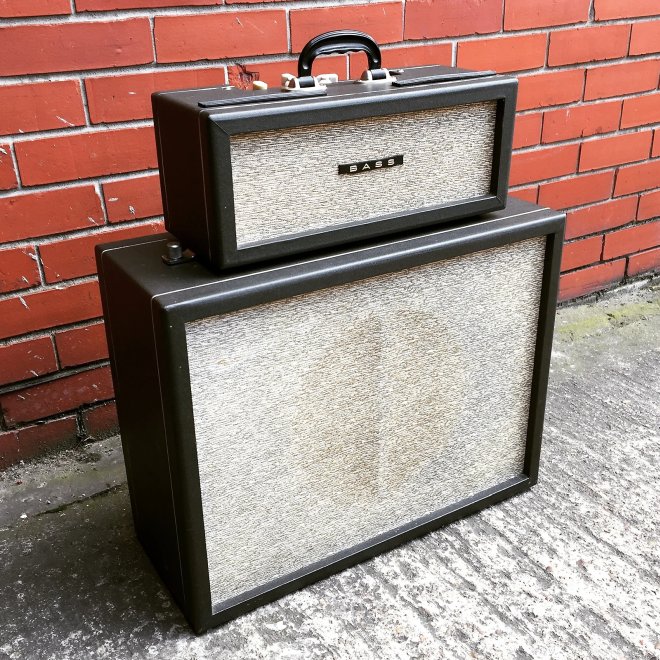
Only shots of the exterior, which looks to be in good condition. The speaker is not shown, which may indicate that it was replaced at some point.
Serial number 2652
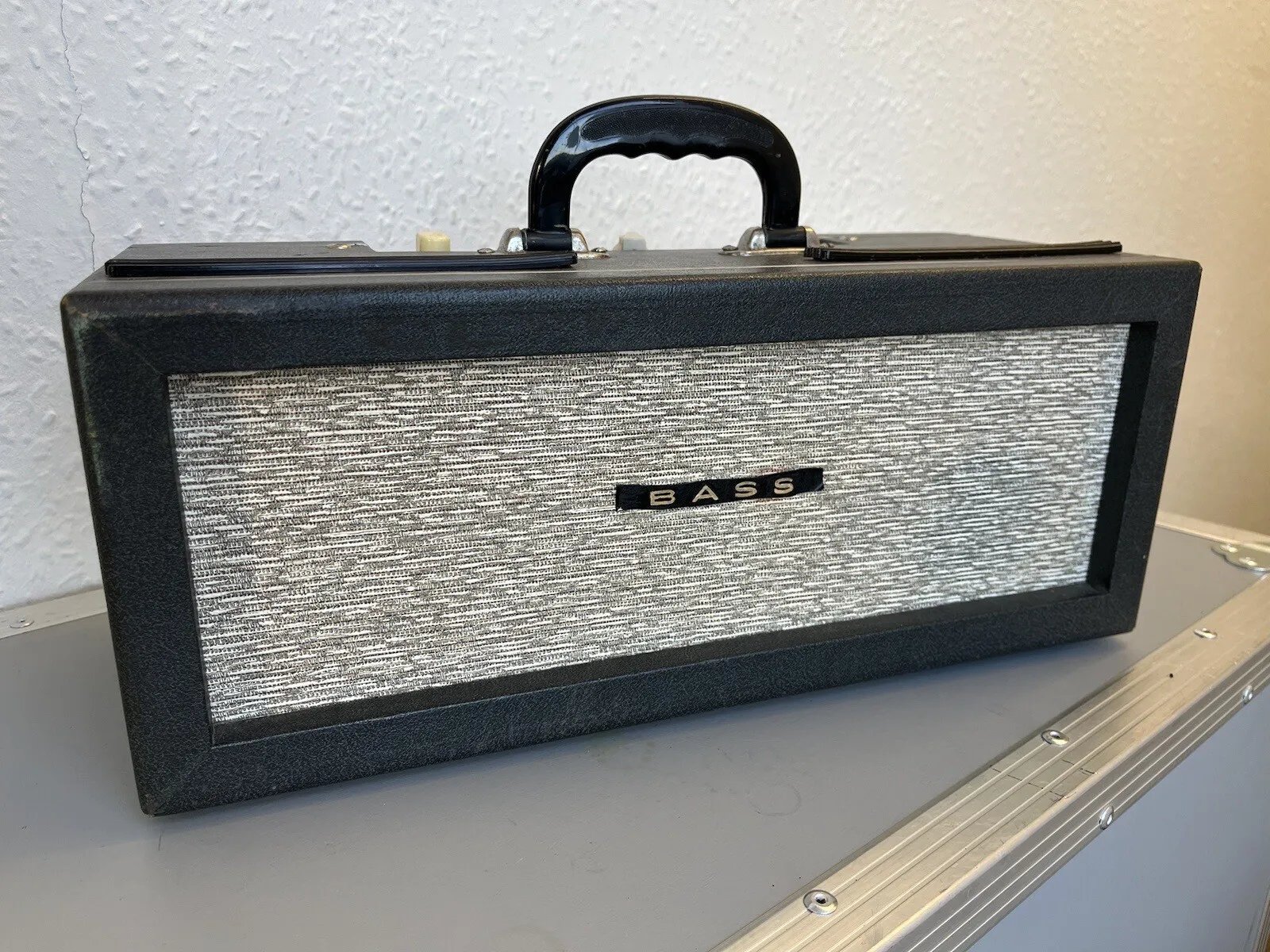
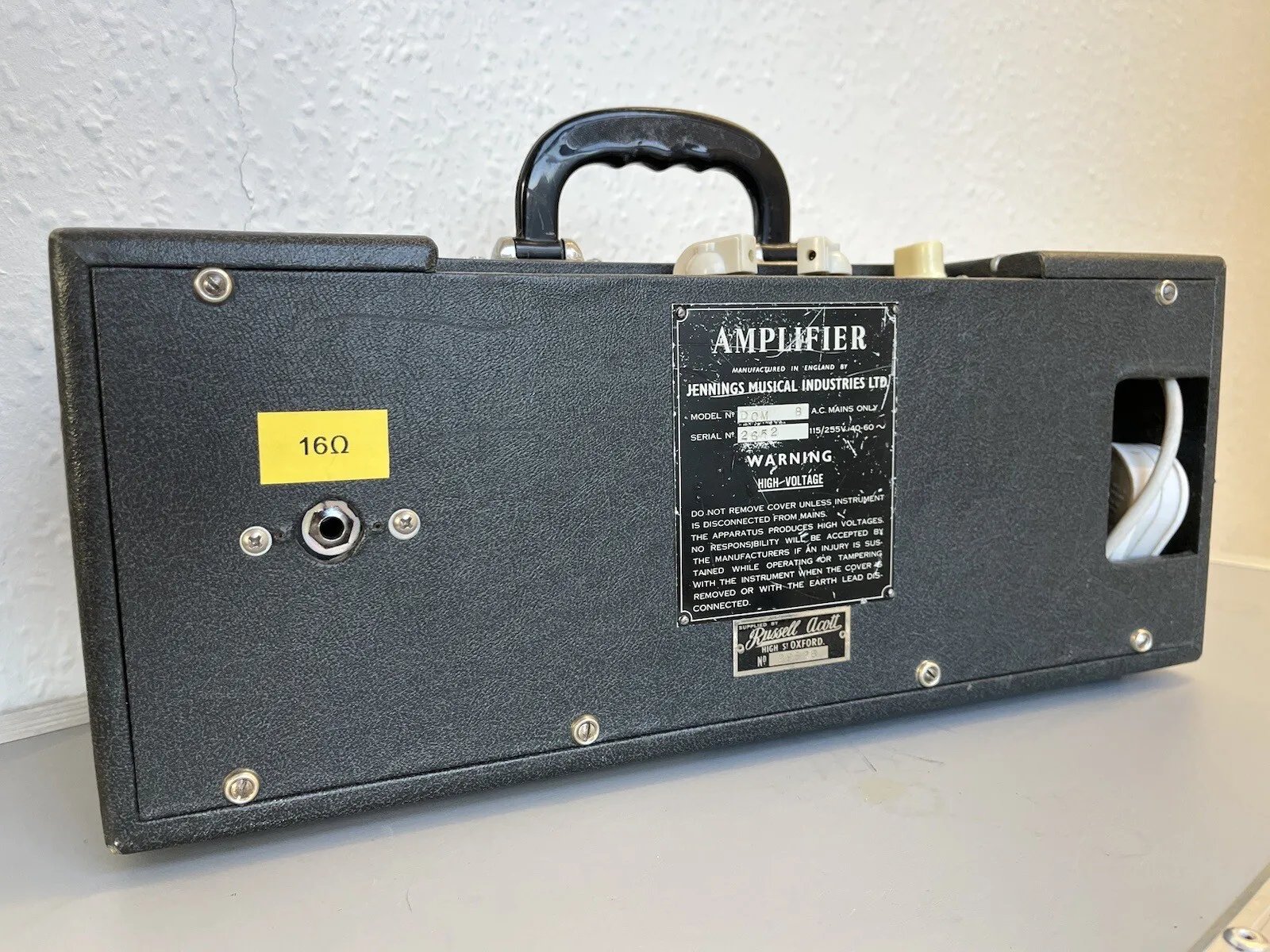
Amplifier section only. Chassis signed in pencil by "G" and "MJ". The main Hunts filter cap in the preamp has the date code "WST" = 15th week of 1964 for its manufacture; the power section filter has "WUT" = 16th week 1964. Sold by Russell Acott in Oxford, a Jennings dealer from the late 1950s
Serial number 2817
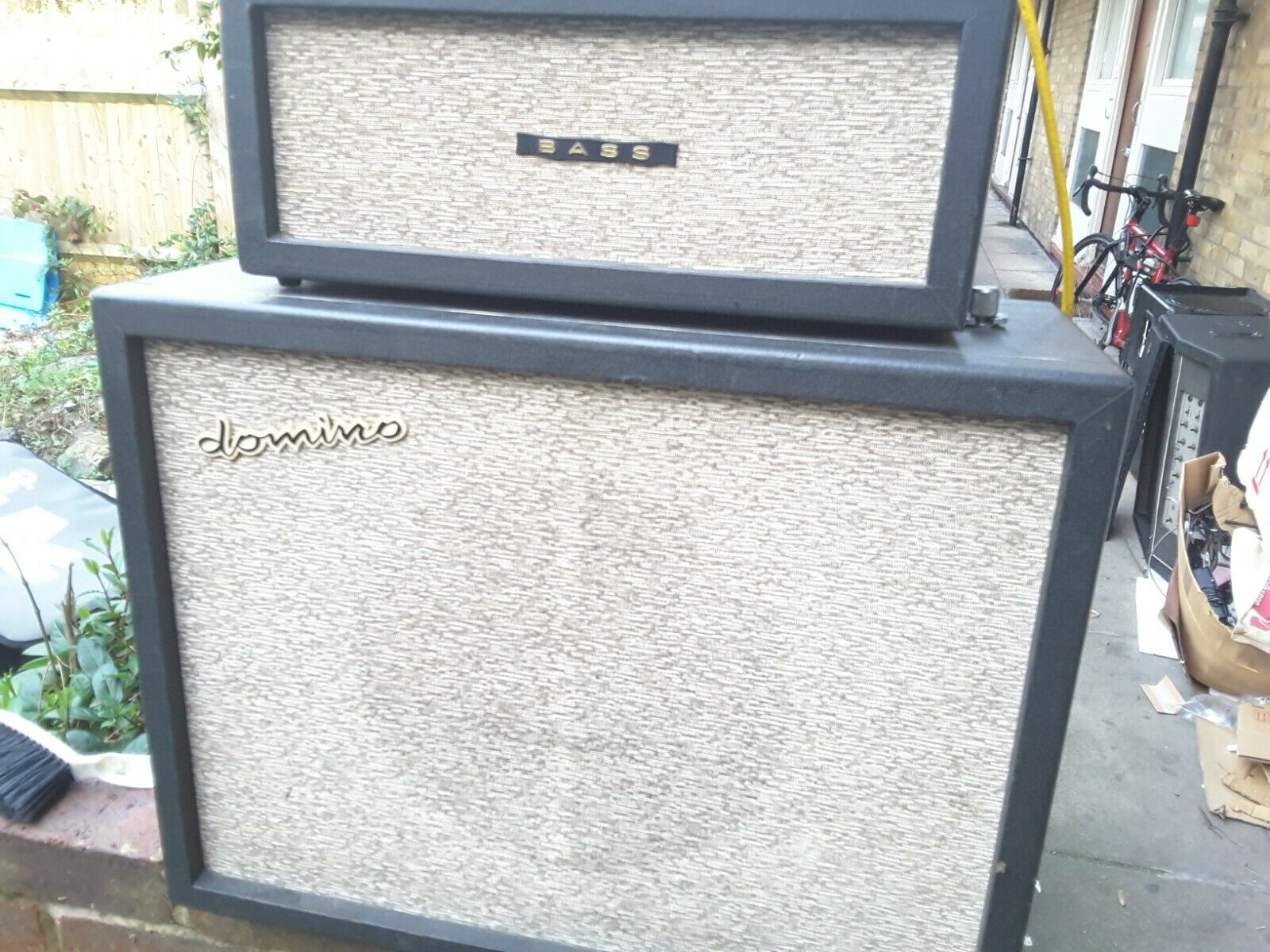
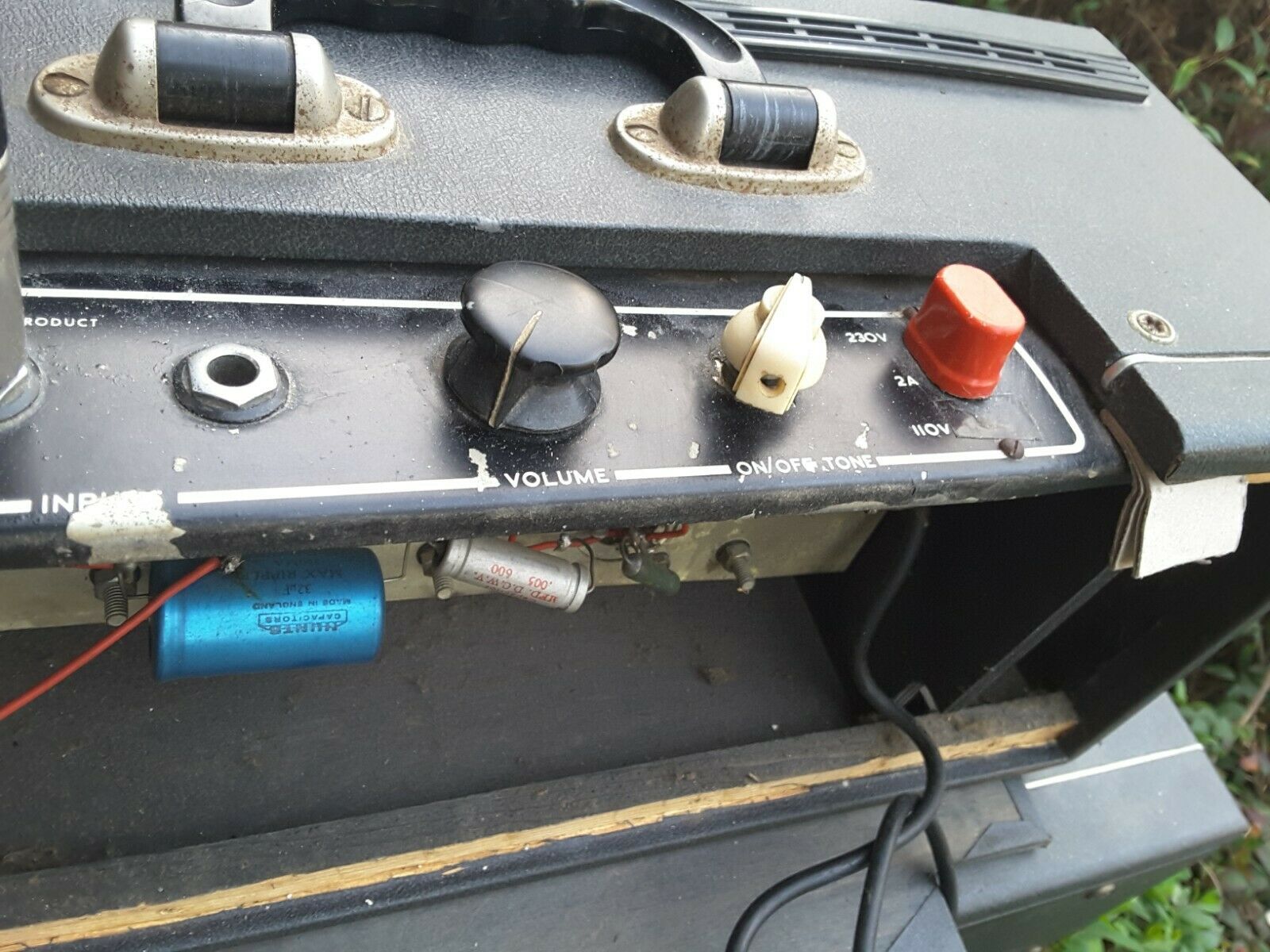
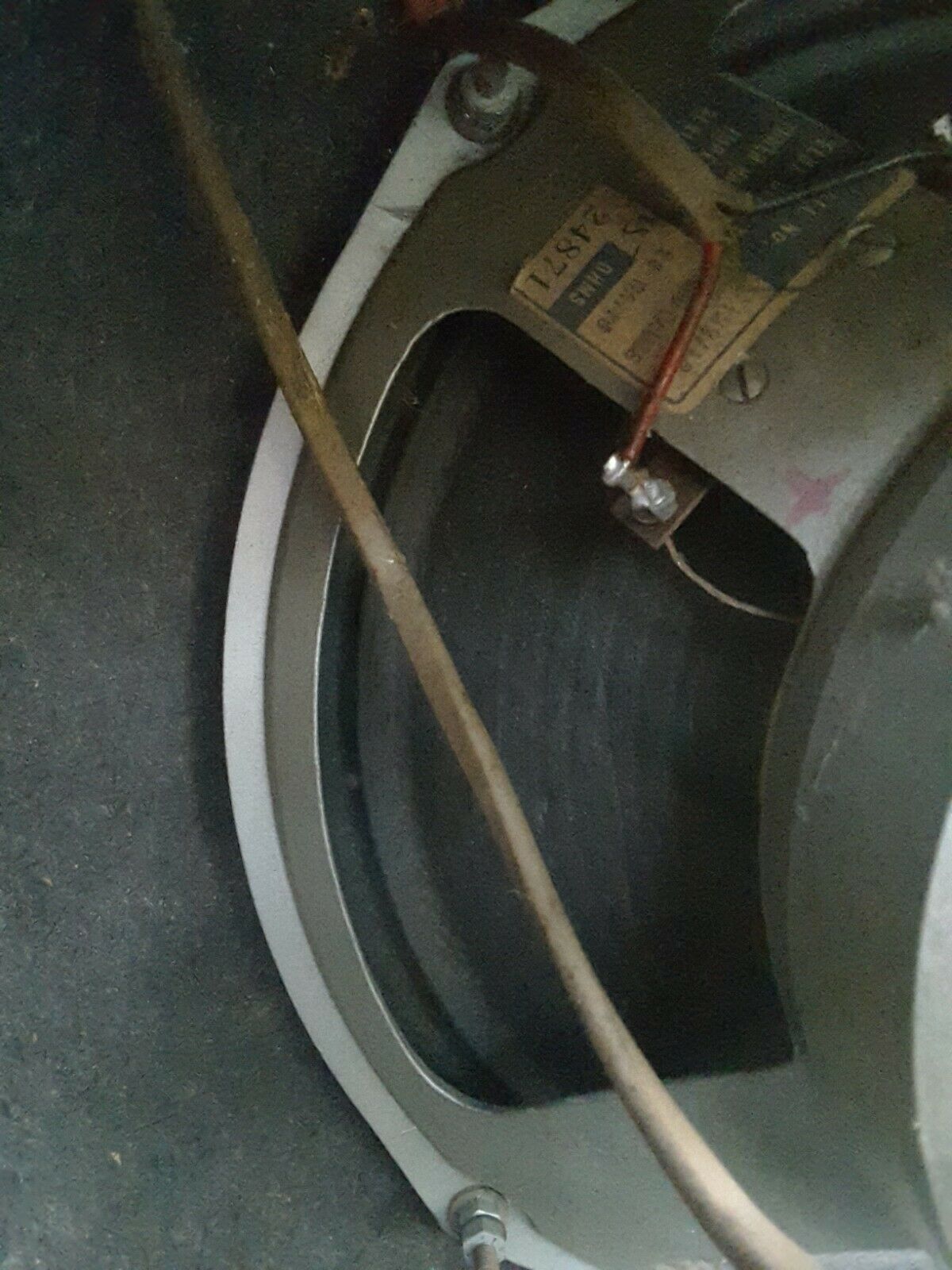
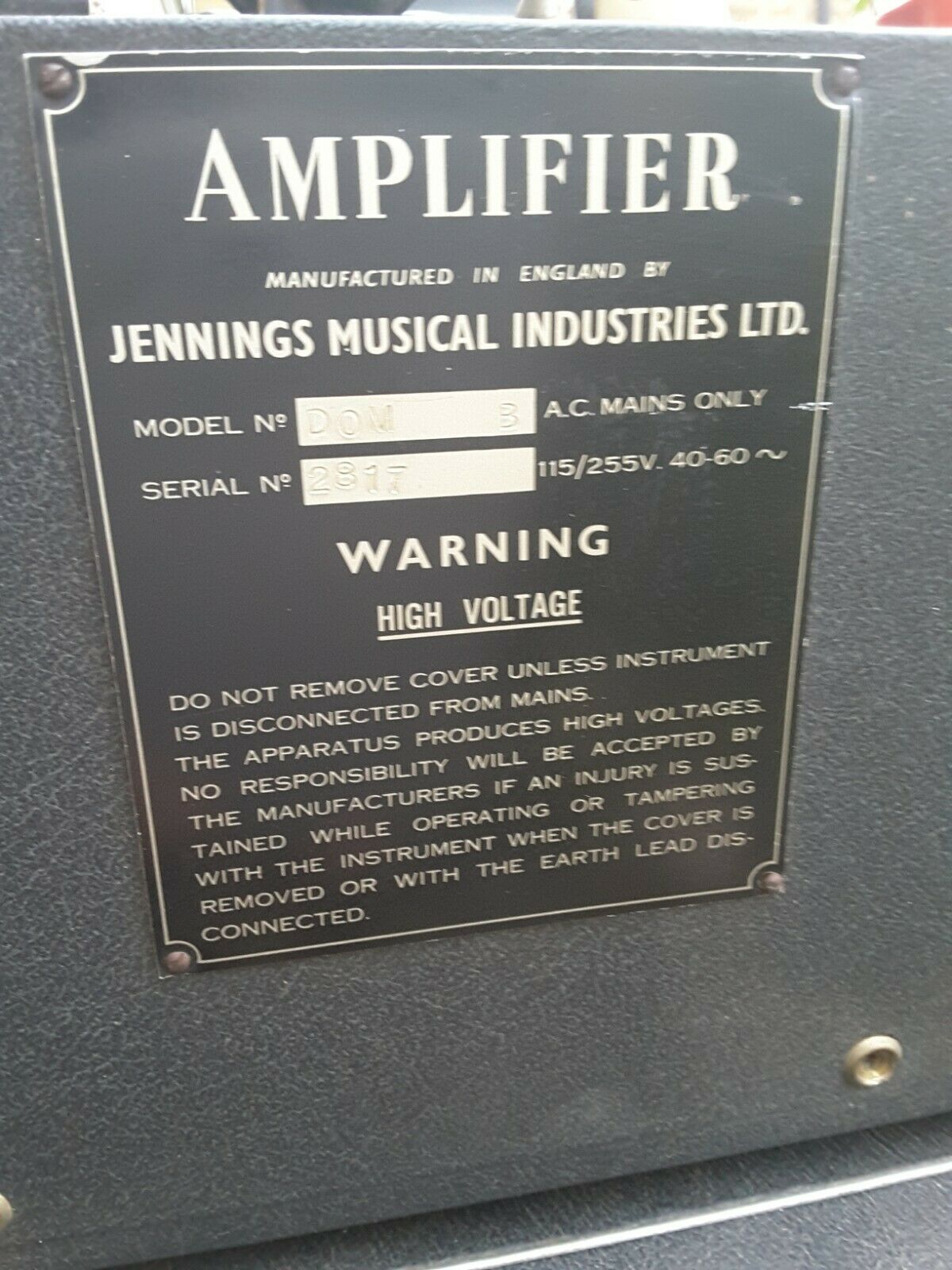
Amplifier and speaker cabinets have white Radiospares "Vynair" cloth. Old-style amplifier chassis.

An amp similar to the ones above, McCullough Piggott Music in Dublin, late summer 1967.
Serial number 3353
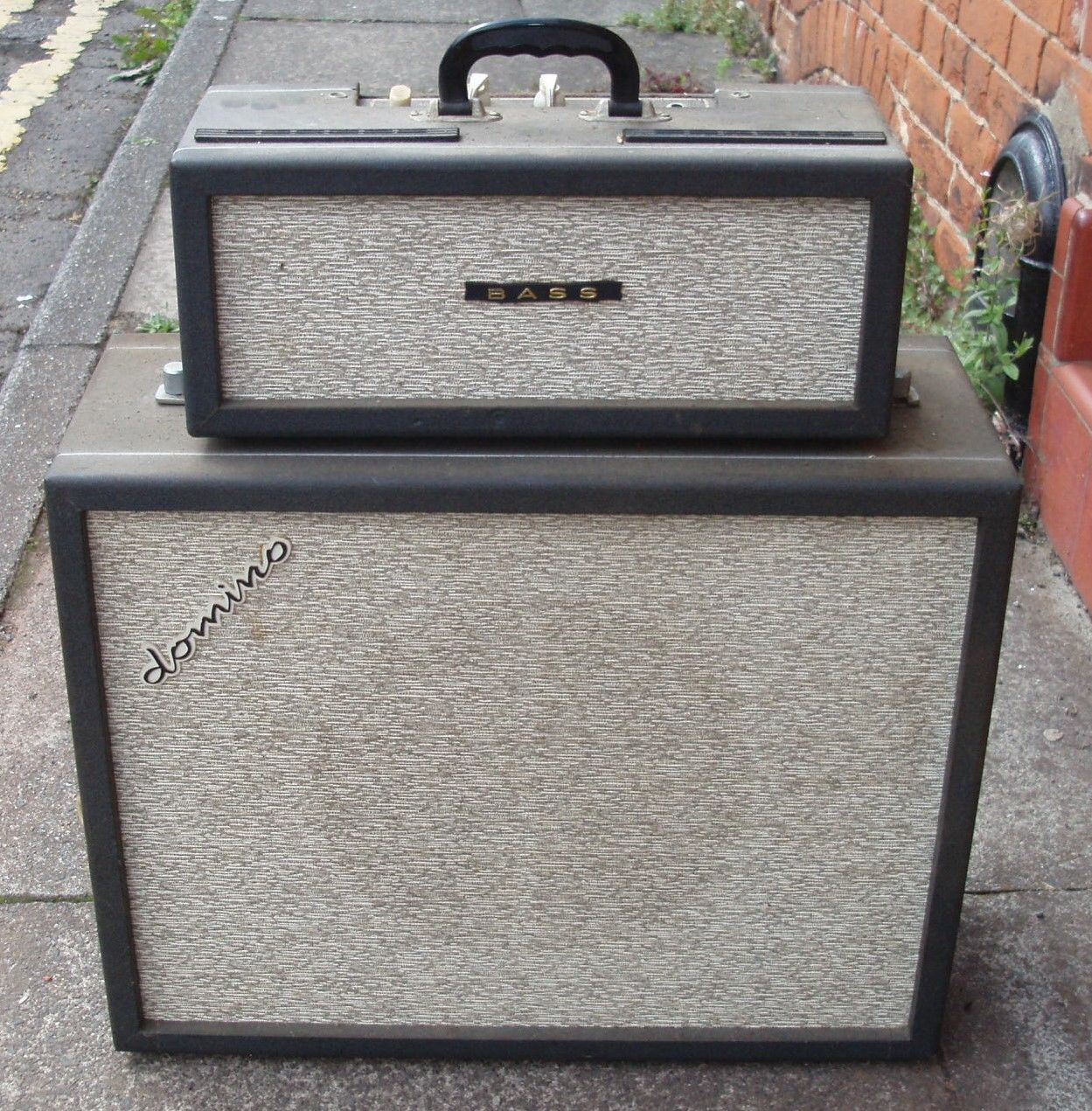
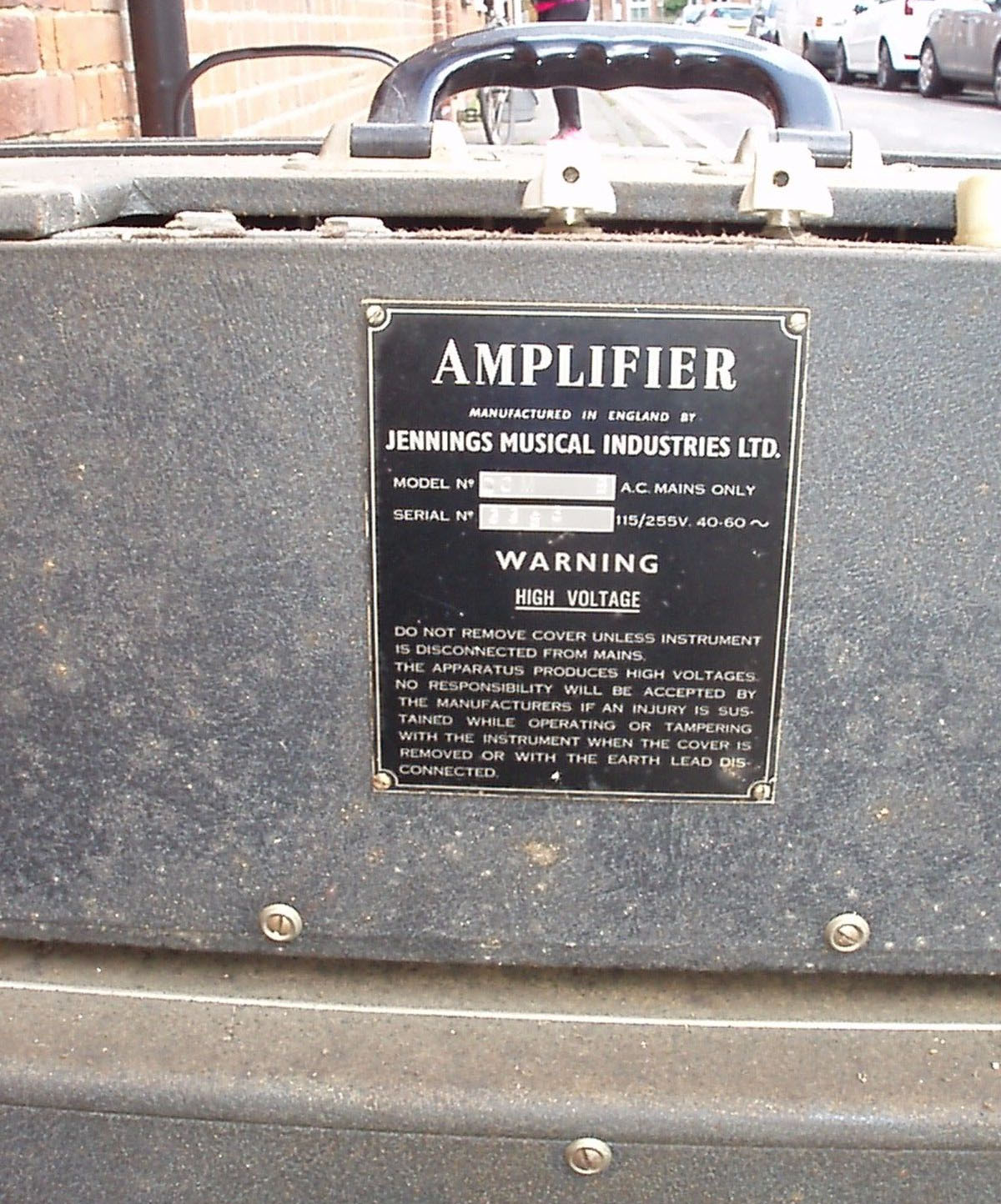
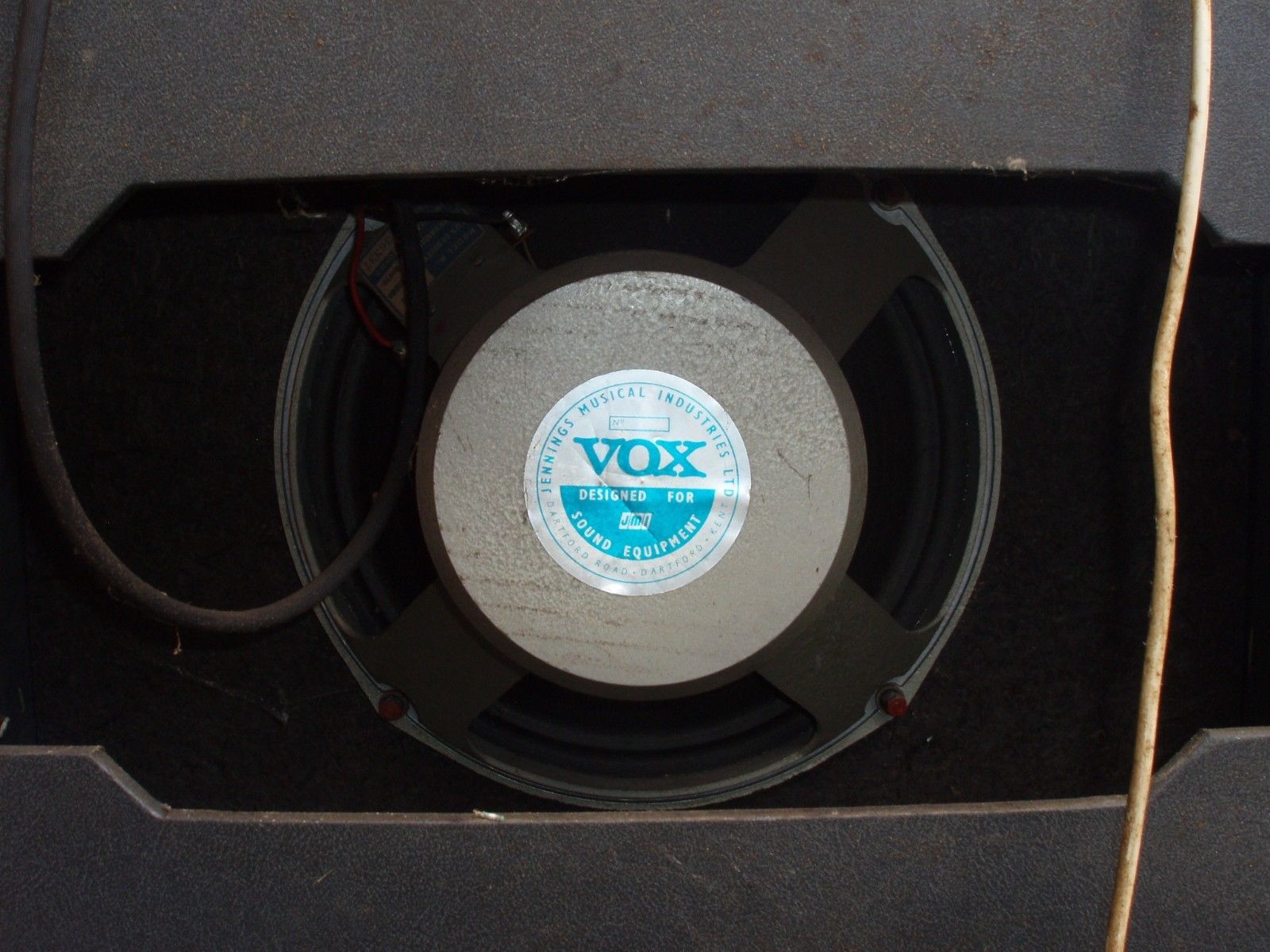
Unusual to see a Domino Bass speaker with - or at least still with - its Vox label. The speaker cabinet was evidently mounted on screw-in legs at some point.
New green livery briefly from this point.
As mentioned further up this page, the new green and silver livery was unveiled at the Russell Hotel Trade Fair in late August 1964. New-style chassis were substantially wider than the older type (same format as the AC4).
NEW
Serial number 3408
Serial number 3411
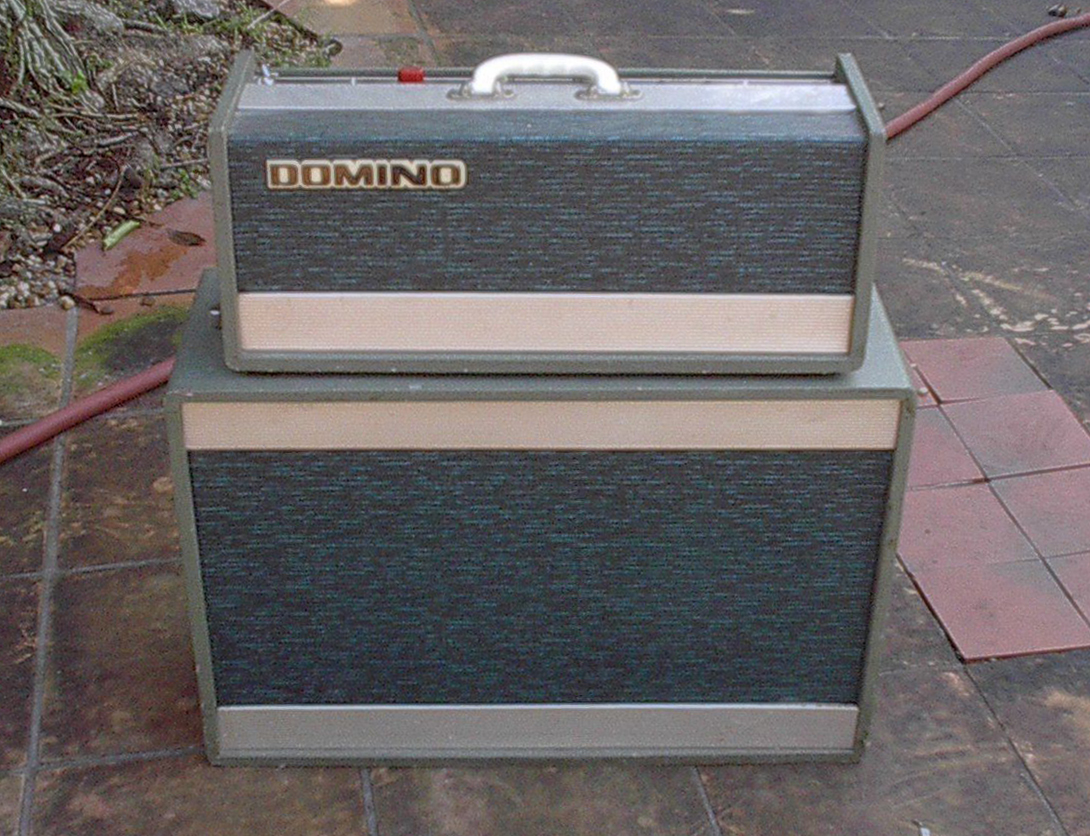
The cabinet, which is likely to have been produced for a Domino Reverb, has two 10" Celestion drivers. The seller was apt to make "sets" from disparate elements. Fans of Denis Peyton of the Dave Clark Five beware.
Serial number unknown
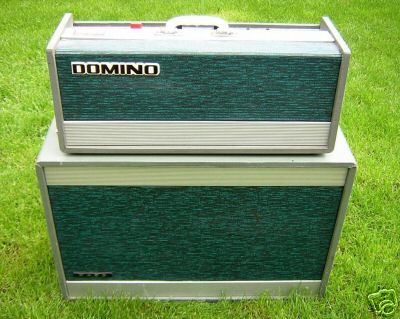
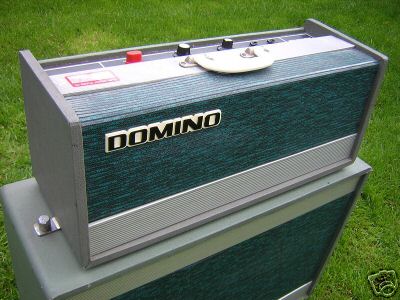
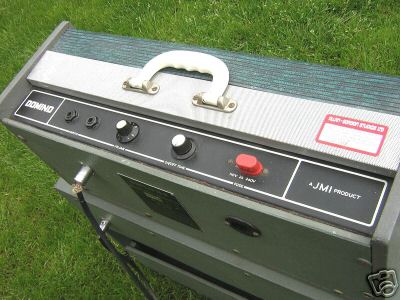
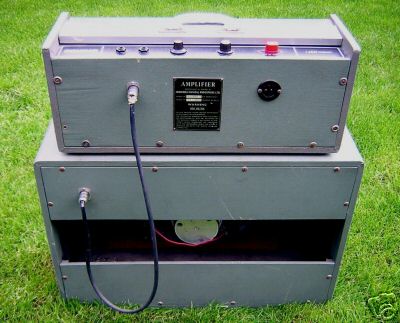
Pictures from years ago. Also owned at one point by the seller of serial number 3411 above.
1965
Serial number 3486 or 3488
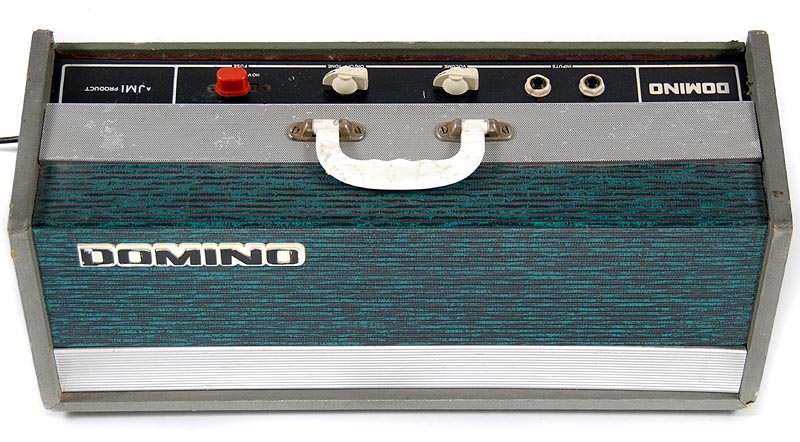
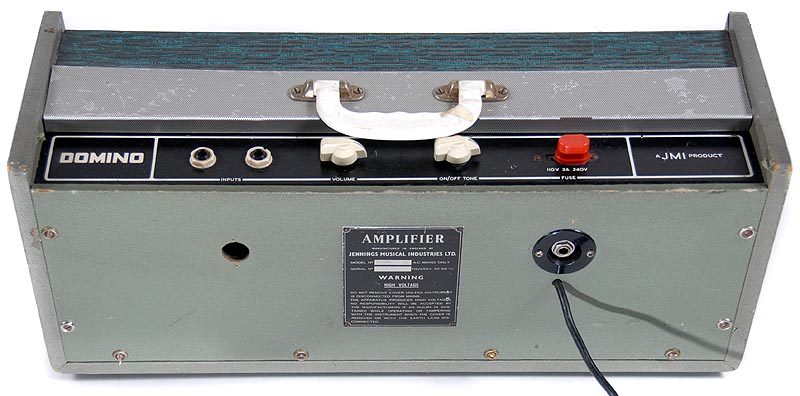
Amplifier section only. New green and silver livery, larger case. The mains transformer is an RT.290 produced for JMI by JD Electronics. In the preamp, a Mullard mustard capacitor with the date code "A5N" = first quarter of 1965 for its manufactured.
Machine-stamped serial number plates appear from this point
Serial number 3863
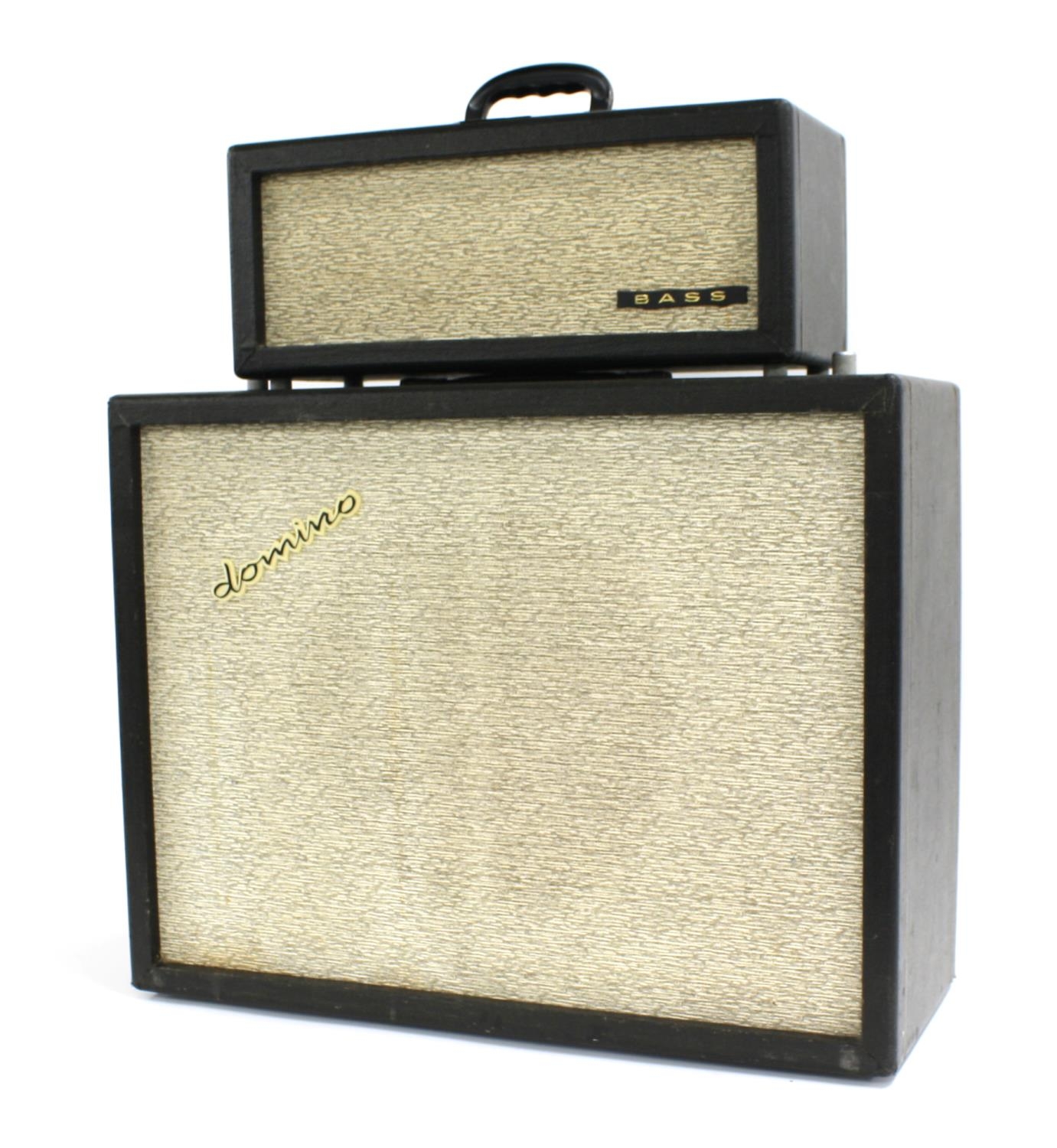
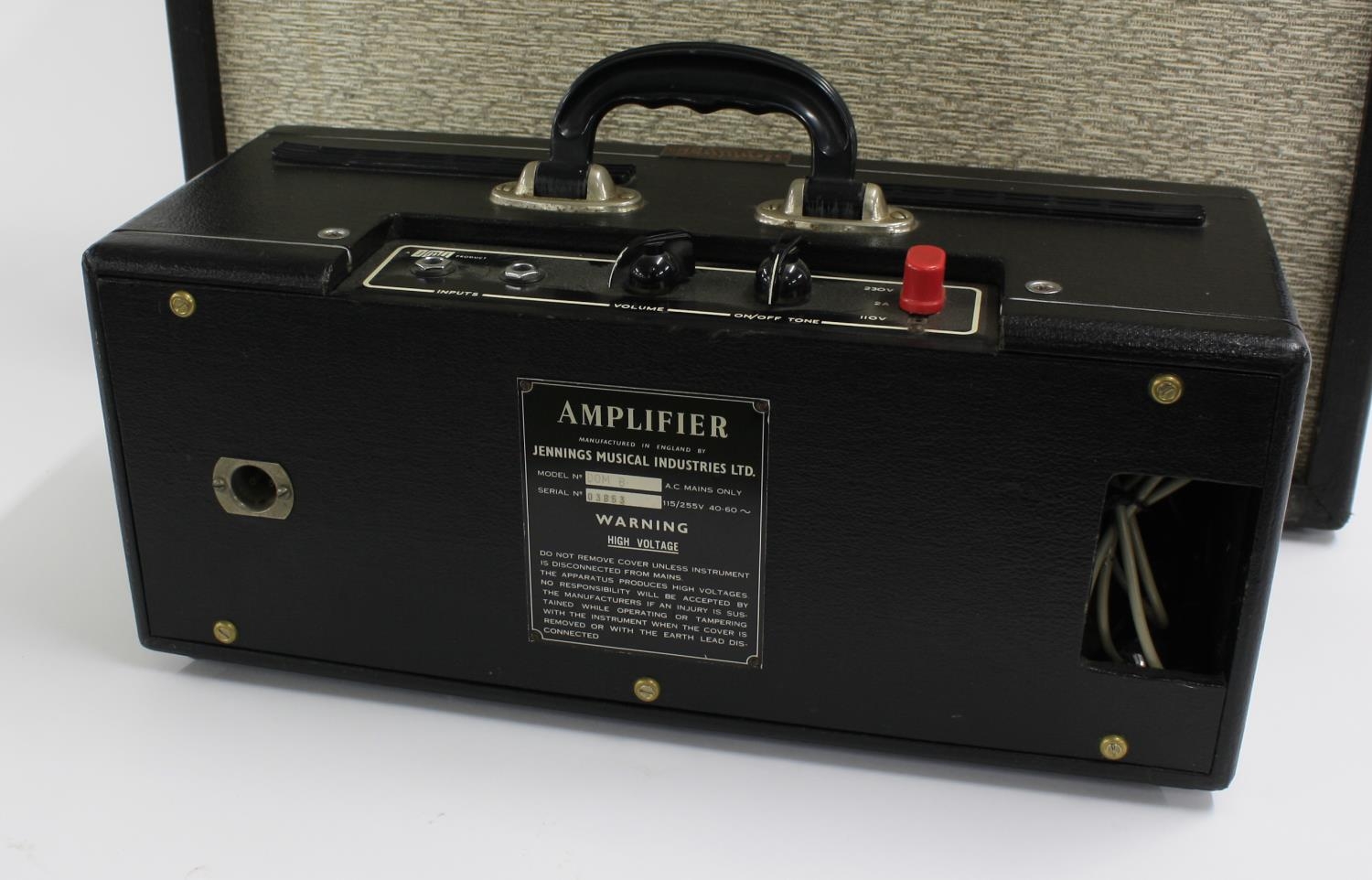
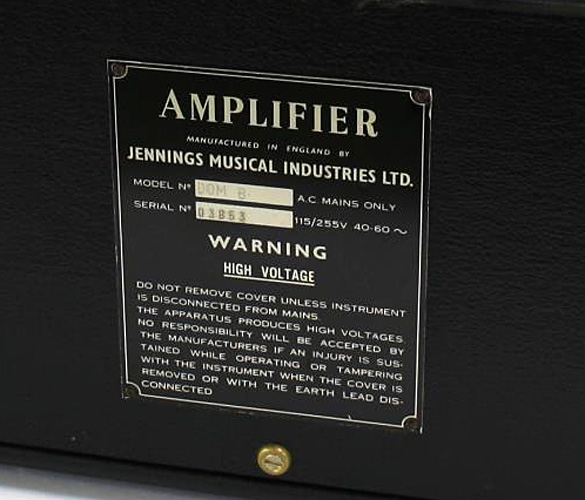
Return to old-style cabinets, and old-style amplifier chassis, as serial number 3924 below. Amplifier and speaker cabinet have rough-woven beige "Vynair" cloth. Exterior shots only, none unfortunately of the electronics. The serial number plate is machine stamped, though those of 3920 and 3924 are hand-stamped, as in 1964.
Serial number 3920 (?)
New-style amplifier chassis. The plate is stamped for a Reverb model. Amplifier and speaker cabinet have rough-woven beige "Vynair" cloth. The mains transformer is made by Allen (printed with the company's name and electron orbit logo). The Mullard mustard capacitors have the date code "A5N" = first quarter of 1965. The output transformer is stamped "5200 15".
NEW
Serial number 3924
Old-style amplifier chassis, the cabinets of both sections fitted (at factory) with white/beige Radiospares "Vynair" cloth. In the preamp, Mullard mustard capacitors with the date code "A5N" = first quarter of 1965. The main Hunts filter capacitor in the power section has "YAS" = 9th week of '65 for its manufacture. The speaker is a Fane 122/10, 20 watts power handling, 15 ohms. The original yellow and white-print Mullards have the paint code "MC" = March 1965.
Old-style cloth, new-style wide chassis and control panels
So far, no serial numbers in the 4000s for any type of Domino Bass.
NEW
Serial number 5066
Machine stamped serial number plate. Amplifier section only. Rough oatmeal-coloured cloth. In the preamp, Mullard mustard capacitors with "A5N" date codes = first quarter of 1965 for their manufacture.
NEW
Serial number unknown
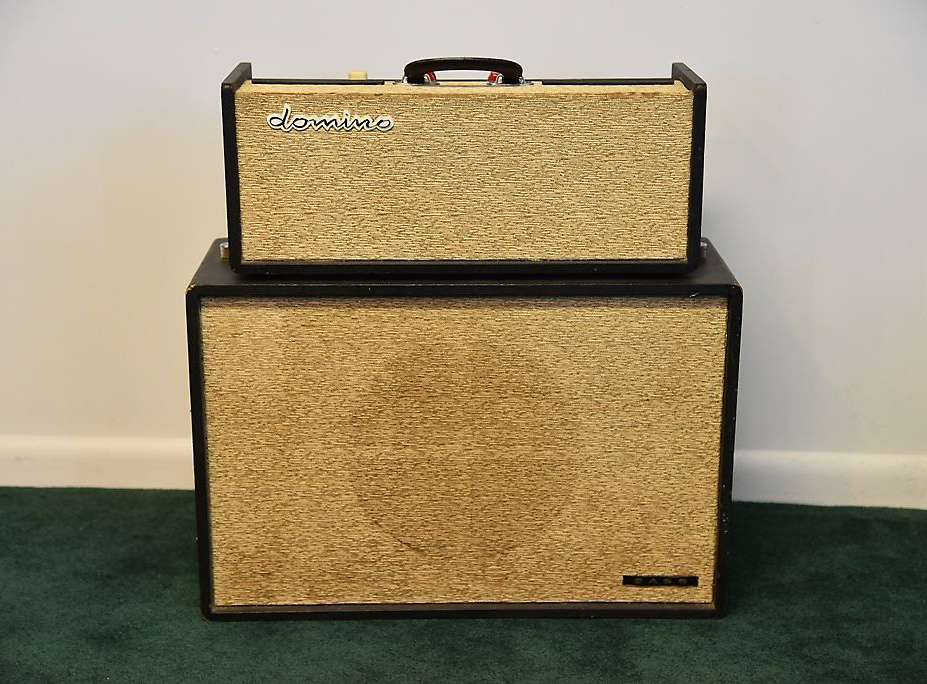
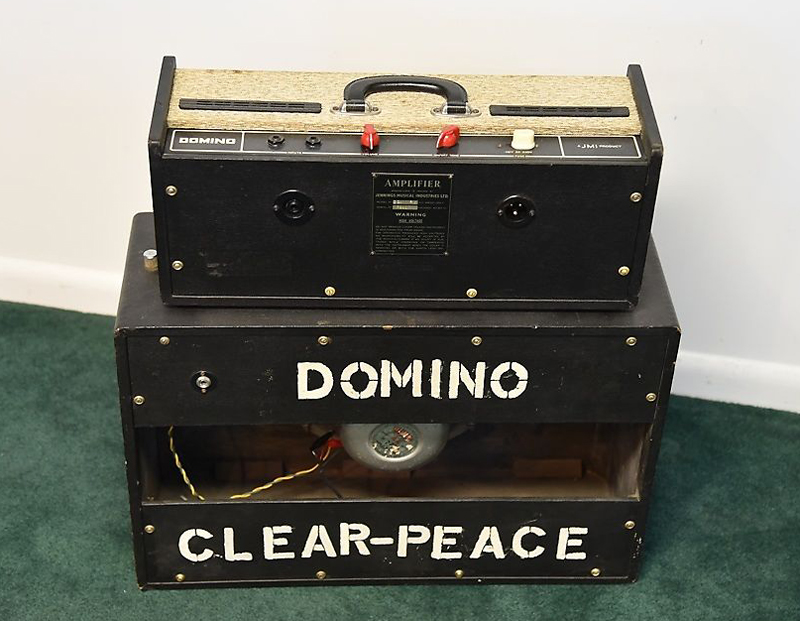
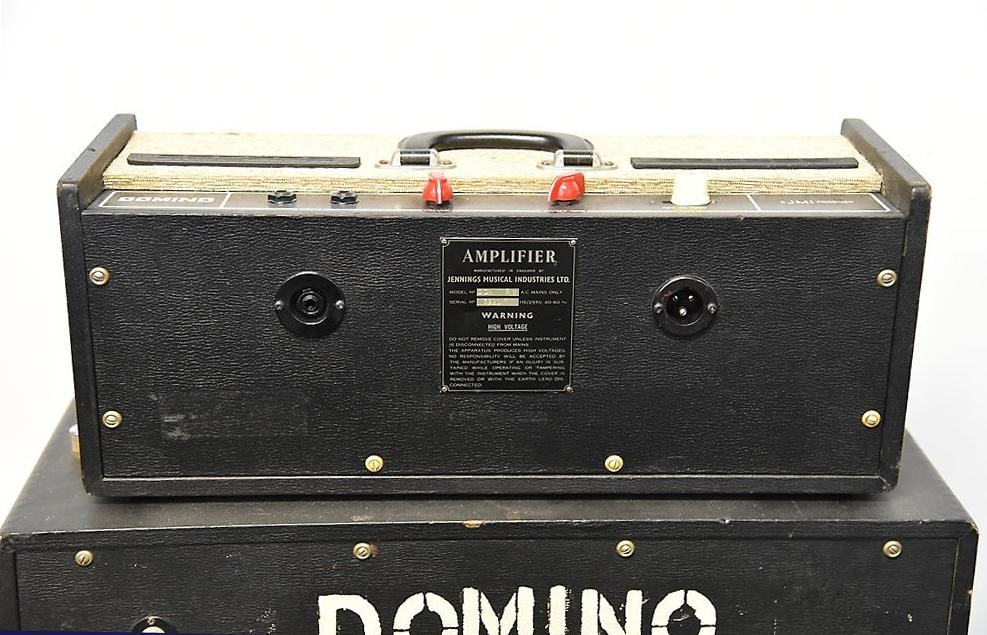
New-style format all round, but rough-woven yellow "Vynair" cloth, full height on both cabinets. The speaker is a Celestion P44. One also finds Celestions - a pair of 10" units with July 1965 date codes - in a late Domino Reverb speaker cabinet.
Serial number 5076
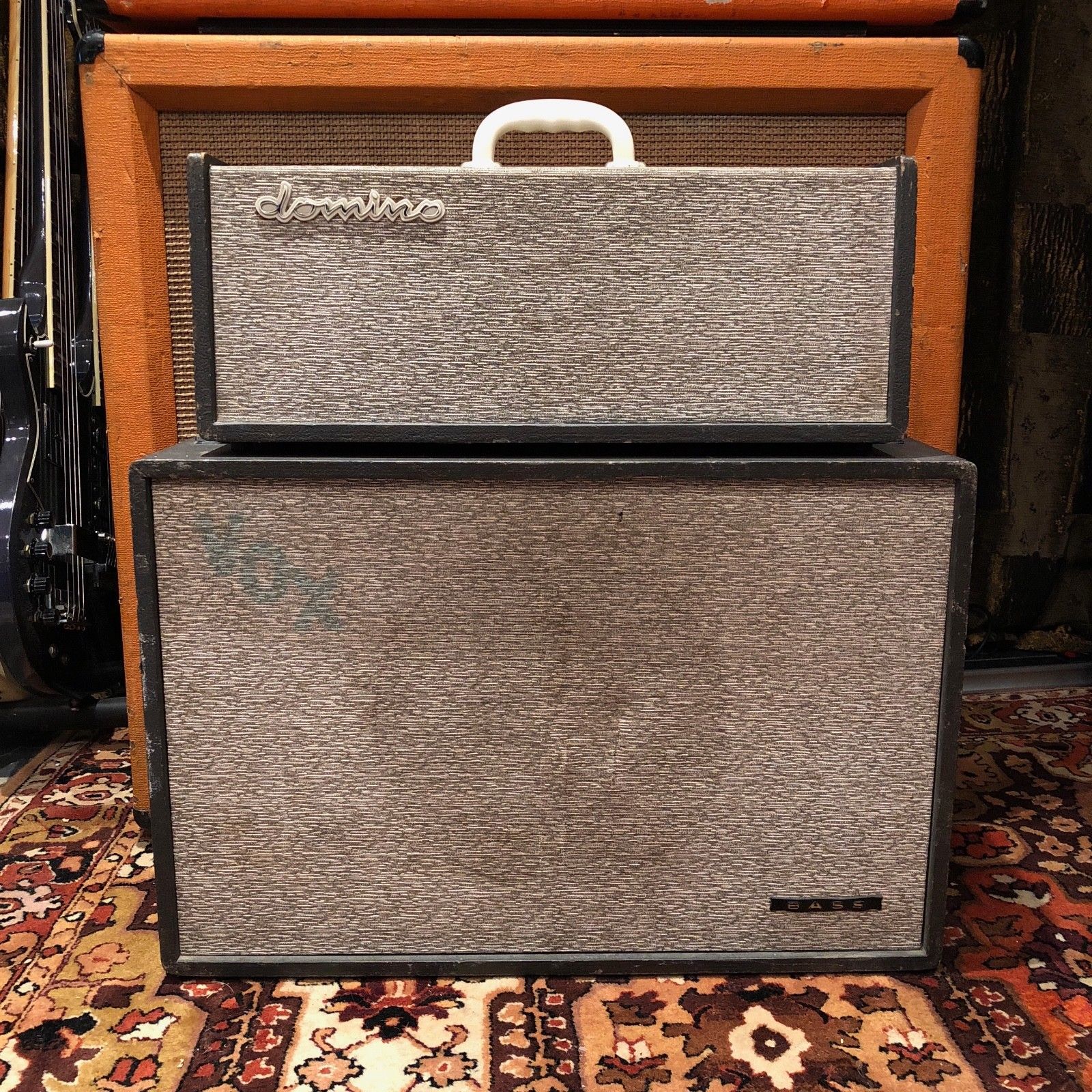
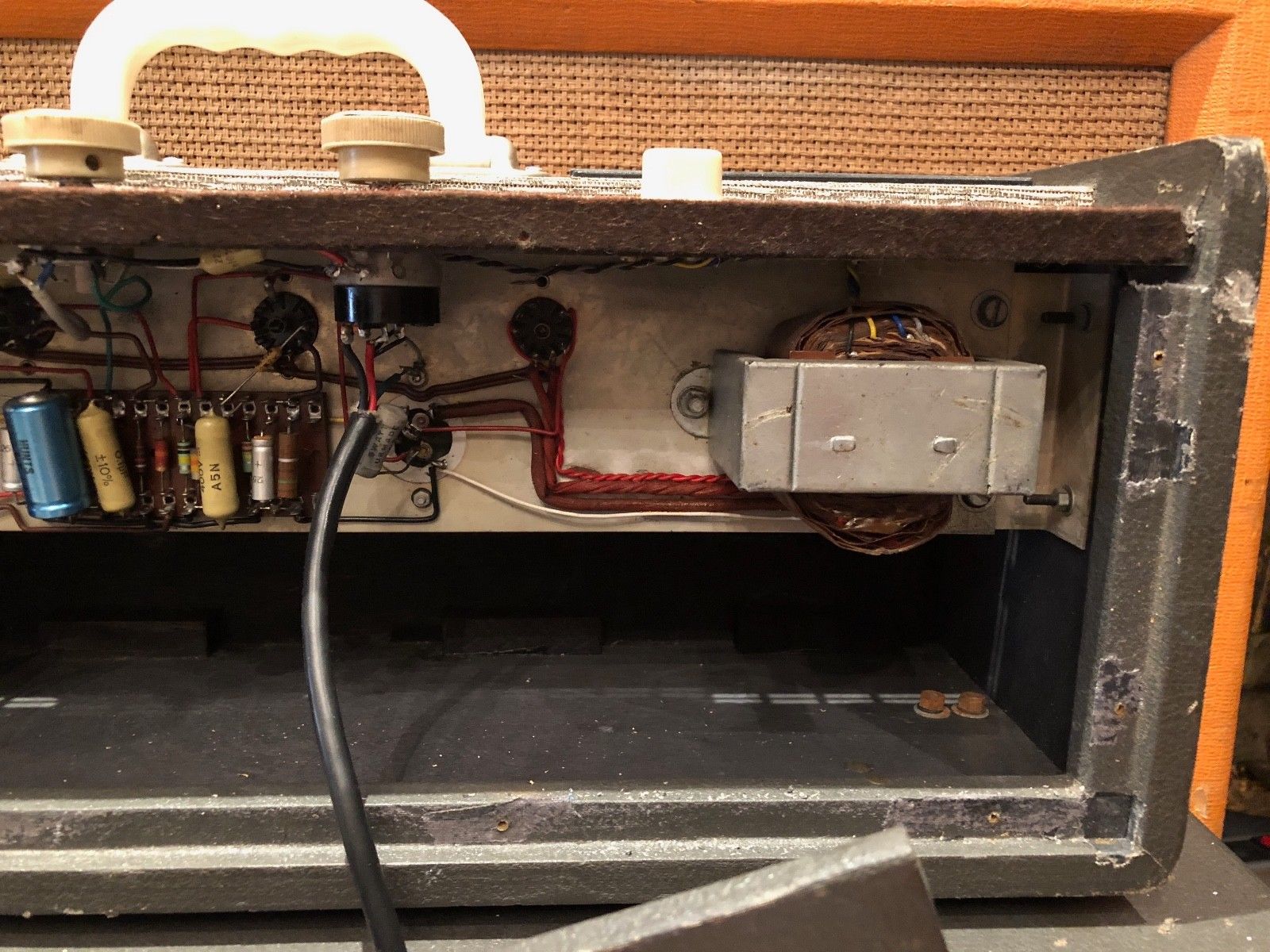
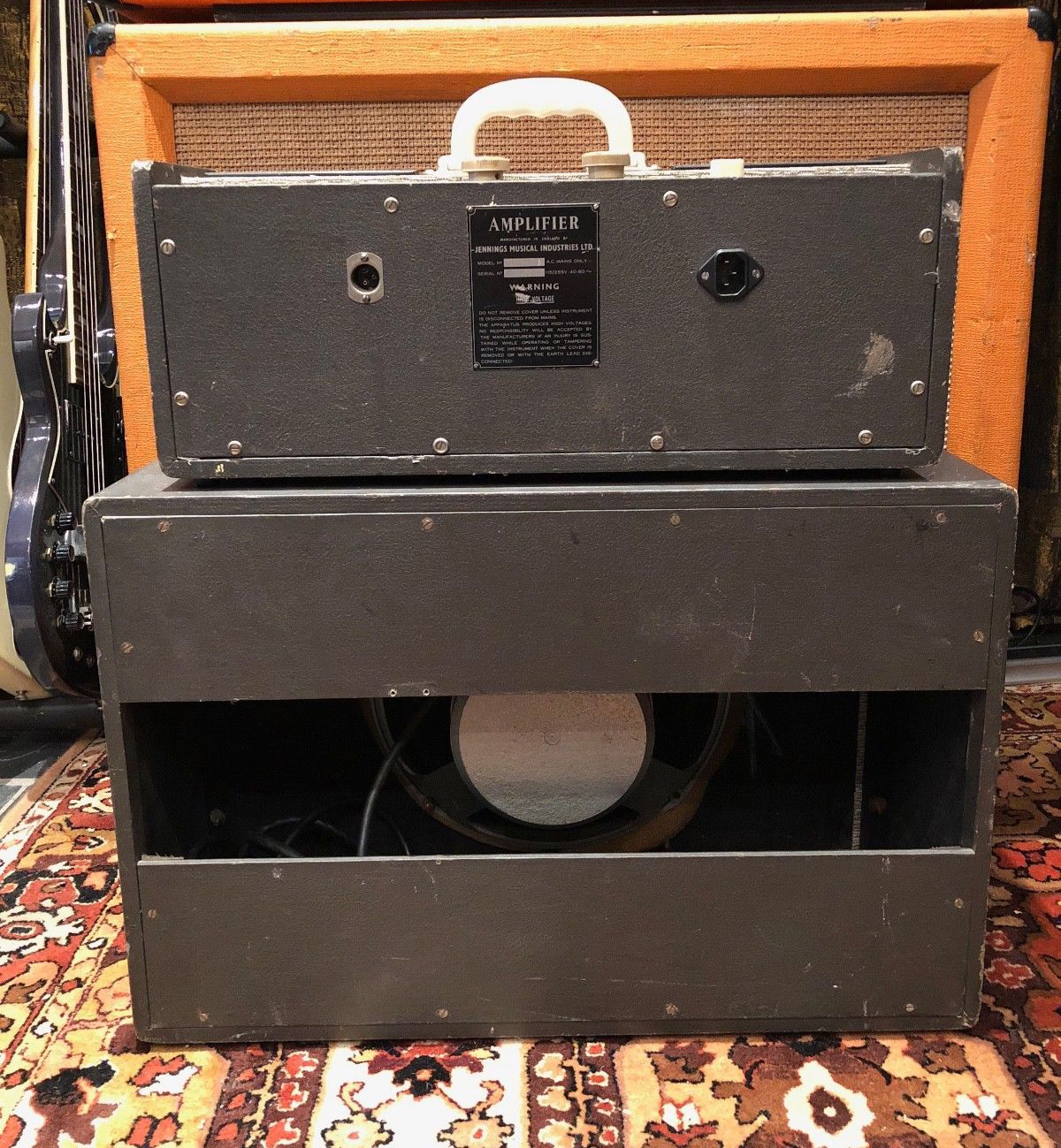
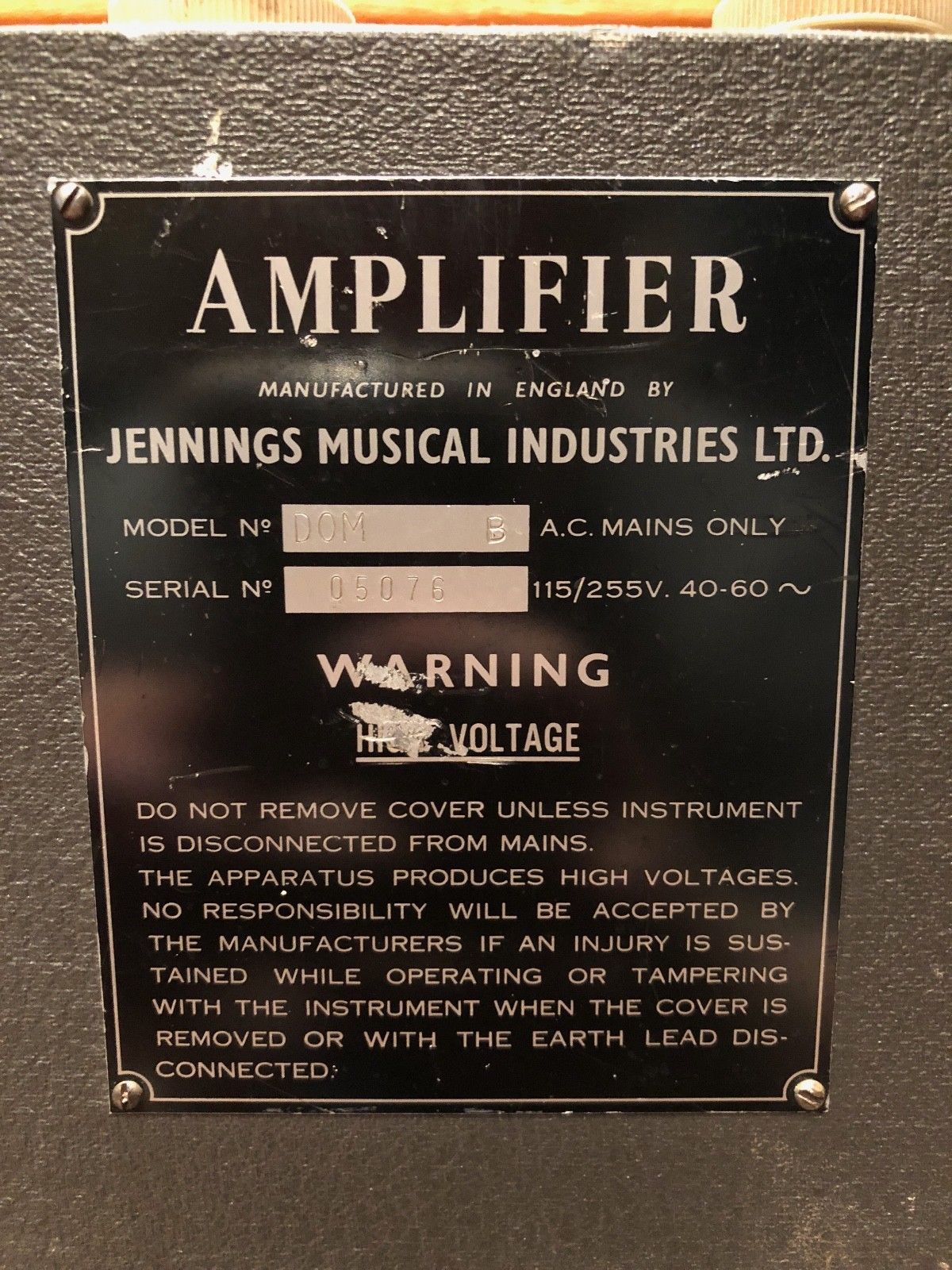
Machine stamped serial number plate. Rough oatmeal-coloured cloth for amplifier section and speaker cabinet. The former has a solid white handle, possibly a replacement. The main Hunts filter capacitor in the power section has "YAS" = 9th week of '65 for its manufacture. In the preamp, a Mullard mustard with "A5N" = first quarter of '65. The speaker is a Fane 122/12.
Serial number unknown
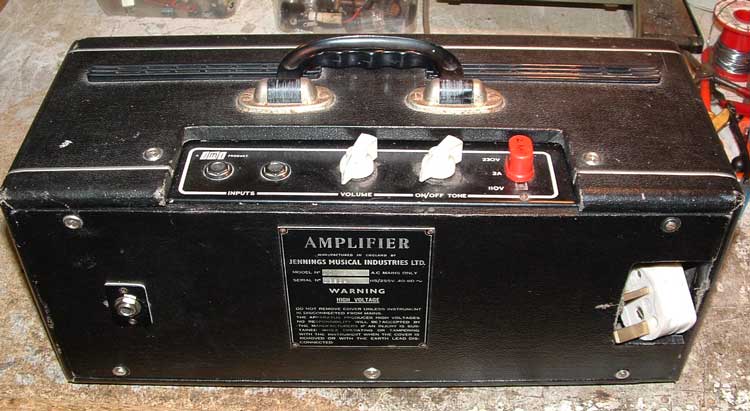
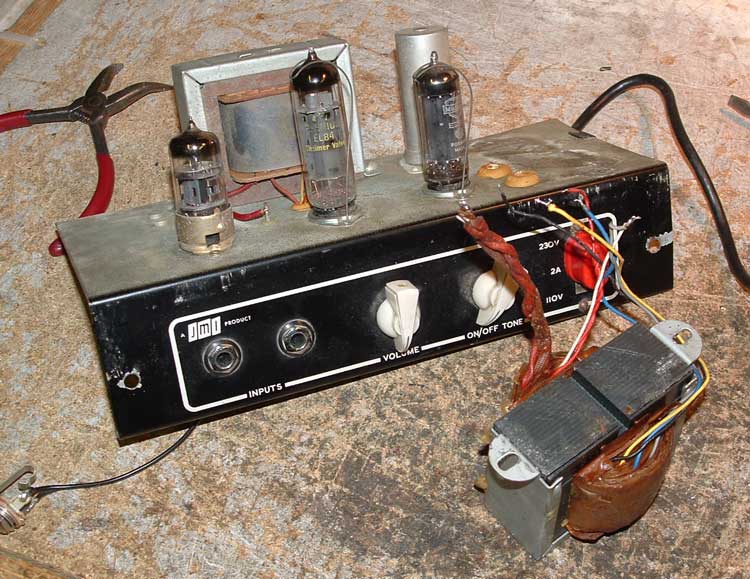
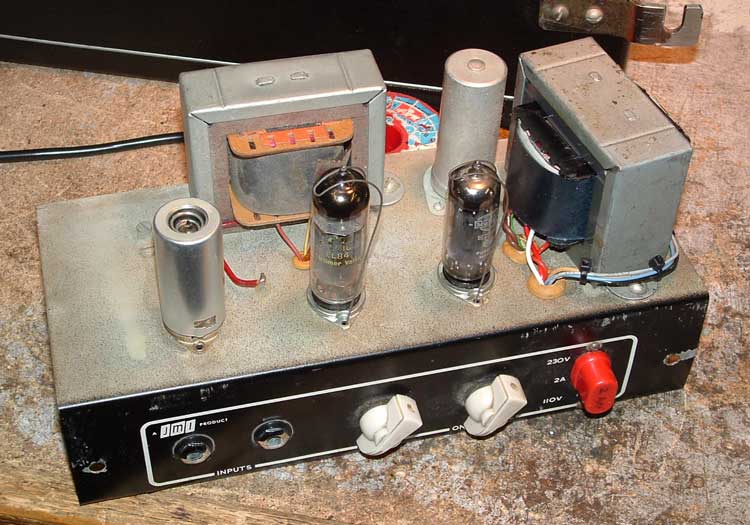
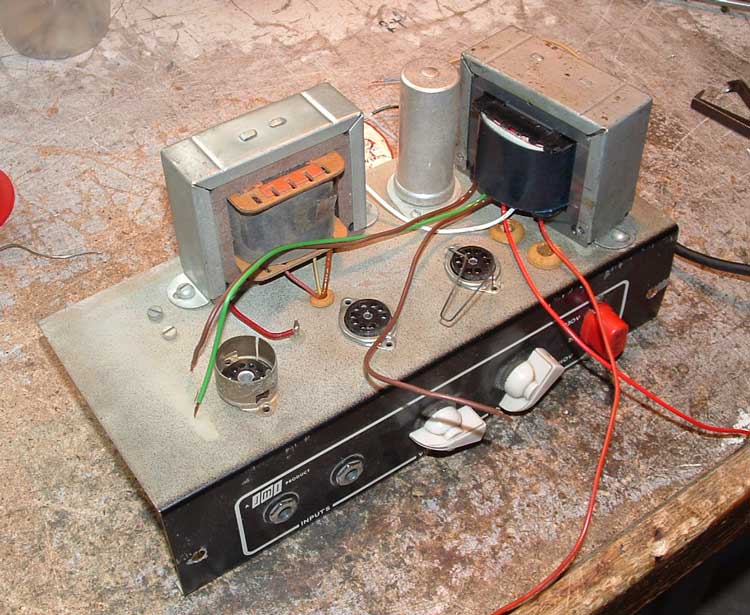
As serial number 5076, the serial number machine stamped. Pictures taken by John Chambers during the reinstallation of the rewound mains transformer.