
The Vox Domino Super Reverb Twin (SRT) amplifier
Late 1963 to late 1964

Detail from the JMI "Precision in Sound" fold-out catalogue of later 1963.
The Super Reverb Twin - or rather "piggy-back" - was the flagship of the new Domino range brought to market by Jennings in late 1963 along with the Domino Normal and Reverb combos, and the "piggy-back" Bass. Price: £47 and 5 shillings, which would also just about get you a Vox AC10 single speaker amp. The Domino Super Reverb therefore represented pretty good value for money. Its main rivals though in the increasingly congested world of "budget" amplifier production will have been the units offered by the likes of Fenton-Weill, Dallas, Watkins, and so on - often cheaply and poorly constructed.

Prices, Spring 1964, from a pricelist printed for "Musicland", the Jennings shop in Bexleyheath.
In many respects the design of the Super Reverb owed more to Fender than existing Vox models - front-facing controls, a long chassis with transformers and valves on top (or rather hanging below when the chassis was mounted in its cabinet), and so on - more on these aspects below. That its circuit had been borrowed from Ampeg is one of those high ironies.

Rear of a Domino Super Reverb
Chassis
Chassis for the most part were assembled under contract for JMI by Westrex in North London. A page on the company can be found here. Westrex also assembled chassis for AC30s (mostly destined for Super Twins), and numbers of other models, notably early AC100s.
Below, a small image, a placeholder for the moment, to show the Fender-style arrangement of the transformer and valve "side":

It is perhaps worth saying that the chassis of the other Domino models were assembled by Triumph Electronics (in Purley). All had versions of the chassis originally designed for the AC4. Their control panels were blue initially then black. The Super Reverb so far as can be judged was the only one to have a copper control panel (from beginning to end of production).
The circuit adopted for the Super Reverb is set out in OS/026, Issue 3, drawn by Albert Hogben on the 27th January, 1964. It is not known at present what Issue 2 was like. The sheet to use is the one printed by Jim Elyea as Number 8 in his portfolio of "schematics". Although the AC10 SRT is referenced, the circuit corresponds to that of the Domino Super Reverb. An original copy of OS/026 naming the Domino SRT in its information panel is known but remains inaccessible for the time being. More to come in due course. An overview of the various versions of OS/026 is given here. On no account use Jim's sheet Number 9: this is factitious and deeply problematic (for reasons to be taken up elesewhere).

Detail of OS/026 reprinted by Jim Elyea as sheet 8 in his portfolio.
In broad outline, the amplifier has a single channel, two inputs, and five front-facing controls: Volume, Tone, Vibrato Speed and Depth, and Reverb. Power output was around 10-12 watts:

The valves employed were: an EZ81 rectifier, two EL84s (run in cathode bias); and in the preamp, one ECC83 and three ECC82s. As the latter were of relatively low gain (in comparison with ECC83s), the drive from the preamp was slightly lower than normal for a Vox amp.
As Glen Lambert has kindly pointed out, the HT voltages marked on all known copies of OS/026 are inaccurate. Real-world figures will be supplied as soon as they are to hand. Just to note for the time being that the supply to both the screens and the OT (for the anodes) comes via a 1K resistor, a means of attenuating the overly high voltage resulting from the mains transformer and EZ81 rectifier.
Below, a detail from Domino Super Reverb serial number 2509 to show the 1K wirewound resistor and the intricacy of the Westrex wiring scheme:

Inside the chassis. The green wirewound 1K dropping resistor can be seen above the can capacitor. The single spring reverb tank occupies most of the width of the enclosure.
Also to say that the circuit is not without quirks (introduced by JMI). The two inputs are of equal gain (no High or Low) as in certain early Vox single channel amps, and the tips are ungrounded when the sockets are not in use. Thanks to Tanner for these points. His SRT - number 2509 - can be seen in more detail on this page.
Speaker cabinet
As in the case of the Domino Bass, mounting hardware was provided to fix the amplifier section to the top of the speaker cabinet. The design was a more or less straight copy of the solution originally devised by Fender in the late 1960s. JMI had been Fender's main distributor in the UK from early 1961 to mid 1962.


Speakers were generally a pair of 10" Elacs, 15 ohm impedance and 10 watts handling apiece, wired in parallel - as in the AC10 Twin - for a total impedance of 8 ohms. The amp below has a pair of silver/grey frame Elac 10N/85s. It may be that the earliest Domino Super Reverbs had Elac 10N/81s, much the same characteristics as the 10N/85 but sprayed Jennings blue.

The speaker sockets and cable connectors were Italian-made Gelosos, which JMI also used on the Domino "piggy-back" Bass and on certain early Vox AC30 Super Twin cabinets.
Cloth
Prior to late 1964, three types of "Vynair" cloth were used: dark grey flecked with black; white flecked with grey; and cream flecked with grey. White flecked with grey was used fairly consistently on the Domino Bass and is probably the best known of the various types of "Vynair" these days, having been used by Marshall early on.
Late 1964
In late 1964 the Super Reverb was merged with the Domino Reverb combo to form a new type of "piggy-back" amplifier, issued in the new green and silver livery:

Detail from the "Precision in Sound" newspaper-format catalogue printed in September 1964.

Detail of a new-style Domino Bass amplifier section to show the general scheme.
Four controls were provided: Reverb, Volume, Vibrato Speed, and combined Tone and On/Off. Although no example has come to light so far of this new-style Domino Reverb, its control panel will probably have looked like the example below (on a relatively early Domino Reverb combo).
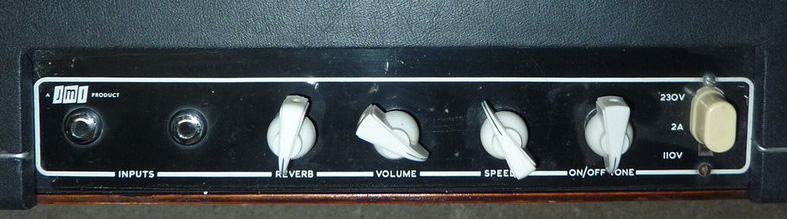
Domino Reverb combo, serial number unknown.
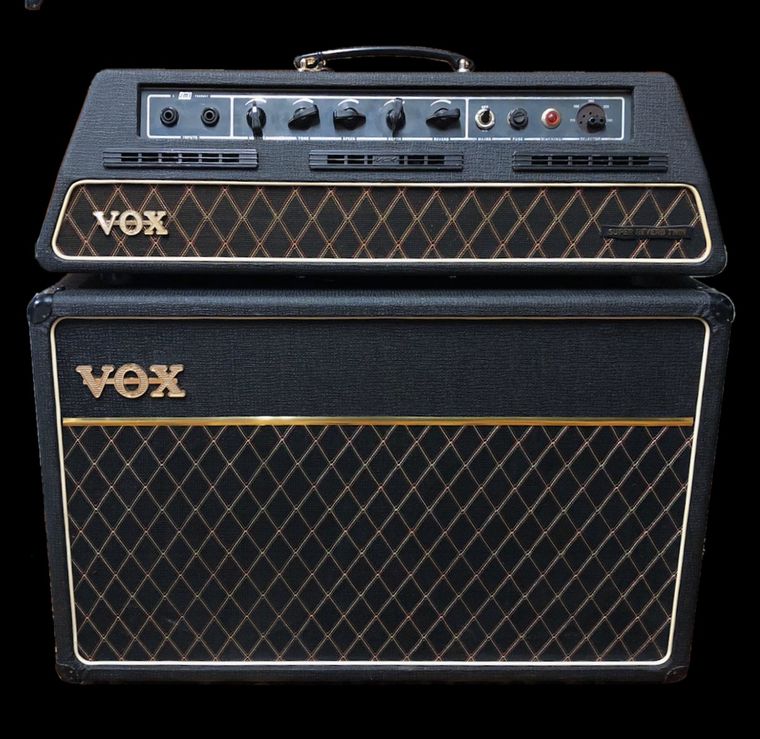
The reason for the creation - or at least promotion - of this new model seems fairly simple: to make way for the new AC10 Super Reverb Twin - with trapezoid amplifier section and five front-facing controls on a grey panel. In other words, the amp of "The Doug and Pat Show" fame. The circuit of these AC10 Super Reverb Twins conforms by and large to the last version (Issue 4) of OS/026.
The price of the new AC10 SRT on release in late 1964? - £84, that is to say £36 and 10 shillings more than the Domino Super Reverb, effectively for the same amplifier. The question naturally arising is did the Domino Super Reverb ever make a profit? Probably not is the answer. As for the AC10 SRT, most were evidently exported to the USA as part of the deal with Thomas Organ. A page on the model will be available shortly.
Evidently a number of old-style five-control chassis were retained for a number of years, some incomplete, to be sold off at the liquidation sales of late 1967 and 1968. They were bought up and used for the so-called AC20 / Mystery Amps - see this page.

"Exchange and Mart" magazine, December 1968 - some of the loose Domino SRT chassis on offer.
Surviving examples
It seems that all Domino amplifiers shared a single serial number sequence starting at 1000. At present no Domino SRT has emerged , however, with a number under 2000, perhaps indicating that the model came to production slightly later than the others. The designation for the model stamped on the serial number plate was "SR". For the three types of plate used on Dominos, see this page.
Serial number 2058
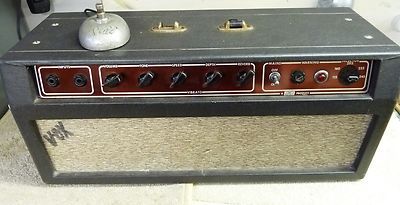
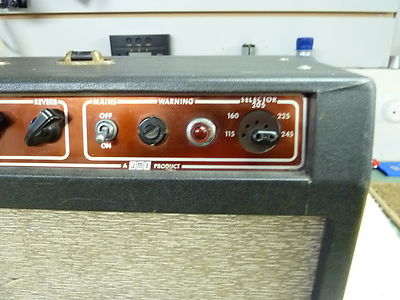
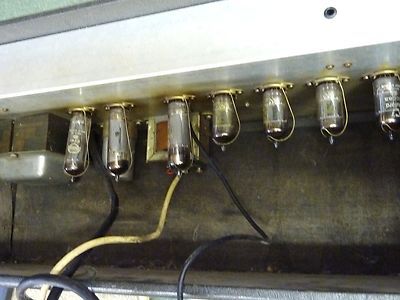

Serial number 2073
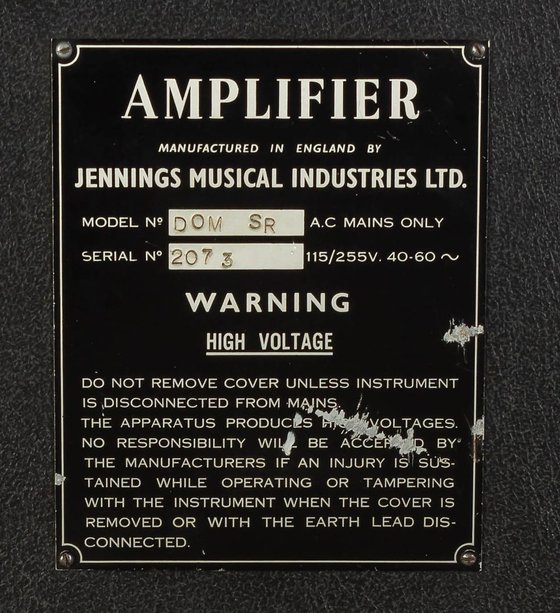
Amplifier section only (in superb condition), sold by "Main Drag Music" of Brooklyn in 2021.
Serial number 2506
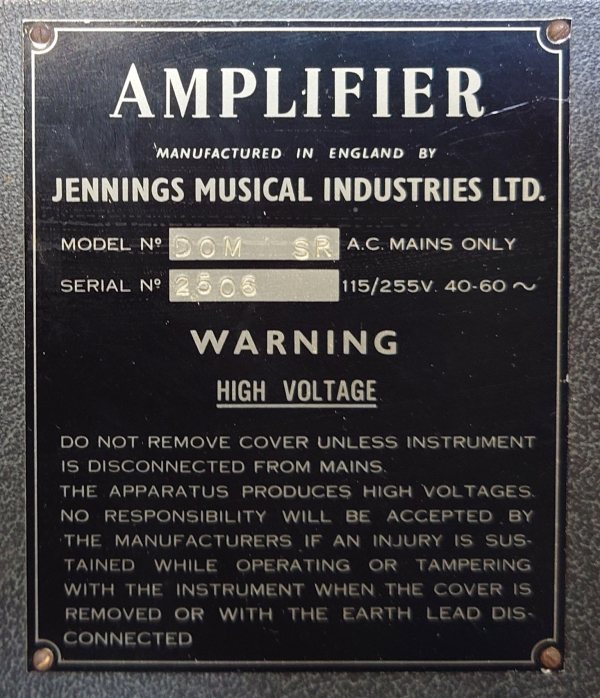
A superb set (amplifier section and speaker cabinet). As in the case of the amps below, heavy mid grey vinyl, flecked grey/white cloth. Thanks to James for info and pics. Further details can be found on this page.
Serial number 2508
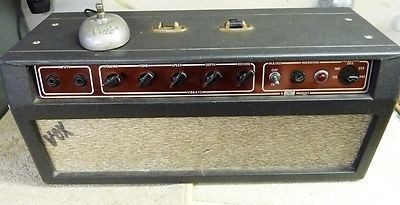

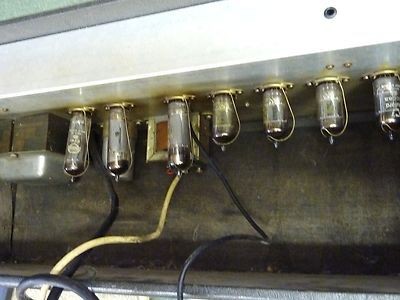

Old pics of an amplifier section sold some time ago.
Serial number 2509


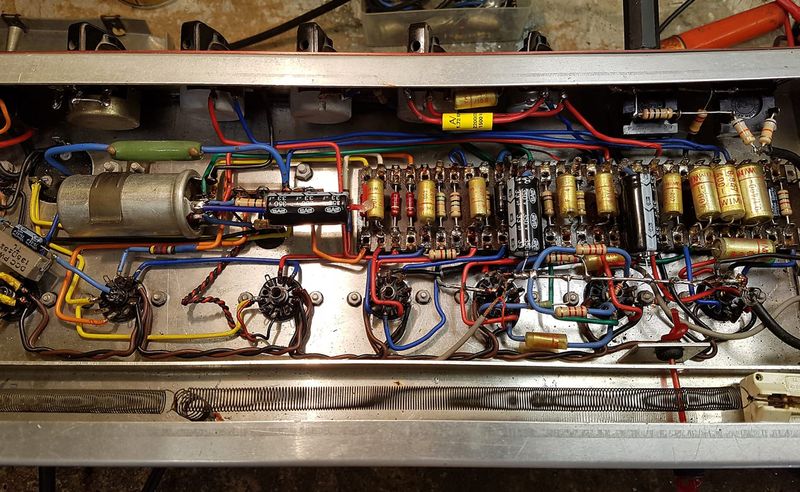


Again, amplifier section only. Superb near original condition - only a few later renewals of components.
NEW
Serial number 2531


Serial numbers unknown
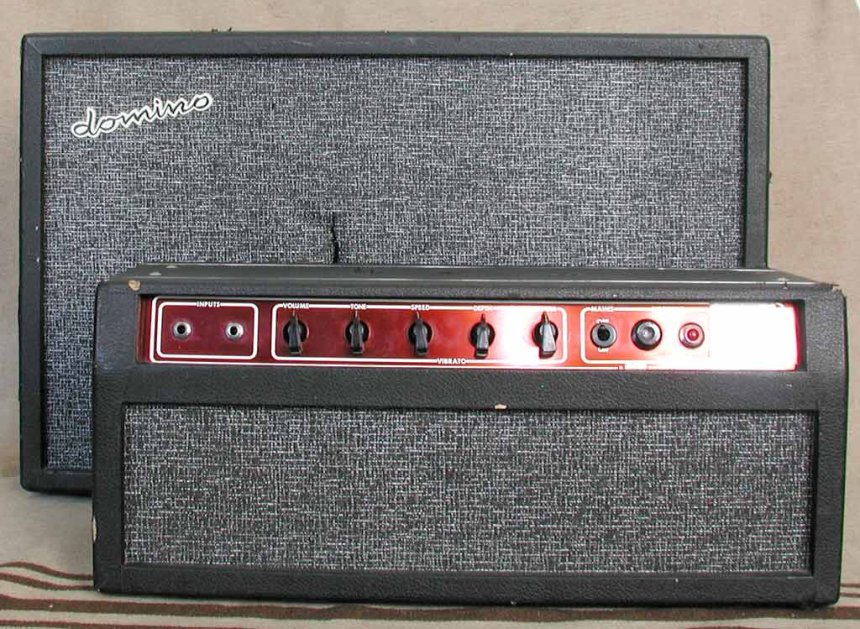

The preamp has Mullard mustard capacitors with date codes "A3W", "D3W", and "B4", respectively first and last quarters of 1963, and second quarter of 1964. The main preamp filter cap has "UL" = November 1963.
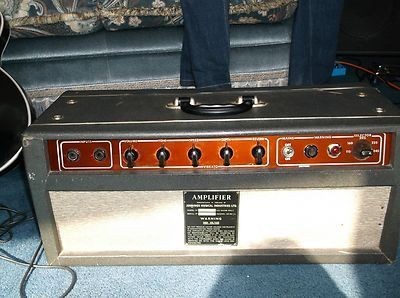
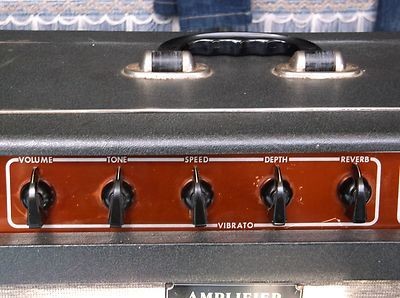
Amplifier section only, the serial number plate reattached to its front.


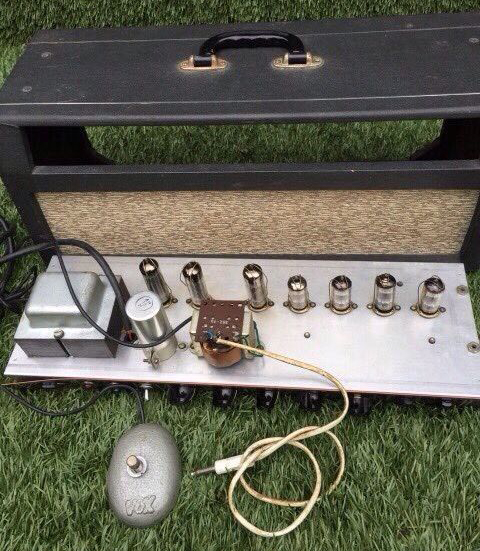
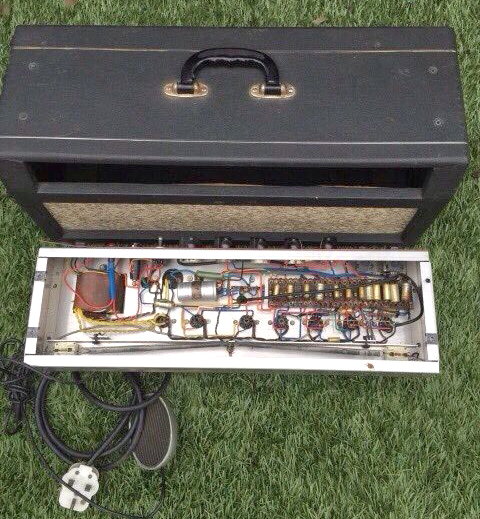


Amplifier section only. Assembled, in company with the others on this page, by Westrex under contract for JMI. Immaculate wiring. In terms of component date codes, one of the gold-coloured 25uf bypass caps has "VI" = August 1964; the main preamp filter has "VJ" = September 1964.