
Vox AC30 website updates
October 2024
30th October
Although firm information on the Jennings "Minivox" is extremely hard to come by, it seems likely that the unit was shown at the "British Industries Fair", Olympia section, in late April / early May 1953. Five models (un-named) are signalled in the advert. These will have been the J51 Entertainment Organ; the Univox J5, J6, and J7; and the Minivox.
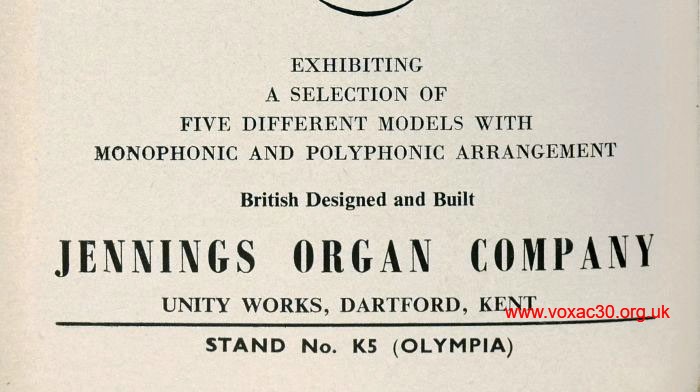
Detail from the BIF catalogue, 1953.
29th October
January 1953, the "Minivox", a short-lived off-shoot of the "Univox". On the latter in 1953, see this page.
In 1955, the idea behind the "Minivox" was taken up again in the form of the Jennings J48 portable organ.

January 1953.
28th October
A detail of the speaker compartment of the TV Front Twin mentioned yesterday. The remains of something similar can be seen in a Twin that turned up some years ago in the UK (and now in the USA much "changed").
Whether such terminal blocks are original, fitted perhaps only to certain (early) batches of cabs, is unknown at present.


Speakers not original. Picture taken before "restoration".
27th October
Pictures of what may be an original, well used, TV Front AC30/6 Twin have recently come to light. Those to follow. The speakers, with oyster/sand coloured frames, are likely to be T3757s. Some of the original pink wiring survives. In terms of the amp's date, probably last third of 1960. The earliest advert for the AC30/6 Twin to have emerged so far is from the end of July 1960, though it is certainly possible that some were available before that at the shop on Charing Cross Road.
One of the questions surrounding the chassis of TV Twins - AC30/4s and AC30/6s - is how many were re-boxed in split-front cabinets early on: where AC30/6s are concerned, principally those produced in and before February 1961, the point at which the first change listed on the circuit diagram was introduced.
Unfortunately the TV Twin - apparently with an AC30/6 chassis - that currently bears the serial number plate 4290N is a patchwork created in modern times.
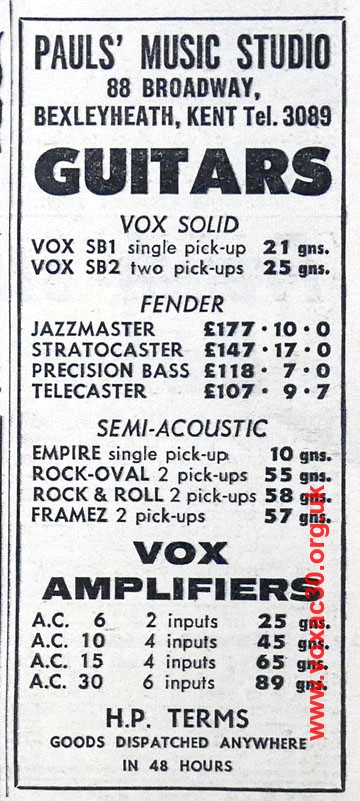
Late July 1960. Paul was Paul Jennings, Tom's son. The "Music Studio" became "Musicland" some months later.
25th October
Below, a detail of the Haddon mains transformer - dated 22nd July 1963 - in AC30 Twin serial number 9078B. The transformer is by no means the latest dated component in the amp though - two of the original Mullard yellow-print ECC83s survive with September 1963 paint codes.

Detail of AC30 Twin serial number 9078B.
Also to note, a Westrex-made AC30 has recently turned up on ebay with a choke stamped - in the same way - 16th July 1963. Transformers look to be Haddons too.
24th October
The page on Vox in Australia has been rearranged slightly to give a better view of the material from a chronological standpoint. Some items from 1966 and 1967 to come.
23rd October
The pages on the Treble circuit and AC30 Twins with serial numbers in the 10000s have now been updated. More to follow on the changes introduced in early 1964 - the Expanded Frequency AC30; AC30 Lightweight; new serial number sequence for Super Twins; and the first amps with Treble chassis - in due course.
22nd October
A fourth AC30 Twin with "Normal" on its plate but a Treble chassis, component date codes consonant with final assembly in early 1964: - serial number 10705.


AC30 Twin serial number 10705N, chassis number 03450, Hunts cap. dated 41st week 1963, cabinet modified in various ways. Note the non-standard screws for the plate.


AC30 Twin serial number 10440N, chassis number 02901, pots with November 1963 date codes, the serial number plate still with its original screws (as in the case of serial numbers 10586 and 10600 - see the entries below). Thanks to Chris for the pictures.
As for the larger picture, it seems highly likely in light of serial numbers 10440, 10586, 10600, and 10705, that the AC30 Treble circuit was developed - for production - in parallel with the Expanded Frequency AC30 (Top Boost controls integrated on the chassis) in late 1963 / early 1964. Perhaps there has always been a sense that this was indeed the case. That no early diagram for the Treble amps has come to light is just another of those things that has no ready explanation. OS/056 as we have it was drawn up in September 1964, one suspects primarily for the main Thomas Organ Service Center in Evanston. Why no copy for repairmen in the UK? The same question arises in relation to the integrated Top Boost circuit. The earliest sheet known at present is from 1969.
21st October
In relation to yesterday's entry, another Treble chassis in a cabinet with a plate giving the voicing as "Normal" - serial number 10440. Component date codes are, again, perfectly in line with the point of production in view (early 1964).
If early Treble chassis were indeed sent out as Normals, one question arising is whether this caused any confusion - for a band, for instance, that bought two "Normals" that sounded completely different.
The other question is why not simply stamp the plates "T", as in the case of serial number 10920T, the earliest known at present. One possibility is that the nature of these amps was not signalled to the Dispatch Department (which was responsible for plates and numbers) clearly enough at first by the testers. The Burndept stamp on the chassis and flash of red paint will not have been evident of course once the the back boards had been screwed back on.
20th October
The lowest serial number that has come to light so far for an AC30 Twin with Treble voicing, expressly designated, is 10920T. More on that to come.
Simply to note here that Treble chassis also crop up in serial numbers 10586 and 10600 (the latter mentioned below). What to make of the fact that the two plates in view give the voicing as "Normal" however? If the chassis were "swapped in" in the 1970s or 1980s, say, to replace dud originals then an incredible coincidence not only that both are Trebles, but that they also have component date codes perfectly in line with the point in production at issue - early 1964. Oversights in the stamping of the plates at factory seems more likely than not (put it that way).
The page on the Treble circuit has been updated provisionally and is likely to need updating again.
19th October
Thanks to Robert, two new entries have been added to the list of AC30 Twins with speakers of known date - serial numbers 10600N and 15911B, the former with speakers dated 16th December 1963, the latter 22nd September 1964. Where 10600 is concerned, cabinet, serial number plate, and speakers all belong together. A slight question mark surrounds the chassis though as its voicing is Treble rather than Normal. Possibly a mistake from factory? More to come shortly.
18th October
Just to note, the correct starting point for AC1/15 serial numbers - 3500 (NOT 3000) - has now been registered on this page.
16th October
A couple of new entries on the page for AC30 Twins with numbers in the 22000s: 22130TB and 22208TB. The entry for serial number 22480 has been corrected.
15th October
June 1964, one of the first full page ads for Vox - "now for the first time in Australia" - in the Australian music press: "... due to particularly heavy demand only 10 and 15 watt models available at present.". Thanks to Martin for the image.
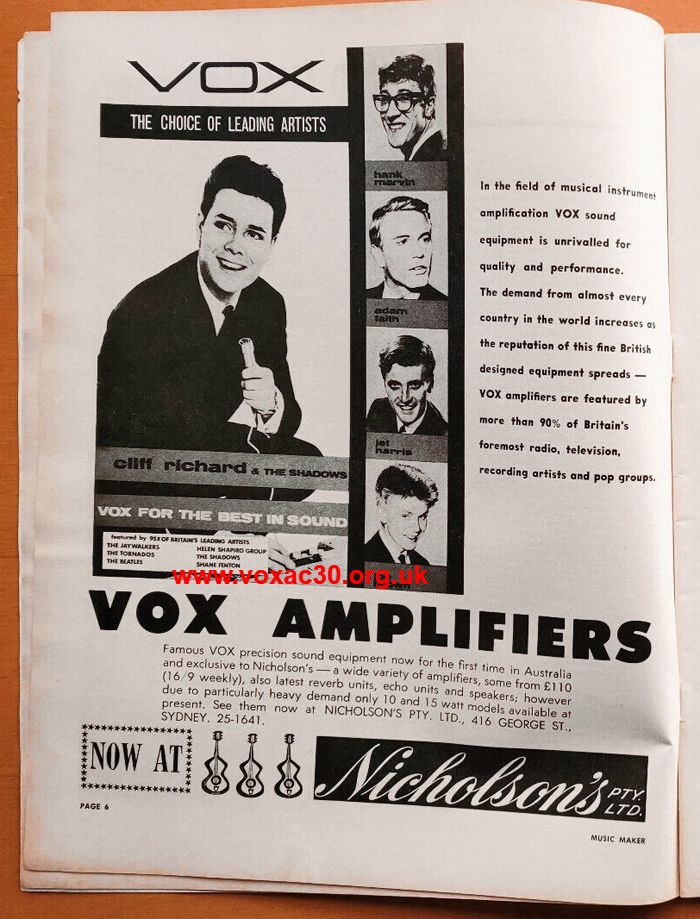
June 1964.
14th October
The cover of "Music Maker" magazine, July 1965 - "The Steeds" with a short Tom Echo unit and two AC30 Twins from the first half of 1963 or earlier. Both have leather handles. The amps were presumably imported prior to the distribution deal struck by JMI with Nicholson's in Spring 1964. The company became sole distributor of Vox equipment in Australia through to 1968.

July 1965.
13th October
A correction/update in relation to the entry below for 11th October. A still higher chassis number in the main sequence is known - 14889 (AC30 Twin serial number 22789).
12th October (2)
The latest "old-style" T1088s that have come to light so far - date code on the gasket - are a quad from an American Super Beatle speaker cabinet with "16LM" = 16th November 1967. The next earliest after that are from Spring 1969 - "new-style", with heavily-stamped numbers longitudinally on the frame and new format date codes.
Is there any such thing as a T1088 from 1968? For much of the year Celestion was occupied with moving premises from Thames Ditton to Ipswich.
12th October
Some notes on Celestion T1088 and T1096 speakers in late 1967 and early 1968 with reference to JMI.
The Celestion T1096 was the higher impedance (15 ohm) brother of the T1088, used by JMI in its T60 Bass cabinets and later by "Vox Sound Equipment Limited" in certain Vox Supreme speaker cabinets. Below, a couple of examples - the first from September 1967, the second from September 1968.


Above, a T1096, poly grey finish, reconed, but the original gasket retained - date code "11JM" = 11th September 1967.
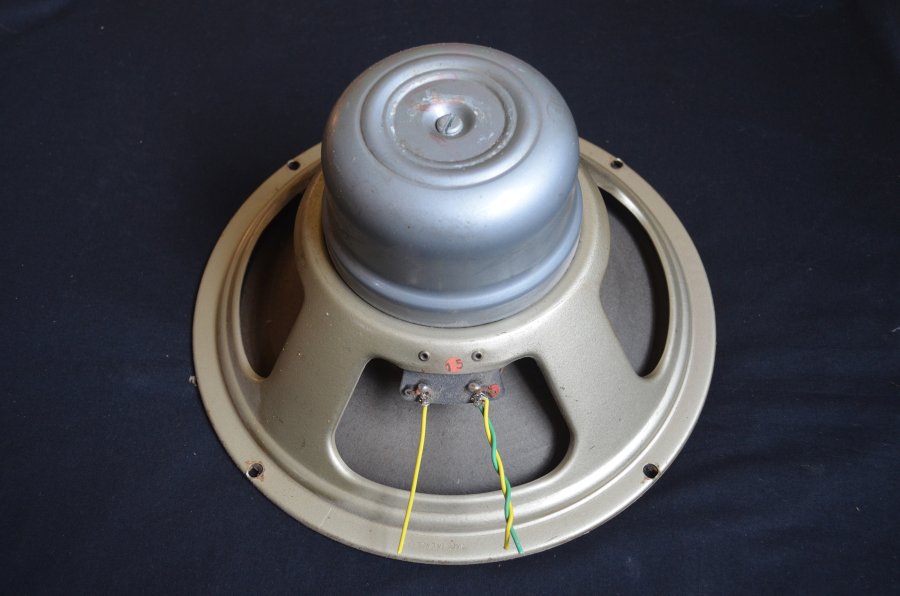
T1096, sand-coloured frame, poly-grey bell, one of three with September 1968 date codes from the same Vox Supreme cabinet as the speaker above.
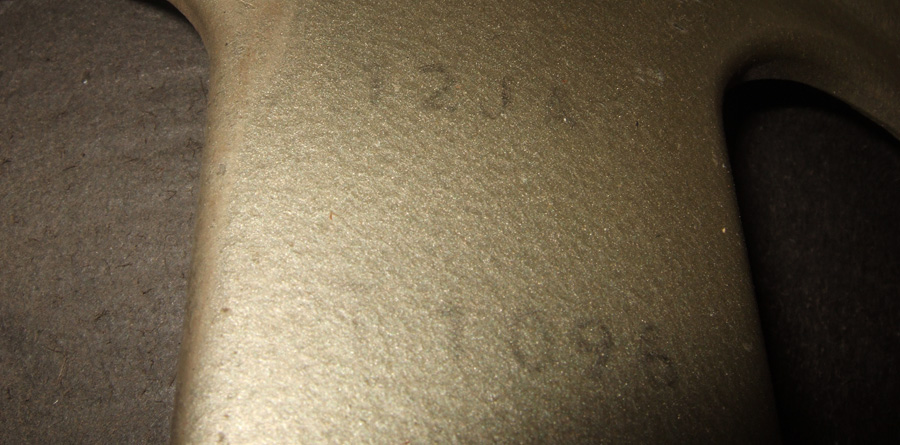
A detail from one of the three T1096s, date code and model number stamped on their frames: "12JA" = 12th September, 1968. Early date codes of this type have generally not lasted well, often fading completely.
The speakers above straddle two main changes: - new colour of frame; and new position for the date code.
As far as Celestion T1088s are concerned, all JMI AC30s seem to have had poly grey, the latest date codes currently known being from November 1967 (still stamped on the gasket). It may be, however, that examples from December 1967 and early 1968 will also come to light.
A couple of things to bear in mind: batches of speakers bought in from Celestion are likely to have lasted longer in 1967 than in earlier years (sales had naturally slowed); and from mid December all purchases, large and small, required the approval of the official receiver. JMI had been placed in his hands when Royston Industries, which had a controlling interest in the company, went to the wall in early December '67. Speakers of course were vital for business and the receiver - R.N.D. Langdon - is unlikely to have been minded to block their purchase outright. But orders may have been strictly regulated.
From early 1967 through to 1968, pairs of T1088s were also used in most (though not all) Vox Conqueror cabinets and in a small number of late AC100 speaker cabs. Relatively few date codes from these are known at present.
11th October
The highest chassis number encountered so far [not so, see above, entry for 13th Oct.] - 14442. Although the amp's serial number plate is missing, component date codes indicate that the chassis is likely to have been assembled at some point in early 1967, a serial number in the 22000s.
Remember that chassis were not fetched from store (for wiring up on the work benches) in any particular order. The page on Burndept chassis numbers has been updated.

10th October (2)
As a sort of companion piece to the entry below, an advert placed by Nicholson's for Vox in "Music Maker" magazine, May 1965. Three notable absences: the AC50 Super Twin (for guitar); AC100; and Continental organ. It may be that they were either out of stock or perhaps not felt to be appropriate for this advert.
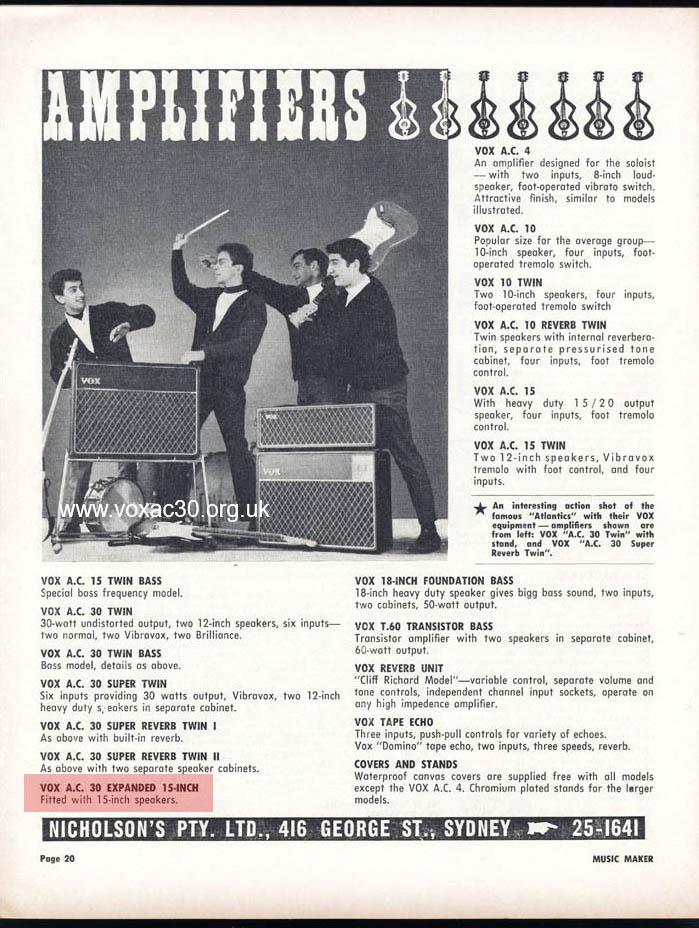
May 1965.
10th October
May 1965, "The Impacs" from Lismore, New South Wales, with a Vox Foundation Bass; two AC30 Twins; an Expanded Frequency AC30; and a Continental (with something over its keys). All are likely to have been imported by Nicholson's in Sydney.
Expanded Frequency AC30s did not sell particularly well (and it is rare to find bands pictured with them), so if one turns up in Australia ...
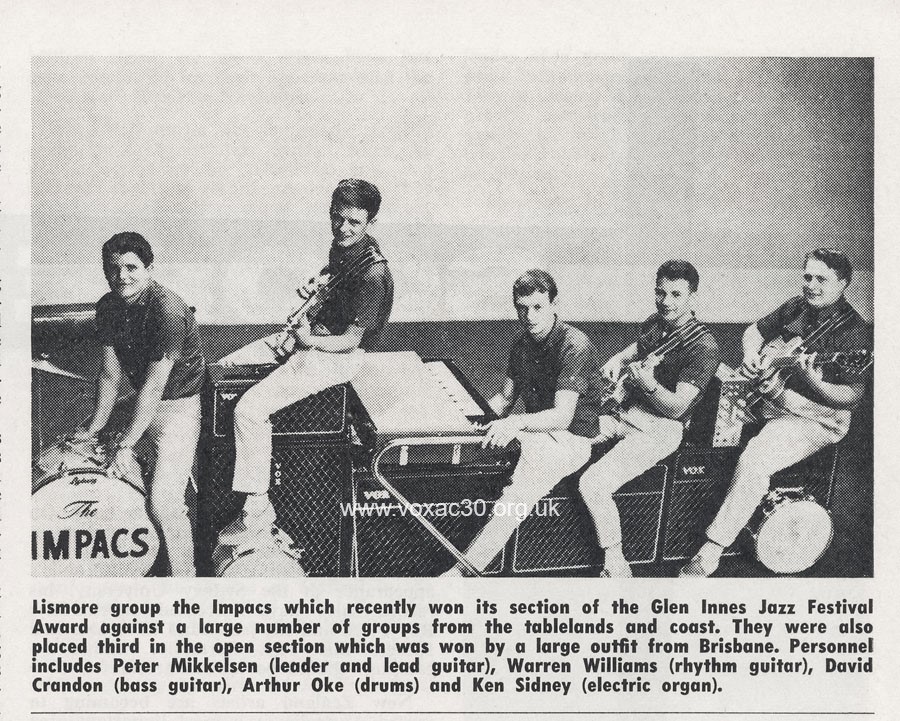
May 1965.
9th October
The page on AC15s, 1964-1968, has been updated. Thanks to Don for pictures of serial number 5518, single speaker, early summer 1964 - shortly before the introduction of Celestion silvers.
5th October
March 1957, from a collection of promotional pieces (recently come to light) placed by Tom in the music press in the 1950s. Although the line "Sufficient volume for congregations up to 1000" had already been used in descriptions of the Model A, it is here for the first time as a "strap line".
The price of the Model G, which had been brought to market in late 1956, is stated as being: "£1500 plus, according to specification". The "specification" in view was - principally - the extent of the accompanying array of speakers. The "basic" schema drawn up by Derek Underdown can be seen in the entry for 23rd August further down on this page.
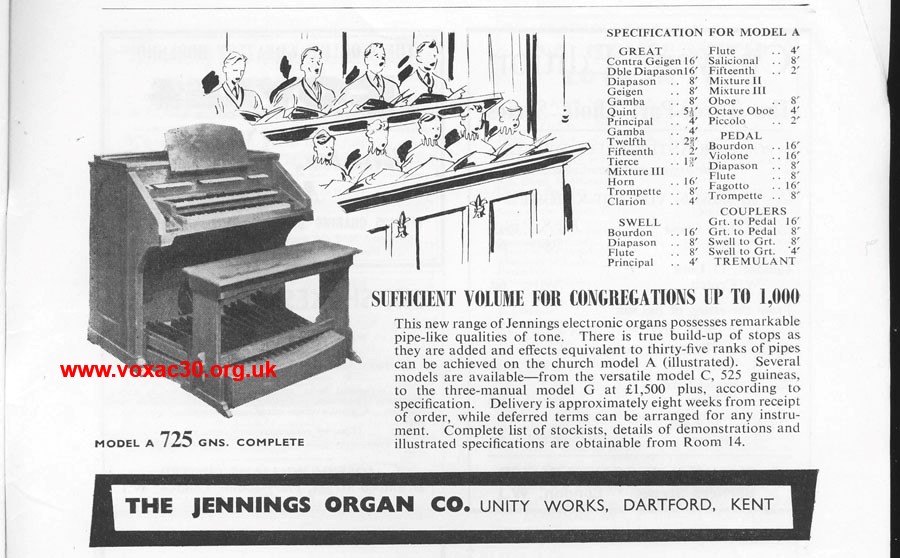
March 1957.
4th October
Two Vox Dominos sold by Russell Acott in Oxford - a Domino Bass, and new-style Domino Reverb (piggy-back, rather than combo). The pages on the Domino range can be found here.
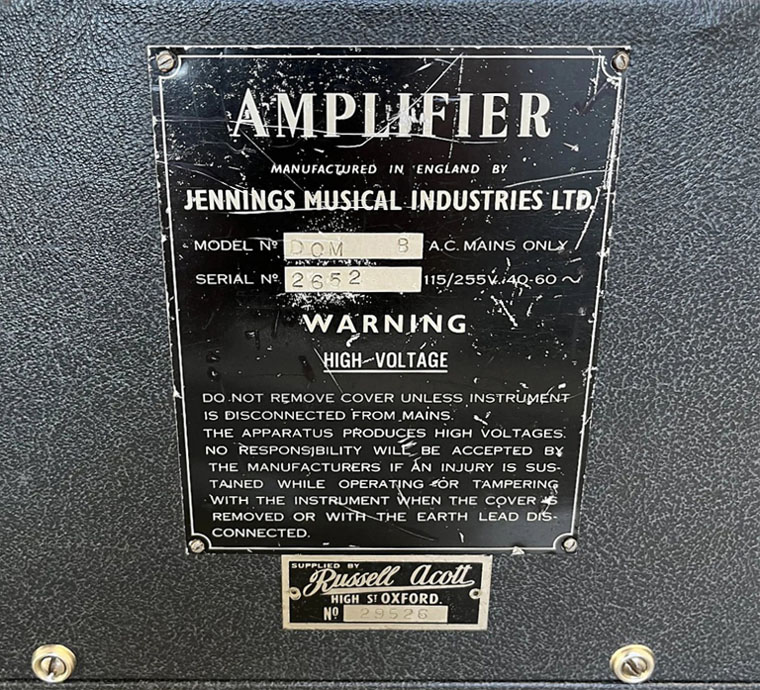
Vox Domino Bass serial number 2652, shop tag number 29526.

Vox Domino Reverb serial number 3329, shop tag number 30130.
In company with certain AC10 Super Reverb Twins from late 1964 and early 1965 (the slope-sided or "trap" head amps), the Domino Reverb has a DIN socket for its footswitch. The XLR socket is an Italian-made Geloso, used by JMI periodically on amplifier sections, speaker cabs, and guitars from 1962. Gelosos were standard on Meazzi Echomatics.
3rd October (2)
Thanks to Kev, shots of one of the Celestion blues in AC30 Twin serial number 12010T, "03CJ" on its gasket = 3rd March, 1964. The amp has been added to the list of AC30s with speakers of known date.


The initial Pulsonic code - 51/102/003 - was also deleted on a blue (now removed from its amp) dated 2nd March, 1964. The error appears to have been ironed out by the 4th.
3rd October
AC4 serial number 2479, output transformer stamped "5200" and still with its "Richard Allan" label. JMI, or rather Triumph, used these transformers from later 1962 through to 1965. One also finds a version stamped "5000".
Allan was probably better known as a manufacturer of speakers but evidently made or sub-contracted the production of other items. Its hi-fi amplifiers were based on designs by Sugden.
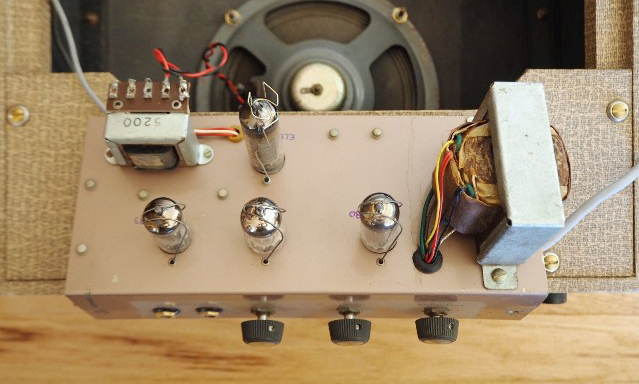

AC4 serial number 2479 - registered on this page.
2nd October
The page on later Vox AC4s (from late 1963 on) has been updated further. Exports to Thomas Organ (following the "Million Dollar Deal" announced in late August 1964) were evidently underway by serial number 3921, and JMI fitted the amps destined for the States with a grey Radiospares 0.05uf/800v capacitor from the mains supply to ground (to suppress noise/arcing at switch on). These are sometimes called "snubber" caps.

Centre, grey Radiospares 0.05uf mains "snubber" capacitor removed from AC4 serial number 3921.

The cap in situ in AC4 serial number 4150. Thanks to John for the picture.
Other models were also fitted with these caps, notably the AC50 and AC100, and going by the circuit diagram drawn up by Thomas Organ, the AC10 (V-1-3) too, though no example has come to light so far.

Detail from the Thomas Organ circuit diagram for the AC10 (V-1-3).
That the principal (known) sheets for the AC4, AC50, and AC100 in the Thomas Organ Vox Amplifier Service Manuals do not record the presence of the capacitor is just one of those things - details that slipped from mind.

Detail from the Thomas Organ circuit diagram for the AC4 (V-1-1).
1st October
A provisional overview of the point at which machine-stamped serial number plates were introduced in 1964 and early 1965, model by model. The only member of the Domino range known at present to have such plates is the Domino Bass. Public Address amplifiers had numbers in the same sequence as the guitar and bass amps. The overview leaves out for the time being Vox Echo units.

The stamping machine had five digits, all necessary where the AC30 Twin was concerned. For models that still had numbers in the 100s, two prefatory zeros were set - for example, AC100 serial number 00306 (which hand stamping would have given simply as "306"). For numbers in the thousands, a single zero was set (as MC15 serial number 05590).
AC4: in the 3600s, mid 1964.
Domino Bass: by the 5000s, late 1964.
AC10 single: none.
AC10 Twin (and SRT): from around number 3000, late 1964 / early 1965.
AC15: by number 5590, mid 1964.
AC30 Twin: from serial number 13000, mid 1964.
AC30 Super Twin (and SRT) : in the 3400s, late 1964.
AC50: from around number 1760, though the model designation is still hand-stamped, late 1964.
T60 Bass: from around number 900, late 1964.
AC100: from serial number 300, early 1965.
Continental organ: by number 1800, late 1964.
PREVIOUS UPDATE PAGES BY MONTH, 2024
UPDATES 2023
UPDATES 2022
UPDATES 2021
UPDATES 2020