
Vox AC30 website updates
November 2024
30th November (2)
Some new material added to the page on the AC10 Super Reverb Twin. More to come shortly.
30th November
A page on AC10 serial number 3146, early to mid 1960, is now available here.
29th November
Entries have been added for six more AC10s with serial numbers in the 1000-2000 range: 1277, 1281, 1329, 1354 (Super Reverb Twin), 1461 and 1623. Select pictures to follow.
28th November
A page coming soon on the Jennings Univox, 1956 to 1966, the models in view being the J6 ("Deluxe"); J7 ("Standard"); and J10 ("Concert Grand"). The J8 may have been the short-lived "Minivox" (1953). As for the J9...
The advert below is something of a puzzle. On the one hand, Roger La Verne and Clem Cattini when interviewed in 2008 made it clear beyond doubt that a Clavioline had been used on the recording of "Telstar". On the other, a number of publicity shots taken at Joe Meek's studio at some point shortly after the track's release (Joe Meek appearing in two of the six currently known) show the group with a Univox, its distinctive chrome keyboard stand plain for all to see. A simple misunderstanding / wrong assumption on the part of Jennings? Jumping on the bandwagon? Selmer so far as one can tell did not put out any adverts relating to "Telstar".
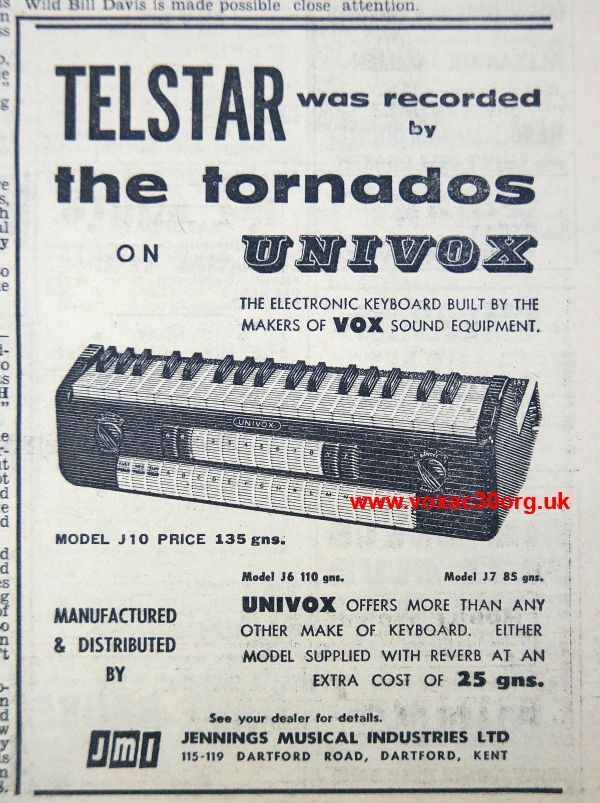
Mid November 1962.
27th November (2)
Entries have been added for six more AC30 Twins with serial numbers in the 14000s: 14177TB, 14328T, 14309T, 14491T, 14517T, and 14728TB. Select pictures to follow.
27th November
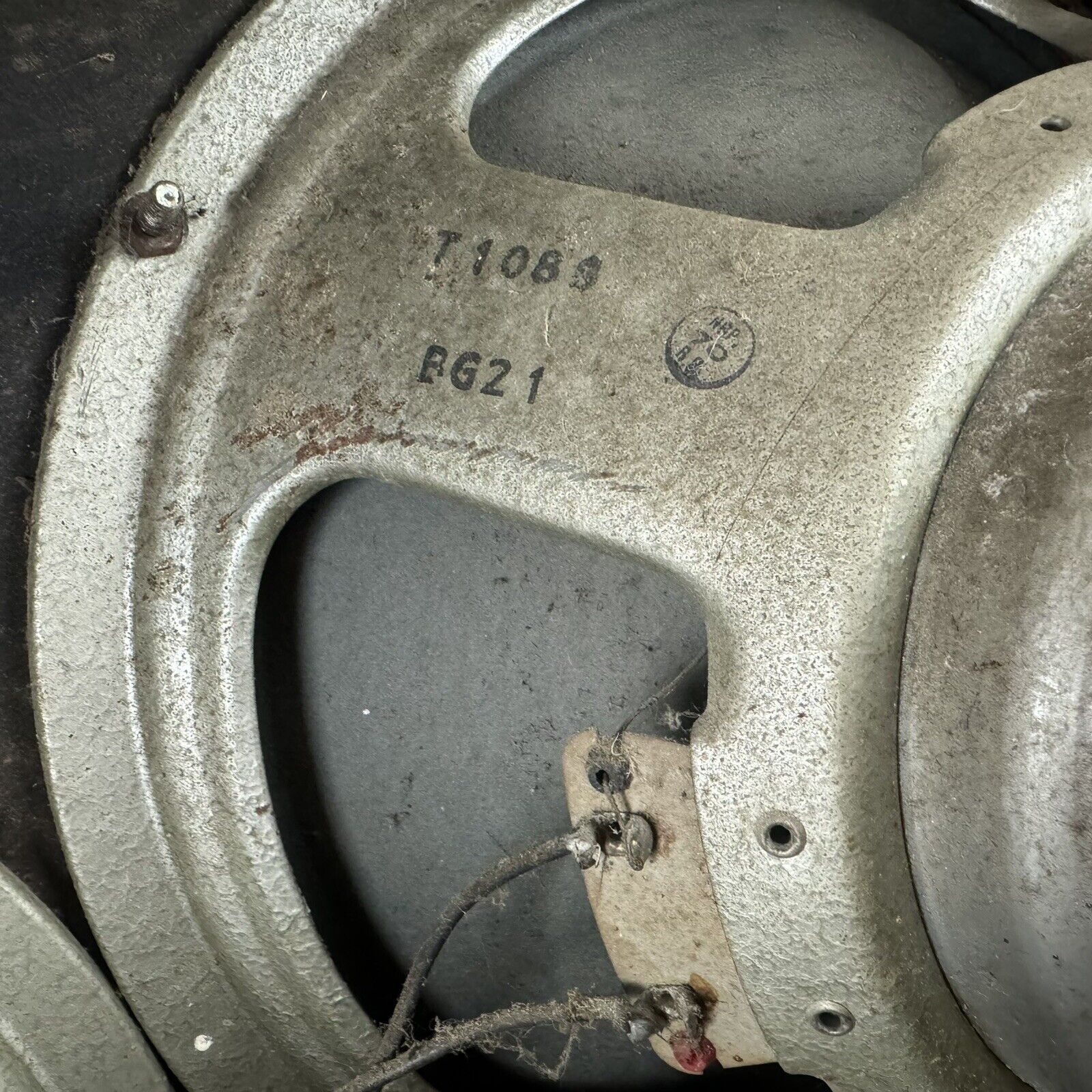
An interesting AC30 that emerged recently: solid state rectified; printed circuit board construction (not of the Birch-Stolec type); T1088s dated 21st February and 10th April 1974; no serial number plate. The cabinet has three plastic vents on top (as some "Vox Sound Limited" cabs from 1972), and a single central handle only, no holes in the vinyl for side handles.
In terms of general date, the amp seems to sit between the acquisition of "Vox Sound Limited" by Dallas in the late summer of 1973 and new factory production (at Shoeburyness) in the autumn of 1974. The only date codes known at present are those of the speakers (ie. nothing of the electronics).
As things stand, the amp is either likely to be early Dallas production, or part of a run made by someone else from left-over "Vox Sound Limited" materials. Whatever the case - and it would be good to determine which - the services of a professional PCB maker were evidently sought.
A page on the AC50s knocked up by a group of fly-by-night boys in South-East London following the collapse of JMI can be found here.
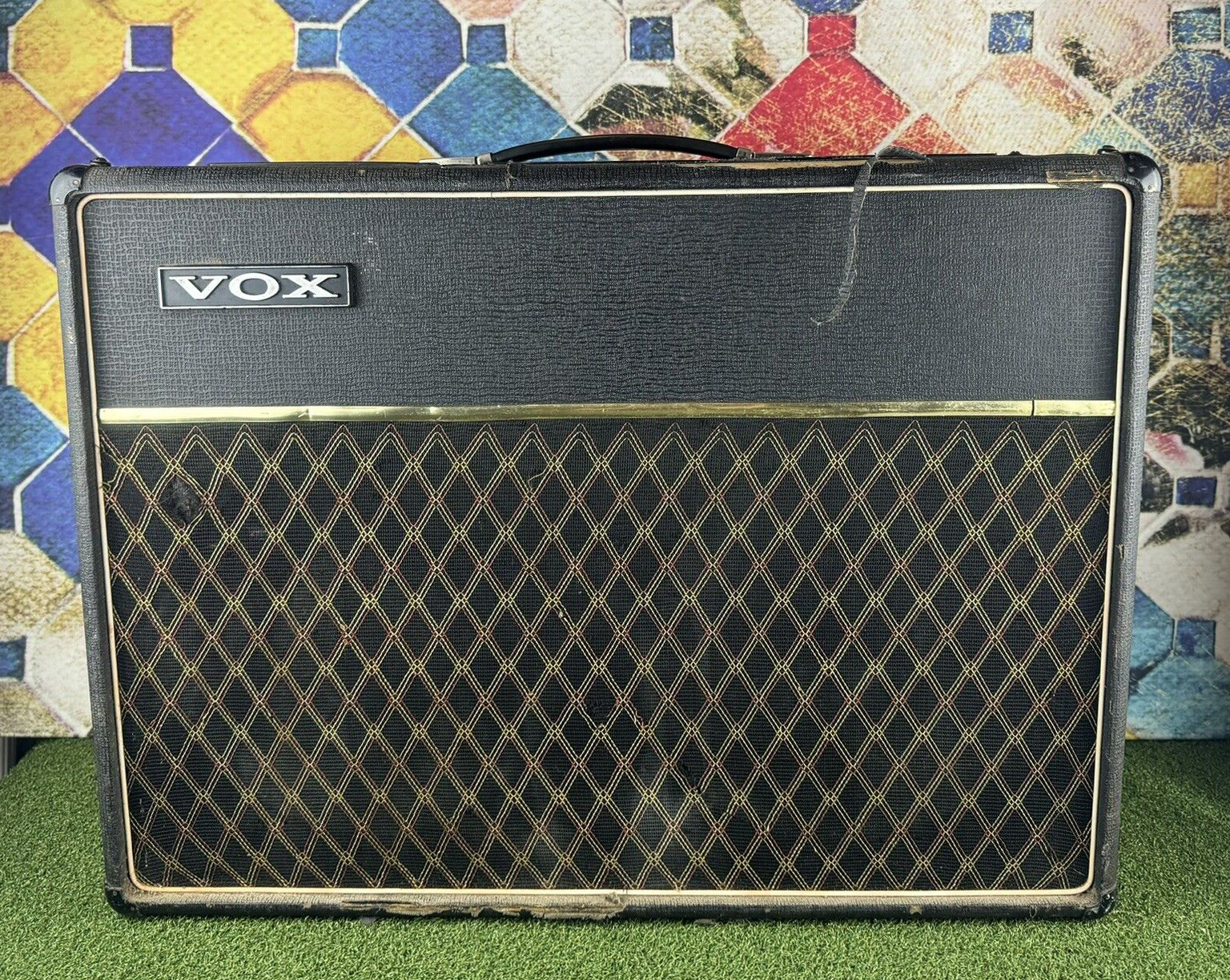
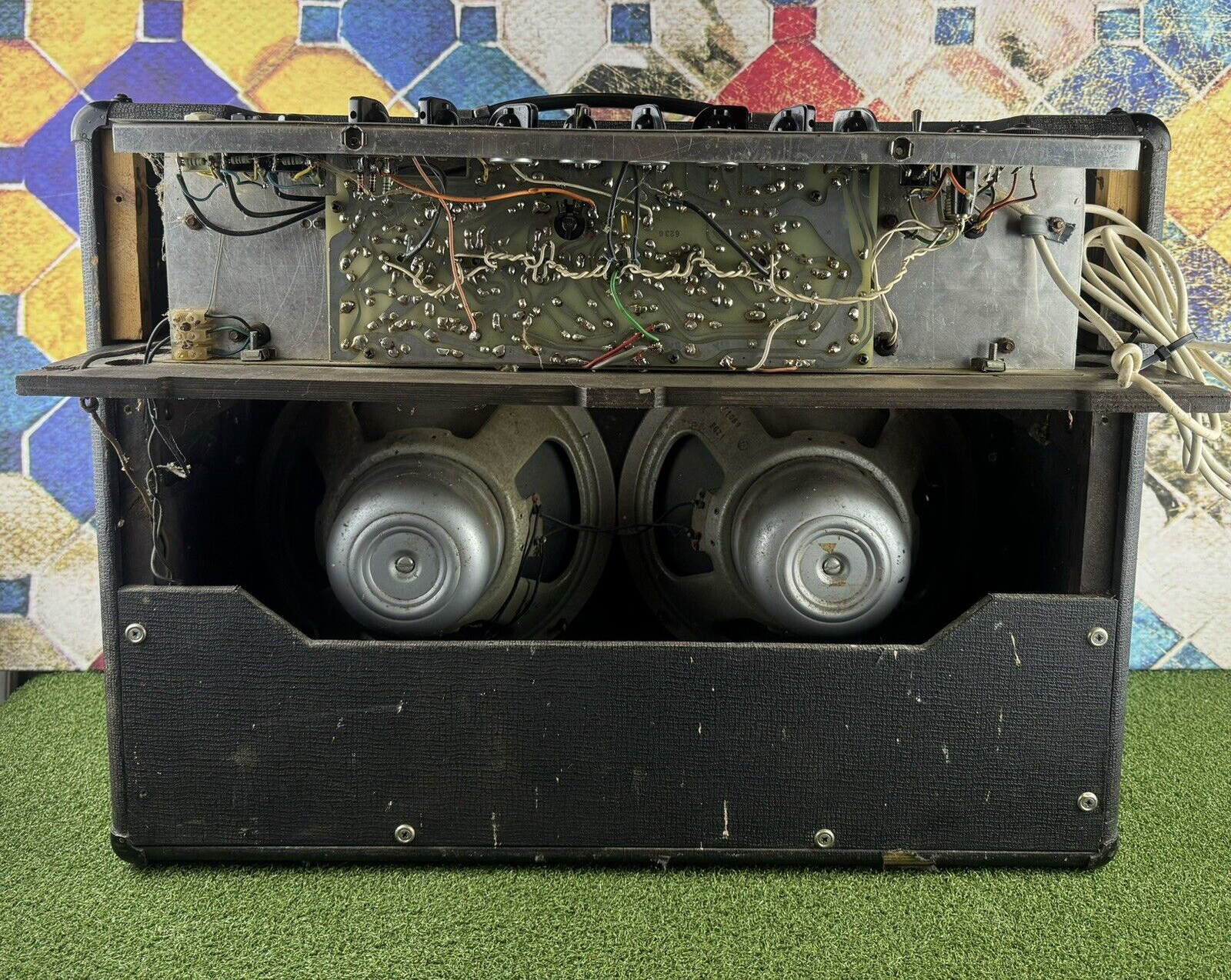
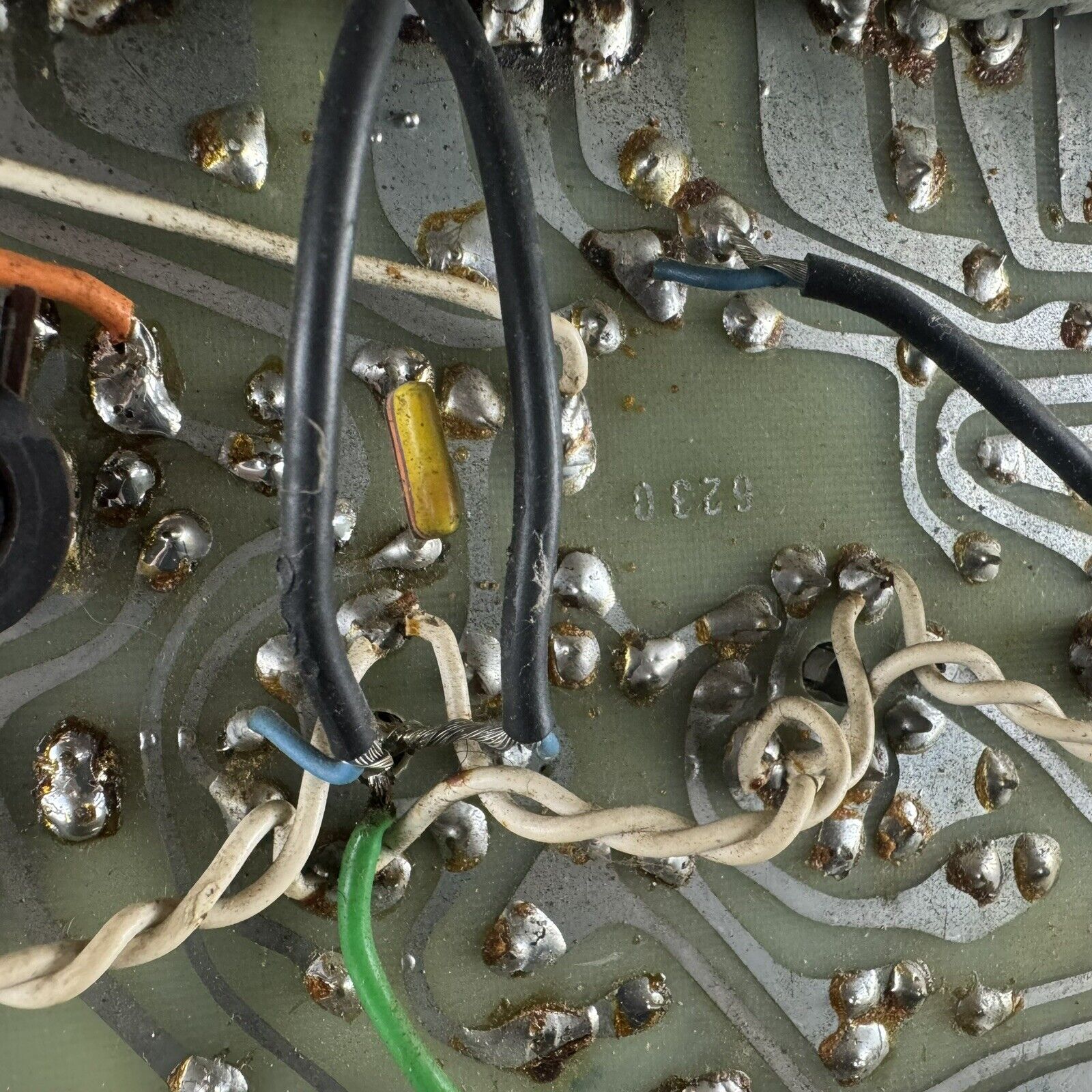
AC30 from 1974 (?). There is no choke. The mains transformer is a Lemark.
26th November
On the page for AC30 Twins with serial numbers in 6000s, three updated entries: 6006N, 6019B, and 6649N.
25th November
Thanks to Phil, pictures of Jennings AC40 serial number 1197, Celestion T1096s dated November 1971, have been added to this page (on the Vox AC100 website).

AC40 serial number 1197 (at right) with solid state JV40 serial number 1188.
23rd November
Really just to accompany yesterday's entry, a screen-shot from the relevant episode of "Thunderbirds", 1966 - well-enough known, plenty of clips on Youtube.
Also to add the miniature AC100 cab seen with "The Beakles" is still extant, somewhere in England....

Marionette Shads with miniature AC30s.
22nd November
Published in "Music Maker" magazine, April 1967, "The Beakles", miniature drum kit, AC30s, AC100, and guitars made by Mick Bennett of JMI. Mick was responsible for prototyping many of JMI's guitars, cabinets, and cases through to 1968.

20th November
The front of AC10 serial number 3146. Its plate is illustrated below (entry for 16th November). Thanks to Andy.

AC10 serial number 3146.
17th November (3)
The preliminary sections on AC30 Twins with serial numbers in the 11000s have now been rearranged and updated - particularly in relation to "Treble" models. A nonsensical sentence relating to speakers has also been put right.
17th November (2)
Although the pictures are small, the chassis of AC30 Twin serial number 11137T is likely to be a "Westrex Treble" too. The entry for the amp has been updated.
17th November
A new page on an AC30 Twin with an early "Westrex Treble" chassis has now been set up here. Thanks to Steve for pictures and info.

"Westrex Treble" stamped in purply-blue under the input jacks.
16th November
Thanks to Andy, coming shortly some pics of TV Front AC10 serial number 3146, square format case, "Amplifier No. 2" circuit - see this page for an overview of the model.

AC10 serial number 3146.
15th November (2)
A sub-note to yesterday's entry. Mullard was by no means the first manufacturer to use yellow print. Below, a Brimar from mid 1954. Whether Brimar used yellow to denote stock to be supplied to manufacturers (rather than the public) is not known at present. The Brimars used/fitted by JMI in the 1960s had white print.

A Brimar 6BW6 from a Jennings Univox J10 (early 1956).

Brimar date code of the valve above: "4F5" = fifth week of June 1954.
15th November
A further ten entries have been added to the page on AC30s with original valves: serial numbers 5300s, 6948, 12000s, 13099, 14491, 15029, 15050, 17169, 17505 and 17663.
14th November
Three new entries have been added to the page on AC30s with original valves: for serial numbers 9078 (mentioned below, 25th October); 11066; and 13098. More to come.
Yellow-print Mullards: various things have been ventured over the years, the principal suppositions being (a) that they were of higher quality; (b) that they were in fact "seconds" ("B-grade"); or (c) that they were intended mainly for equipment manufacturers (of radios, televisions, amplifiers, and so on) rather than the general public. Supposition (c) is almost certainly correct, though it is clear that some yellow-print valves were boxed up for sale in shops. Some of the main themes, batted back and forth, can be found on this thread.
As for JMI, yellow-print Mullards appear to have been used from around AC30 serial number 6000 (early 1963) through into later 1965 (early fixed bias AC100s). The general consensus seems to be that Mullard first used yellow print in 1963.
The valves fitted to pre-1963 AC30s will in almost all cases have been white print Mullards.
13th November
It is clear from at least three surviving AC30s from early 1964 - serial numbers 10317 (a Twin, Burndept chassis); 2791 (a Super Twin, Westrex chassis); and a Twin (Westrex chassis) with a number originally in the low 11000s - that Canadian-made Mullard EL84s were sometimes fitted at factory.
Presumably these were imported, either by Mullard or some intermediate supplier used by JMI, to make up for a short-fall in production at the main factory in Blackburn.
The EL84s in the Super Twin are the latest of the three: - paint codes "KK" = November 1963 (after which the valves will have been inventoried, boxed, and made ready for dispatch).
The page on AC30s with original valves has been updated, but will need updating further to take account of other amps.

Paint code "KG" = July 1963. The manufacturing code (not visible in this pic) is "r3D1" = 1st week of April '63. The small "r" indicates the Ontario factory.

EL84 with manufacturing code "r3G1" = Ontario factory, 1st week of July 1963.
12th November
A brief note on "Westrex Treble" chassis (more to follow soon). In 1964 the majority of Westrex-made chassis went into Super Twins, those produced by Burndept mainly reserved for Twins.
As far as serial numbers are concerned, the earliest "Westrex Treble" chassis currently known are the ones in AC30 Super Twin serial numbers 11076 and 11077, both classed as "Normal" on their plates. AC30 Super Twin serial number 2525N (new series) may align with these. The TCC capacitors in 11076N and 11077N have later 1963 date codes.
Below, the arrangement of the Treble network (capacitors and resistors) at the volume controls in serial number 11077.

Detail of AC30 Super Twin serial number 11077 (Westrex).
A detail of the same arrangement from different angles in two Burndept-made Treble chassis:

Chassis number 3018 (Burndept). Thanks to Glen for the picture.

Chassis number 3082 (Burndept).
11th November
Enlarging the picture of the preamp of serial number 10067 beyond its natural size reveals that there are indeed markings to indicate Treble voicing (contrary to what was ventured yesterday): - a dash of red paint on the lower tagboard. This is likely to have been made to assist the build process at Burndept, not for those at JMI.

Serial number 10067; chassis number 3417.
And it is possible too that the chassis of 10067 also has a flash of red at right. This is certainly so in the case of chassis numbers 3086 and 3443 - a flash of red only, no "TREBLE", nor any sign of anything having rubbed away.

Chassis number 3086.
10th November
Picking up from the entries (late October, below) on Burndept-made Treble chassis - serial number 10067, classed as a "Normal" on its plate, is evidently a "Treble" too. No markings seem to be present in its preamp, however.
More to come shortly on early Westrex-made "Trebles".


AC30 Twin serial number 10067N (Treble).
9th November
Entries for six AC30 Twins with serial numbers in the 12000s have been added to this page - 12395N, 12423T, 12542B, 12613TB, 12726T and 12746T. Some of these amps are not without anomalies. Pictures to follow.
5th November
Thanks to Chris, the entry for AC30 Twin serial number 20648TB, last quarter of 1965, has now been updated.
4th November
March 1956, a note in the high-brow music press setting out the merits of the new range of Jennings organs - the "V-series". Octaves were indeed generated independently. Model C organs, for instance, had seven separate assemblies for the 12 notes of the relevant octaves, as the one below.
Further below, a detail from the patent document, approved in 1959. Organ serial number plates generally give the application number.

March 1956.

Detail of a Model C organ - generator for the twelve notes of a given octave.

Detail of the switch structure for the keyboard action.
3rd November
A Celestion blue with "14AF" tippexed on its frame. If this code were stamped on the gasket, 14th January, 1961, would be in view. Unfortunately without a shot of the gasket, the tippex cannot be relied upon. It may simply be a colossal red herring. The picture below seems to indicate that the cone code has, inconveniently, rubbed or blotted away.

2nd November
Five new entries have been added to the page on AC30 Twins with serial numbers in the 22000s: numbers 22035, 22050, 22455, 22563, and 22750.
PREVIOUS UPDATE PAGES BY MONTH, 2024
UPDATES 2023
UPDATES 2022
UPDATES 2021
UPDATES 2020