
Vox AC30 website updates
December 2024
31st December
There is now a page on the Vox AC.1 of late 1960. Its place was quickly taken in the Vox line-up by the single input AC2. A page on the TV Front Vox AC6, early 1960 to early 1962, to follow soon.
29th December
An AC10 Twin / Super Reverb Twin stand probably from the second half of 1964, extremely scarce these days. The central parallel bars are 24 1/2" wide; 8" deep (outer edge to outer edge); and their tops are 18 1/4" from the ground (castors included). The example below turned up recently in the USA - thanks to Ihor for signalling its existence.


Below, a detail from the first JMI advert for the AC10 Super Reverb Twin. Note that the amplifier section is too broad for the stand pictured. Aspects of the design were clearly still in flux when the photo was taken.

February 1963.
Promotional images from later in 1963 show the amplifier section embraced fully in the stand. The production design can also be seen in the earliest Vox catalogue issued by the Thomas Organ Company in the USA, late 1964 / early 1965.

Detail from the Thomas Organ "Million Dollar Deal" catalogue.
28th December
Below, pictures of an early T60 speaker cabinet. The 15" drivers are a species of Goodmans "Alcomax", re-sold by Lafayette, Jensen, Bell and Howell, and various others in the late 1950s and early 1960s, the name presumably indicating a magnet composed principally of aluminium and cobalt rather than aluminium, nickel, and cobalt ("alnico").
The Goodmans in the cab in view are likely to pre-date the 15" speakers that JMI went on to commission in blue - Tannoy, Celestion, and a little later Fane. Whether Paul McCartney's T60 cabinet (received by him in March 1963) had "Alcomax" drivers is unknown - but very possibly it did.
How did JMI come to use these Goodmans? Presumably following its adoption some months earlier of the 12" version for the AC15 Twin. Many a Bell and Howell projector speaker cabinet has since been raided to make AC15 Twins look "correct".

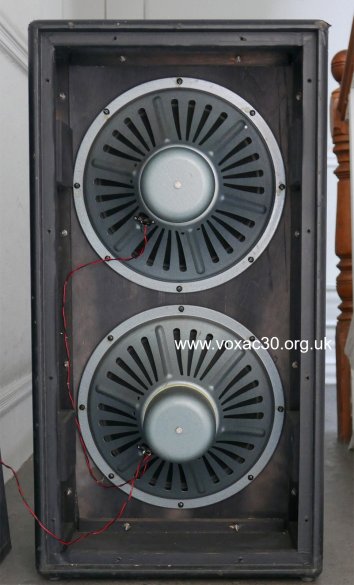
Early T60 speaker cabinet, probably Spring 1963, perspex logo missing its "X".
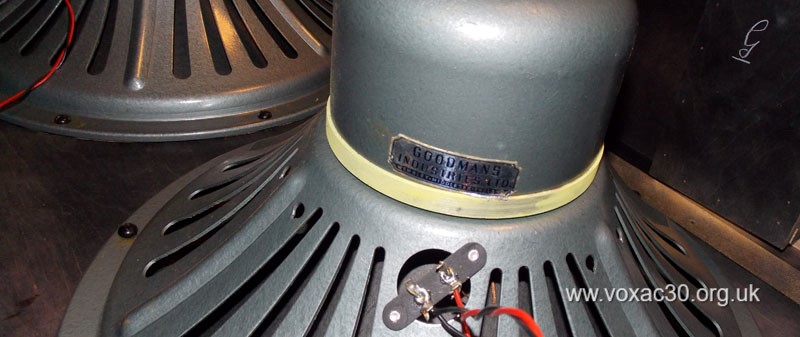
The chalked "G" - the initial of one of the cabinet finishers at JMI - survives in several other cabs, see this page.

Detail from Lafayette advertising, late 1950s. The speakers used by JMI do not have the resonator at centre, nor the high frequency horn unit.
22nd December
The "Radio Hobbies Exhibition", November 1960, Royal Horticultural Society's Old Hall (now Lindley Hall), Westminster. The show was opened by Brian Rix, star attraction of many a "Whitehall farce".
"Build it yourself" projects were the staple of British radio clubs and magazines in the late 1950s and early 1960s. Jennings was at the show primarily to exhibit its new kit guitar, the "Pacific", and in all likelihood the new AC.1 and AC.2 too, the original plan (as related by Rodney Angell, who worked at JMI from c. 1960 to 1968) being to bring those to market in the form of kits as well, constituent components selected and prepared by Triumph Electronics.
If any such amplifier kits were actually made ready for sale, numbers will have been extremely small. At present the earliest AC.2 we have is number 20 (serial number 2020), registered on this page. The idea of kits was evidently shelved fairly rapidly, along with the AC.1.
Fully-assembled budget amps in any case made much more sense. Wire up a kit guitar wrongly and little harm would come; wire up a transformer wrongly ....
That beginners continued to be of huge importance to JMI into the mid 1960s can be gauged from the hundreds of adverts for budget guitars and amplifiers placed by John Willament and Reg Clark (successive General Sales Managers) in daily and local newspapers, listings magazines, and select mail-order catalogues. Some of the many ads put out in the name of "Musicland", the Jennings shop in Bexleyheath, can be found on this page.

Detail of a JMI pricelist from November or December 1960.


The best general picture of the show to have emerged so far, probably a view across the width of the hall rather than up and down its length.
21st December
Thanks to John, pictures of AC10 Twin serial number 2345 have been added here.


AC10 Twin serial number 2345.
19th December
Thanks to Steve, a detail showing the blue overspray in the chassis of AC1/15 serial number 3539, mid 1958, can now be seen here.
18th December
Thanks to Andy, further pics of the chassis of AC10 serial number 3146, early to mid 1960:

Main elements left to right: renewed mains transformer; output transformer (attached to preamp upright); and choke. Valves left to right are: a pair of EL84s at front; EZ81 rectifier at back (not in view); ECC83 phase inverter (on the preamp upright); ECF82 and EF86 (both on the preamp upright above the output transformer). The sockets for the EL84s and ECC83 are riveted rather than bolted in.

Underchassis. Note the cut-out for the winding and flying leads of the output transformer. The original green TCC 25uf/25v cathode bias capacitor can be seen in the middle of the picture. The green Painton ceramic cathode bias resistor beside it is probably a later replacement.
17th December
An entry has been created for AC30 Twin serial number 23061, one of the last to have been made (and sold) by JMI, probably in mid or late March 1968. Final assembly of AC30s evidently ran on for a short time thereafter - into early April 1968 - coming to an end a few weeks later, when the company was formally wound up by the official receiver.
8th December
Thanks to John, pictures of AC30 Twin serial number 13171T bought new at Yardley's in Birmingham in 1964.


AC30 serial number 13171T.
7th December
Some sad news: Allan Billington, manager of the Jennings shop on the Charing Cross Road from 1950 to 1956, passed away earlier this year. Post-Jennings, Allan set up shop in Welling, advising and equipping generations of musicians (of all genres) in Kent and further afield. A brief page on Allan can be found here.
6th December
A detail below of one of two Twins with chassis from early 1964 - copper control panels, Top Boost controls integrated - but late serial number plates, and three 1970s Vox handles fixed with the same type of screws.
The amp below has a three-line serial number plate, so a number in the high 20000s or higher. The other has a number in the 19000s.
In view of the handles, it seems likely that the two passed through the same hands (some time ago by the look of things). The chassis were presumably made originally for "Expanded Frequency" AC30s - the AC30X.
More on chassis with copper "Top Boost" control panels to come.
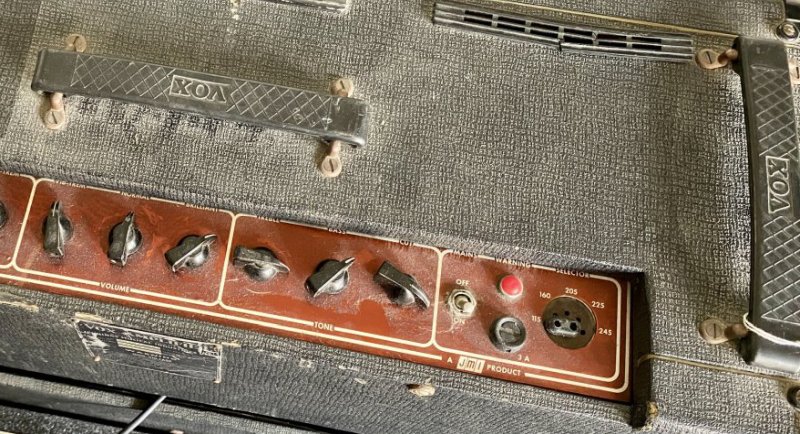
1970s Vox handles, three-line serial number plate. Speakers are blues.
4th December
A Top Boost ("Expanded Frequency") chassis with an unusually clean copper panel. Although repros are at large in the world, the panel pictured below is likely to be original.
Chassis manufactured by Westrex; Albion tranformers; main preamp filter with the date code "UG" = July 1963 (the only component date code definitively known at present). Perhaps of more significance, some of the original valves apparently survive:
The Mullard yellow-print GZ34 has the paint code "KF" = June 1963 for its completion, and the Mullard EL84s have "KH" = August 1963. The EL84s were made in the Philips/Mullard factory in Canada - a fourth instance of such valves in AC30s of late 1963 / early 1964.
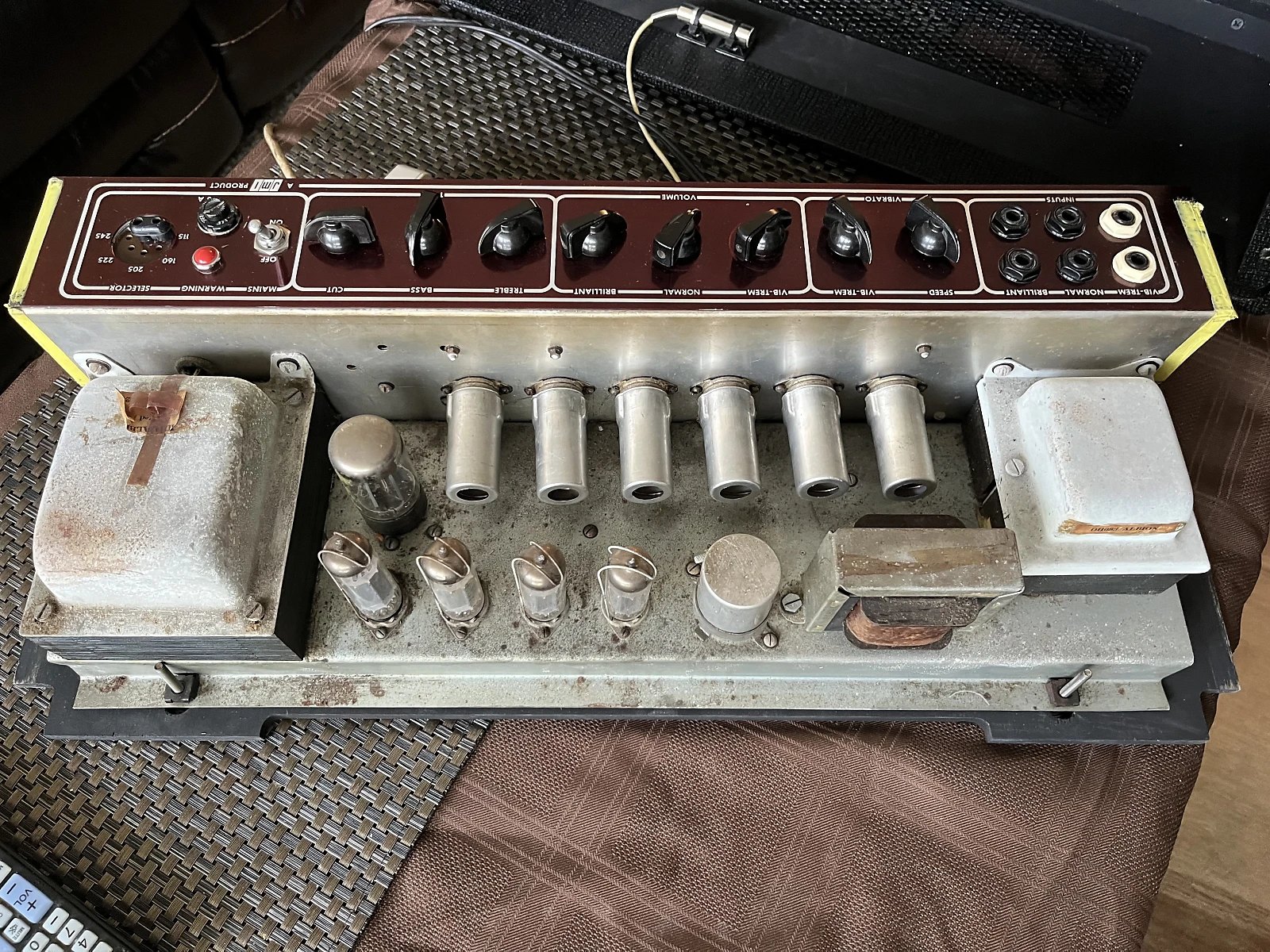


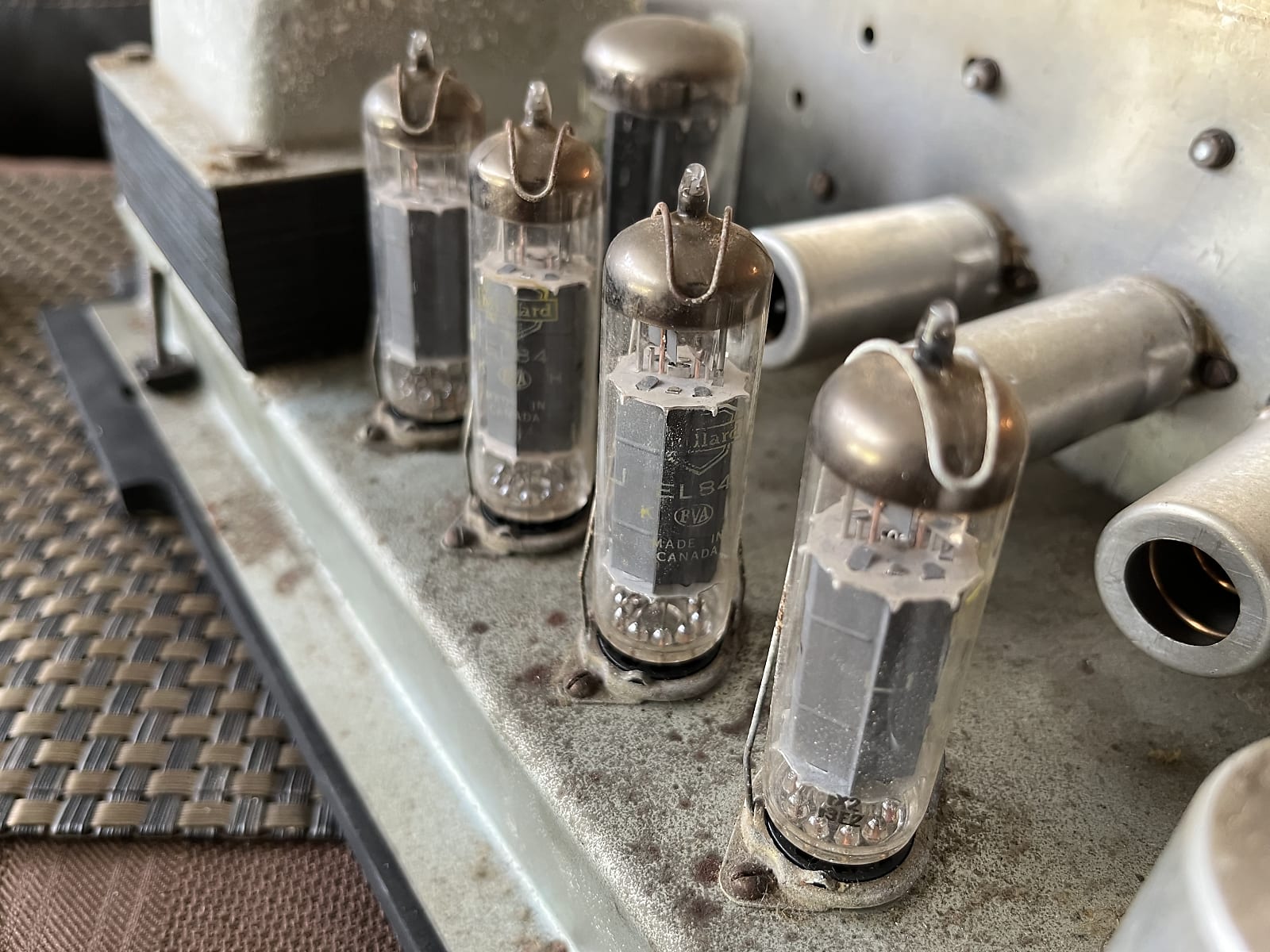
The manufacturing date of the EL84 at front in the fourth pic is "r3E2" = Ontario factory, 2nd week of May 1963. The chassis is now in a repro slope-sided Super Twin cabinet.
3rd December (2)
Just to record that all AC30 Twins with numbers in the 15000s are so far "Treble", "Bass", or "Top Boost" - not a single "Normal" (yet).
3rd December
Some updates/new entries on the page for AC30 Twins with serial numbers in the 15000s: 15029T, 15417B, 15510B, 15531TB, 15555B, 15738TB, 15881T, 15965T and 15978TB. Select pictures to follow.
1st December
A provisional overview of the numbers of Univoxes made, model by model, 1950s to mid 1960s:
J5: spring 1952 to spring 1953, probably no more than 100 made, serial number sequence beginning at 600.
J6: spring 1953 to the mid 1960s, around 3600-3700 made, serial number sequence beginning at 100.
J7: spring 1953 to the mid 1960s, around 1300-1400 made, serial number sequence beginning at 100.
J10: spring 1954 to the mid 1960s, around 400-500 made, serial number sequence beginning at 100.
Thanks to Martin for his notes on surviving examples and numbers. Univox J6s were evidently made and sold by Jennings in far greater numbers than its lower-powered amplifiers - the AC1 (of late 1960); AC2/AC4; and AC6. Sales of the AC10 surpassed the J6 only by a few hundred.
Total sales of all models of Univox exceeded the AC10, AC15, and AC100 individually by some margin.
PREVIOUS UPDATE PAGES BY MONTH, 2024
UPDATES 2023
UPDATES 2022
UPDATES 2021
UPDATES 2020