
Vox AC30 website updates
January 2025
31st January
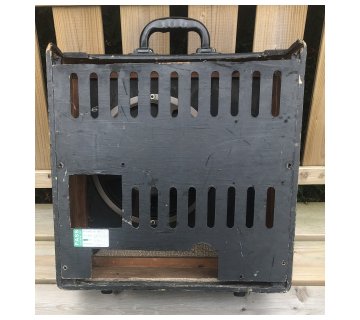
A flyer produced by JMI for the BMII Trade Fair at the Russell Hotel in August 1967 - the Riviera console organ and Gyrotone III, the latter a member of JMI's new range of rotary speaker cabinets, rivalling Leslie. A new page on the organs displayed at the Fair will be added shortly to the section on Jennings Organs.

Front.

Rear.
The Riviera was shown for the first time at the Frankfurt Musikmesse in February, set up for display (and checked) by Rodney Angell. Below, Rodney's tickets.

Thanks to Martin for the picture.
28th January
Entries - mainly to register the existence of the serial number plate and original voicing - for six more AC30 Twins with numbers in the 13000s have been added to this page. Amps from 1964 seem particularly prone to being parted out and/or "reconfigured" by the smiler boys.
26th January
Late 1964, one of a number of experiments that JMI made with front-facing controls on guitar amplifiers - the new Transistor Lightweight with a sort of "Fender" feel to it. No coincidence perhaps that the "Million Dollar Deal" made with Thomas Organ - to distribute Vox equipment in the USA - had just been announced. Legends can be made out under each knob. The centre knob of each panel has a legend above it too. Perhaps pre-production only, though it is by no means impossible that a small number were produced for sale.
At least four other types of amplifier with front-facing controls were tried out early on (ie. in late 1964 and 1965) too, though in those cases all valve.


Detail from the "Precision in Sound" newspaper-format catalogue of autumn 1964. There is not quite enough detail in the original picture to read the legends on the control panel unforunately. Transistor Lightweights up to this point normally had three 10" speakers - see this page for examples.
24th January
Ten new entries have been added to the page on Italian-made AC30s. A couple of incorrect speaker dates have been put right - "GD" = July 1971, not August.
It may be necessary to create two pages for these amps in due course, one for numbers in the 2000s, 5000s, and 6000s, a second for the 30000s. It seems likely now - though by no means a foregone conclusion - that the starting point of production/sales was 2500 rather than 2000.
23rd January
Some pictures of the assemblies for the transistorised reverb fitted to Italian-made AC30s, serial numbers in the 6000s and 30000s. The circuit stands in close relation to the one used by JMI and Thomas Organ in their respective solid state ranges - for JMI (and later, VSEL and VSL) the Virtuoso, Conqueror, Defiant and Supreme. The factory at Recanati in which the AC30s were made was a joint English, American, and Italian venture.

Serial number 30748.

Detail of the transistorised circuit in serial number 31082.


Above, two details of serial number 30989. The cartridge/transducer has a paper sticker with "150/AB" on it.

Serial number 30182. The spring assembly is stamped "8EB2C1B".
22nd January
Entries for a further ten AC30s made in the Birch-Stolec factory in Hastings (really St-Leonards-on-Sea), late 1970 through to 1973, have been added to this page - serial numbers 25208, 25325, 25417, 25449, 25467, 25567, 25570, 25627, 25928 and 25929. Select pictures to follow.
21st January
The page on TV Front AC30 Twins has now been tidied and updated and will remain as it is for the time being. Further material - pictures and notes - will be added in due course.
20th January
The introductory sections of the page on black panel AC30/6s in split-front cabinets have now been rearranged slightly and updated to include a note of the revised form of AC30/6 chassis introduced around May 1961 (as outlined in the entries for 15th January, below). New headings and further links to pages on the site have also been provided.
The increase in price of the AC30/6 between December 1960 and March 1961 - long noted on this page - is intriguing as there was no associated increase in the price of the AC30/4. The reason for the change: - the introduction of the new split-front cabinet, Celestion blues, or both? Were AC30/6s fitted with Celestion blues before AC30/4s? AC30/4s did not go up in price until March 1961, at which point the AC30/6 went up again.
19th January
Just to mention that work on the Vox T60 website has resumed recently. There is a huge amount of new material to incorporate - to be added in the coming weeks.

JMI advert for the T60, late 1963.
17th January (2)
Thanks to Marc, an entry for AC30 Super Reverb Twin serial number 4655 has now been added on this page.


AC30 Super Reverb Twin serial number 4655.
17th January
The page on the split-front AC30/4 has now reached a settled state in relation to updates, ironing out wrinkles, and so on. There will be more material to come, but not just yet.
The page on TV front Twins needs some reshaping first. One of the spectres overshadowing (yes, bad pun) the TV fronts unfortunately is the matter of what used to be called "lash-ups" - amps made in relatively recent times from disparate elements, a cabinet from here, a chassis from there ...
A couple of entries for TV front amps have already been updated, but it may take a few days for the page as a whole to reach a settled form again.
16th January (2)
Below, two versions of a type of circular control knob used by Jennings in late 1960 and 1961 (possibly ordered from Bulgin): (i) deep brown - for the AC2 through to the advent of pink control panels; and (ii) black for runs of AC15s (serial numbers in the 3800s through to the 4400s), and for shorter runs of AC10s and AC30/6s. The three models are depicted with these knobs in the JMI brochure of Spring 1961.
Only the black version had a little pointer incorporated in the gold ring inset on top. At present, the rule of thumb seems to be that AC30/4 chassis regardless of the type of cabinet - ie. TV front or split-front - were invariably fitted at factory with Bulgin chickenheads, no other type. Two or three surviving amps have had circular knobs fitted more recently, but that's a different matter.
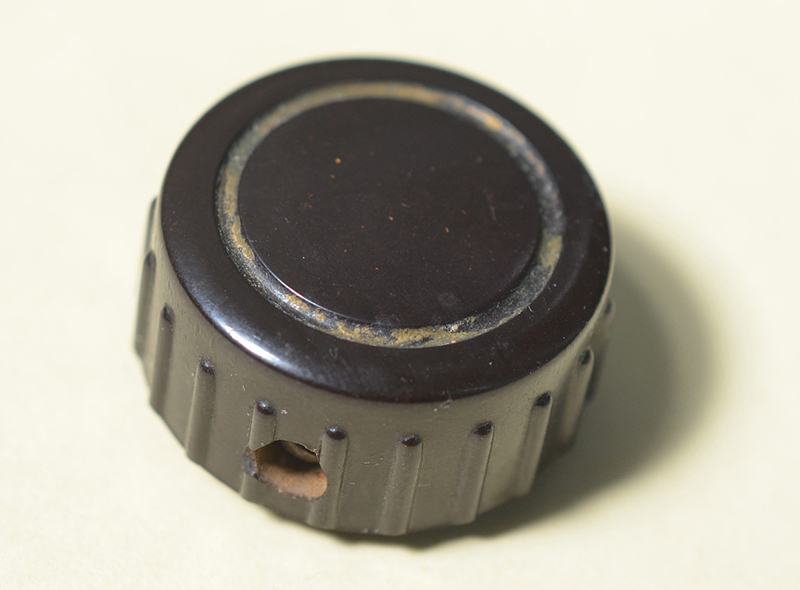
(i) knob belonging to an early AC2, serial number 2027.
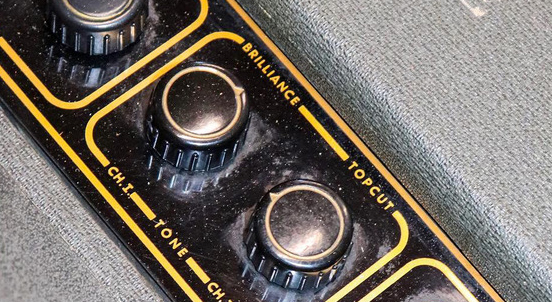
(ii) detail of the control panel of a late two-tone AC15. Black version of the knob with inset pointer - for a "professional" rather than a beginner's amplifier.
16th January
Picking up from the first of yesterday's entries, a couple of shots of TV front AC30/4s from early 1961 to illustrate the drawbacks of the thin aluminium lip at the rear of the chassis - a series of fixing points along the top edge of the back-boards, new ones having to be made as the holes provided on the lip at factory gave way.


15th January (2)
It has been clear for some time now that Westrex began working for JMI under contract in 1960, assembling AC6 chassis initially, then AC15s and AC30/4s. The page on split-front AC30/4s has been updated - at long blooming last (again) - to take account of this. The "W" stamped on serial number plates indicates who was responsible for production. "Westrex-made chassis" has been noted in all relevant instances. In some cases the "W" is visible in the picture of a plate, but not the number itself.

AC30/4 serial number 4669, BASS voicing. "W" to indicate the chassis had been made by Westrex.
The reason for the designation? Partly record-keeping, partly to assist if (and when) some repair was required - a manufacturing fault, for instance, manifesting itself only after purchase.
The impression is also that Westrex was not always the only party at work producing AC30/4 chassis - otherwise why have the "W" at all?
15th January
The tidying of the page on AC30/4s continues, a couple more entries to add / update. Also to signal that in the late spring of 1961 JMI introduced a new type of chassis for the AC30/6 (along with a list of changes to its circuit). AC30/4s remained much the same as before (some small details to mention in due course).
Below, a detail of the early style of AC30/6 chassis, its rear lip having a drop of around 1/4" to 3/8". The upper back board screws were screwed directly into the aluminium:

Early AC30/6 chassis. Thin aluminium lip.
The later form of chassis, first seen on serial number 4350, had a lip of 5/8" to accommodate holes for cage nuts (for machine screws from the upper back board). A rear lip of 5/8" remained standard for AC30/6s through to the end of JMI production.

Detail of AC30/6 serial number 4680 with original cage nuts inset in the lip.
The (conventional) view that AC30/4 chassis were simply AC30/6 chassis with two of the input jack holes blocked off by the control panel is therefore only true in a general sense for around 7-8 months of production.
The impression given by surviving (genuine) black panel amps is that AC30/4 chassis always had thin rear lips - in other words there was no "cross-over" or mixing and matching.
The rule of thumb for AC30/6s is that thin rear chassis lip = spring 1961 or earlier, though admittedly one can often pick that up just as well from the electronics (pre-"List of Changes"). All the same a potentially useful detail. More on early AC30/6s (and chassis) in the coming days.
14th January
The entry for the AC30/4 pictured below has been updated - serial number in the 4500s (probably). It was owned in the early 2000s by Rob Livesey, who was well known in collecting circles. The thumbnail images are from his old website.
Interesting to note that pictures of this amp have recently appeared online - on Reverb.com - with two different locations cited. The latest (current) is New York.


Cabinet recovered, possibly acquired by Rob separately. The backboards do have square corners though. The serial number plate that appears in the right-hand image is of a later type and probably a repro.

Thumbnail images from Rob's old website.
13th January
There are now a couple of picture pages, thanks to David, on a split-front AC30/4 from early 1961 (second page linked at foot of the first).
A number of entries on the main page on AC30/4s are in the process of being tidied and augmented.

AC30/4 early 1961.
12th January
Thanks to Steve, a new page has been started on AC1/15 serial number 3539, currently the earliest fully working Vox amplifier known.
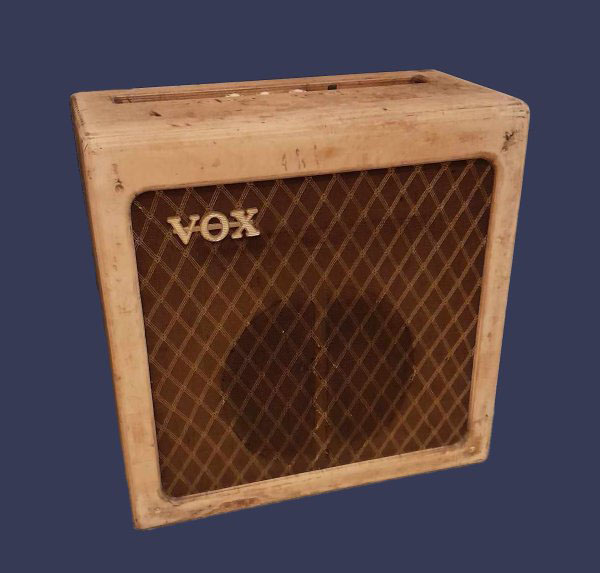
AC1/15 serial number 3539.
11th January
Pictures from the early 2000s of a (very) late AC30 Lightweight, still brown grille cloth, but grey panel amplifier section, probably a serial number in the 14000s. As has long been known, the Lightweight was designed around a modified T60 bass amplifier chassis. Grey panels first appear on T60s around serial number 800.
Unusually, the amp below still has its "LIGHTWEIGHT" runner, lower right on the grille cloth. The page on AC30 Lightweights has now been updated at long blooming last.


10th January
There is now a page on the only Univox J5 known to survive, early 1953. Thanks to its owner for pictures and details.
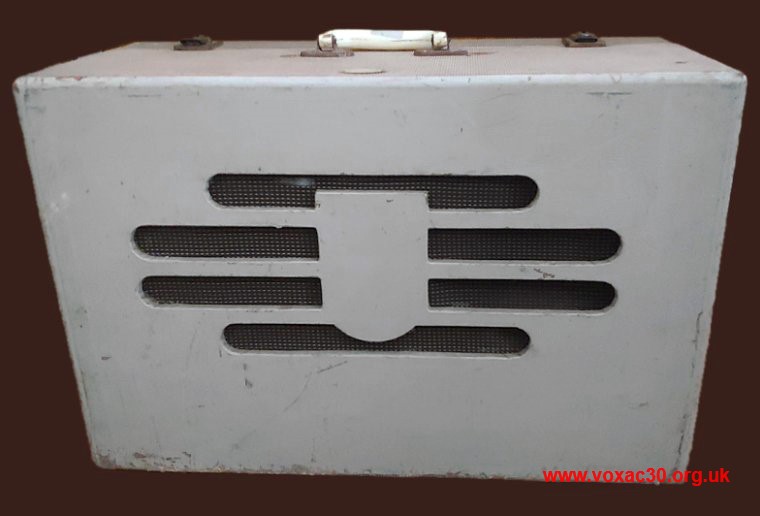
J5 serial number 664.
The page on the Univox J10 has recently been updated with a section on "Case and Cables".
9th January
In relation to yesterday's entry, another two AC30 Super Twin amplifier sections with their BASS runners (originally) directly beneath the logo can be seen on this page, both in powder blue vinyl. Although logo and runner are missing on the first of the two amps pictured, the relative positions can be gauged from remains of the glue.
Also to mention that the BASS runner on certain Twins from 1962 (probably only a very small number) was also positioned high up on the front - on the right-hand side however, above the horizontal gold trim, as below.

Late 1962. Note the early "tray" stand with "VOX" logo.
8th January
Pictures coming shortly of AC30 Super Twin serial number 7289B, with BASS flag up by its logo, as serial numbers 6056B and 9664B. The amp still has a number of its original yellow-print Mullard preamp valves.

7th January
The page on the Univox J10 from 1956 is now in progress here. A page on the only Univox J5 known at present to follow.
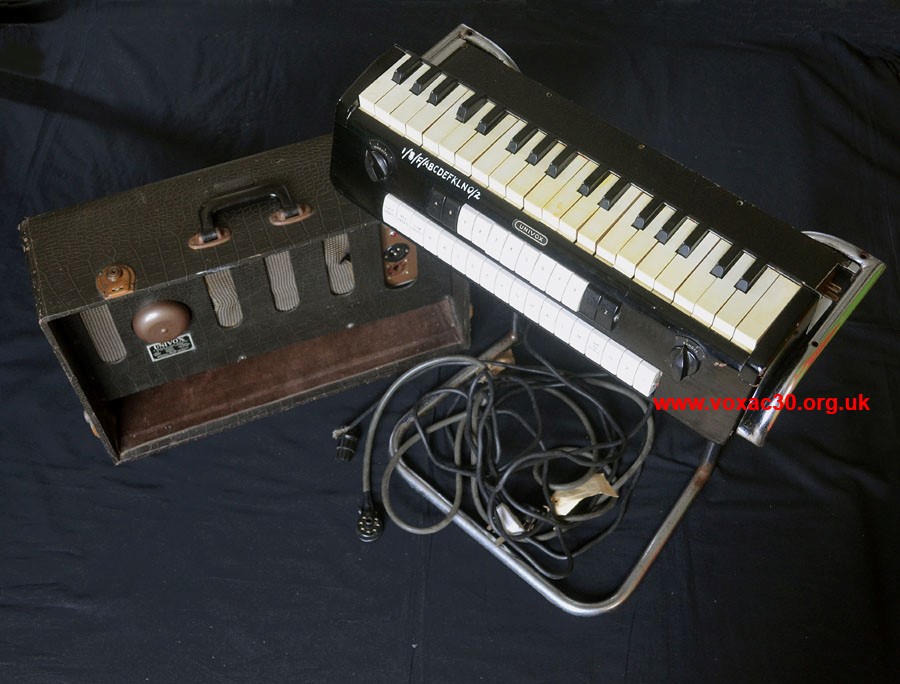
Univox J10 serial number 182.
5th January
Coming shortly, a picture page on Univox J10 serial number 182 (from early 1956, not 1955 as previously stated), with its original cables, gigster stand, and volume control (swell) bar, and still in working order.

Univox J10, serial number 182.
4th January (3)
Added to the page on later AC15s, serial number 05594, a 15 watt Metal-Clad (MC) public address amplifier. Its power section is identical to that of the AC15 guitar amps, the front end naturally quite different. The Metal-Clads across the range were assigned numbers by Jack Jennings in the relevant guitar and bass amplifier sequences (MC30 = AC30 sequence, MC50 = AC50, and so on). For more on Vox public address equipment, see these pages on the Vox AC100 website.


MC15 serial number 5594, mid 1964.
4th January (2)
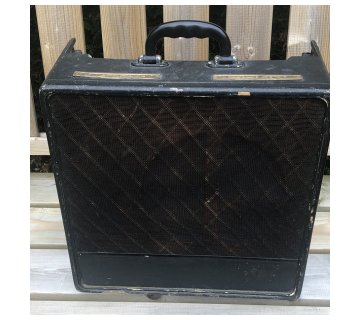
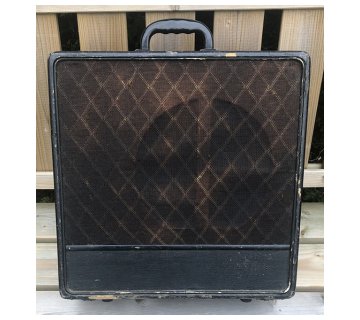
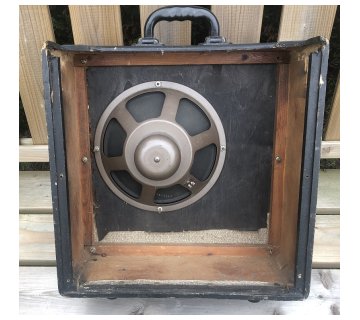
A curiosity more than anything. A Vox AC10 "Throwback" cabinet (and speaker) probably from 1961, the baffle refitted upside down, and the case painted and repurposed. When it came to light last year the amplifier inside was a WEM. Thanks to John for the pictures.
The third illustrates well how the speaker was offset to allow room for the mains transformer on the power section in the foot of the cab.
4th January
The pages on early AC10 Twins and split-front single-speaker AC10s have been updated with a half dozen or so entries. Select pictures to follow.
3rd January (2)
The new page on the Vox AC6 has now reached a stable form and will remain as is for the time being, select images of a spread of surviving examples to be added in due course. The "vibrato" - really tremolo - introduced in late 1960 turns out to have been identical to the "vibrato" built into the AC.2, doubtless a sensible "twofer".
3rd January
Thanks to Dan, an entry for AC15 Twin serial number 1441 - a Bass model - has now been added here.


AC15 Twin serial number 1441.
2nd January (2)
Just to mention that the new page on the AC.6 - link in the entry below - has been updated. From early to late 1960, the AC.6 was evidently a "simple" amplifier, volume and tone controls only. In late 1960, "vibrato" was added, presumably to update the model in relation to the new AC.2, which had vibrato from its inception.
2nd January
The page on the Vox AC.6 is in progress here. To be added shortly, notes on the circuit, some general specifications, and images of surviving examples.

1st January
A placeholder thumbnail of OS/006, the circuit diagram for the AC6 dated 8th December, 1959. In company with second circuit AC15s, the AC6 had a slide in / slide out board on runners for its chassis (as in the AC30 later on).

OS/006. Only one recension of this diagram is currently known.
PREVIOUS UPDATE PAGES BY MONTH, 2024
UPDATES 2023
UPDATES 2022
UPDATES 2021
UPDATES 2020