
Vox AC30 website updates
April 2025
29th April
The Fentones with their full-cloth front AC30 Super Twin cabinets, location and date of the photo currently unknown - before summer 1962 though. Further pics of the cabs can be seen on this page.

28th April
Below, a snippet from "Guitarist" magazine, August, 2012, Hank's recollection of being shown a Meazzi Echomatic by Joe Brown, then acquiring his own from Jennings.

"Guitarist" magazine, August 2012, article on Hank's echo units, p57.
Gene Vincent first appeared on the Jack Good television show - "Boy Meets Girls" - on 12th December 1959, the session perhaps recorded some days before. Vincent played his first concert in UK on the 6th.
It is worth noting though that Joe's recollections have not been reported well. It has sometimes been said for instance that he owned the Meazzi in question and gave it to Hank. Not so. And it has not helped that Hank has occasionally spoken of his first encounter with the Echomatic without mentioning Joe at all - see for instance this video on YouTube, 5'40" to 7'50", from 1997. But the piece printed in 2012 is clear enough.
As to how the Meazzi came to be on the set of the "Boy Meets Girls" show, one of the regular early guests may hold the key - "Little Tony and his Brothers". Little Tony - Antonio Ciacci by birth - was recommended to Jack Good by Marino Marini, and it just so happens that Marini had been an early adopter of the Framez/Meazzi Echomatic in Italy. His use of the Echomatic is expressly mentioned in early Jennings adverts.
A further possibility of course is that Jennings had simply made the unit available in advance of Gene Vincent's appearances (12th, 19th and 26th December, 1959).
That Joe actually owned the Meazzi he showed to Hank seems unlikely. Not only were they hugely expensive, but if he didn't like it - as Hank clearly recalled - why not sell or give it Hank? The unit was not - one suspects - Joe's to pass on. At any rate, it evidently didn't take Hank long to make a bee-line for the Jennings shop on Charing Cross Road.
The page on Jennings and the Meazzi has been updated.
23rd April
A new page on Vox Continental logos has been started - an overview initially, further material to be added in due course.

Standard form of logo (though not exclusively) in 1964.
22nd April
Earl Preston behind a square-top Vox Continental (from late 1963) at the Cavern Club in November 1964. The "VOX" logo - a stencilled panel (?) - is of the first type tried by JMI. The very earliest Continentals had no logo of any sort on their back panels.

The poster behind Preston advertises a forthcoming appearance by The Hollies on 24th November '64.

Vox Continental serial number TC-1089, ready for sale a month or two after August 1963.

Front of serial number TC-1089.
By serial number TC-1094 JMI changed things again, moving to a panel at rear with "VOX Continental" (all cursive). That became its standard form. In their first year of production, Continentals were a sort of work in progress. The status of the logo at front on TC-1089 is not certain. One occasionally finds the same type of panel on the back panels of Continentals from 1964.
21st April
Thanks to Hubert, there is now a page on Italian-made AC30 Twin (Top Boost Reverb) serial number 30273.
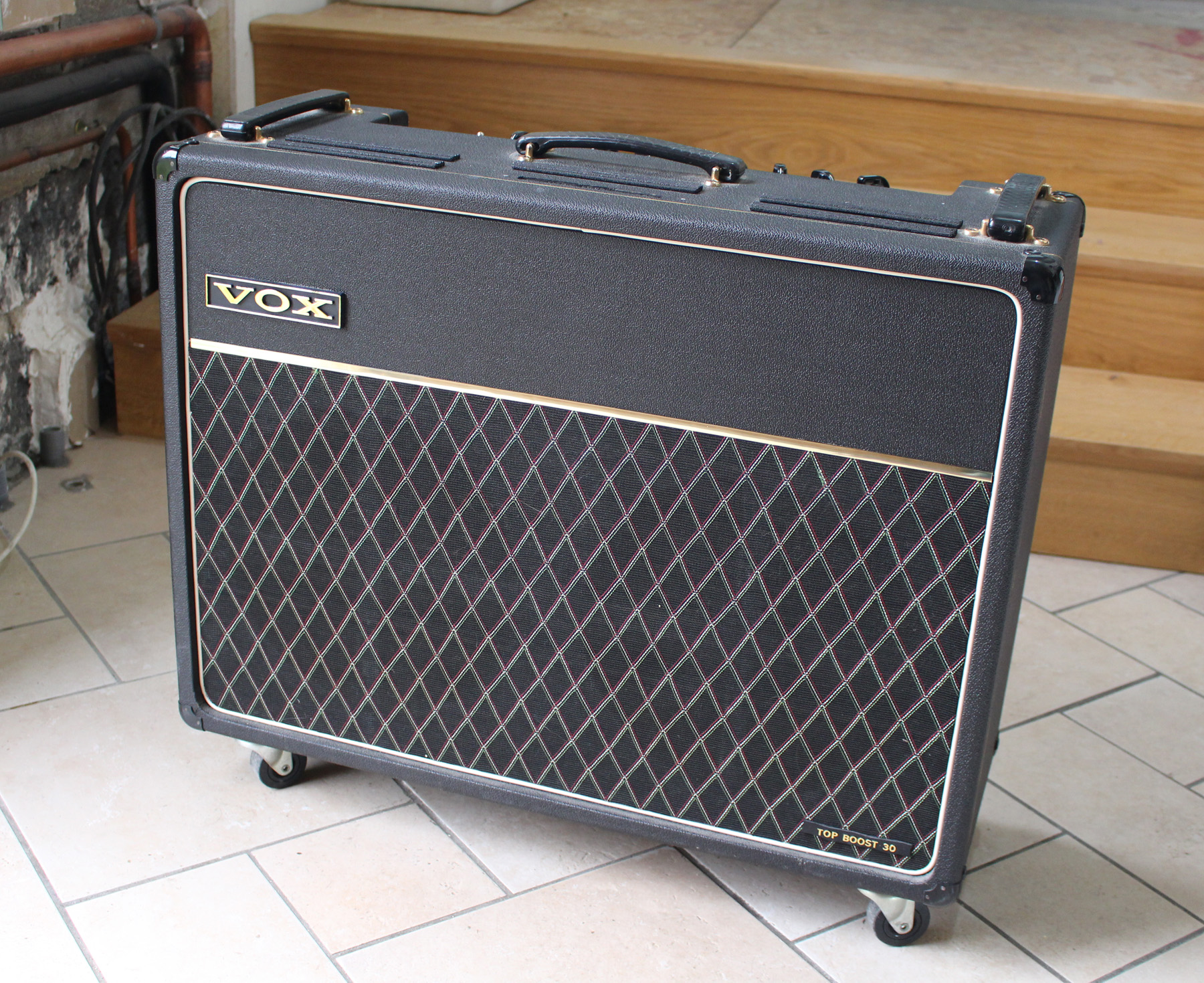
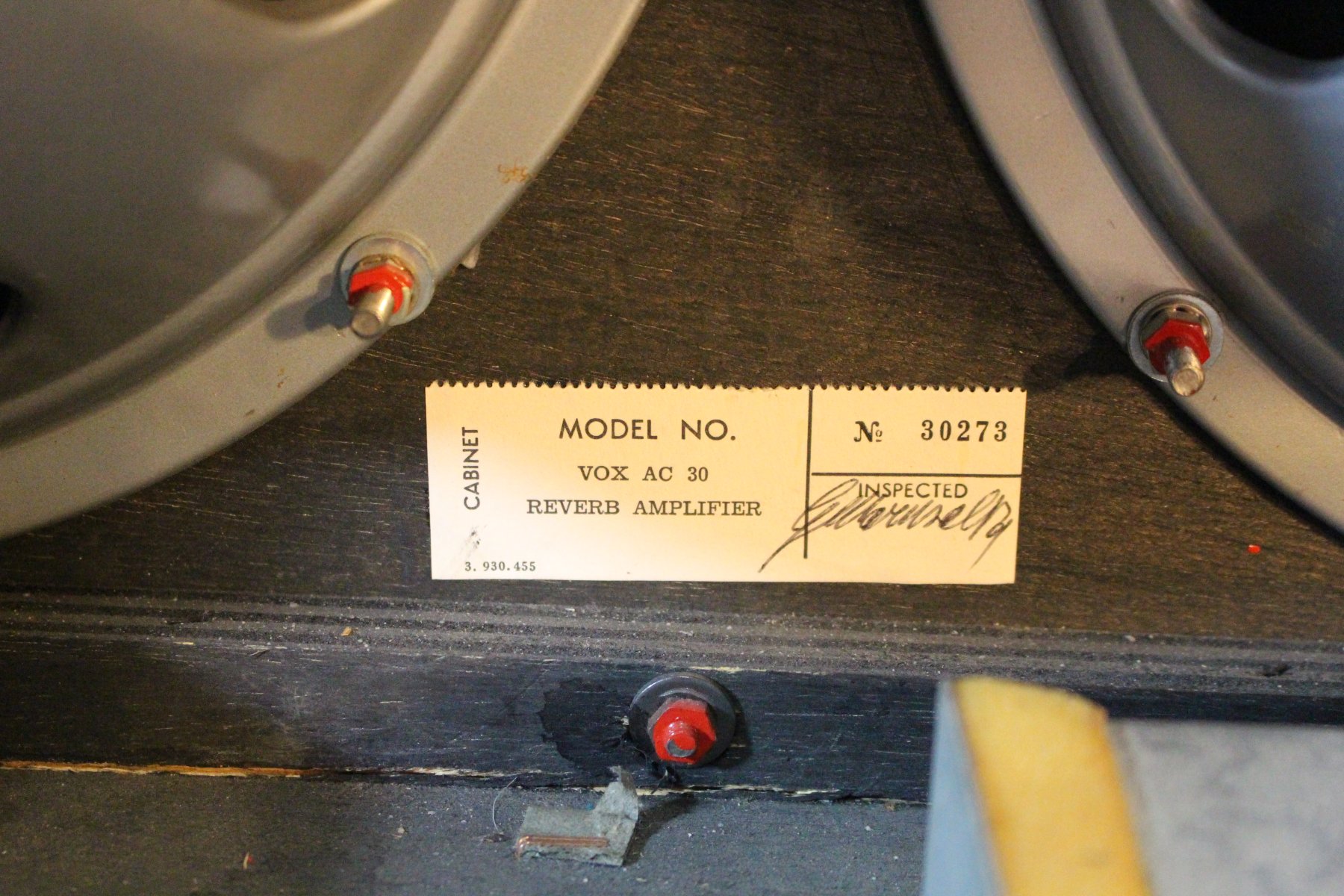
AC30 TBR serial number 30273.
20th April
Thanks to Andy, a couple of pics of AC30 Super Reverb Twin serial number 5131 T, probably late 1965. More to come soon.


AC30 Super Reverb Twin serial number 5131 T.
19th April
Below, a shot of the former Kimber Allen Engineering works in Swanley, Kent. Kimber made among things a good number of the keyboards (keyboard actions) for Jennings console organs (from 1953 into the early 1960s).
The wooden key Continental keyboards on the other hand were made initially by Herrburger Brooks in Long Eaton (into 1965), then British Piano Actions in Llanelly.
Assemblies that could not be used (including those submitted by other manufacturers in the hope of winning a tender) were stored from early 1965 in the sub-basement of the Erith Works - seen and remembered by David B., who worked as a contractor for Derek Underdown through to 1966.
More on the work these companies did for Jennings to come.

The Kimber Allen Works, sold by the company relatively recently. Documentation relating to older orders and contracts unfortunately no longer exist.
18th April
Entries for a further six AC30 Twins with serial numbers in the 21000s have been added to this page: 21203TB, 21270TB, 21377B (Bass unusual among late amps), 21500TB, 21512TB, and 21632TB. Select pictures to follow as ever.
17th April
Some brief notes on circuit diagrams for the Vox Super Continental organ (late 1965 to mid 1967):
The main sheet supplied by JMI to dealers, who will in many cases have been the first port of call for a buyer looking to have his Super Continental repaired, was TMO/015, a sort of companion sheet to TO/065 for the single manual. As mentioned yesterday, the prefix "TMO" stood for "Two Manual Organ". So far as one can tell the sequence mostly encompassed component layout sheets, i.e. sheets illustrating the position and value of resistors, capacitors, and so on, on the PCBs.
At present, two TMOs for the Super Continental are known: TMO/015 and TMO/002 (referenced by name alone, see the pic in yesterday's entry). TMO/001 and TMO/003 to TMO/014 may have been "Works Only" sheets, supplied to dealers only on request.
It is possible that there was some gap after TMO/015. TMO/030 is the main sheet for the Vox Super Continental II (released in the autumn of 1967) - circuit drawn out by Albert Hogben at some point in the second half of 1967, but the information panel later adjusted first by "Vox Sound Equipment Limited", then "Vox Sound Limited". TMO/071 breaks the "two manual" mould however, being for the single manual Vox Corinthian organ.
Component layout sheets for the Guitar Organ had a sequence of their own: "GTO", presumably "Guitar Transistor Organ".

The information panel of the main sheet provided for the Super Continental in the dealer service manual, drawn by R. Lester, no date.
16th April
Below, the information panel of JMI circuit diagram OS/095, the earliest sheet that has come to light for the Vox Super Continental's "Walking Bass" unit, drawn out on the 17th January, 1965, a small change noted in 1966.
The design of the two-manual organ was evidently underway relatively early on - relative at least to JMI's unveiling of the prototype for the first time in public at the BMII Trade Fair in August. Development is likely to have run in parallel for a time with that of the Guitar Organ.

Information panel of OS/095. The sheet looks to have been signed off by Doug McDonald. The component layout was given on TMO/002. The prefix "TMO" stood for "Two Manual Organ".
15th April (2)
The photo preceding the one in the previous entry from the set printed in January 1967:

West Street Works, January 1967.
15th April
Local Kent press, January 1967, production of organs in full swing on the second (top) floor of the West Street Works in Erith - final assembly of a Vox Super Continental organ. Following the fire at the Works in early December 1965, the Organ Department had returned to Dartford Road for a time, moving production back in stages to Erith in 1966 and early 1967.
In August, JMI released the Super Continental II, though without really saying how it differed from the existing model. The organ pictured below is a Super Continental I (not that it was ever called that).

January 1967
14th April
There is now a page on a superb early Super Continental dual manual organ that came to light in the UK a few years ago. Thanks to Steve for the pictures.

13th April
The first of a set of pages on the Vox Super Continental dual manual organ has been started here - a good deal of material to come. Below, Dick Denney and "Miss Vox" at the Frankfurt Musikmesse, late February/early March 1966, an early Super Continental just visible at left.

Frankfurt, 1966.
12th April
Posted yesterday on the Vox AC100 website, part of a longer piece on Tom Jennings, mainstream Liverpool press, September 1964, the Beatles having been in the USA for near on three weeks.

15th September 1964.
The Stones' Blackpool concert seems to have been remembered and reported as being particularly destructive. But other instances must also have been in Tom's mind. The Dave Clark Five for instance lost a good deal of their gear in a riot after a concert in Sweden in May [not July] 1964. JMI had to fly replacement amplifiers to New York for the American leg of the band's summer tour.
Below, a detail from a photo of The Stones with the wreckage of an AC30, probably Blackpool (24th July 1964?). Note that the amplifier chassis has top boost controls in panel.

Albion transformers (the choke ripped away); eight knobs on the control panel.
10th April
Dublin, October 1963, a relatively rare instance (where small ads are concerned) of a Vox Super Reverb Twin expressly mentioned as being in stock. 160 guineas (£168) was the standard Jennings list price in the autumn of 1963.
Generally speaking only the larger shops outside London would stock the whole range - Gamlins in Cardiff, Kitchens in Leeds, Barratts in Manchester, and so on, some models doubtless supplied by Jennings on a "Sale or Return" basis.

October 1963.
9th April
Just to note there is now a new page lining up the various versions of the AC10 against select JMI pricelists and adverts, late 1957 to 1961 - page number two in the Vox AC10 section of the website.
7th April (2)
Jack Woodroffe's, one of at least two Birmingham music shops to have had Italian-made Vox Echos in stock in late 1961, £89 and 15 shillings being only 10 shillings over the standard Jennings list price of 85 guineas. In 1961, £90 was equivalent to around £1700 in today's money. The page on the early Vox Echos is here.

October 1961. With a fancy red Stratocaster (perhaps a refin?) at £164 one could make a pretty good start at emulating Hank.

Jennings prices, October 1961.
7th April
Swan's, Manchester, September 1958 - certainly one of the first 100 - perhaps first 50 - AC1/15s. Swan's was a fairly long standing Jennings organ dealer. The page on early AC15s can be found here.

September 1958.
6th April (2)
Kay Westworth's, Birmingham, April 1959, a two-input AC10 at 27 guineas and an AC1/15 (classed as being 20 watts) at 59 guineas in stock.

April 1959.
6th April
Nottingham, April 1953, report of the social evening held by the local Radio Engineers Society, a Minivox played by Mr Weightman:

April 1953.
Pontypridd, South Wales, July 1953 - a Minivox ("Univox Minor") in stock at the Arcade Music Shop. 60 guineas was £63.

July 1953.

January 1953, currently the only known advert for the Minivox.
5th April
One of the earliest adverts for Vox in America illustrating equipment recently arrived (i.e. not simply reprinted from a photo supplied by JMI) - 1st November, 1964.
Left to right: an LS40 column; AC4; AC50 Foundation Bass; and an AC10 Twin. The guitars are: Vox Clubman; Dominator; Symphonic Bass; and Super Ace. The Clubman's hang-tag can be seen at left.

Cleveland, November 1964.
3rd April
A small correction to yesterday's entry. The Brimar ECF82 in AC10 serial number 3224 is certainly from late 1959, not 1969, as the "STC" logo appears above "BRIMAR" in the valve's print. STC owned Brimar from 1933 to 1960, when it sold to Thorn.

Brimar ECF82 dated "1H9" = 1st week August 1959.
2nd April
At least one of the valves fitted at factory to AC10 serial number 3224 survives: a Mullard ECC83 dated April 1959 ("B9D").

The Brimar ECF82 currently in place is dated "1H9", which means 1st week of August either of 1959 or 1969. In the bag of spares and duds that came with the amp are two unused Brimar EL84s dated "4G8" and "1H8", respectively July and August of 1958 or 1968. That they are unused suggests that all three Brimars are from 1968 and 1969.
The only other early valve (i.e. before the mid 1960s) in the box is a white print Mullard ECF82, made in Holland, dated March 1961.
PREVIOUS UPDATE PAGES BY MONTH, 2025
PREVIOUS UPDATE PAGES BY MONTH, 2024
UPDATES 2023
UPDATES 2022
UPDATES 2021
UPDATES 2020