
Vox AC30 website updates
February 2025
28th February
A correction to yesterday's entry - AC30 Twin serial number 9158 NOT 9581, "TB" stamped in the lower panel.

27th February
A note on copper control panels with integrated Top Boost controls. The very earliest are serial numbers 9029 and 9158, both likely to be genuine (i.e. the chassis are in their original boxes with original serial number plates). The plate of the latter has "TB" stamped with JMI stamps. Serial number 9836 has a repro/fake plate and other indications of being a later put-together, so unfortunately all bets are off.
That small numbers of these chassis were made ready for sale (and sold) in the last quarter of 1963 seems perfectly in order. Component date codes in the very earliest units are generally of June/July/August '63. It was only when JMI got going with the new Expanded Frequency AC30s that more Top Boost chassis were fitted to AC30 Super Twins and Twins.
24th February
Thanks to Helen, pictures of AC30 Super Twin serial number 6328, early 1963, have been added here, and on the early Super Twins page.


AC30 Super Twin serial number 6328.
23rd February
Thanks to S., some recent pics of a late TV Front AC30/4 - serial number in the high 4300s (probably 4373) - illustrated towards the end of this page. More to come shortly.


21st February
Thanks to Marc, pictures of an AC30 from the first half of 1967 have been added here. There are no signs of any screw holes for a serial number plate on the amp's back panel.


19th February (2)
Pictures of a superb AC30 Super Twin, serial number 10346, with Top Boost controls in panel, have recently been added on this page (and on the relevant Super Twins page here).


19th February
Thanks to S., further pictures coming shortly of a late TV Front AC30/4.
17th February
There is now a new index page bringing together links to the existing pages on Burndept-made AC30s. A further page dealing in detail with production numbers (and related matters) will be added shortly.
16th February
A new index page has been set up to bring together in one place links to the various pages on AC30s with Top Boost, primarily in the period 1961-1964. Some unnecessary overlaps (from page to page) have been smoothed out. More to come shortly on early Burndept-made chassis with integrated Top Boost circuitry.
15th February
Recently sold in the UK, an AC30 Expanded Frequency cabinet from late 1964, Fane 15" drivers added later. It may be that this was one of the empty cabinets acquired by Andertons in Guildford following the collapse of JMI in 1968: in other words, the cab was made for JMI by "Gla-Rev" (note the stencil) but not sold by JMI. The AC30EX did not do well. A good number of the chassis - with integrated Top Boost controls - made for the new model were subsequently re-purposed.


AC30 Expanded Frequency cab, late 1964, Fane speakers added later.
10th February
McCullough Piggott Music in Dublin, late summer 1967, an early Domino Bass in stock and a fawn split-front single-speaker AC15 with a shop plaque above its logo.

Late summer 1967.
9th February
Vox Continental organ music stands: these were fitted to the first 80 or so organs. The last of the "square tops" evidently did not have them.
The very earliest Continentals simply had the stand. Some way into production, a perspex "stop" was provided at the front of the lid to stop the music sliding off onto the keyboard.
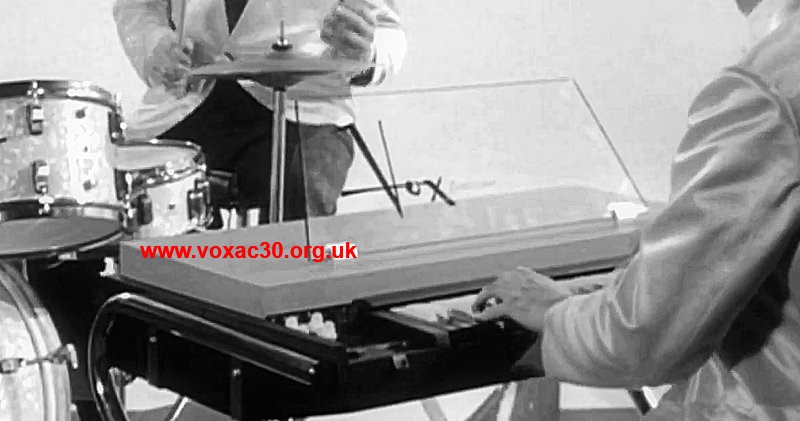
The Tornados, late 1962.
Below, a couple of shots of the organ used by Sounds Incorporated, one to show the stand and perspex "stop" at the front of the lid, the other showing the re-purposed Fender volume pedal (on top of the stand, still flat on the lid).
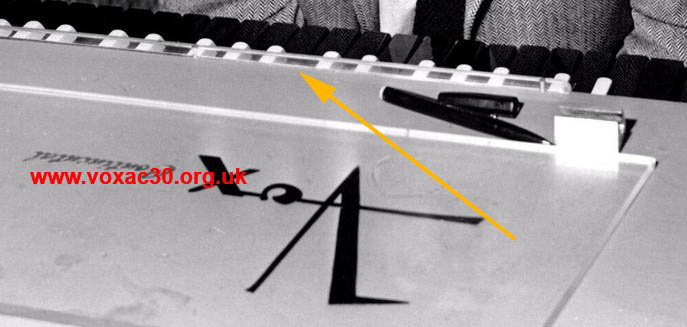
Continental used by Sounds Incorporated, perspex runner at front, fixed with three screws. Serial number TC1076 still has its runner though the stand is gone.
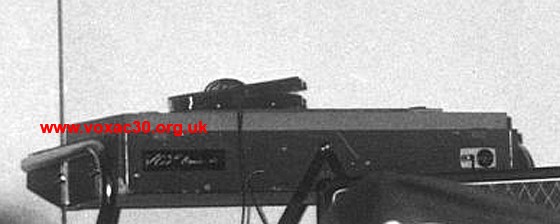
The Continental used by Sounds Inc. seen on stage, the chrome footswitch on top of the music stand.
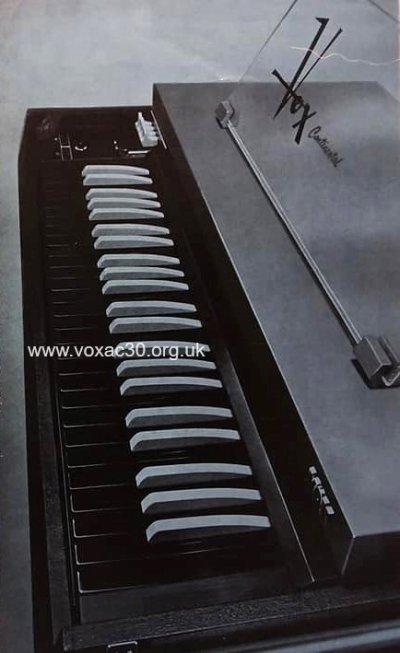
JMI's promotional Continental, no perspex runner or screw holes.
6th February
Below, a gentle probing of the question of how many Vox Continental organs were made (ie. made ready for sale) at Dartford Road in early years:
Late 1962 to late 1963 - probably around 130-150, from TC1000 through to the mid 1100s (insofar as serial numbers are concerned).
Late 1963 to late 1964 - somewhere over 400, from the mid 1100s into the higher 1500s / low 1600s.
400 in one year is a colossal number - approximately 8 per week. A note on known component date codes will be set out in due course.
Herrburger Brooks (makers of keyboard assemblies for JMI): a preliminary search through the Herrburger archive in the Derbyshire County Archive a little while ago did not bring to light - at first pass - any ledgers with details relevant to Jennings or Continentals. It may be that something will emerge in further trawls.
What does seem clear at present is that the numbers stamped by Herrburger on the assemblies it made for Jennings increase as JMI's own serial numbers increase. Their only relation however is up.
5th February
Some notes on English-made Vox Continental organs, 1964 to 1965, preparatory to a forthcoming page:
1) - few Continentals have come to light so far with "TC" numbers ("Transistor Continental") in the 1600s, 1700s, and most of the 1800s. Why? Simply one of those things? It seems unlikely that organs with numbers in this range were caught in the fire of December 1965.
2) - between serial numbers TC1597 and TC1888 a new mode of assembly was evidently brought in: generator boards laid flat in a metal tray instead of being held upright in a metal frame. The change is likely to have been introduced soon after the Organ Department moved to Erith in late 1964 / early 1965. An organ with new-style boards is seen during final checking in one of the films made at the Works in early '65. Serial number TC1888 is certainly from 1965.
3) - the machine stamping of plates comes in at much the same time as the change in production noted above - between TC1597 (hand stamped) and TC1888 (machine stamped).
4) - also, a new style of serial number plate appears. "The Jennings Organ Company Ltd" becomes "Jennings Musical Industries Ltd" with "Dartford, Kent, England" underneath. The voltage rating changes - from "200/250 VOLTS" to "110/250 VOLTS". Bulk exports to the USA - in other words to Thomas Organ - are clearly in view, the deal with Thomas having been announced in late August 1964.
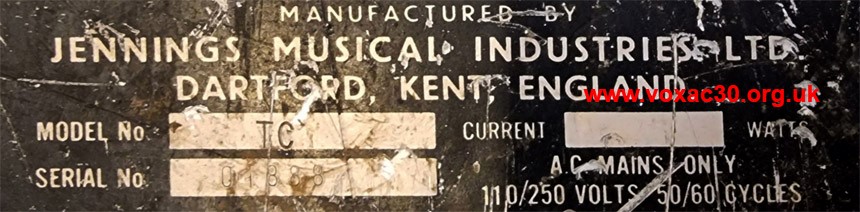
TC1888. On the generator boards, Mullard mustard capacitors with date code "D4N" = last quarter of 1964 for their manufacture. But see (6) below.
5) - the fire at the West Street Works (Erith) in December 1965. The most likely picture at present is that organs with numbers in the higher 2000s were destroyed, production thereafter swiftly being passed under contract to Burndept - Continentals with numbers in the 3000s, plates marked "BD".
6) - in 1964 JMI evidently bought a huge number of Mullard mustard capacitors for use its organs. These have "A4N", "B4N", "C4N", and "D4N" date codes = first, second, third and last quarters of 1964 for their manufacture. In serial number TC2673, Mullards with these dates are found in company with an original electrolytic dated September '65 (the organ therefore not ready for sale until some months later). For the Mullards to have any real value in the assessment of a Continental's date, one needs some secondary point of reference.
3rd February
Added to the new page on Vox organs at the 1967 Trade Fair, a plan showing the rooms allocated to the various companies on the first floor of the Russell Hotel. JMI's main organ display was in room 135 (pictured on the recent page). Thanks to Martin for the shot of the plan.
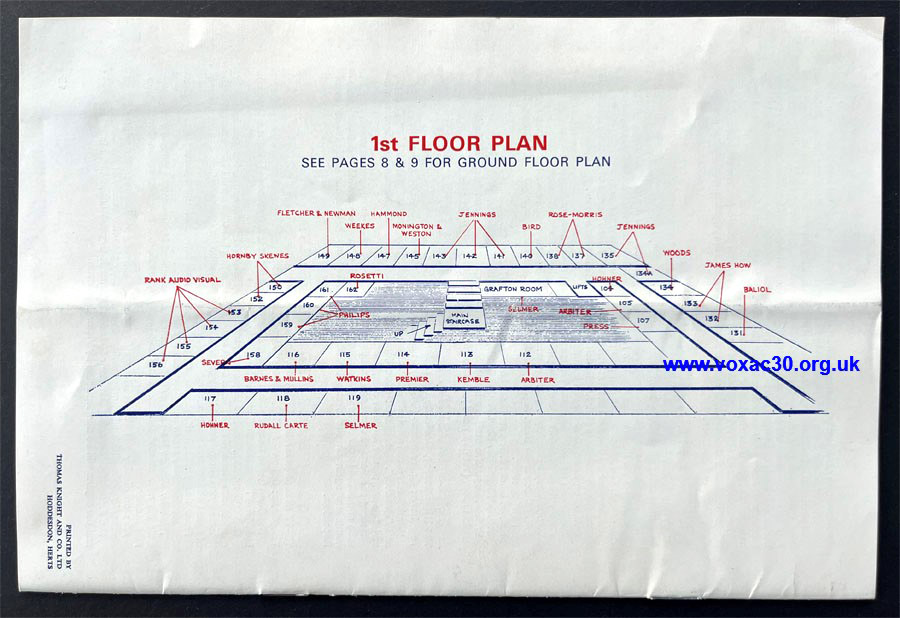
BMII Trade Fair brochure. Jennings had five rooms on the floor: 134A, 135 for organs (probably along with 134A), and 141-143.
2nd February
The page on Vox organs at the BMII Trade Fair of August 1967 has now been started here. Attention centred on six models: the Riviera, Super Continental II, and the four new console organs: the Casino, Carousel, Carnival, and Concerto.
PREVIOUS UPDATE PAGES BY MONTH, 2025
PREVIOUS UPDATE PAGES BY MONTH, 2024
UPDATES 2023
UPDATES 2022
UPDATES 2021
UPDATES 2020