
Vox AC30 website updates
December 2025
30th December
A Jennings Organ Company pricelist from March 1960, and one of the last full-page adverts for the range (July '60) in the music trade press - just a couple more after this one.

March 1960.

July 1960.
26th December
An AC30 Twin with a serial number somewhere in the range 11100 to 11600, Treble voicing, black plastic serial number plate, basketweave vinyl (not the commonest covering at this point), Woden tranformers with "AV" = January 1964, and choke "BV" = February 1964. Perhaps of greatest note: the amp preserves its original yellow-print Mullard EL84s with paint code "LA" = January 1964, i.e. earlier than the choke.


24th December (2)
A little more on the chassis illustrated in the previous entry. What explains its form is JMI's drive during the course of late 1964 and 1965 to produce further models for the American market, ratified by the Underwriters Laboratory (UL).
Below, a detail from a large flyer produced for the Trade Show at the Russell Hotel in August '65. On the face of things, the set illustrated looks like an AC50, but the chassis is clearly suspended from the top of the amplifier section cabinet, and there is a sloping section at back for the controls.
The format of the chassis will in other words have been the same as Alan's: three blank sides, all controls and sockets on a single sloping fascia, rearward rather than forward facing.
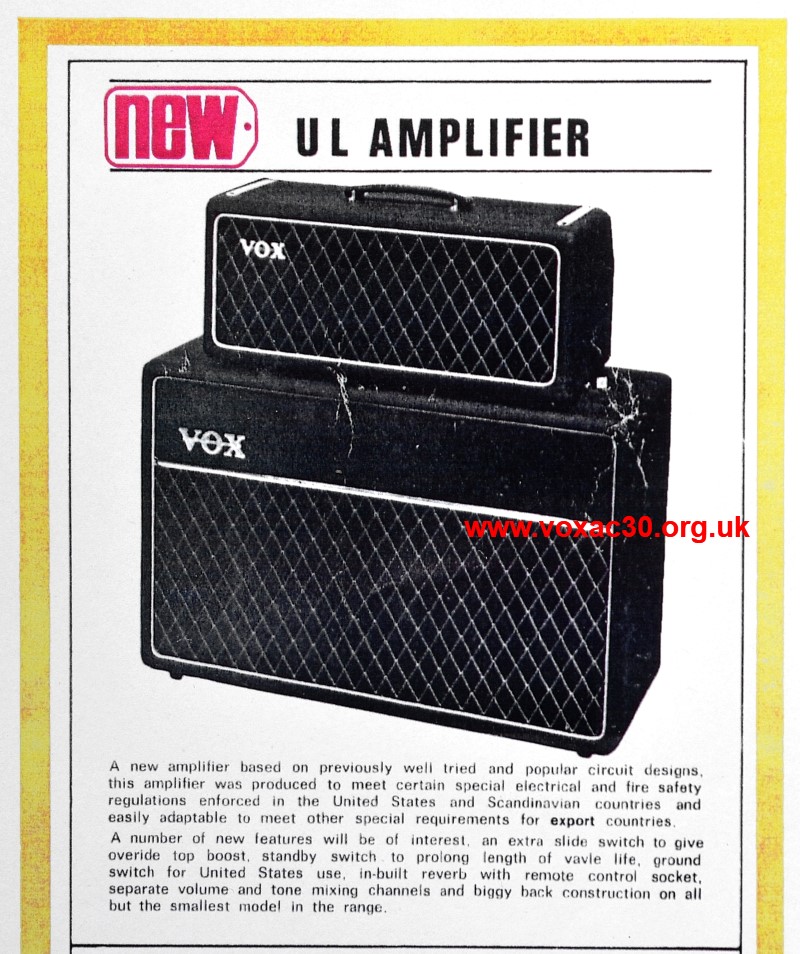
Detail from one of the two versions of the flyer produced for the Trade Show of August '65. Both had the same illustrations but slightly different texts and graphics. Note the mention of a slider switch for Top Boost (bright switch), and ground ("Polarity") switch.
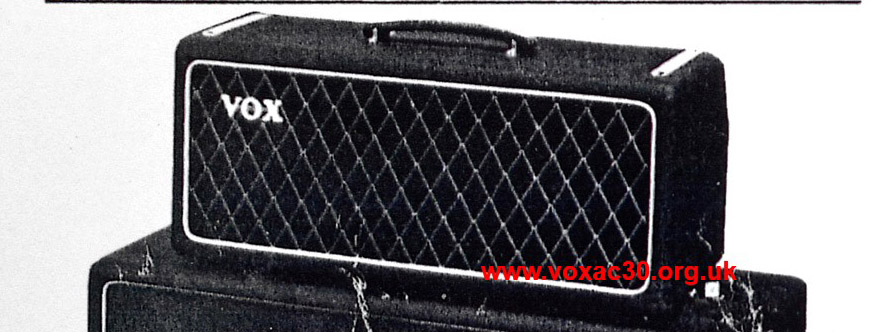
Straps on top of the cabinet (much as Fenders) for the chassis securing bolts, sloping fascia at rear with the controls, the rear of the chassis inaccessible inside the cabinet.
It is not known whether the chassis below was intended for a 10W Twin or Super Twin ("piggy-back") in the new range envisaged by JMI.
24th December
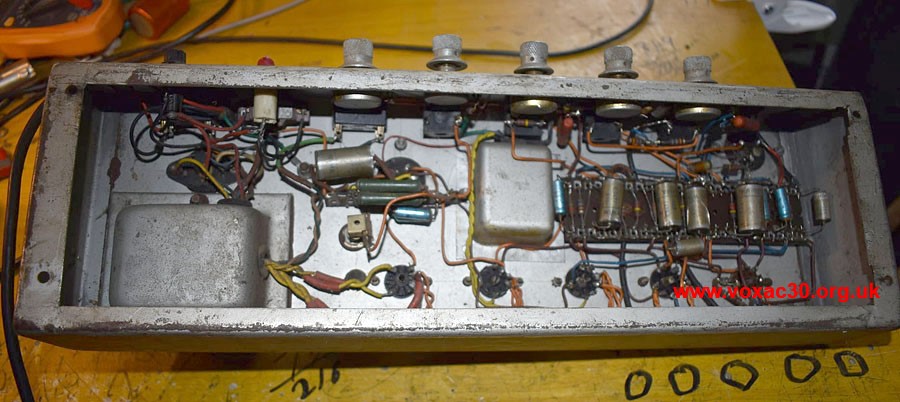
Some shots of a chassis owned by the late Alan Vale, thought - perhaps not wrongly - to have been made (in whole or part) by Dick Denney.
On the back panel in felt tip: "DICK DENNY (sic) PROTOTYPE JMI VOX / £500+ ALL ORIGINAL LESS VALVES". It may be that the person who wrote the note did not know Denney in person. From what one can see, the chassis should really be termed experimental rather than a "prototype" however.
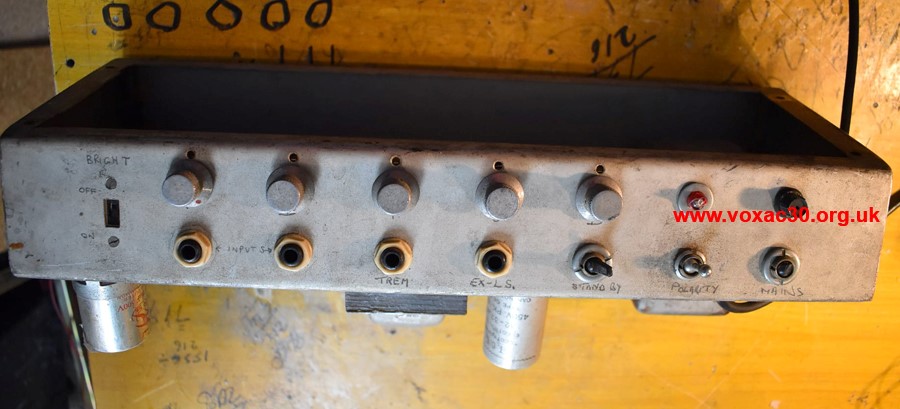
Format: designed to hang from the top of a cab (along the lines of Fender chassis). All controls are forward facing, sockets and fittings too, including an extension speaker socket. Perhaps at this point in the experimentation the cabinet was envisaged as being substantially deeper than the chassis as we have it.
The circuitry: stands in close relation to the Thomas Organ Vox Pacemaker (V-2) on the one hand, and to JMI's UL710 (without reverb) on the other. The output transformer is a Parmeko, possibly also the mains. There is no choke. The valves will have been: EZ80 rectifier [an EZ81 more likely], two EL84s, and two ECC83s.
Controls (left to right) are: Volume; Treble; Bass; and Tremolo Speed and Depth. At left, a bright switch, and below the controls: two inputs; a footswitch socket; an extension loudspeaker socket; and three switches - Standby, Polarity, Mains.
A fuller account of the circuit to follow.
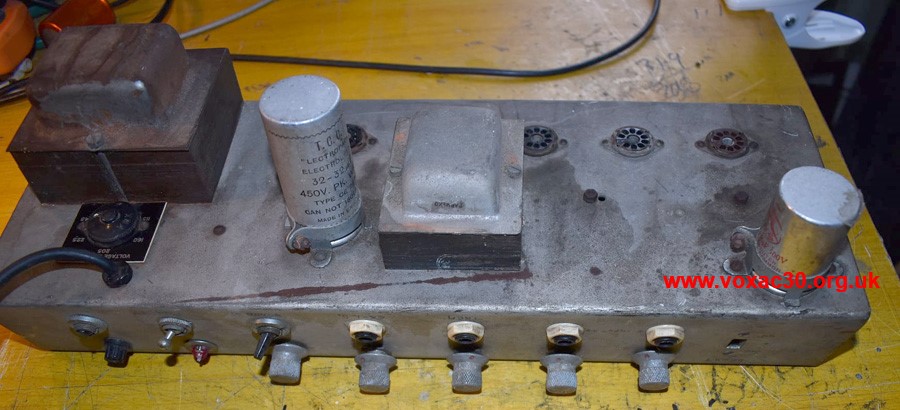
Dome voltage selector.
Unusually orange wire was used for the heater runs (and elsewhere in the circuit). Heater wiring was normally brown and black in JMI amps.
23rd December
Details of the Top Boost module added to AC30 Twin serial number 16960 - genuine JMI electronics from later 1965 and part of what appears to be a kit from the 1980s or 1990s. Such kits were common enough in these decades, often advertised in the small ads of music magazines.
Quite where the Top Boost circuitry now in the amp came from is impossible to say - either the add-on module from another AC30, or perhaps from one of JMI's boxed kits, though why not simply install it with the supplied bracket?

The sheathed flying leads connecting the module to the preamp can be seen at right in the upper half of the pic.

The large blue Hunts capacitor has the date code "IYS" = 30th week of 1965 for its manufacture.
22nd December
For those interested in the construction of transformers, the WayBack Machine preserves an interesting account by Steve Giles of the making of an output transformer for an AC30/4 - the three pages (originally posted in 2011) can be found here.
Although the pictures accompanying the text do not appear to have been saved, the account given by Steve of the make-up of Haddon OTs (from 1960/1961) is useful in its own right.
20th December
Entries for three more AC30 Twins with serial numbers in the 16000s - all Treble voicing - have now been added: - 16431T, 16947T, and 16960T.
19th December
Entries for three more AC30 Twins with serial numbers in the 15000s have now been added - 15048T, 15508B, and 15665T.
18th December
Four new/updated entries for AC30 Twins with serial numbers in the 19000s - 19225TB, 19266TB, 19321T, and 19825TB.
17th December
There are entries now for AC10 Twin serial numbers 2056, 2118, 2268, and 2678 on this page.
16th December
Entries for AC10 Twin serial numbers 1646, 1940 and 1964 have now been added on this page. Further 10s to come shortly.
14th December
Perhaps the chassis pictured below was created/pimped up as a sort of practical joke (the creator is known):
CHASSIS: - produced by Westrex late 1961 / early 1962. Re-welded "phantom" cut-out beside the rectifier valve. Now crudely media blasted.
TRANSFORMERS: - original Haddon mains and choke. The output transformer is a replacement from a much later AC30. Unfortunately the mains transformer has been given a Parmeko label taken from some other amp. Perhaps the media blasting blasted off the original Haddon label.
COMPONENTS: - blue Hunts electrolytic caps with "WDW" and "HTW" = 18th and 24th week of 1961 for their manufacture. The tone pot has "FI" = June 1961.
WEIRDNESS: - recently introduced Mullard mustard caps (with a variety of later date codes) have lurid red dye/paint/nail varnish on their solder joints - not the slightest attempt to match the original Westrex joints. Why bother at all?
CABINET: - a Super Twin amplifier section box, hard to say for sure, possibly a repro.

9th December
Thanks to Johann, pictures of Italian-made AC30 Twin serial number 2773 (TB), signed off in March 1970 though likely to have been ready earlier, have been added here.


AC30 Twin serial number 2773.
7th December
Cathode bias resistors in AC30s: in 1961 and 1962 the value conventionally used was either 80 ohms or 82 ohms, generally a green-bodied Welwyn ceramic rated at 4.5 watts.

82 ohm cathode bias resistor in an AC30 chassis assembled by Burndept, early to mid 1963 (Woden transformers dated "AU" = Jan. '63).
In the summer of 1963, as has long been known, the value of the resistor was reduced to 50 ohms (an addition dated 14th June on the main service sheet) in order to gain more power from the EL84s, a change that resulted also in hotter running.
As to the point at which the new value was introduced by the contractors charged with assembling AC30 chassis (Westrex and Burndept), evidence is scanty at the moment, the earliest instance in terms of available photos being AC30 serial number 8298. One should probably be looking more to amps with numbers in the higher 7000s for the actual point of changeover however.

50R cathode bias resistor in AC30 serial number 8298, small detail.
So far as one can tell, Westrex normally used a 50 ohm Radiospares cement resistor, Burndept a green ceramic Welwyn 47 ohm, the closest value available. Welwyn did not produce 50 ohm ceramics.
5th December
The Beatles, Paris Theatre (London), 18th December 1963, a good glimpse of the backs of the three AC30s, Top Boost controls centre (as ever) and serial number plates to their left. George Harrison's had a sticker on its plate.
A few days later the band received new amps from JMI: AC50s for John and George, and an AC80/100 for Paul.

3rd December (2)
The first entry for today has been readjusted. Also to note the presence in serial number 21944, normal for the point of production in view, of the later (latest) form of JMI control panel, introduced during the course of the 21000s, the earliest instance so far being serial number 21937.

Detail of the control panel of serial number 21944, the letters of "JMI" on individual panels of silver lying in between (ie. not running into) the main horizontal bounding lines.
3rd December
Recently sold in Europe, AC30 Twin serial number 21944 TB, its guarantee envelope still extant. The amp is likely to have been ready for sale in early 1967 - no shots of the electronics unfortunately.

PREVIOUS UPDATE PAGES BY MONTH, 2025
PREVIOUS UPDATE PAGES BY MONTH, 2024
UPDATES 2023
UPDATES 2022
UPDATES 2021
UPDATES 2020