
Vox AC30 website updates
February 2026
27th February
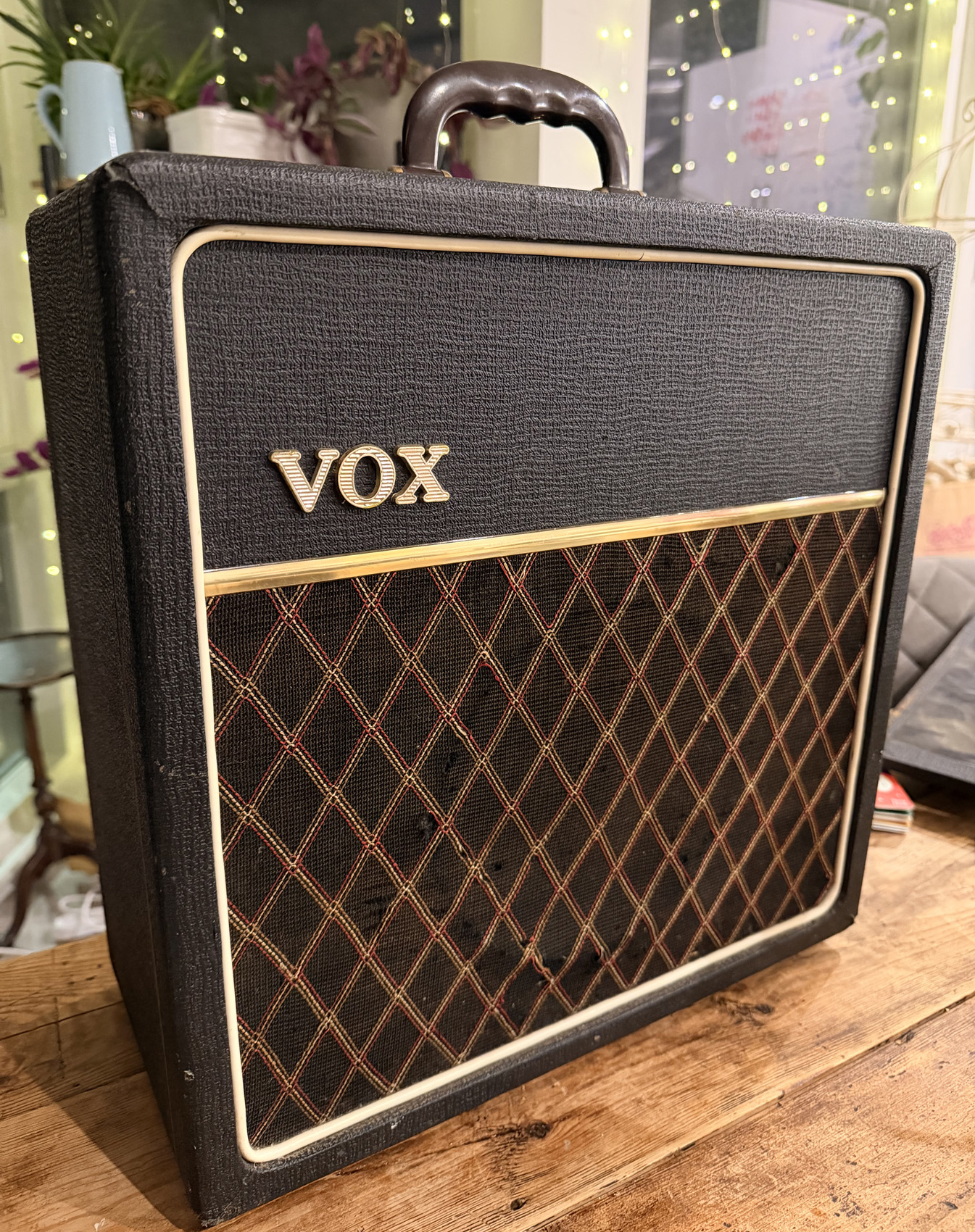
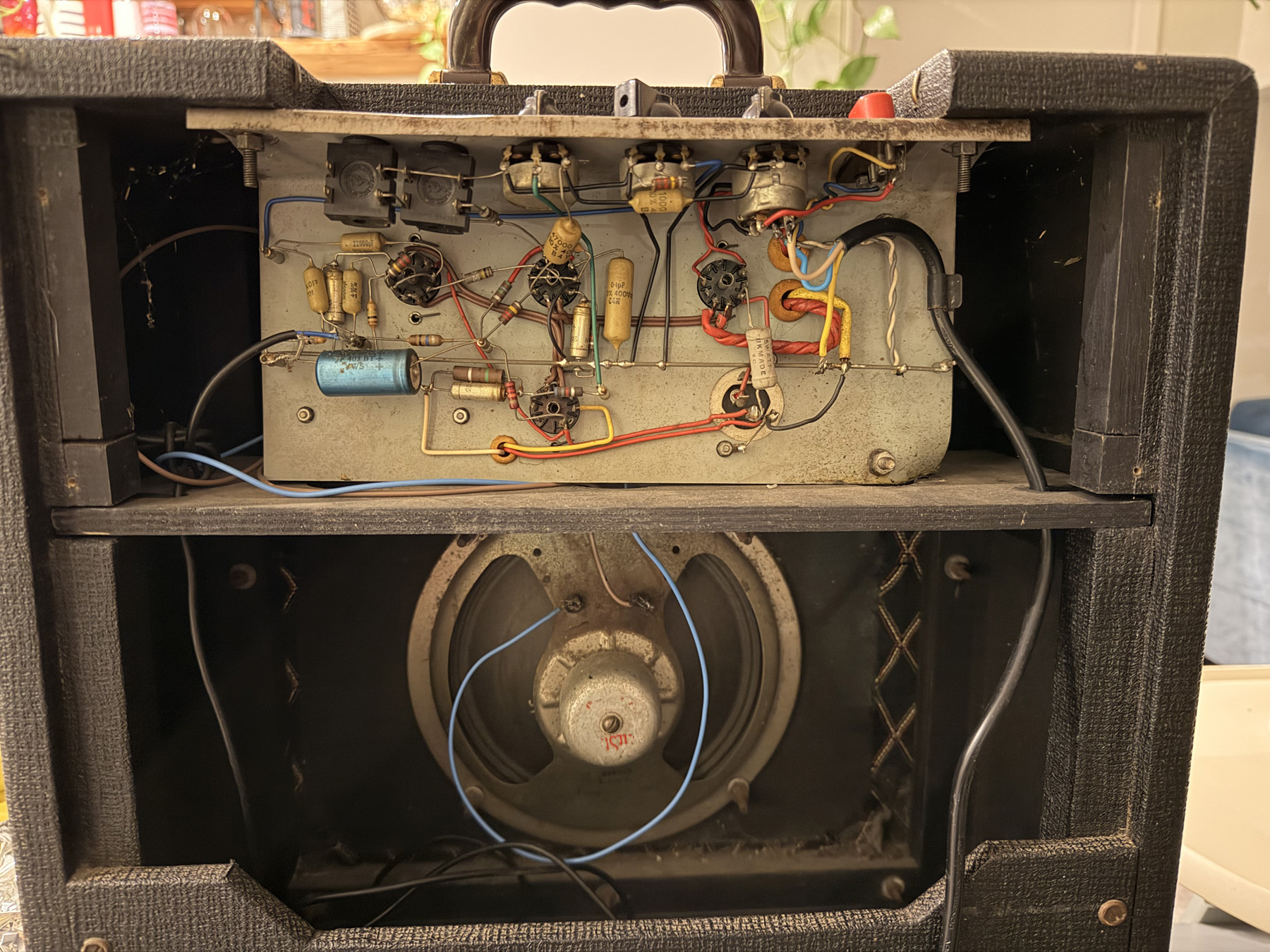
Thanks to Chris, pictures of AC4 serial number 4889 have been added here.
26th February
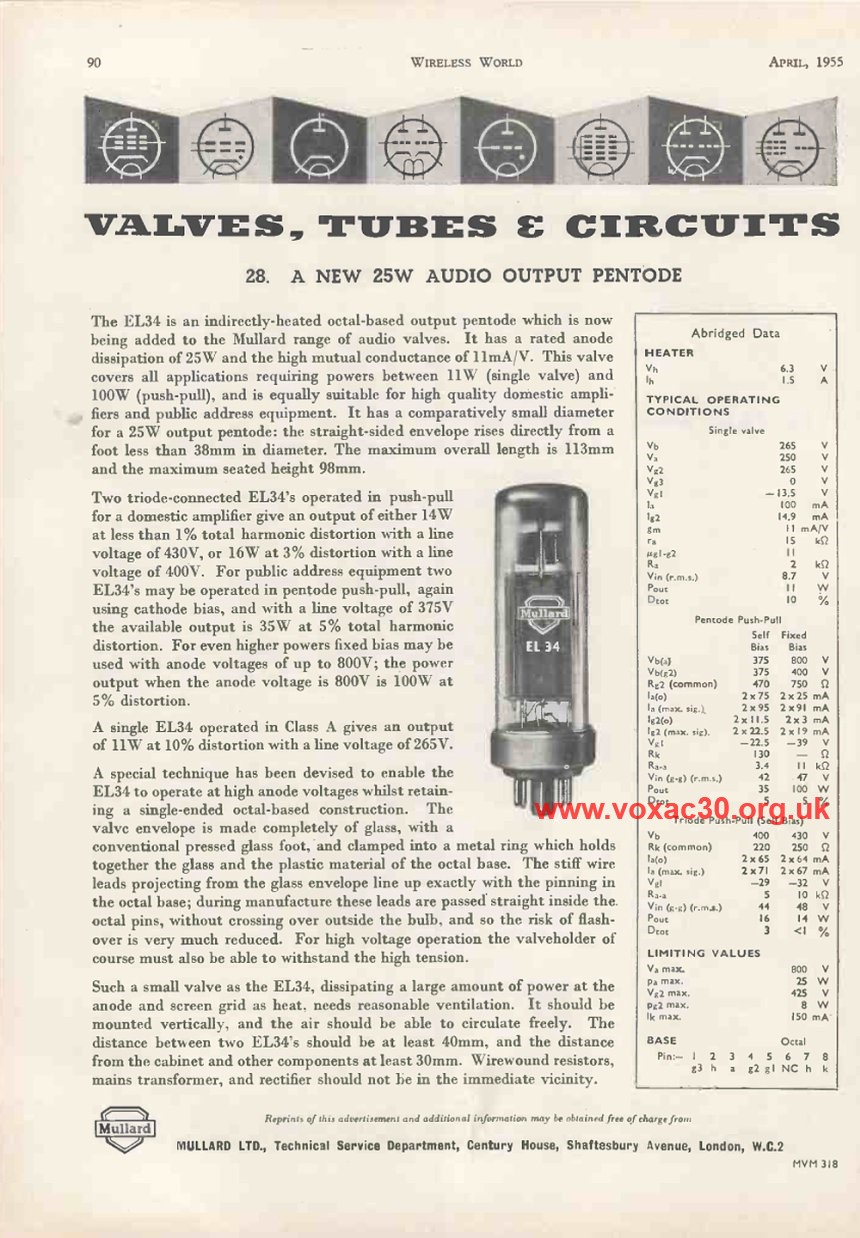
Some notes coming on the use of EL34s in Jennings amplifiers (organ and guitar) in the later 1950s. Below, a copy of one of the earliest adverts for the valve in the UK - "Wireless World", April 1955. Reports of adverts from 1952 are incorrect (probably just typos as 1952 is impossible).
The valve pictured is of the earliest principal type, flattish-topped glass envelope, metal base, not ideal as it turned out for high power applications in confined spaces as the glass and metal expanded at different rates resulting in breakages. So far as is known, Jennings did not use these.
April 1955.
24th February
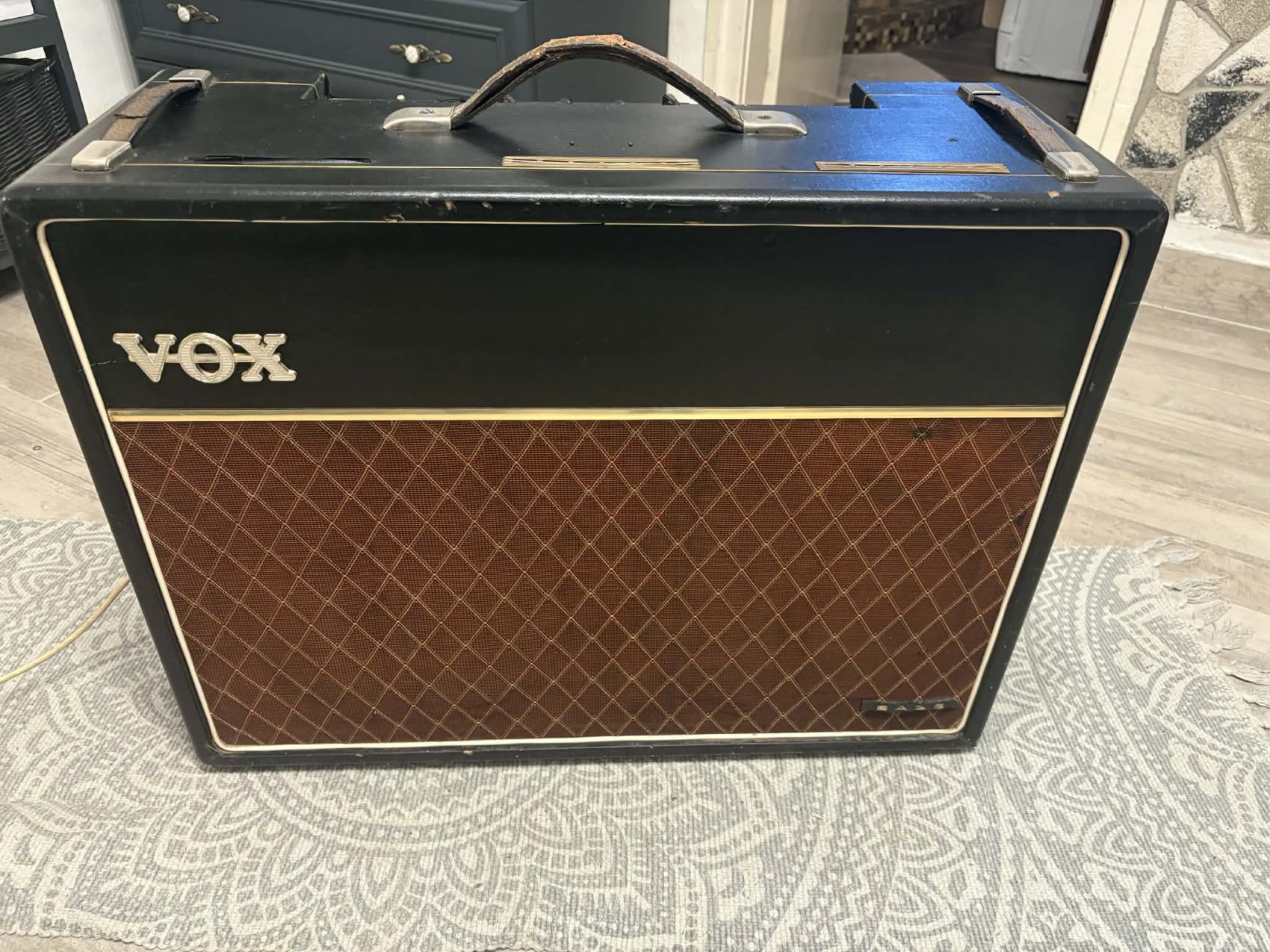
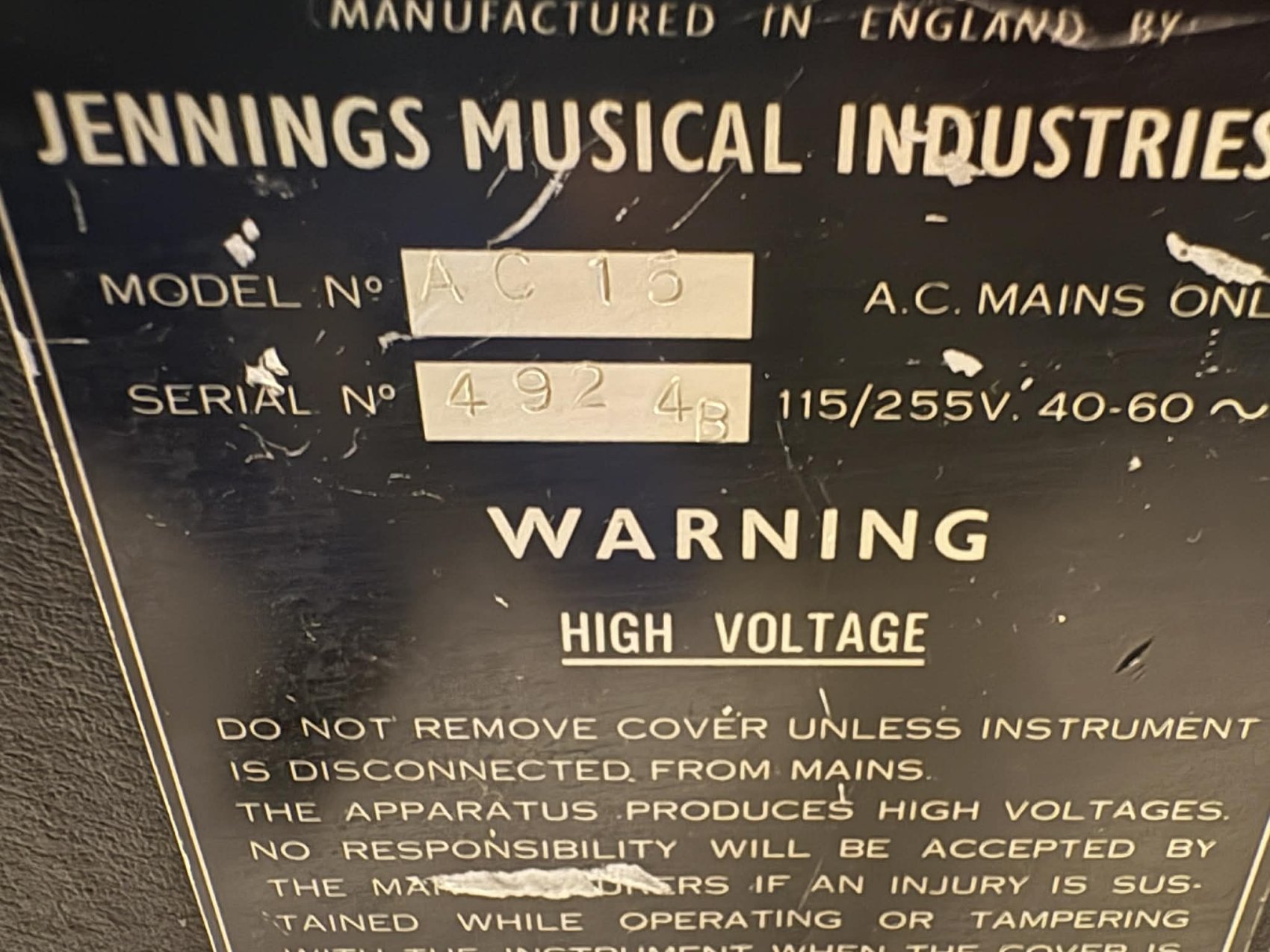
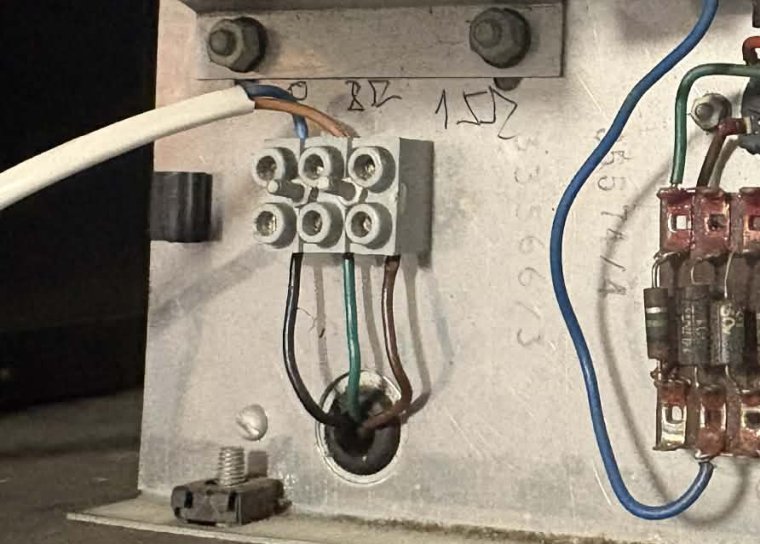
Thanks to László, some pictures coming of AC15 serial number 4924B, late 1962 / early 1963. In the preamp, some interesting stamps: "35574/4" and "33566/3".
23rd February
In the summer of 1972, "Vox Sound Limited" went to the NAMM show in Chicago as the "English Organ Company", a little bit of mischief as the Thomas Organ Company still held the sole rights to sell and distribute VOX equipment in the USA at this time. Below, two amps prepared either for display on the EOC stand or for an American customer (or customers) who had ordered at the show, one an AC30, the other a V100.

Trade Press, July 1972.

"English Organ Company" AC30 serial number 25905, letters in gold colour. The speakers are dated August 1972, so this amp is likely to have been ordered at the show and sent over later.

"English Organ Company" V100 serial number 1094, letters in silver.
22nd February
The general page on types of early AC10 - a sort of overview of surviving examples - has been tidied up and updated, further material to be added in due course.
21st February
A provisional overview of the move from thin-edged to thick-edged cabinets across the range of JMI amplifiers in later 1964:
AC4: - in the 3500s.
AC10 single speaker: - in the 4500s.
AC10 Twin: - accompanying the move to a new serial number range beginning at 1000.
AC15 single speaker: - in the 5580s.
AC15 Twin: - no change.
AC30: - no change.
AC50: - around serial number 1100.
AC100: - around serial number 220.
Below, details of two AC10 Twins:

Thin-edged cabinet.

Thick-edged cabinet.
20th February
Text entries for a further eight AC30s with serial numbers in the 22000s have been added on this page: 22118, 22226, 22403, 22492, 22596, 22615, 22712 and 22715. Select pictures to follow.
19th February
Further instances of second-hand Domino amplifiers in small ads:
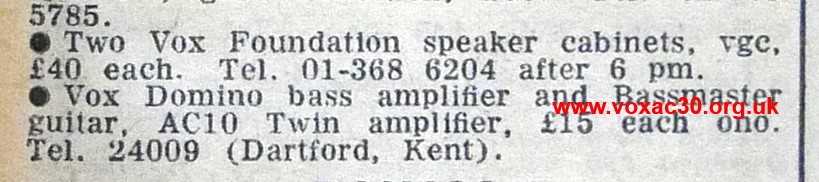
July 1968, a Domino Bass (presumbly amplifier section only).
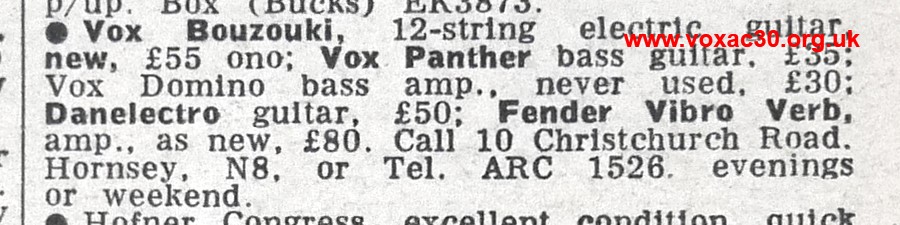
August 1968, a Domino Bass, unused (presumably the piggy-back set).

February 1967, surplus/obsolete stock bought in by a seller whose shop was a few doors down from the West Street Works in Erith. The Dominos were "P/B" = piggy-back.
The page on the Domino Bass to be updated shortly.
18th February
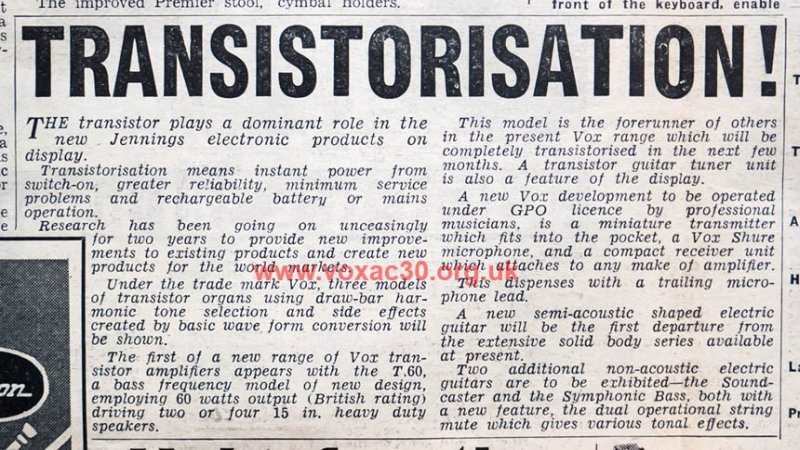
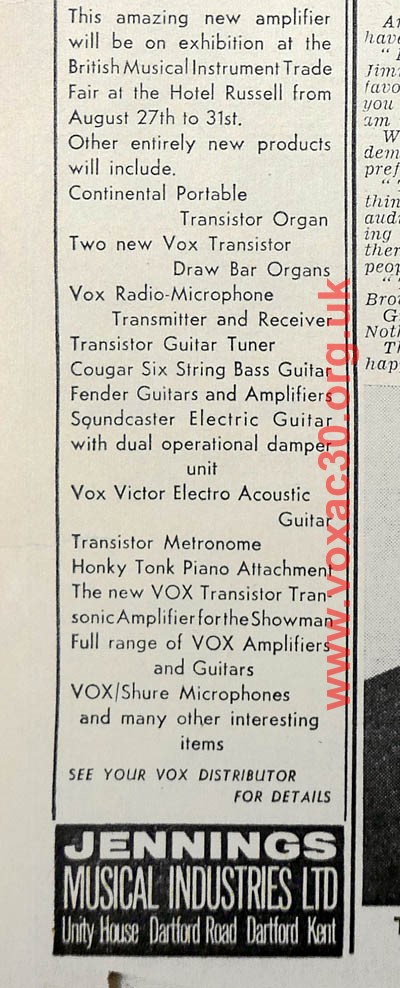
Late August 1962, a couple of previews of the Jennings stand at the Russell Hotel Trade Show, the first a brief account of the new things - "Transistorisation!" - the other a list of coming models in an advert for the T60 placed in the magazine by Tom. As far as amplifiers are concerned, the review only singled out the T60 for mention. Jennings naturally referenced both the T60 and the Transonic in its ad, the two seen in pictures taken at the show.
The Radio Microphone took a good while to bring to market - an overview can be found on this page on the Vox AC100 website.
17th February
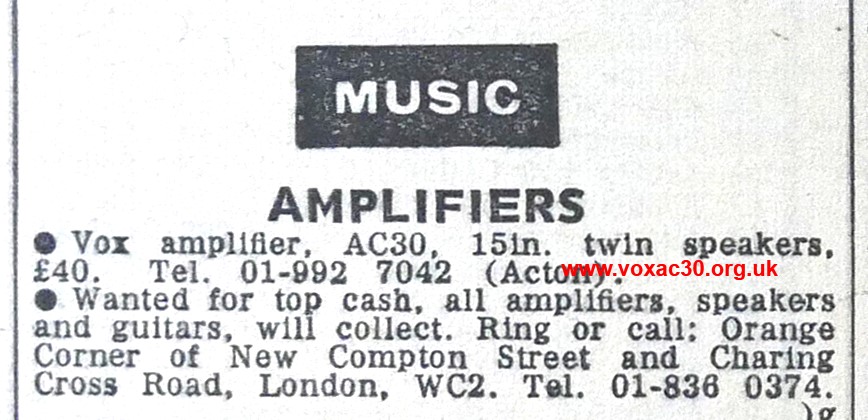
October 1968, "Exchange and Mart" magazine, an AC30 with twin 15" speakers ("Expanded Frequncy"), possibly standard production, but it could just as well have been one of the amps made up from parts purchased at the liquidation sales held at Dartford Road and the West Street Works in Erith.
16th February
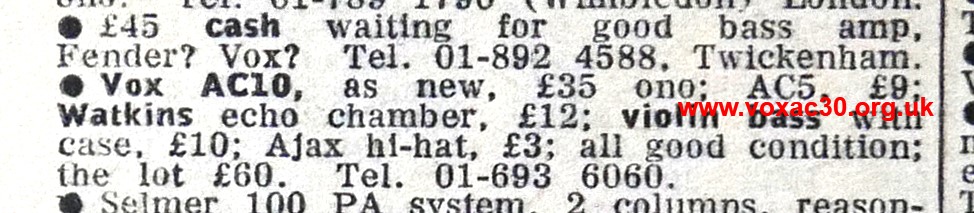
June 1968, "Exchange and Mart" magazine, an AC6 for £9 (around £140 in today's money) rather than an AC4?
14th February
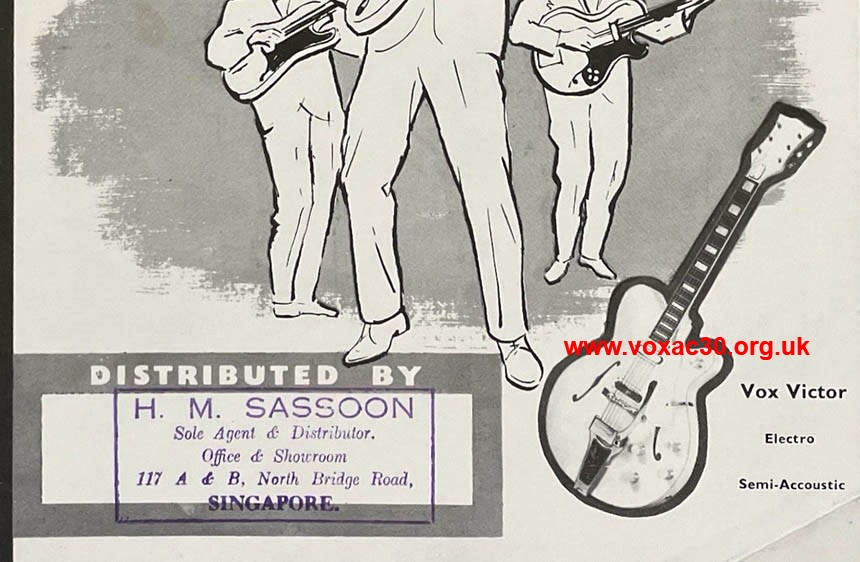
A detail from a copy of the "Choice of the Stars" fold-out catalogue of late 1962 sent out by Jennings to H.M.Sassoon in Singapore, probably the only Vox dealer in the Malay Peninsula at the time.
Jennings normally supplied its latest literature. The "Choice of the Stars" brochure catalogue was superceded in mid 1963, where amplifers were concerned, by the "Precision in Sound" catalogue in light blue - pics on this page, entry for 15th September.
Sassoon was also the local agent for Royal Enfield motorcycles, a position he held into the early 1980s.
13th February
An entry for single speaker AC15 serial number 5646N has been added here . Its speaker is a Celestion silver (T1088) from Spring 1966 or later, solder terminals on a discrete board, though whether it is the original is difficult to tell for certain. The solder does not look new however.
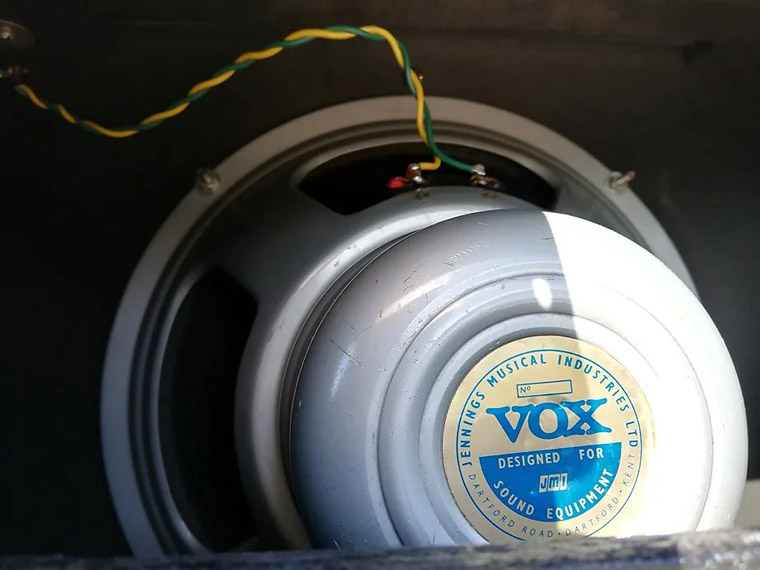
Pictures to come shortly of serial numbers 4999N and 5630N, also single speaker.
10th February
Further notes on the chassis pictured below, said to have been Dick Denney's "prototype" for the AC30 Twin (1960).
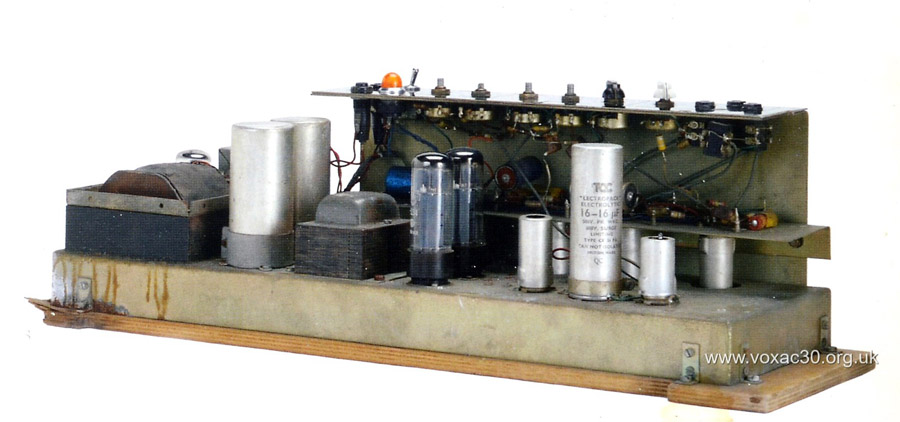
Picture from Jim Elyea's book, p. 381.
1) - as mentioned elsewhere, the chassis has all the appearance of having been made by Triumph Electronics, one of JMI's principal contractors. The same sort of preamp "shelf" arrangement is also present in the first version of the Vox MC100/6, produced by the company for JMI in late 1964.
2) - insulated stand-offs (soldering points) are used throughout the preamp and power section, again typical of Triumph. One looks in vain for these in amps known to have been built at Dartford Road or by other JMI contractors (Burndept, Westrex, etc.).
3) - there is no Vibravox, only Tremolo (a single control positioned before the volume controls).
4) - the Treble and Bass controls are labelled "Presence", a term not used by JMI.
5) - the arrangement of the preamp valves - facing downwards through holes in the chassis plinth - is just bonkers.
6) - there are hum balance potentiometers for the 6.3V lines in the preamp and power section.
7) - the metalwork of the chassis is clearly passivated (electro-dipped to hinder corrosion). The chassis of single speaker AC30s were plain untreated steel through to the summer of 1960.
8) - input jacks in diamond formation are only otherwise found in the Vox AC50 of late summer / autumn 1964, assembled for JMI by Triumph.
9) - a variety of makes and types of capacitor and resistor are used. The former have date codes ranging from the 1950s through to 1964, the latest being Mullard mustards with "A4N", which can only be first quarter of '64 or, not particularly likely, first quarter of 1974. Hunts electrolytics have "WDW" = 18th week of 1961 for their manufacture. There is absolutely nothing to suggest that these, or the Mullards, were "subbed in".
10) - the valves (probably EL34s) envisaged for the octal sockets were evidently to have been cathode biased. Each socket has its own cathode resistor and capacitor (values unknown at present). The valves in the picture above are 1970s Mullards.
11) - as things stand, the screen voltage supply comes directly from the output transformer, no screen grid resistors. The OT is likely to be a replacement however for whatever was there originally. The cut-out in the chassis was evidently made for a larger unit.
Was this really a try-out for the Twin? Why no Vibravox? Treble AND Bass controls on the panel? We will doubtless return to all this in the near future.
8th February
A preliminary note on JMI's repeat percussion circuit (OS/063). There were at least two versions, one early (December 1964), and one late (December 1965 with further additions/changes). The latter was intended not only for use in the Continental, but the Guitar Organ and Electronic Accordion too.

Guitar Organ, 1966. The percussion circuit occupies around two thirds of the upper section.

JMI schema.
One of the key characteristics of the two JMI circuits as we have them (early and late) is the use of a pair of interstage transformers (T1 and T2 in the schema above). It may be no coincidence that one finds the same arrangement in an early circuit employed and probably devised by Thomas Organ. Below, a thumbnail of the sheet for the Thomas BL-3 (also known as the "Coronado"). The BL-3 was one of the models displayed by Jennings for Thomas at the Russell Hotel Trade Fair in August 1964.

Thomas Organ BL-3. One finds the same divisions on the JMI sheets - Trigger, Multivibrator, Modulator.
Later on Thomas revised the circuit, omitting the transformers, so some care (in terms of reference) is needed. Note that the sheet above, part of a large collection of material given away by Thomas when it closed its offices and service centre in West London (Alperton), is said to be "Schematic No. 2". If the collection, which is in storage at the moment, preserves a copy of "No. 1", details will be posted as a future update. The repeat percussion built into certain Thomas amplifiers and the V809 pedal, it should be said, has little to do with the circuits in view.
As has been mentioned before, the other avenue for investigation goes back much further - the transistorised effects module created by JMI for its D2 Entertainment organ.

October 1959.
The Thomas connection seems the more promising at the moment, however.
5th February
December 1956, a shortlist of regional distributors of Jennings organs covering much of mainland Britain (though not at this time Wales). Rushworth's and Forsythe's were perhaps the largest (most important) of those named. Larg and Sons were principally piano dealers, though with an unusually strong voice in the trade association through to the 1960s.

December 1956.
4th February
Thanks to Mark, pictures of Super Twin serial number 8066B (amplifier section only) have been added to the main page for AC30s with numbers in the 8000s and on the page for Super Twins with BASS and VOX logos positioned together.


AC30 Super Twin serial number 8066B.
2nd February
Thanks to Bob, pictures of AC15 serial number 4755B, probably ready for sale in the third quarter of 1962, have been added here.


1st February (2)
AC30 Super Twin serial number 10253 N, what may be an early instance of an Expanded Frequency (Top Boost) chassis in its original context, i.e. still in the cabinet (and with the serial number) assigned to it by JMI. As is well known, good numbers of these chassis - some certainly having been sold "loose" in the liquidation sales of 1967 and 1968 - were at various later dates slipped into "spare" cabinets by owners and traders.
JMI it should be said also played a small part in this "redeployment", sending out a handful or two of chassis from unsold Expanded Frequency AC30s (the AC30X) as Twins in later 1964.
In terms of date codes, really the usual spread: cathode bias resistor and electrolytic caps with "UG" = July 1963; original yellow-print Mullard ECC83s with paint code "LA" = January 1964.


1st February
Music Trade Press, June 1962, the picture from this short piece posted below last week. In the final paragraph, the earliest mention that has emerged so far of the Vox Continental, which was indeed exhibited at the Trade Show in August. Evidently there was some confidence in the announcement.

June 1962. The journal corrected the statement that Williment was to head the service department (main text) in its next issue. The caption to the picture is right.
Where Cyril Windiate is concerned, the meetings at which he was to represent Jennings were of the "Electronic Organ Constructors Society", established in mid 1961, its main publication the "Electronic Organ Magazine". Copies of this magazine are extremely scarce these days. The one mentioned in yesterday's post was an unexpected find.
As the note below indicates, Jennings was scheduled to demonstrate its "transistor organs" - Continental presumably included - at a meeting of the Constructors Society in London in June 1963. A review of the event will probably have been written up for the Society (and magazine) by Alan Douglas, one of the founding members and author of some pretty fundamental books on transistor organ design. Alan was the Society's principal reviewer at this time.

Quite when Jennings joined the Society is unknown at present - perhaps not too long before Windiate was appointed though. Tom - and Jennings - only joined the "Association of Public Address Engineers" when the company's new range of PA amplifiers and microphones was ready for sale in 1964.
As for early records of the Society's transactions (from 1962 and 1963), a search is on - thanks to current members. The "Electronic Organ Magazine" did not acquire an ISBN number until 1981.
Last, simply to note that Cyril and Tom Jennings were old friends. Organist at St Aidan's in Gravesend in the mid and later 1950s, Cyril had from 1957 been a fulsome endorser of Jennings electronic church organs.

The issue in which the picture posted in yesterday's entry was published.
PREVIOUS UPDATE PAGES BY MONTH, 2026
PREVIOUS UPDATE PAGES BY MONTH, 2025
PREVIOUS UPDATE PAGES BY MONTH, 2024
UPDATES 2023
UPDATES 2022
UPDATES 2021
UPDATES 2020