
Vox AC30 website updates
June 2026
25th June
Currently on ebay, an early "Vox Sound Limited" AC30, serial number 25189. No affiliation. Its speakers - Celestion "silvers" (T1088) - are dated 20th August 1970, presuambly part of a batch that arrived at the Vox factory either in September or October. There a good number of examples of late September codes. This is the only instance from August so far. The earliest T1088s to have surfaced to date in these amps are dated November 1969.
The page on the "Vox Sound Limited" AC30s will be updated in due course.
20th June
The encapsulated ("dome") voltage selector introduced by JMI in mid to late 1964 was evidently made or sourced by Re-An, a few streets over from Dartford Road. A page on its jack sockets can be found here.
JMI used these new-style selectors - they superceded the older plug-in link selector - in their thousand across its range of amplifiers, both valve and solid state, and its accessories. Below, the line for the selector in the Burndept parts roster for the Vox Supreme and Super Foundation Bass power section.
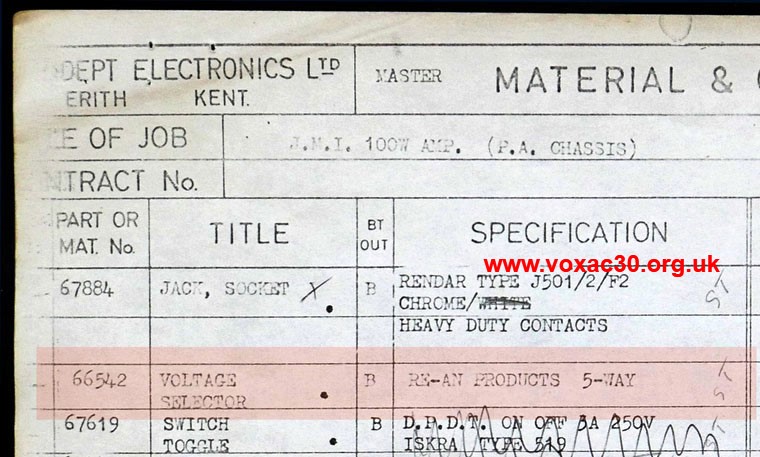

The voltages printed on the control panel of the amplifiers fitted with these were normally: 115v, 160v, 205v, 225v, and 245v.
Images of the dismantled selector were originally posted on this page in 2024, entry for 6th July.
19th June
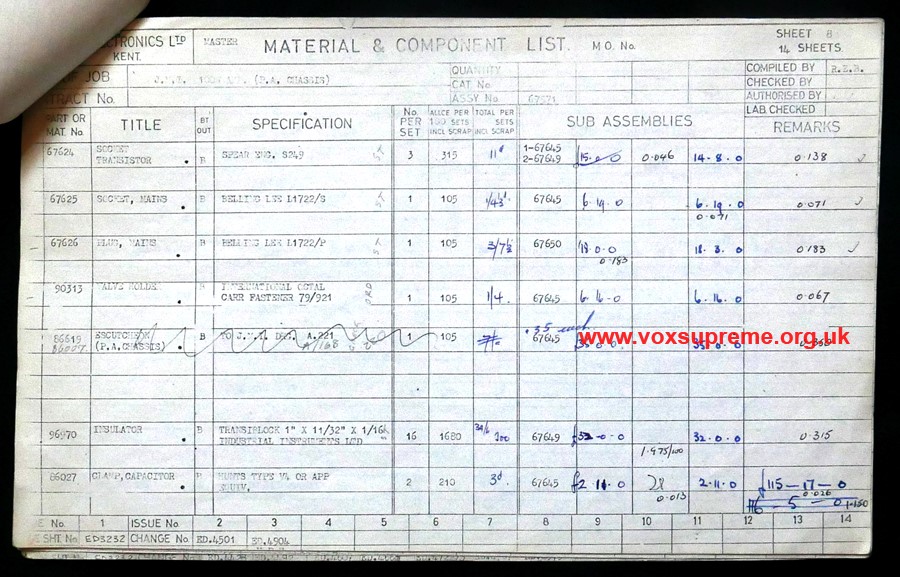
August 1967, a Burndept parts roster for the power section of JMI's Supreme and Super Foundation Bass amplifiers. 100 assemblies were envisaged and provisioned for in this batch. Reference is made periodically to JMI's mechanical drawings - for the control panel, the drilling of the heatsinks, and so on.
The notes on the final sheet indicate that such rosters were drawn up for previous batches too. AC30s, AC50s, AC100s, organs, and accessories, were presumably documented in much the same way. Burndept must at one time have had cabinets bursting with paperwork relating to JMI contracts.
That the procedure of making such rosters went back at least to 1966 is clear enough, perhaps having begun in mid 1964, when JMI moved into Burndept's West Street Works. Whether it went back further - to 1962, say - is unknown. Nor do we know anything much at present of contract record-keeping at Westrex. Perhaps something will materialise eventually.
A further class of documentation currently lacking is the Burndept and Westrex build sheets, i.e. the sheets created for the assemblers on the work benches. Stories used to pop up occasionally along the lines of: "I know a man who knows who has them" sometimes followed by mention of Eric Snowball. But alas, no. Fun all the same.
At any rate, if anything is certain it is that the circuit diagrams sent out by JMI to repairmen and hobbyists - the OS and other series - have (and had) precious little relevance to the actual assembly of chassis.
18th June
A couple of updates to the page on early AC4s. Several of the blue Daly electrolytic capacitors visible in these early amps appear to have two-letter date codes: "HH", "LH", and "PH". On later Daly caps, year normally comes first, then month, "WB" for instance meaning: 1965, February. Can the Dalys in these AC4s really be 1950s production? Perhaps, at a pinch....
17th June
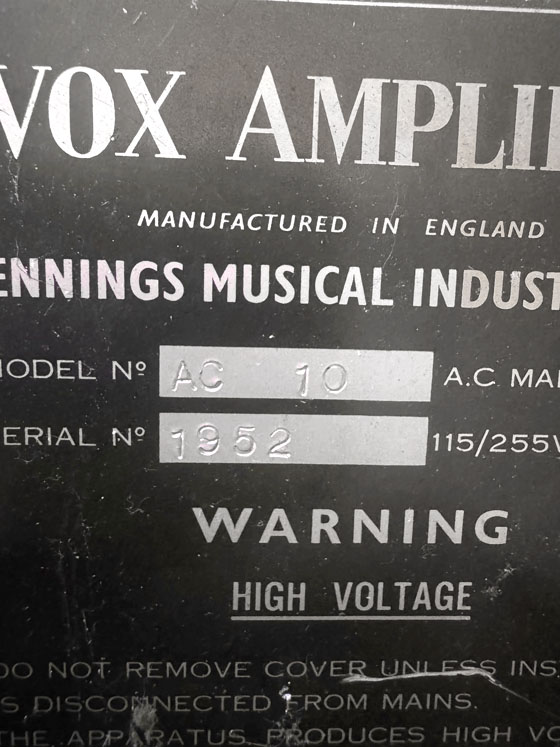
An entry for AC10 Twin serial number 1952 coming shortly. Thanks to Steve for details.
16th June
Sad to say, but perhaps only to be expected, a couple more TV Front AC30 Twins - towards the end of this page - appear to have repro diamond-pattern cloth. Quite what that means for those amps will have to remain open for the moment.
The one currently on offer in the USA is unfortunately a lash-up from top to toe.
14th June
A sample of some genuine JMI rexine from 1960 (AC10 serial number 3224) compared with repro material, as one might find for instance on a lashed-up (pretend) TV Front AC30 Twin.
Beware of TV Front Twins and the monkeys that fabricate them.
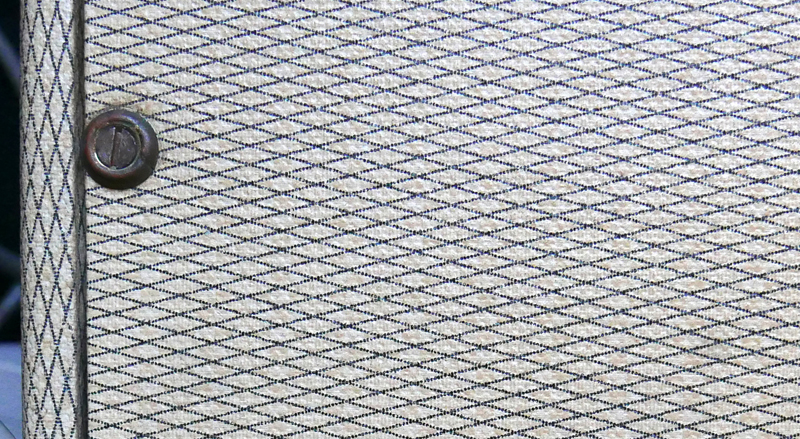

Above, genuine rexine from 1960.
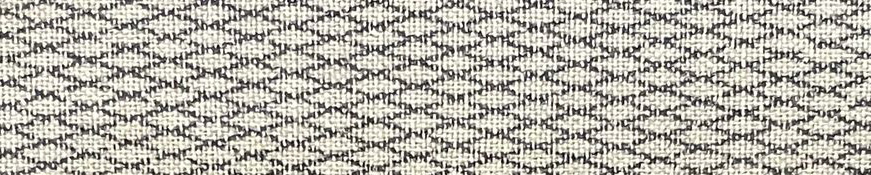
Repro rexine. Note its general crudeness.

Closer detail of the repro rexine.
13th June
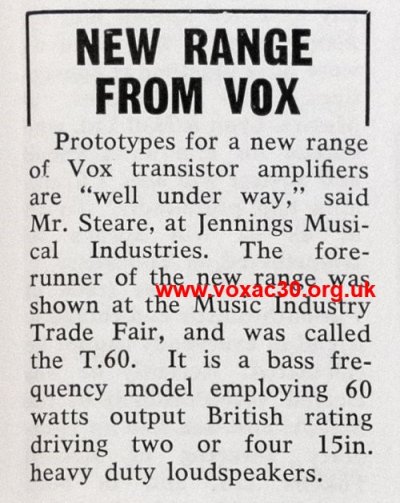
A glimpse of JMI's design process - the steps leading up to full production, in this case, of the T60. In November 1962, Jennings placed a short note in the music trade press to indicate that prototypes for the T60 were "well under way". It is probably no accident that the earliest known circuit diagrams / layout sheets date from close to this time.
A62/031, below, included by Jim Elyea in his "Schematics Portfolio", is one of two schemas for the T60 drawn up in October 1962. JMI presumably provided Burndept, the contractor charged with assembling the amplifier's chassis, with copies soon thereafter.
So far as one can tell, the first batch or batches of fully finished factory-made chassis - the "prototypes" mentioned - are likely to have been ready in or by December. The earliest T60s known to survive have components with November '62 date codes - notably the Woden interstage transformer (date code "LT").
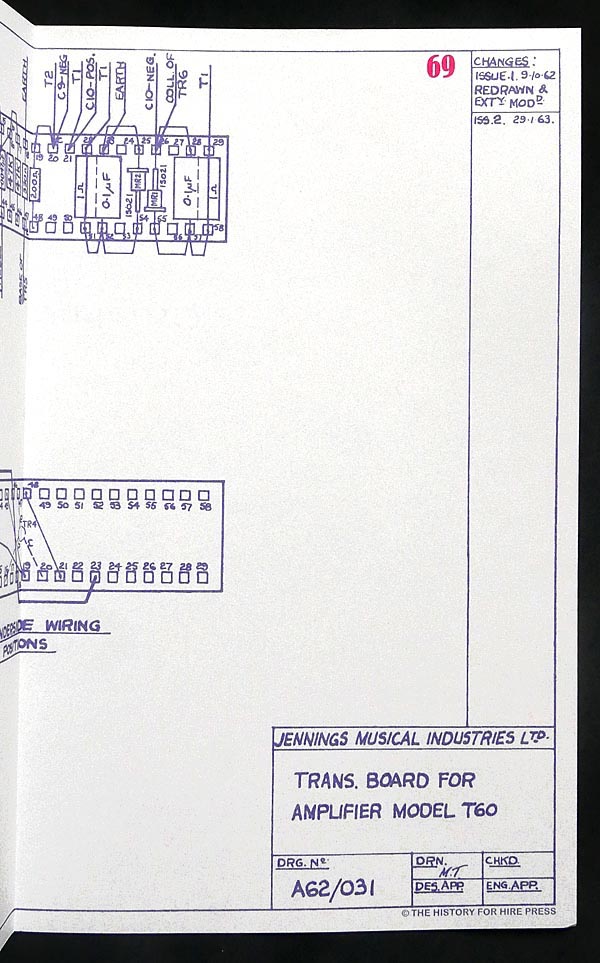
The sheet as we have, based on one initially made in October 1962, was drawn up in January 1963.
JMI doubtless supplied Burndept with similar "real-world" layout sheets for the AC30 and other models - to be copied (and perhaps broken down into sections) for its work benches. More to come on Burndept's procurement and assembly procedures shortly.
Just to signal though - as has long been known - chassis were occasionally assembled in non-standard ways. That is certainly so in the case of a black panel T60 from late 1963: - components as other Burndept-made T60s, but no chassis number, and an eccentrically-arranged early-format (?) tagboard.
12th June
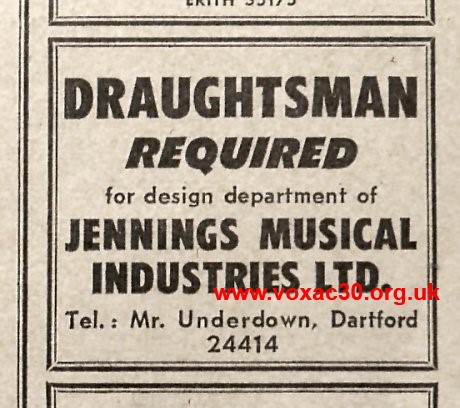
Local Kent press, late February 1964. The successful applicant is likely to have been Albert Hogben, who worked for JMI until late 1967, then for Tom in Tom's new company, Jennings Electronic Developments, later Jennings Electronic Industries.
11th June
Two more early pictures of two-tone AC15s in use: The Cordettes, and Dae Laine and the Strollers.
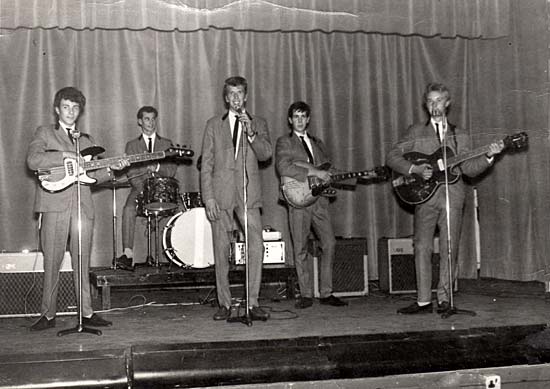
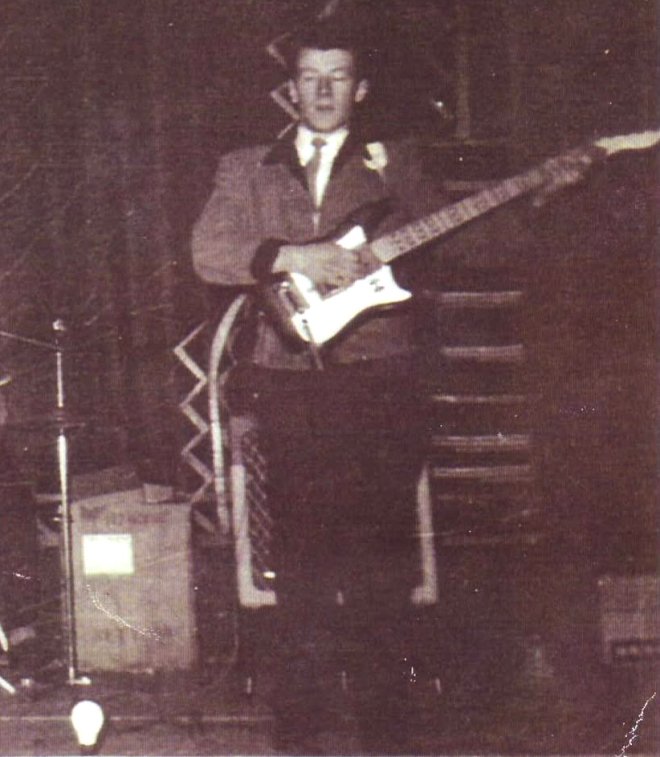
10th June
April/May 1963, the earliest Jennings full-colour advert in a mainstream music magazine. The photo of The Shadows, taken by Dezo Hoffmann, was reversed either by JMI or the publisher. Hank's parting is on the wrong side.
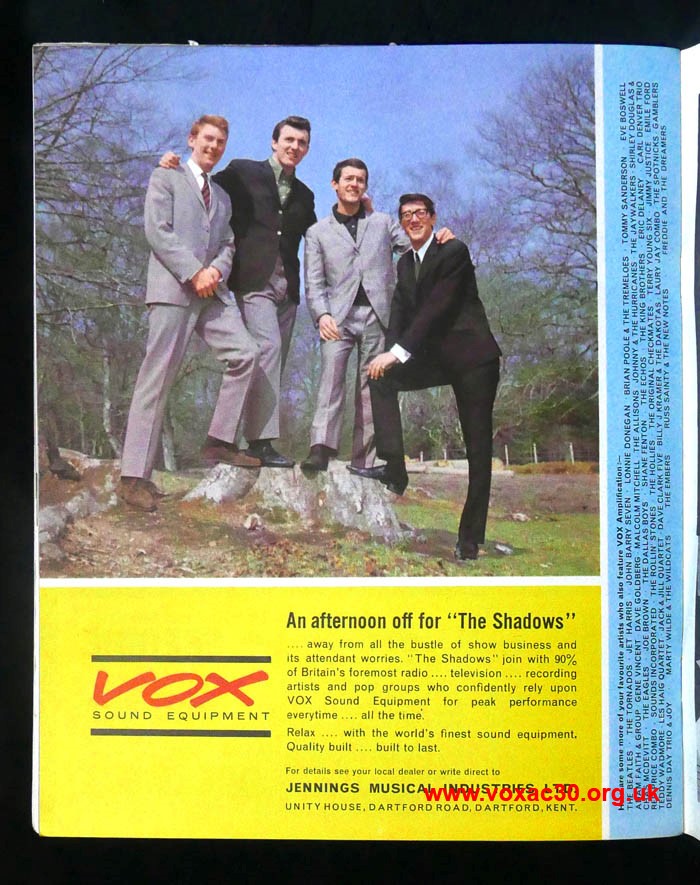
April/May 1963.
8th June (2)
Hullabaloo again, 20th April, 1965, Alan Price, still with The Animals, using the studio's Continental with the "reverse" plaque/sticker designed (and added) by Thomas Organ. The organ was also used on the programme by The Sir Douglas Quintet in May - screengrab below.
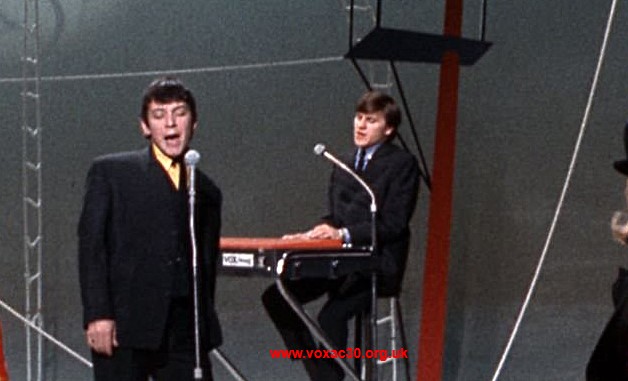
April 1965.
8th June
To be added in due course to the page on the Continental in America, some shots of the "reverse" plaque/sticker - black lettering on a white background - designed by Thomas Organ, and perhaps best known from the film of the Beatles' concert at Shea Stadium, 15th August, 1965.
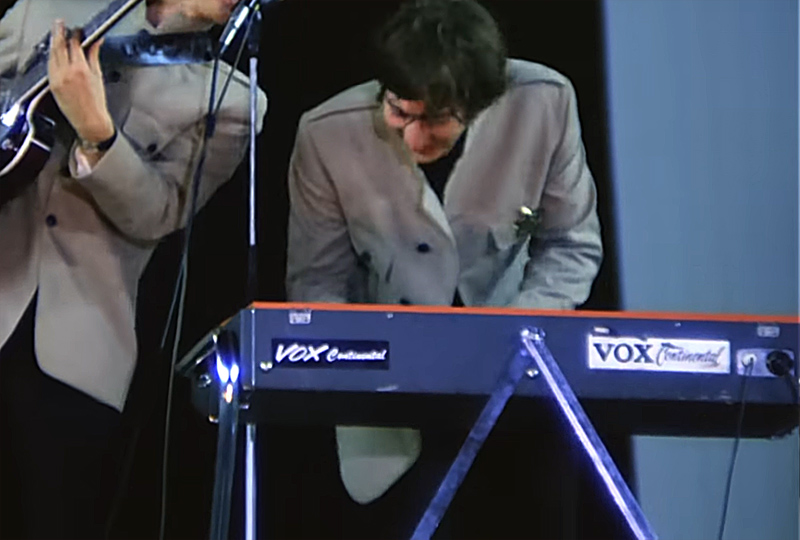
The organ was sold at Christies in 2008.
This was by no means the first time that Thomas had used such a plaque. Below, a screengrab from video of the organ provided for the Sir Douglas Quintet on "Hullabaloo", 4th May, 1965:
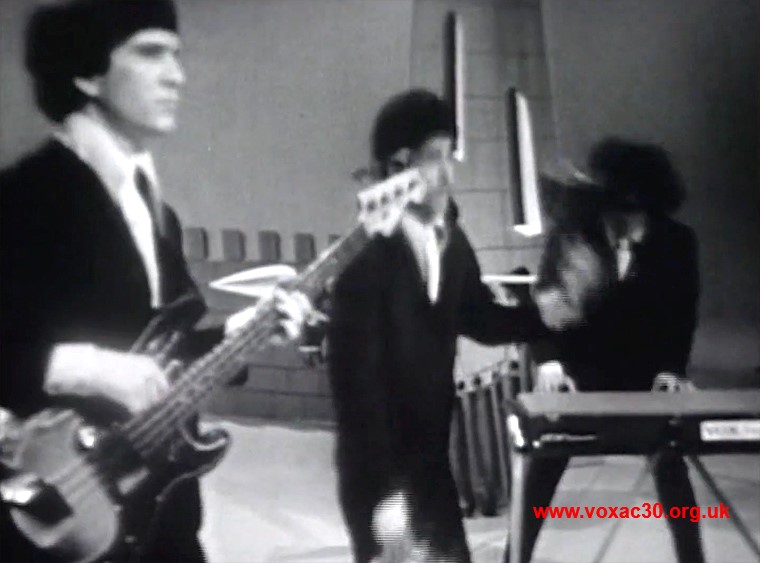
The Sir Douglas Quintet performing on "Hullabaloo", May 1965. It is to be hoped a better image can be obtained to compare with the picture of the organ used at Shea.
Later in 1965 (certainly October), a further Continental was fitted out with a reverse plaque, slightly wonkily positioned. The organ in view was used by the Miller-Goldberg blues band in late 1965 and probably also by Paul Revere and the Raiders on a TV show in March 1966. It has not been possible so far to find an image of any other occasion on which the Raiders used this Continental.
So far as one can tell Thomas used these plaques exceedingly sparingly - there are no photos of a Continental with one anywhere, for instance, in its promotional magazine "Vox Teen Beat", published every six months or so from Spring 1965 to 1969. Perhaps in time a Continental with an original "reverse" plaque will come to light - in the States though, not the UK.
Some care is needed as a repro has been available for a number of years.
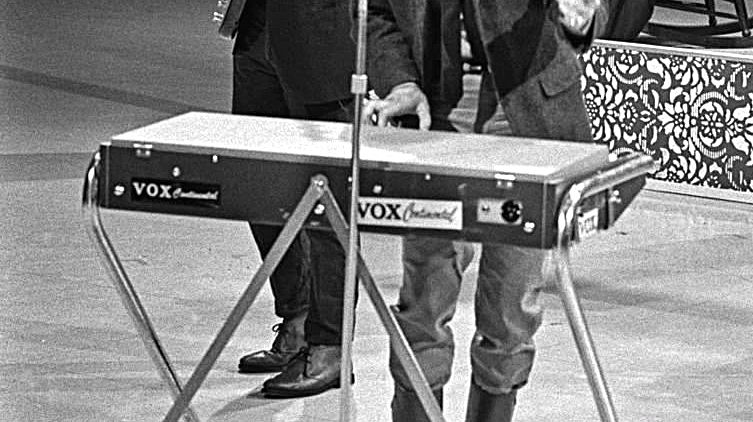
There is also a white and black plaque with the "VOX" logo on the organ's side.
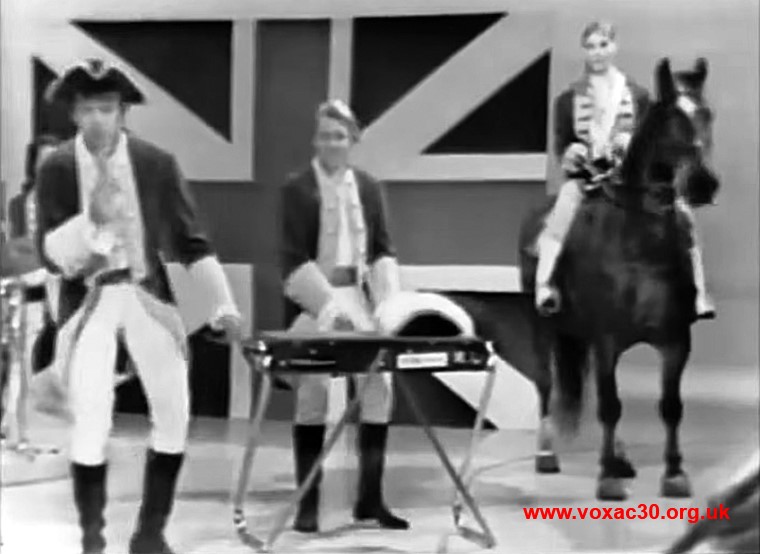
A poor screengrab of Paul Revere and the Raiders, but the white and black plaque is clear enough.
7th June
A shot of The Hi-fis taken in early 1965, Brian Bennett with his late square lid Continental from mid to later 1963 - no music stand (or fixings for one) on top of the lid. Other photos show that the back panel had no logo.
The page on bands with early Continentals can be found here.
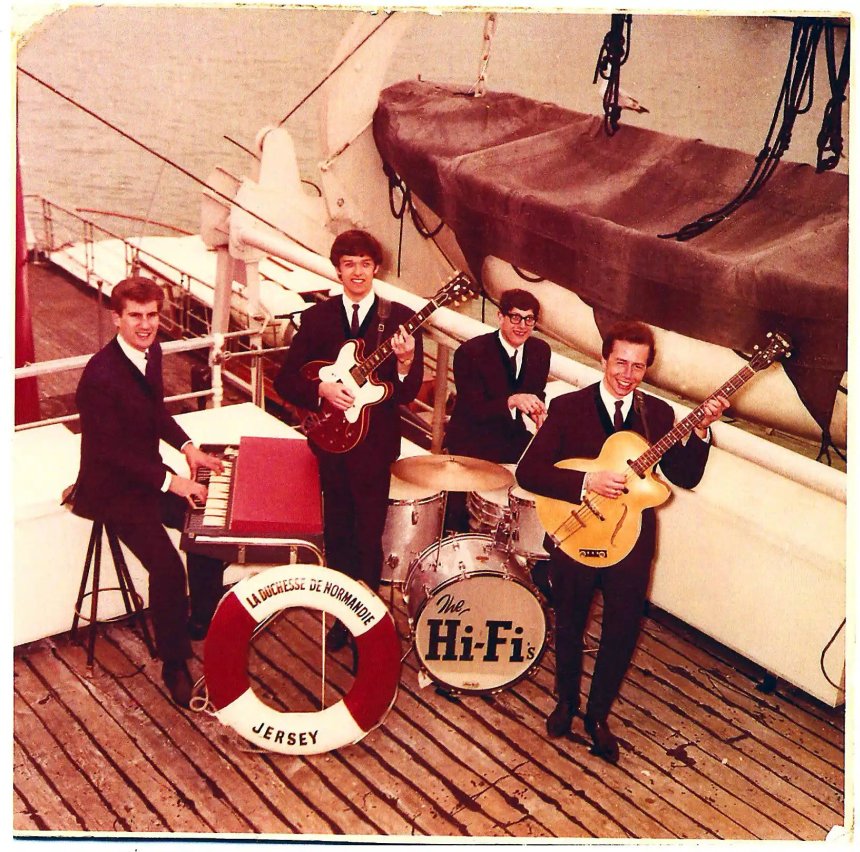
Photo from this page.
6th June
An entry has now been made for AC4 serial number 2406, one of the last to have been issued in the old-style small case. Thanks to Colin for the pictures.
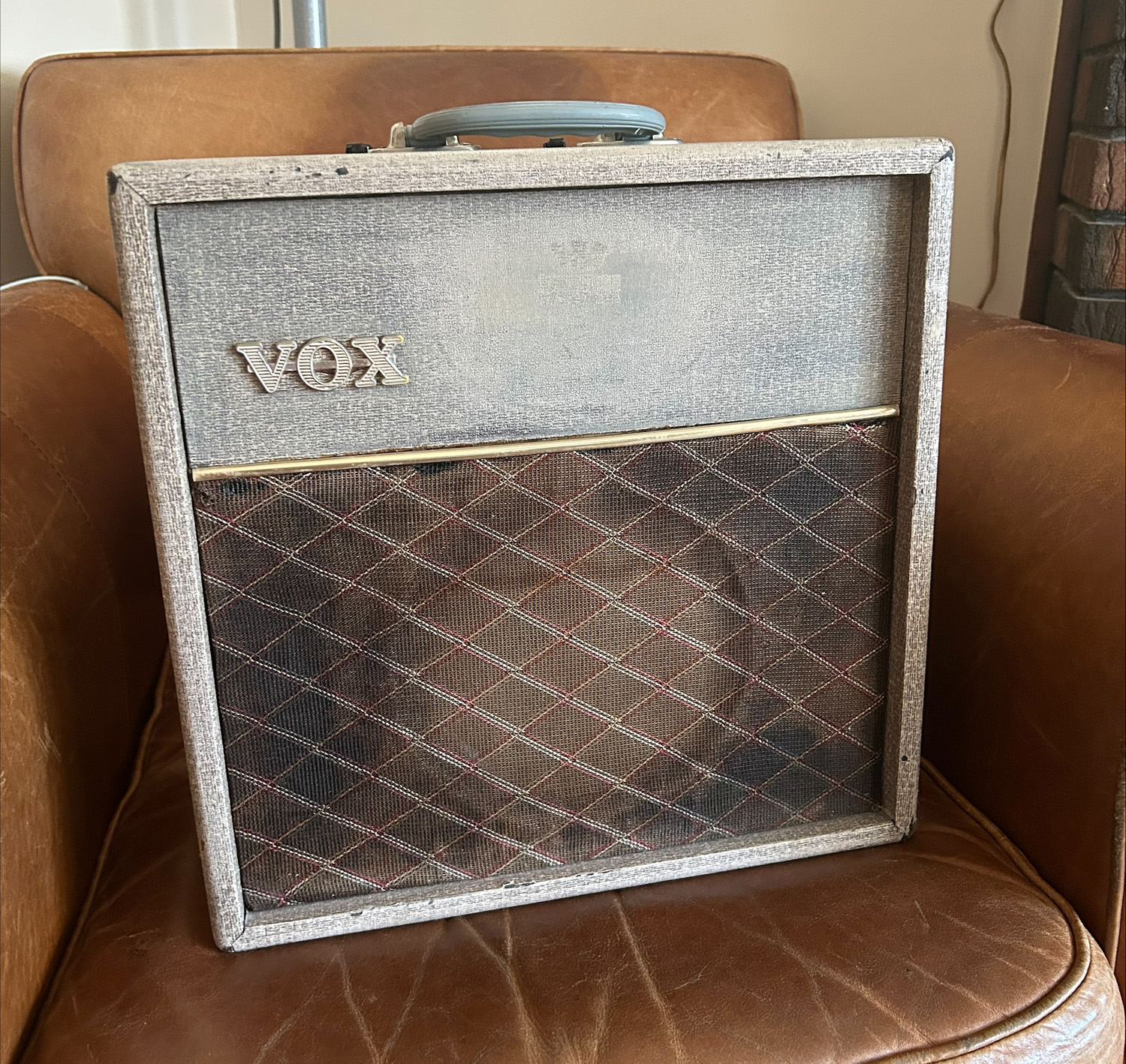
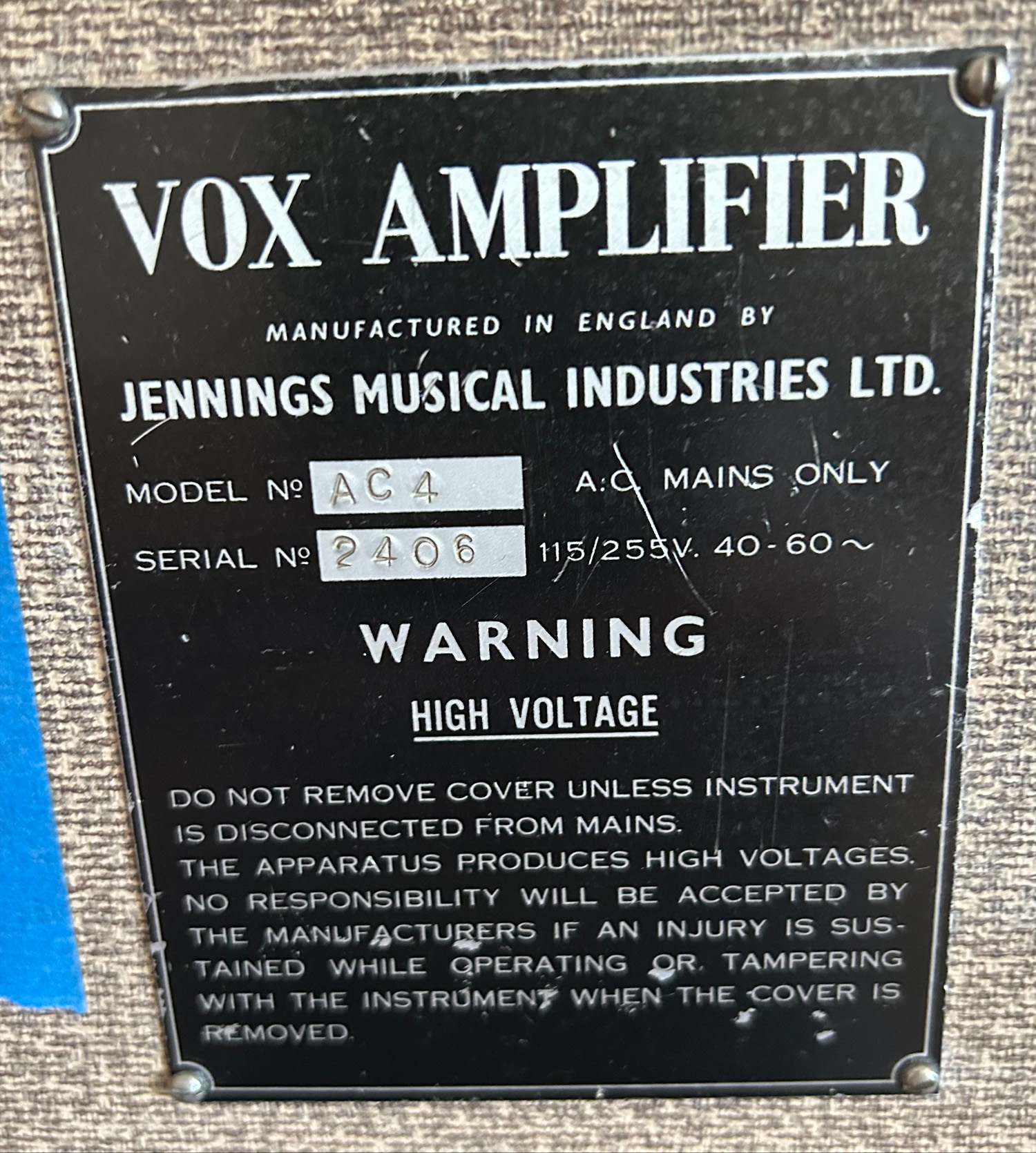
AC4 serial number 2406.
5th June
A good detail from one of Dezo Hoffman's promotional shots of the Stones. In 1963 - probably towards the middle of the year - Jennings supplied him with a new set of equipment, all with black vinyl covering, for such pictures: at least two AC30s, a Continental organ, and a T60 bass set. None of the cabinets had speakers or chassis. The T60 amplifier section was simply the box.
Dezo's first set of equipment - beige vinyl covering - presumably went back to Jennings when the new lot arrived.
Other bands photographed with the new amps and cabs were: The Beatles, The Hollies, Gerry and the Pacemakers, The Swinging Blue Jeans, The Merseybeats, the Mike Cotton Band, The Gamblers, and a good number of others.
Among those photographed with the beige-covered Vox equipment in earlier months were Peter Jay and the Jaywalkers, The Echoes, and The Escorts.
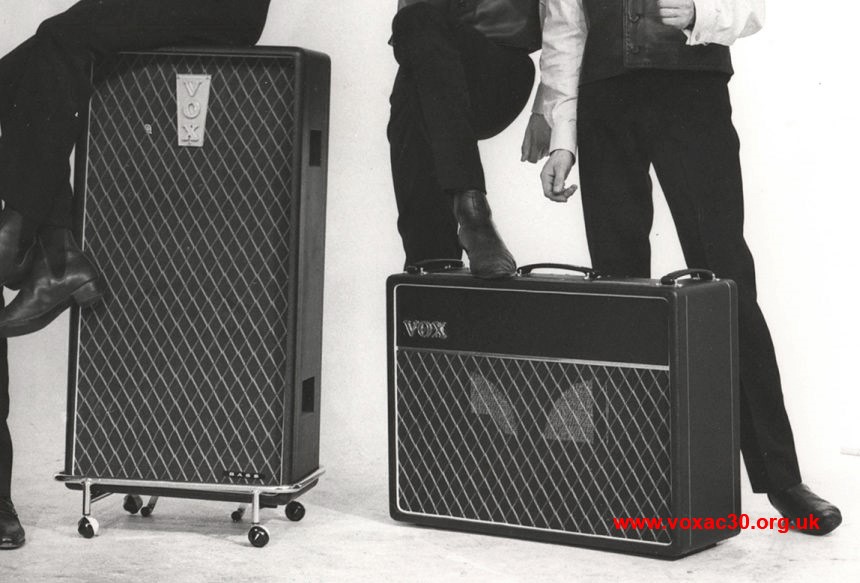
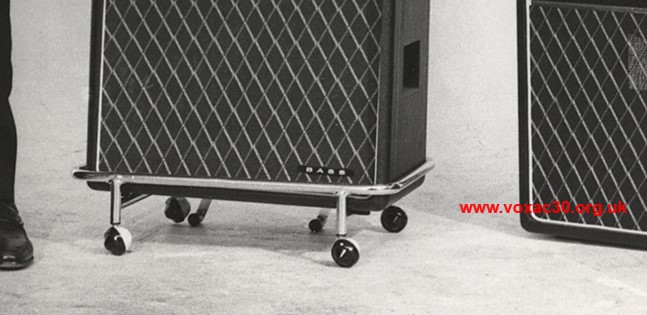
For other instances of the black and white Shepherd's castors, see this page.
4th June
To date, no surviving T60 amplifier chassis has been shown to have been built to the earliest circuit diagrams - A62/030 and A62/031, from September and October 1962, published by Jim Elyea in his "Schematics Portfolio".
Serial number 161, the earliest T60 currently known for certain, was evidently made after the revisions of early 1963 - either that or its electronics have been altered beyond recognition. That the first fifty or so T60s should have disappeared without trace is striking. Were they all inherently unstable? Did the Mulolard OC35 0pwer transistors let them down? Or - possibly a slimmer chance - did the serial number sequence actually begin at 150 (rather than 100) as it appears to have done in the case, later on, of the AC80/100?
Below, the best of two AC30 Transonic amplifier sections known to survive - TS-30 serial number 1024 (ie. the twenty-fourth or twenty-fifth made). The Woden interstage transformer is dated "LT" = November 1962, and the main Hunts capacitors have "TTH" for their manufacture = 44th week of 1962. T60 serial number 239 corresponds in these respects.
The Transonic preserves its original Mullard OC35s; the T60 has later replacements.
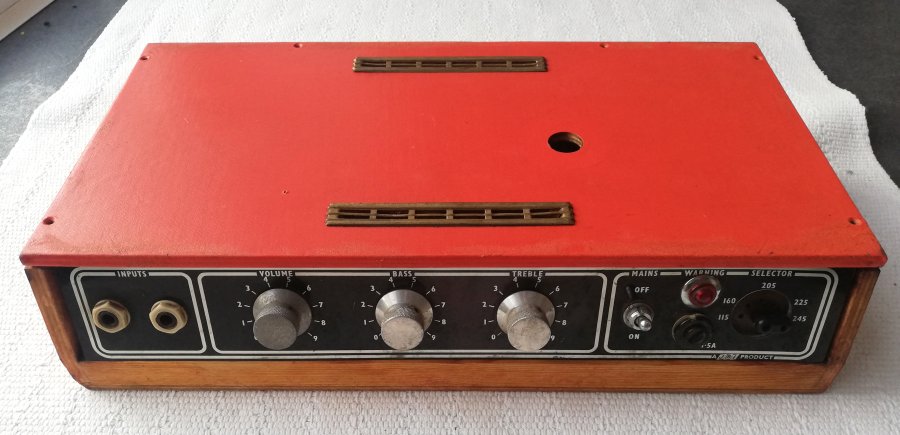
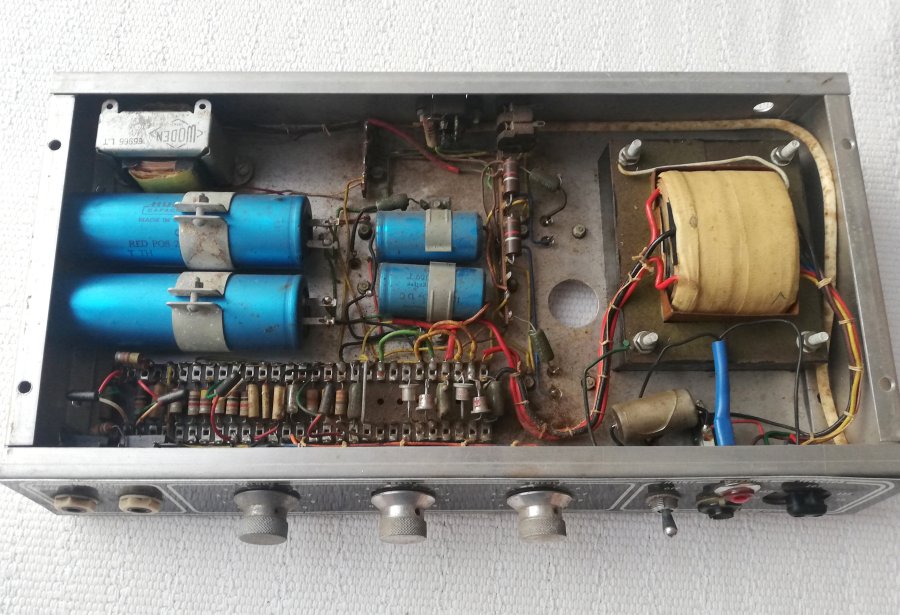
AC30 Transonic serial number 1024, probably early to mid 1963, electronics all original. Thanks to Steve for the pictures.
The only amplifier section with built-in tremolo caught in a photo not taken in a photographic studio can be seen below, entry for 27th May.
3rd June (2)
A couple of pieces of documentation. The first, thanks to Andrew, an overview of the specifications of the Texas Instruments 1S021 diode published by Radiospares in 1965. It is probably from Radiospares that Jennings obtained its supplies, late 1962 to 1968.

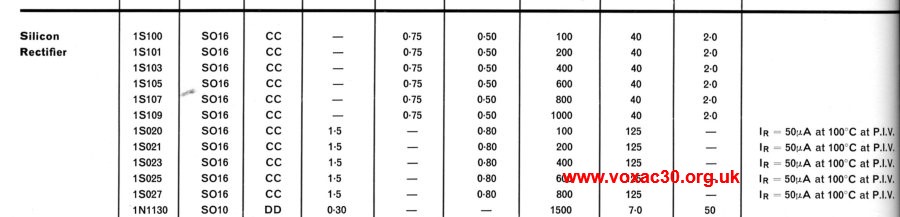
Radiospares catalogue, 1965.
The second, a sheet for the T60's circuit not much seen these days, drawn up in September 1964, presumably - as in the case of other models and their sheets - to accompany exports to Thomas Organ in the USA. A good number of T60s crossed to America in late 1964 and 1965. AC30 Transonics and Lightweights were not included in the various "deals" with Thomas.
The sheet ends with Issue 7. The two sheets most commonly seen these days take the modifications through to Issue 10 or Issue 11. Copies of one or other are often found in versions of the Thomas Organ Service Manual. To date however, no Thomas copy of the September '64 diagram has come to light. There must be one somewhere though.
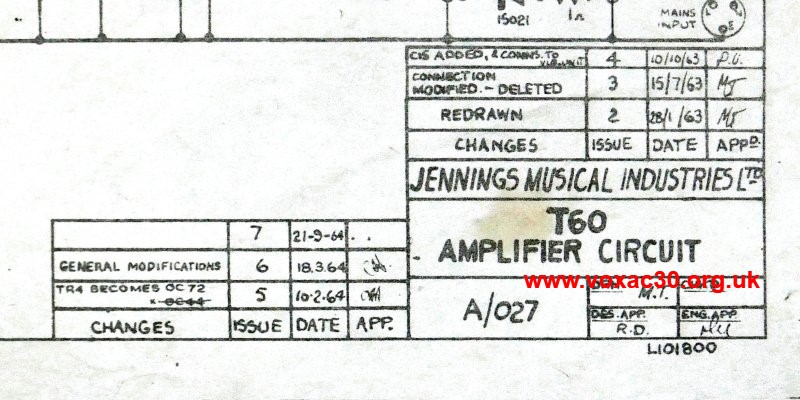
Still the earlier sheet number "A/027". Later ones were redesignated "OS/062".
3rd June
The preamp of the T60/AC30 Transonic has three main sections: (i) an initial gain stage of two OC44s; (ii) volume, treble and bass network, based on the circuit published by Maynard in "Radio Constructor" magazine (see below, entry for 30th May); and (iii) a further two OC44s as a "gain recovery" stage before the driver transistor.
The initial gain stage (i) generally follows that of Mullard's public address amplifier (1960-1961), though Mullard envisaged OC71s, as it did for most of its other cascaded gain stage designs. Why did Jennings prefer the OC44? Hard to say for sure, but it may be that in practice its noise floor was lower than that of the OC71.
At any rate, Jennings, in a manner of speaking, stitched the preamp of the T60/AC30 Transonic together from existing elements.
Below, shots of one of the first Mullard semiconductor data booklets - from 1957 - containing sheets for 10 types of transistor and 9 diodes. The OC44 was new in December 1956, the OC71 had reached its settled form by November.
Whether the transistorised preamp/effects module developed by JMI in 1959 for its "Entertainment" organs had OC44s is unknown.
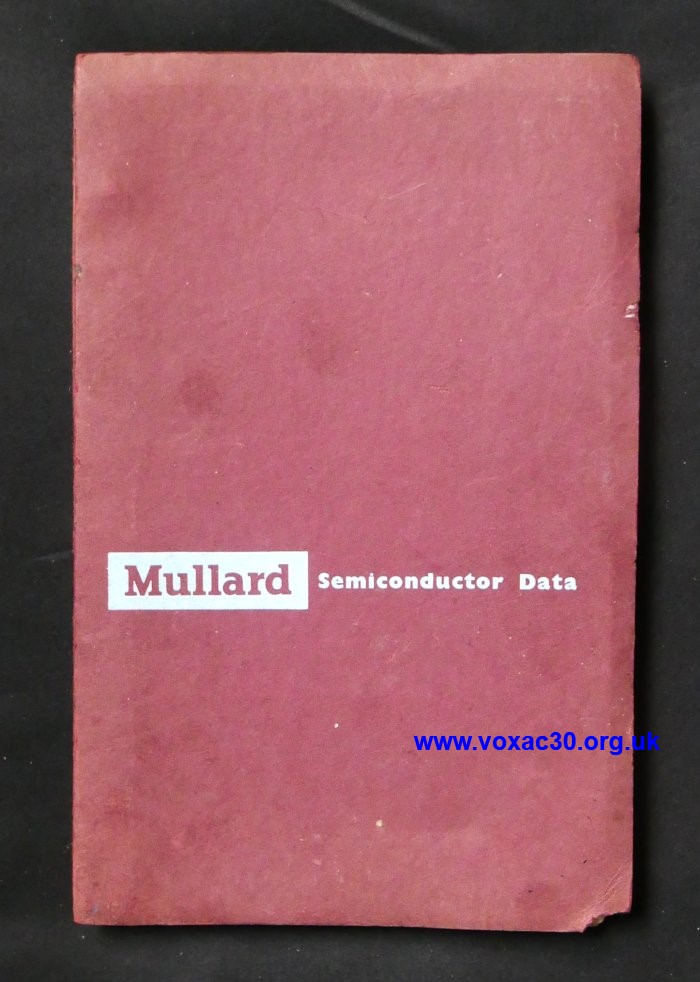
Mullard semiconductor data book, 1957.
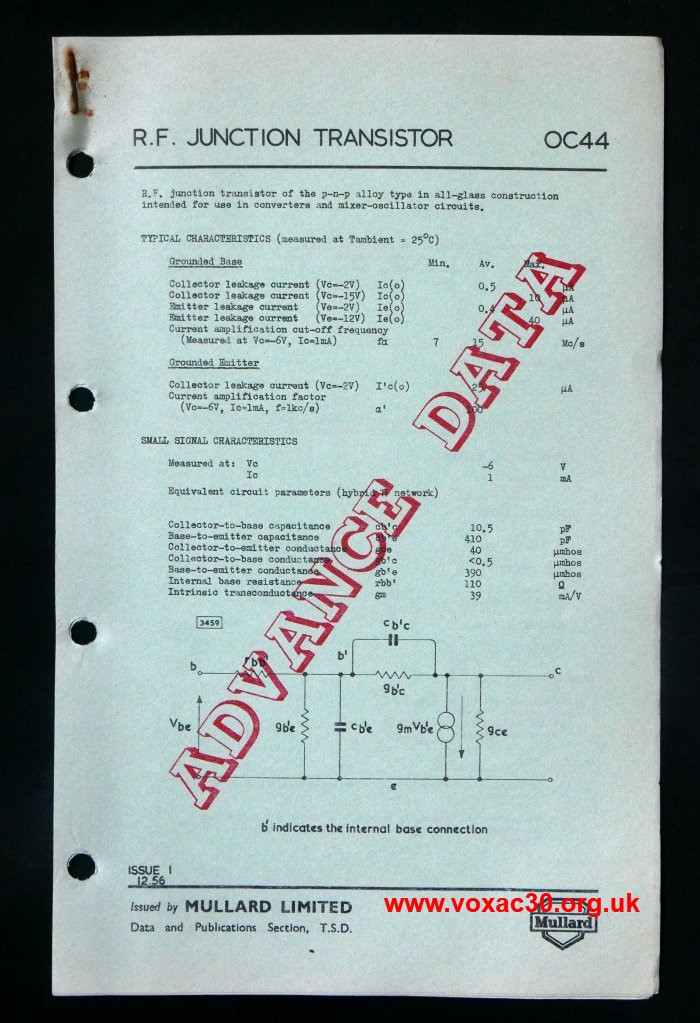
Advance pages for the OC44, December 1956..
2nd June
It turns out that the "1S021" rectifier diodes in the power section of the T60/AC30 Transonic, mentioned below, were manufactured by Texas Instruments. Texas had opened a facility in Bedford around 1960 - see this page - participating in various British trade shows in the early 1960s. Over the course of the T60's production (through to early 1968), Jennings used around 8000 1S021s.
So far, no earlier analogy has come to light for the use of the Mullard OC35 as an audio output transistor. Mullard recommended the OC26 and OC36. The OC35 was "general purpose", not that that can really have mattered for what was primarily a bass amplifier.
It may be that the power section of the T60 as we have it was for the most part a Jennings design (a sort of working forward from the Mullard circuit book). Whether CTH Electronics and Audix, both early to market with solid state public address amplifiers, followed Mullard to the letter is not known.
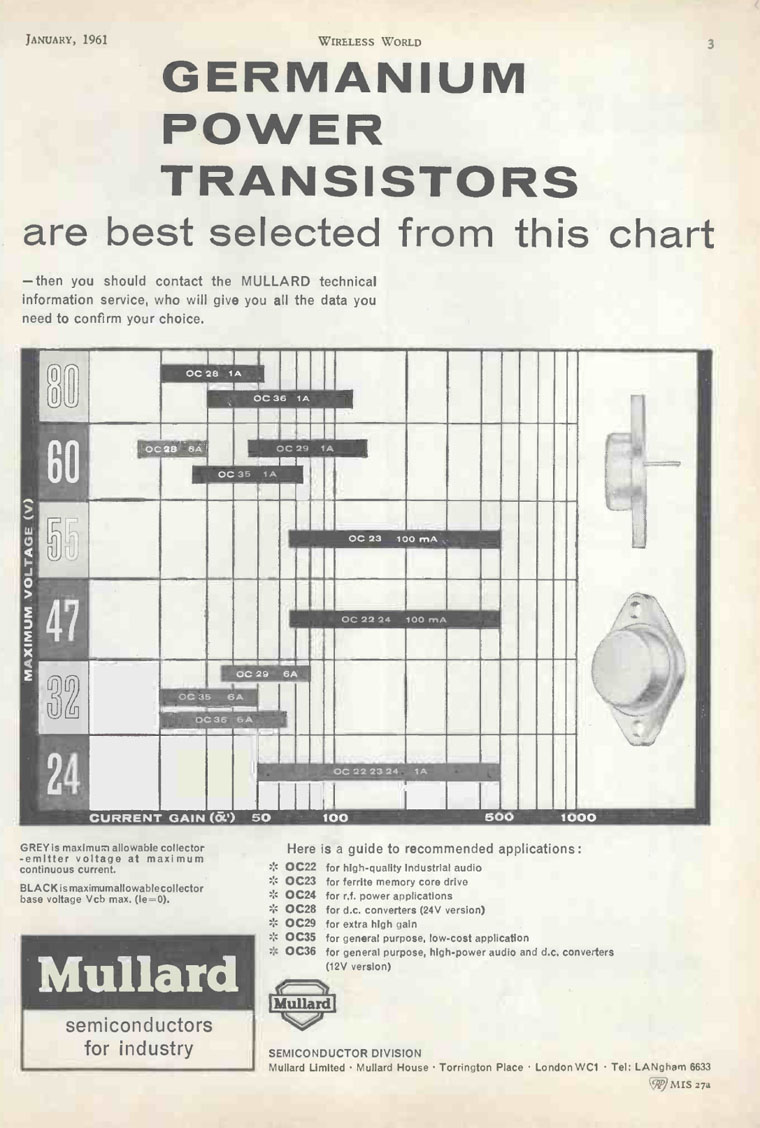
January 1961.
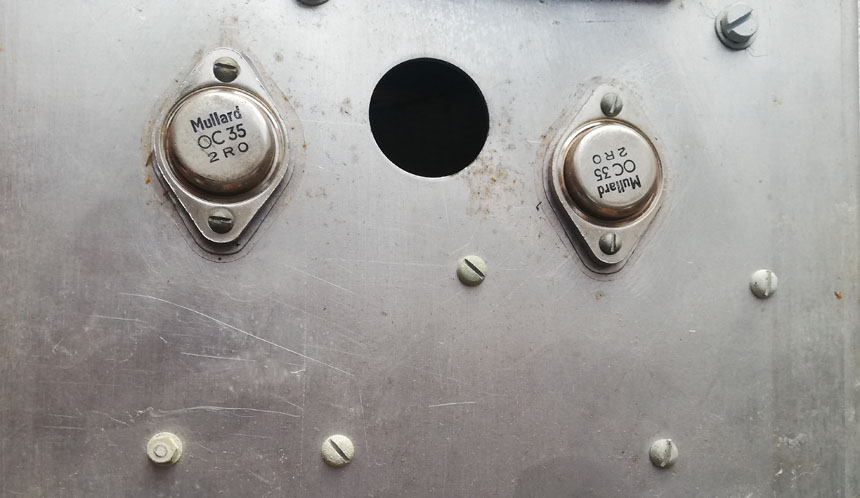
In later 1963, Jennings moved from the OC35 to the OC28, perhaps in the search for greater stability and consistency. Now and again, one finds OC26s. In terms of surviving T60s, the majority have - or now have - OC28s. The principal question marks hang over serial numbers 239 and 268 (black panel, later 1963), which have modern OC28s, possibly introduced by repairmen in line with later and more common versions of the circuit diagram. All this will be tabulated in due course.
An early Transonic amplifier section, however, does retain its original OC35s. Thanks to Steve for the picture.
1st June
Picking up from yesterday's entry, a short note on the power section of the T60/AC30 Transonic amplifiers. This stands half-way between two circuits for a Public Address amplifier published by Mullard in 1960 - one with a 14V supply and an output transformer for the speaker; the other with a 28V supply and a speaker directly coupled to the output transistors (as in the case of the T60).
A peculiarity of the JMI power section is the use of "1S021" rectifier diodes about which there is little documentation. Transistor equivalents books from the 1960s and 1970s give the BYX22 as a direct replacement. Mullard envisaged generation of the HT in its circuits from accumulators (batteries) rather than a mains transformer.
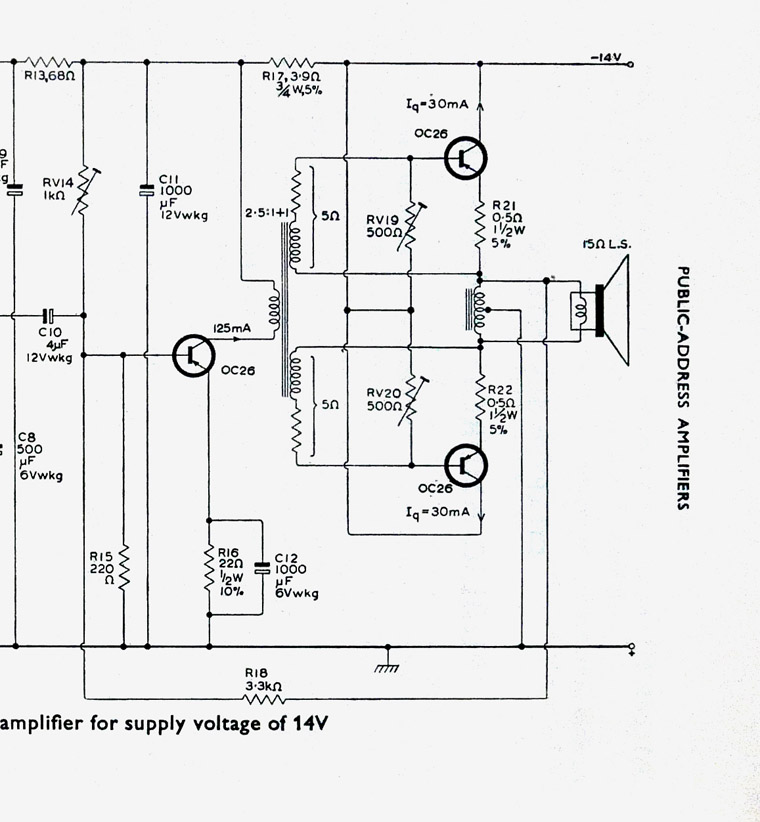
The power transistors in the T60 (OC35s rather than OC26s) are arranged as the Mullard 14V circuit (above) published in the "Reference Manual of Transistor Circuits" of 1960 and 1961; in its HT voltage and directly coupled speaker, the T60 follows the Mullard 28V design.
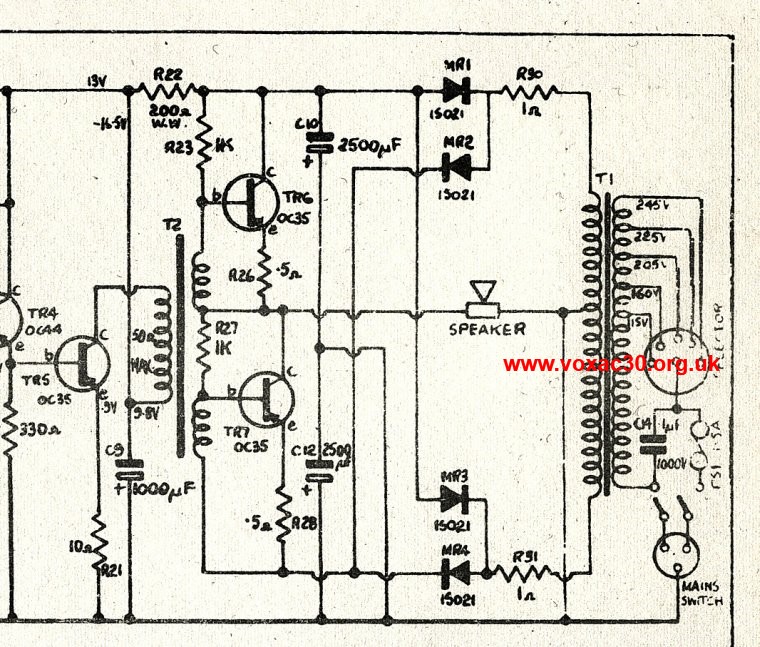
Detail of the T60 circuit of early 1963. The initial design had only two 1S021s. The manufacturer of the diodes is unknown at present.
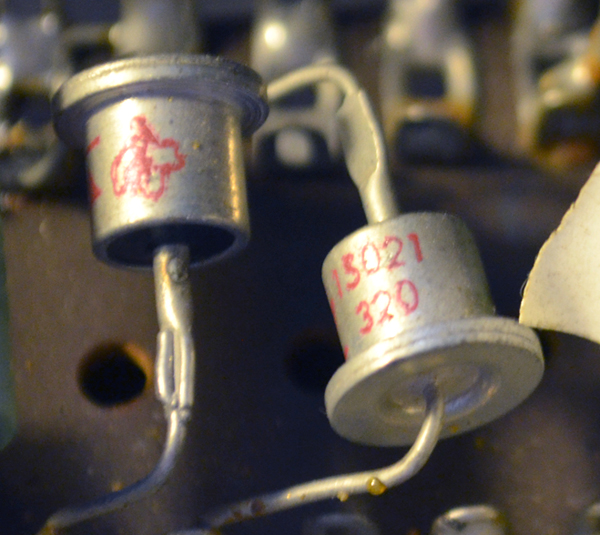
Two of the four "1S021" rectifier diodes in a T60 from the autumn of 1963.
PREVIOUS UPDATE PAGES BY MONTH, 2026
PREVIOUS UPDATE PAGES BY MONTH, 2025
PREVIOUS UPDATE PAGES BY MONTH, 2024
UPDATES 2023
UPDATES 2022
UPDATES 2021
UPDATES 2020