
Vox AC30 website updates
May 2026
30th May
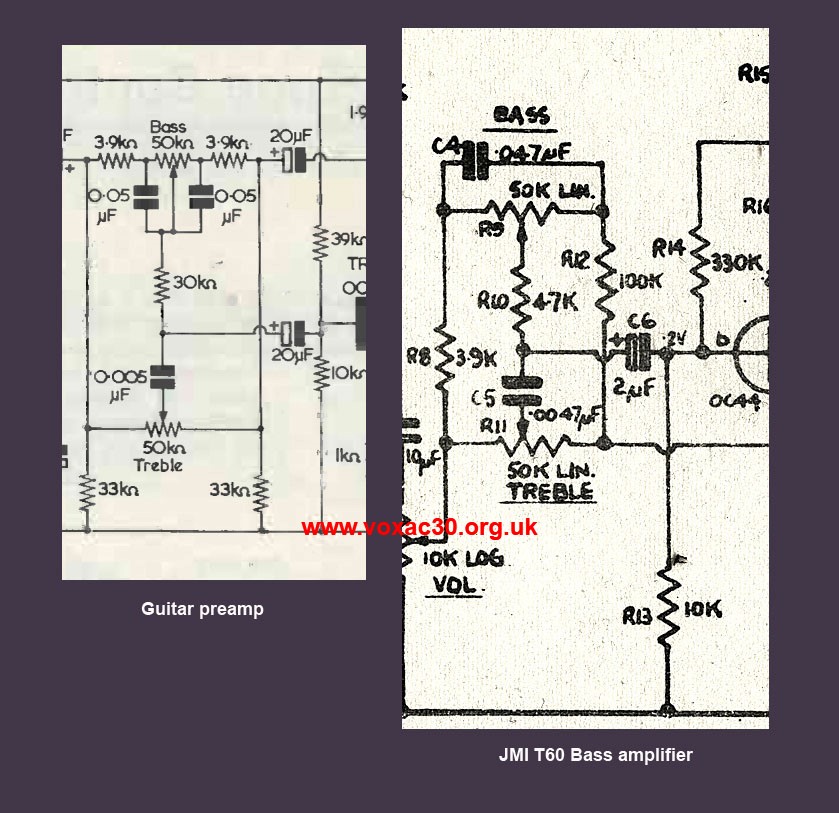
A little more on JMI's work on transistorisation in 1962. Below, a detail from a circuit for a transistorised guitar preamp published in "Radio Constructor" magazine, September, 1961, by D.E. Maynard, alongside a detail from JMI's circuit for the T60 bass amplifier (as used also in the AC30 Transonic and AC30 Lightweight amplifiers).
Allowing for necessary differences - the guitar preamp was battery-powered for instance - the arrangement of the tone controls is pretty much the same. Towards the end of his article, Maynard offered a number of modified circuits (for low-impedance input signals, etc.), one using a 10K volume pot following an initial gain stage, and 10uf coupling caps, things also present (later on) in JMI's T60.
It seems likely that Les Hills and the design team at JMI used circuits or parts of circuits such as these as their starting point. Quite what prompted the employment in the T60 - and the "44" and "55" organs - of Mullard OC35s as output transistors is not clear at the moment though.
Just to note that in 1966/1967 Triumph Electronics, one of JMI's principal contractors, brought to market a transistor preamp incorporated in a guitar strap - a neat idea. Perhaps based on Maynard's article?
29th May
Text entries for a couple of later Jennings Univox J6s - serial numbers 3330 and 3365 - have been added on this page. Both are still in "old-style" form and probably from 1961 - number 3330 has capacitors dated November 1960.
28th May
A little while ago, a Continental from mid 1963 currently in the UK was found to have, beneath the vinyl that had been added in the 1980s, a fixing point for a third outer lid hinge. Two is the norm, and the lid itself, which is original to the organ, indeed only has hardware for two (in the conventional positions).
Further below, details of a similar organ - "square" inner lid, brackets for music stand on top, Bulgin mains socket and jack socket together on the back panel, etc. - used by "The Shouts" in March 1964. One and the same, or simply a twin? Probably the latter. "The Saints" (Wrexham) and "The Sons of the Piltdown Men" (Manchester) also had Continentals of this type, illustrated on this page. Nothing is known at present of the outer lids of these organs.
For a good part of 1963 the Continental was still produced in relatively small numbers. One batch tended to have features - a particular arrangement of sockets, an extra lid hinge, things of that nature - that were not carried over into the next. It took a some time - over a year - for the various elements to reach a settled form. The same is true of early AC80/100s, also made ready for sale in small batches initially (in 1964), one batch differing slightly from the other, the principal variable elements being the sockets, serial number plate, and warning plaque on the back panel.

The hole directly underneath the fixing point is for the screw for the stand's cross-braces.

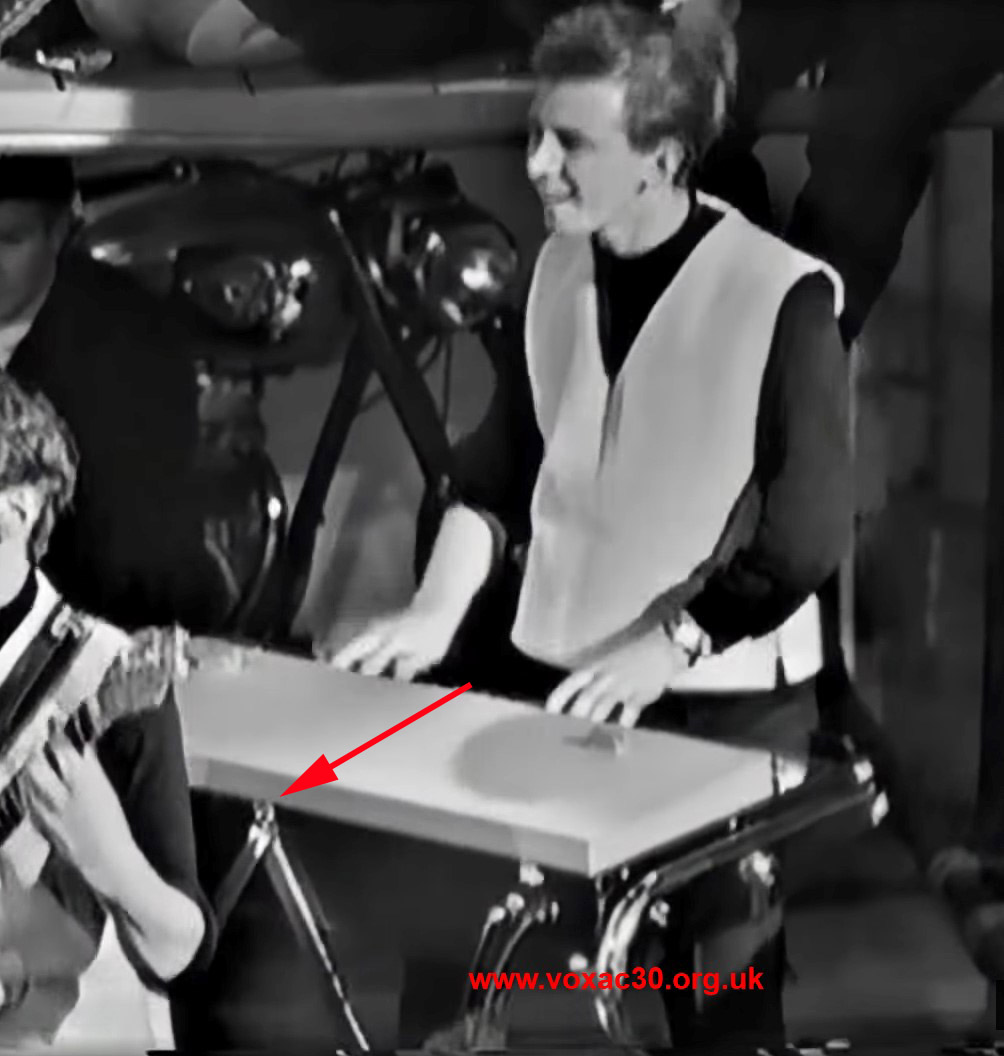
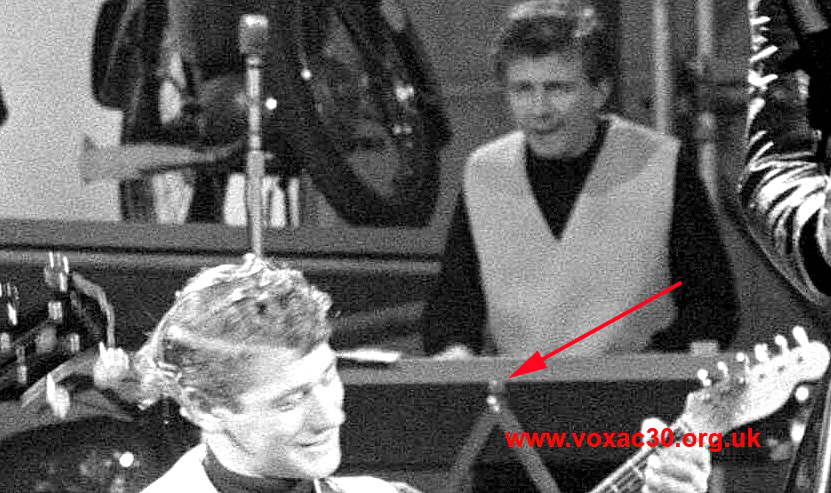
Hinge mount on the body of the organ, the outer lid presumably somewhere off stage.
27th May
Below, a couple of instances of early T60 bass amplifier sets, the first made for Jet Harris and illustrated in the music press in August 1962, the second seen on stage with Sounds Incorporated, who had one of the first Vox Continental organs, in late 1962.
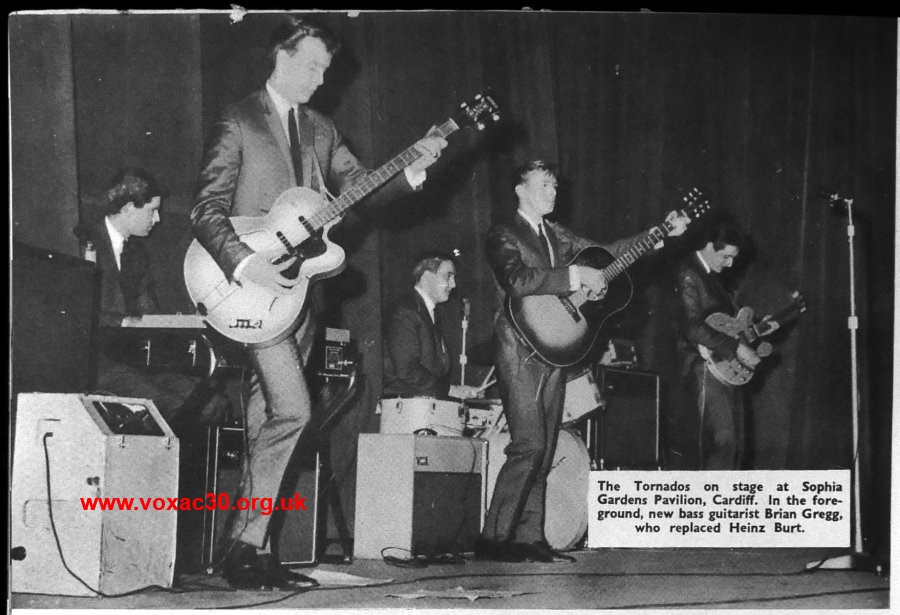
JMI's approach initially seems to have been to provide select bands with T60s and Continentals as a sort of new transistor-based package. The Tornados also had one of each by early 1963, seen on stage in March.
Why no diamond grille cloth on the early T60s? Perhaps at the time JMI did not have rolls that were tall enough for the speaker cabinet. That the one shown by JMI at the Russell Trade Fair in late August 1962 had a standard diamond front (and a standard vertical "pie" logo) has to be borne in mind however.
Jet evidently never used his T60 publicly, either with the Shadows or afterwards (info. kindly supplied by Terry Webster), preferring, when he had the choice, AC30s.
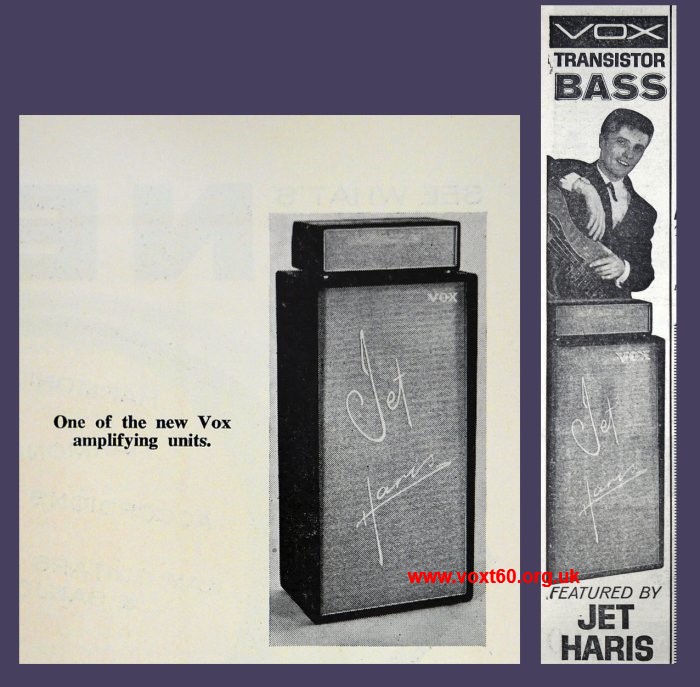
On the left, the trade press photo; on the right a detail from an ad in the mainstream music press, Jet Harris unfortunately wrongly spelt in both. The VOX logo looks a bit half-hearted, certainly in relation to the one pictured below.
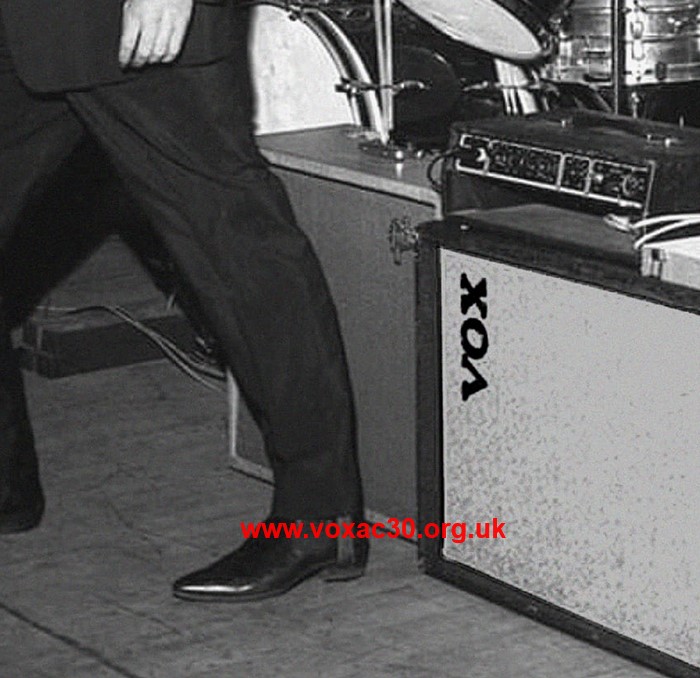
Sounds Incorporated on stage, late 1962. The rear panel of the amp has an extra control, probably for tremolo, as below. By mid 1963 the band had a new "standard" T60.
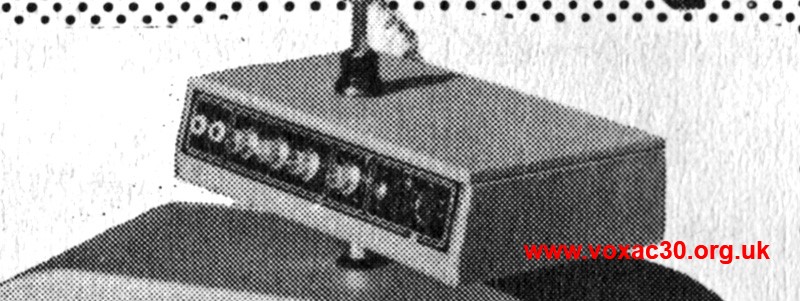
The panel of a Vox Transonic amplifier, effectively a T60 chassis in a space-age-themed cabinet. Controls: volume, treble, bass, and tremolo.
26th May (2)
Having just noted in the previous entry that the earliest known photo of a Continental in use in concert is from March 1963, what should turn up? A picture of the Red Price Combo's Continental taken on the 5th of February, 1963, at the Doncaster Gaumont. The Combo backed Helen Shapiro, the star of the tour. The Beatles were one of the supporting acts.
Red Price appears in the short list of Continental users published by JMI in March.
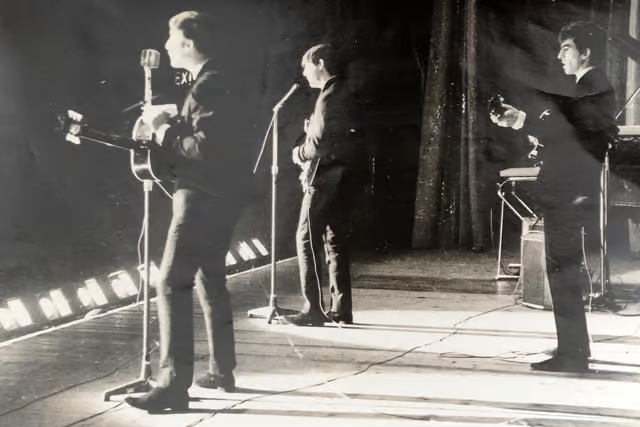
5th February, 1963. Picture from this page.

16th March, 1963.
26th May
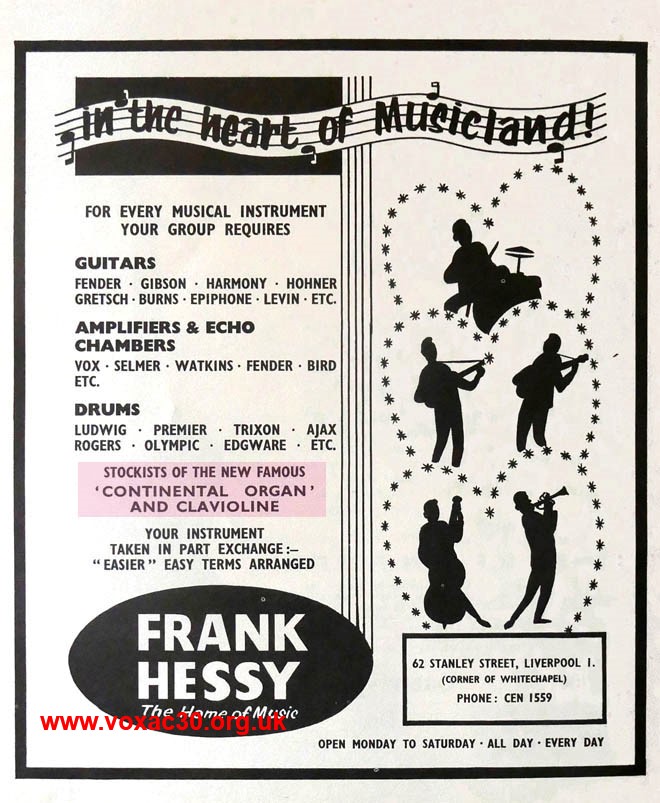
One of the earliest shop adverts to have emerged so far offering the Continental: Hessy's in Liverpool, April or May 1963. Others have been gathered on this page.
In terms of the Continental in use, the earliest instances currently known are: film and recording studio - late 1962 (Tornados and Overlanders); concert on stage - March 1963 (Tornados).
25th May
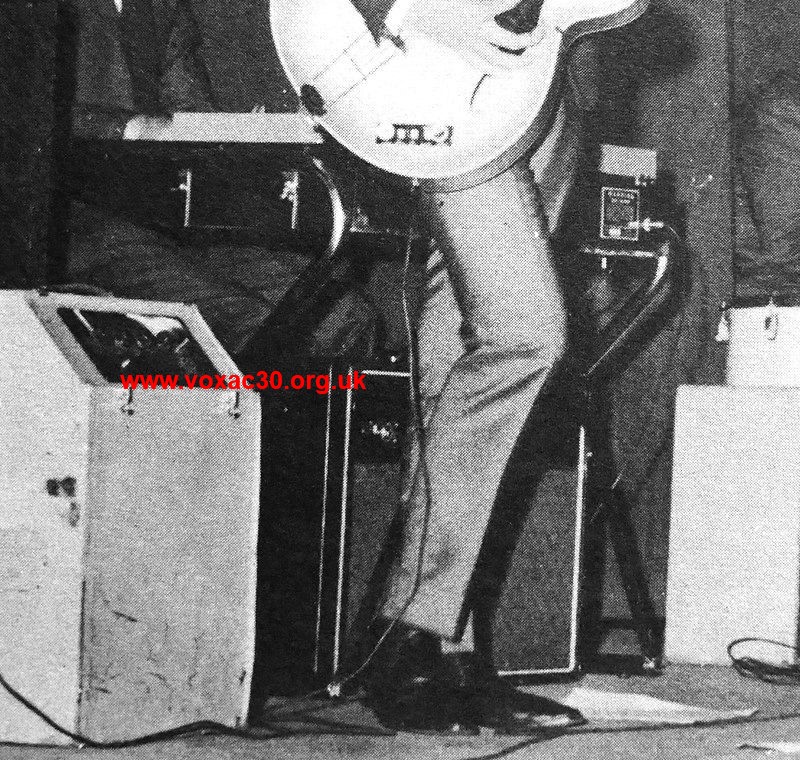
The Tornados (of Telstar), April or May 1963. Heinz Burt left the group in early March; Brian Gregg came in as his replacement a little later (i.e. not immediately). The Continental is the one seen in the posed photo with Burt, detail below, entry for 21st May.
24th May
New Zealand band "The Tornados" pictured in 1961 with a Univox J6 from c. 1954, pale covering (probably tweed pattern), large illuminating logo, serial number likely to have been in the 1300s or 1400s.
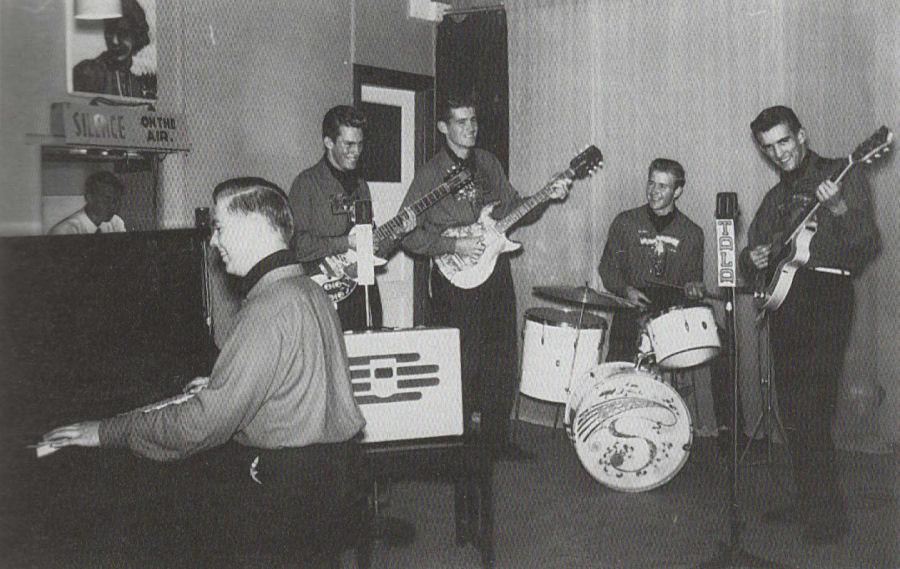
Picture from this page.
23rd May
Prelim. notes on the Mullard OC35 germanium transistor, used by JMI for the T60 (and Transonic) amplifiers; the power section of the Vox Continental; and the amplifiers incorporated in the "44" and "55" organs.
The circuits in view were, in the first instance, the work of Les Hills, who had played a leading part in designing the Univox for Tom in 1951. Les reportedly rarely ventured past the front gate of his house in Belvedere, so people from JMI normally had to go to him.
Where full-time members of the Jennings R&D Department are concerned, Alan Harding had the greatest experience of working with transistors - he developed the Vox Radio Microphone system for instance - but others will naturally have contributed to the designs, not least Derek, Dick, Ken McDonnell, and Tom, who had the final say on functionality and appearance.
Working examples of all three organs, along with the T60 and Transonic, were exhibited at the Russell Hotel Trade Fair in late August 1962.
So far as one can tell, the first adverts for the Mullard OC35 appeared in early 1960. Below, the cover of the Australian edition of Mullard's "Outlook" news and technical reviews bulletin for March and April.
Initially in the UK the retail price of the device was 48 shillings - an enormous amount (November 1960). Bulk / trade prices will have been slightly less. By the summer of 1961, retail had come down to 25 shillings. Late in the year it fell further to 15 shillings, the price of a Mullard EL34.
As for data sheets, it is clear that in June 1962 Mullard circulated new, or at least fuller details in its handbooks and technical service data collections. It is to be hoped that earlier documentation can be illustrated in due course.
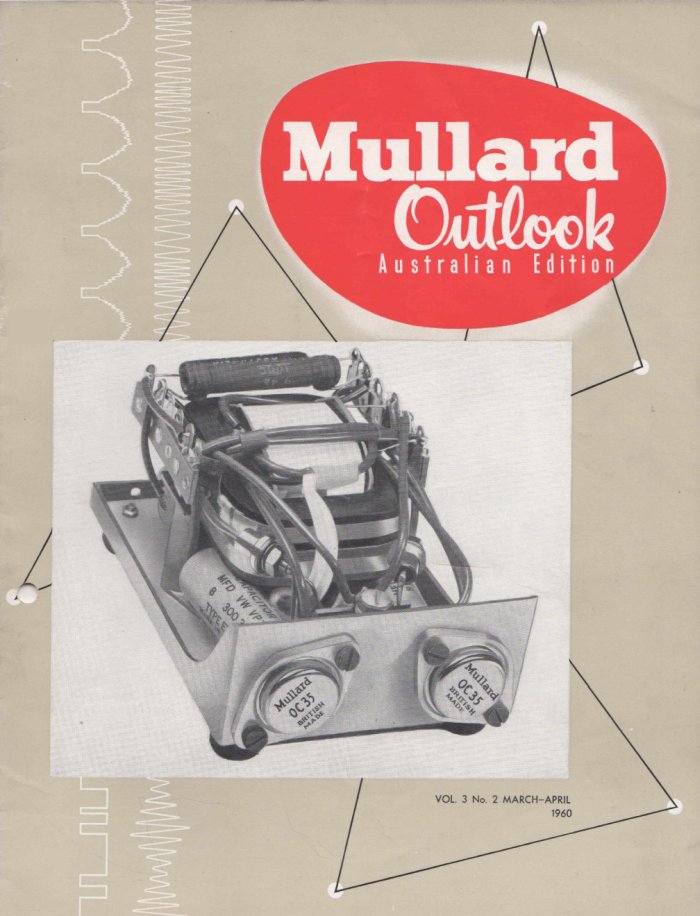
Mullard Outlook, Australian edition - image from this page.
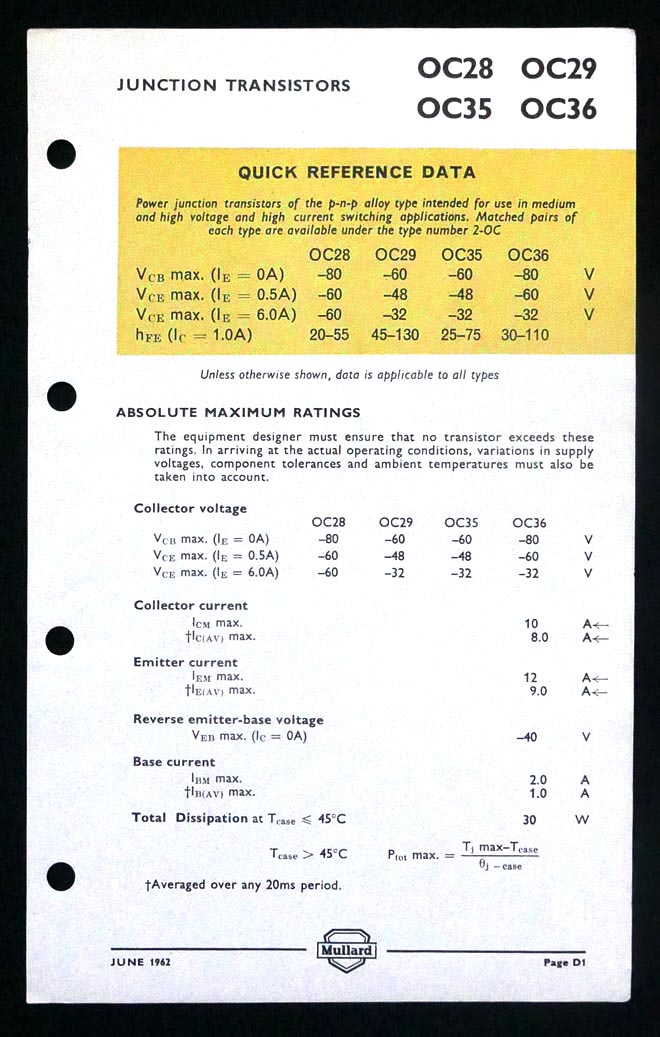
Mullard data sheet, June 1962.
22nd May
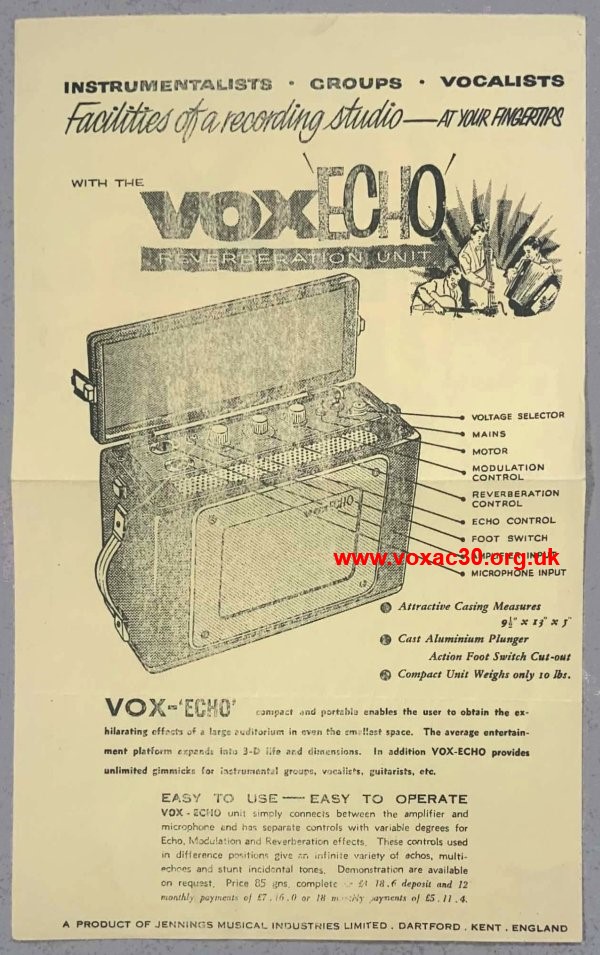
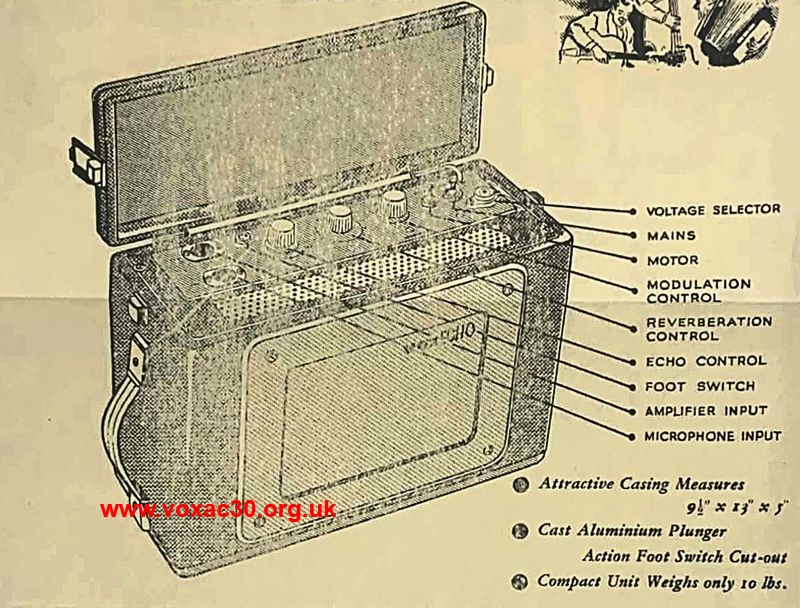
Thanks to Lee, a picture of the flyer issued by Jennings - probably in early 1960 (and extremely scarce these days) - for the Vox/Meazzi Echo. The flyer formed part of a set with the illustrated JMI flyer - headed "Temporary Bulletin" - for four Framez guitars, and a typescript description of the models.
The page on the Echo can be found here.
21st May
A reasonable detail of the back panel of the Continental regularly used by the Tornados on stage in 1963. Just visible at left, their T60 bass speaker cabinet. The AC30 has smooth black vinyl.
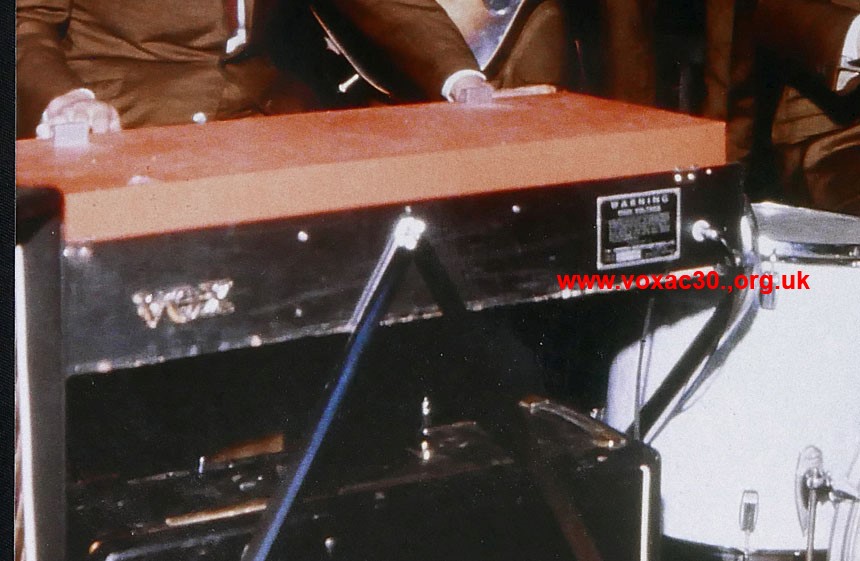
Continental from early 1963 (seen on stage in March): square lid, music stand supports on top; jack socket next to the serial number plate; mains socket on the underside of the cabinet. Further fixing screws appear to have been added along the top of the back panel to secure the lid. Also added, a gold-coloured plastic VOX logo (AC30 Twin size).
20th May
Some provisional notes on the circuit diagram for the Jennings 44 and 55 organs mentioned yesterday. The power section is much the same as, though not identical to, that of the T60. The preamp is quite different: a single volume control at the input; no treble or bass controls; and an unusual negative feedback network for the output. Where the T60 had four Mullard OC44 transistors, the organ amplifier employed one OC71 and an OC72.
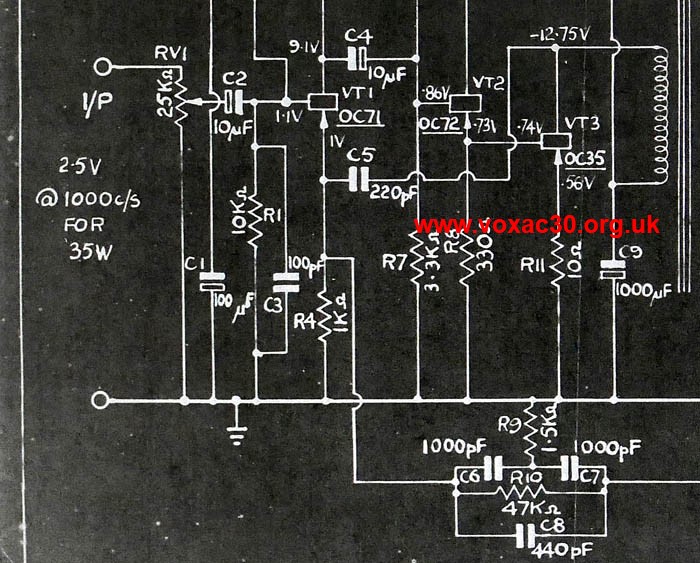
Detail of the preamp of the 44 and 55 organ amplifier. Note that the transistors are represented as oblongs - as in the earliest surviving sheet for the T60 (A62/030). T60 sheets however normally give the positions of the collector, emitter, and base, marked "c", "e", and "b". In 1963 Jennings draughtsmen adopted the standard (circular) symbol for transistors.
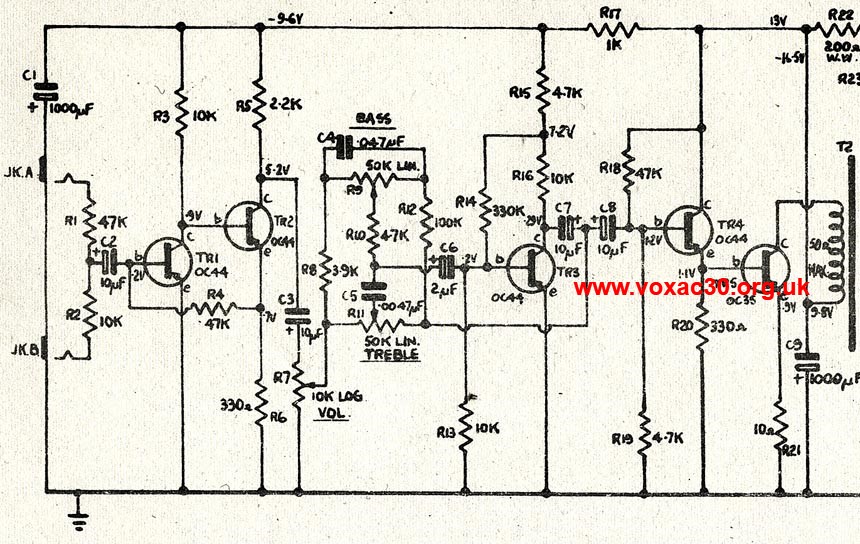
The preamp of the T60 as it stood in early 1963.
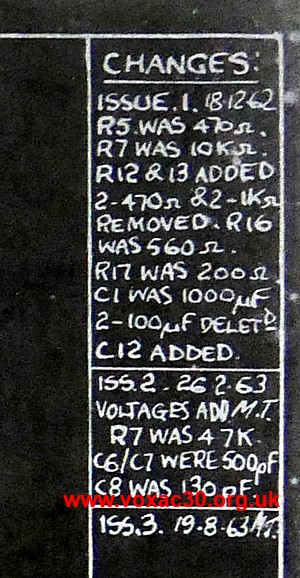
Below, the register of changes, top right of the sheet, running through to August 1963 (the date of the sheet as we have it). Most relate to the preamp. R12, R13, and C12 were present in the circuit of the T60 from October 1962 and perhaps from the outset.
19th May
Below, the information panel of a circuit diagram - dated December 1962 - for a version of the T60 amplifier intended for use in two JMI organs. At least one of the two models in view was made for a customer, but so far as one can tell, neither the 44 nor the 55 found their way into general production.
It could be that they were two of the three new transistorised models mentioned in mid 1962. The third was certainly the Continental.
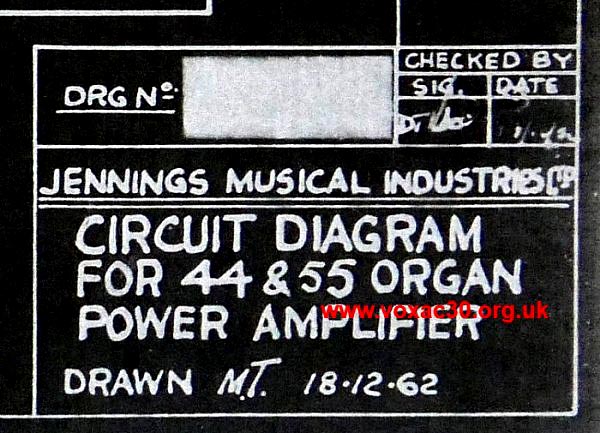
"M.T." is Mike Turner, who produced various sheets for the Continental.
17th May
Well-known pictures taken at the Queen's Theatre, Blackpool, 4th August, 1963. Paul has his new Super Twin amplifier section, not yet with a stand; George, the Maton guitar.
So far as one can tell (from contemporary photos) the T60 amplifier section was used for the last time at Great Yarmouth on the 28th July. From the 2nd August - Grafton Rooms, Liverpool - the new Super Twin is in view, no return thereafter to the T60. The stand is first seen in mid August (Llandudno concert), though it may have been acquired a little earlier.
Did the Super Twin come from Hessy's? Barratt's in Manchester provided the Maton in early July.
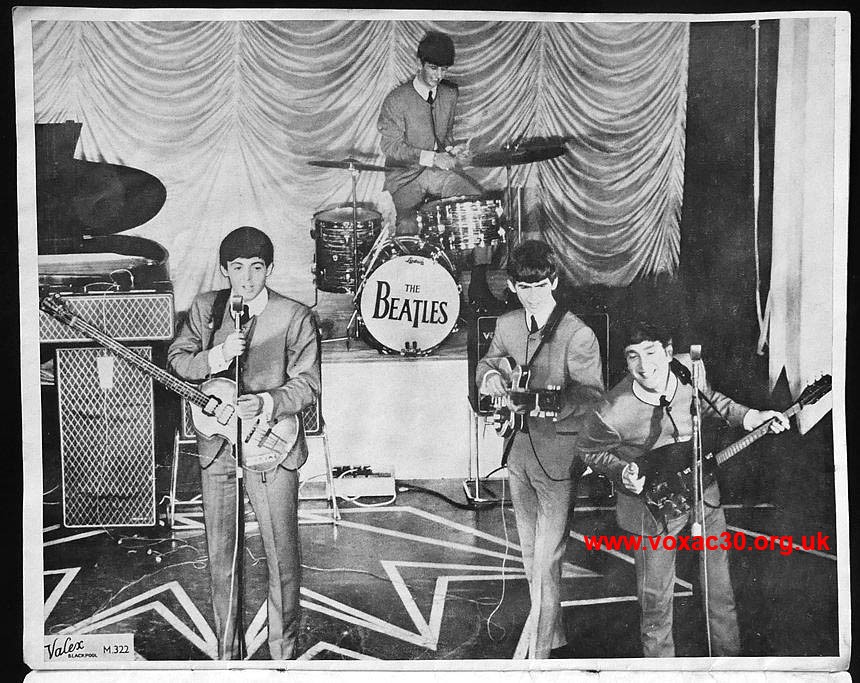
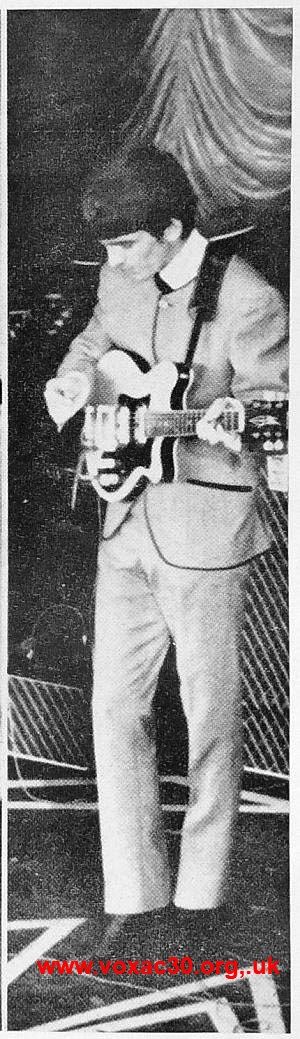
George with his Maton, the Super Twin amplifier section now on the stage floor.
16th May
The Spectres, 1964, with a Continental from later 1963 (square lid, "VOX" logo, no music stand), three members-to-be of Status Quo in picture.
A Continental of much the same date and type can be seen in the entry below for 9th May.
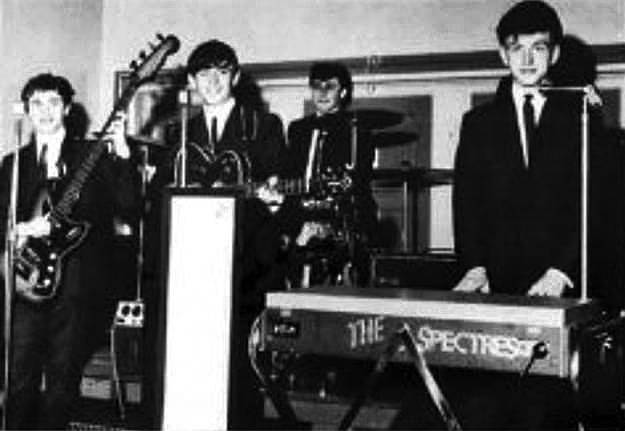
Photo from this page, Francis Rossi second from left.
14th May
Vox amplifier instruction manuals ("Guide to Operation"). It may be possible to pin down the date spans of (2) and (3) more precisely in due course:
1: - 1960 (and probably earlier): a single typescript sheet, half foolscap.
2: - 1961-1963: for the AC30, a small four page booklet with coloured string tie. Normally tied to the amplifier handle along with the VOX tag. An example can be seen on this page.
3: - 1963 to early 1964: a larger four page booklet covering various models, deep blue background: "Operation and Care of your VOX Amplifier" (in white print). In the case of AC30 serial number 14878, this guide was issued along with (4) below.
4: - mid to later 1964: a fold-out booklet, much the same text as (5) below, but with a rudimentary cover: a feint image of an AC30 on a lighter blue background; underneath, "about VOX ..." in white on a dark grey background.
5: - later 1964 to early 1968: the familiar fold-out booklet encompassing the available range, on the cover "about your VOX amplifier". In 1966 "VOX" was set in an oval. The print dates currently known are: December 1964; November 1965; and October 1966.
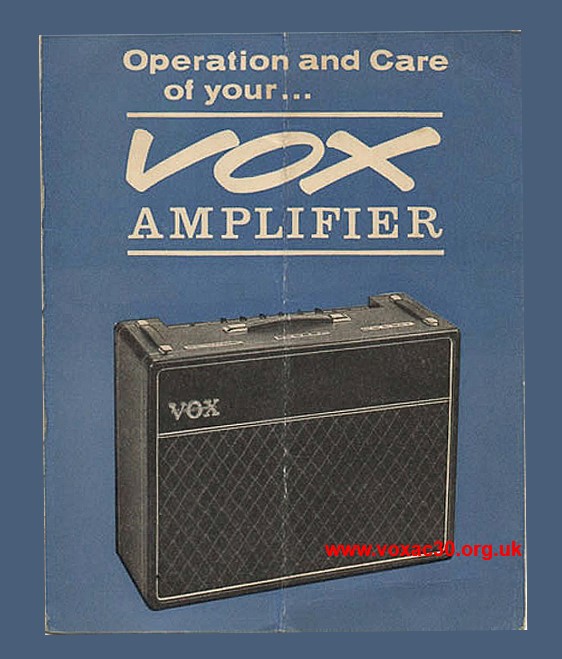
(3)
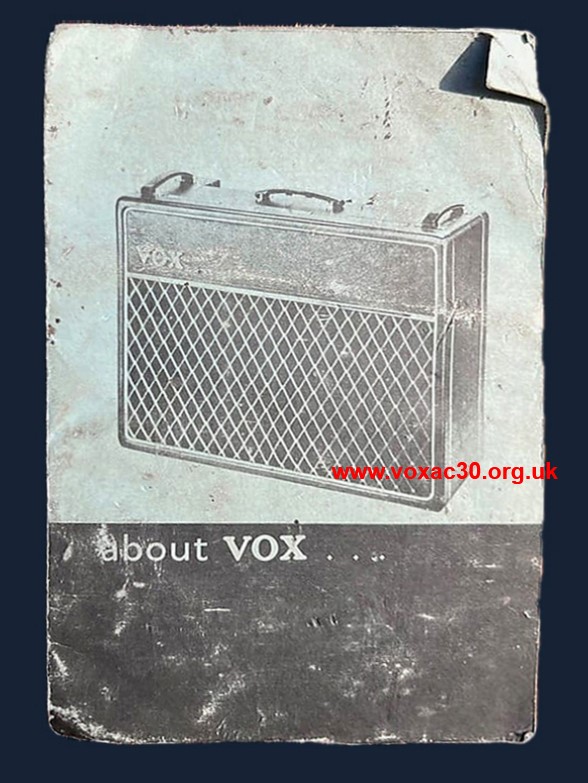
(4)
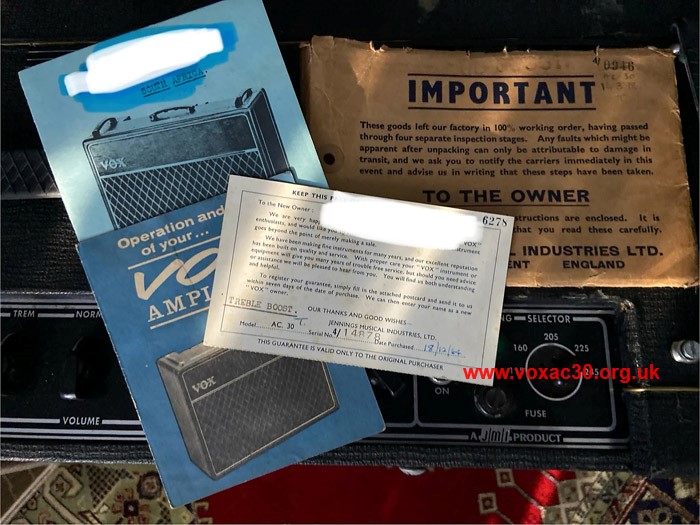
(3) and (4)
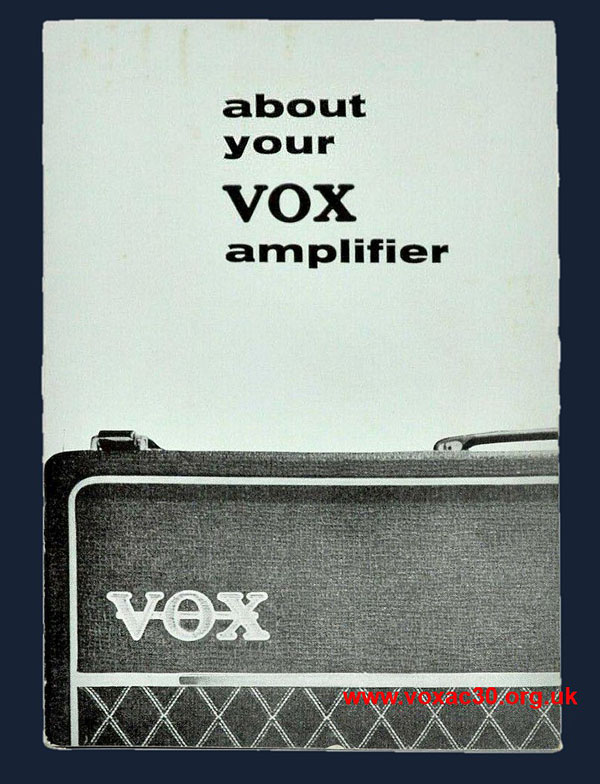
(5)
13th May
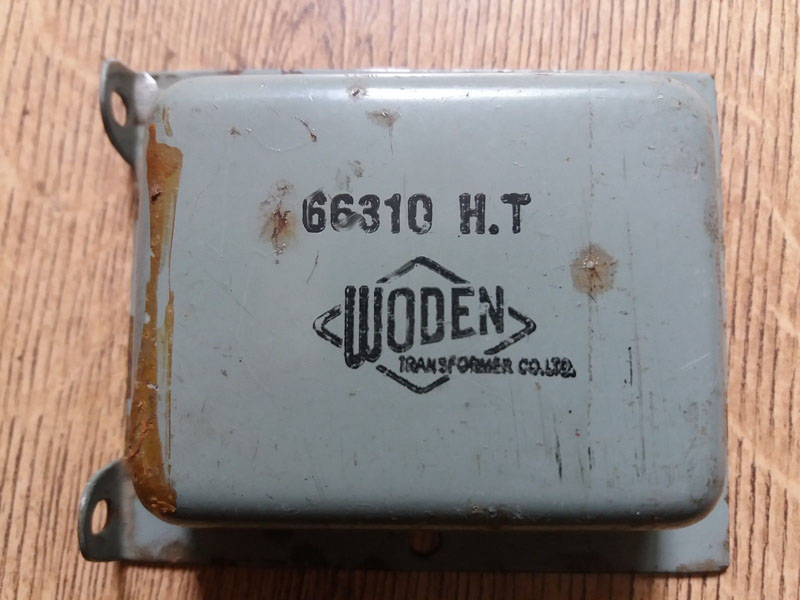
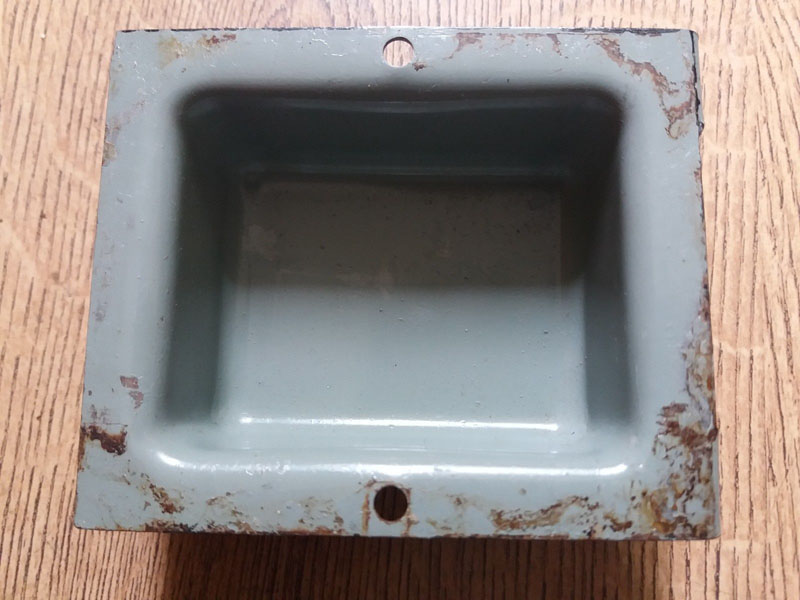
The shroud of an early Woden output transformer - August 1962 - that evidently bit the dust. Green enamel on the inside too.
9th May
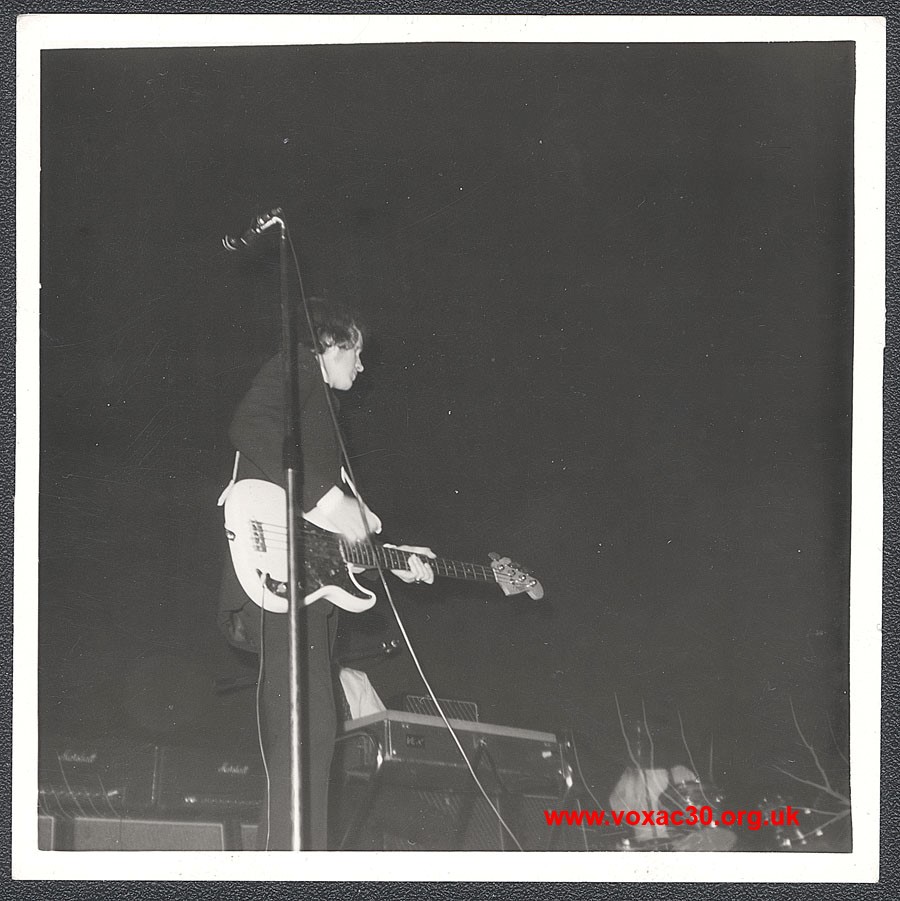
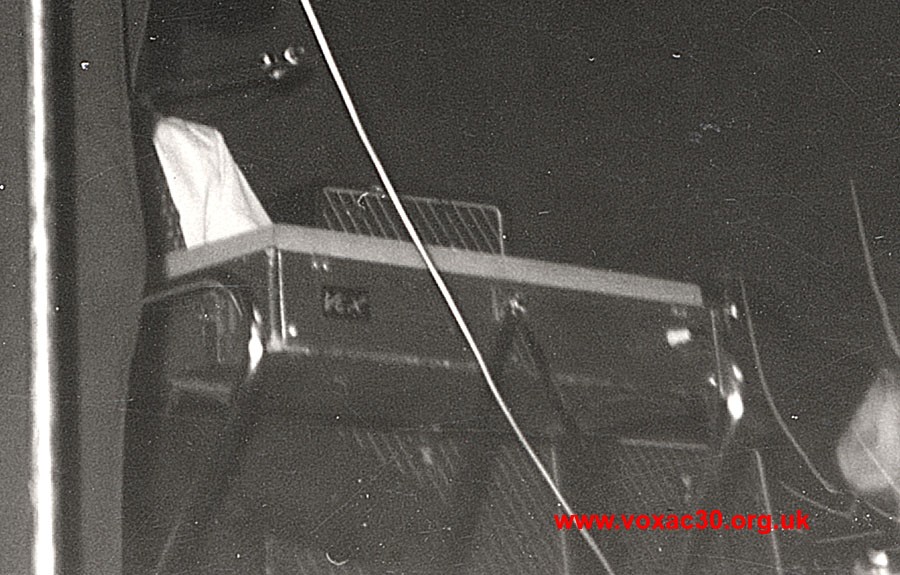
The Spencer Davis group on stage, probably late 1965, a late square lid Vox Continental (from later 1963) present. The logo is "VOX" alone - other examples on this page.
8th May
There is now an entry for AC30 Twin serial number 19907 here. Prior to this, there was nothing intervening between numbers 19858 and 20017 (160 amps). More to come shortly.
7th May
A detail from a shot of Martha and the Vandellas in England, date unknown, perhaps 1964, though not a tour, powder blue AC30 Super Twin in the background. A number of surviving examples can be seen here.
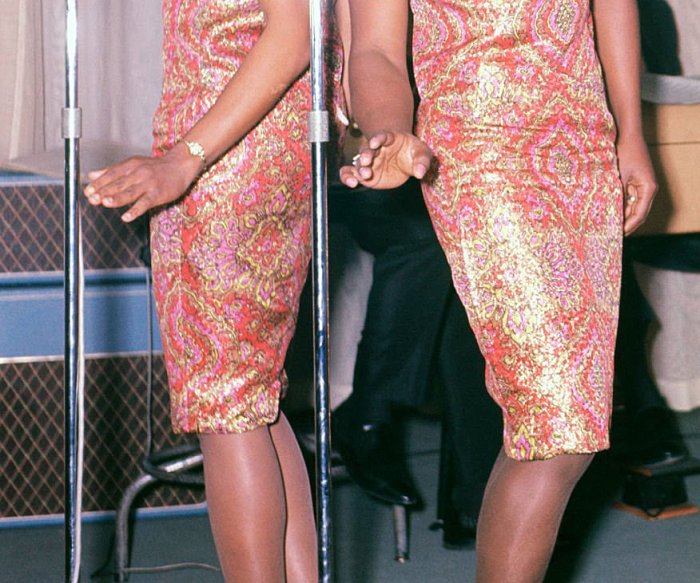
Original held by Getty Images, extremely unlikely to have been "colourised".
6th May
An entry for AC30 serial number 5774N, last quarter of 1962, has now been added here. Thanks to Dan for the pictures.
There is also an entry for an early split-front black panel AC30/6 - serial number in the higher 4300s or lower 4400s, good honest repairs - that appeared a couple of months ago, sadly parted out by a trader/ebay flipper.
5th May
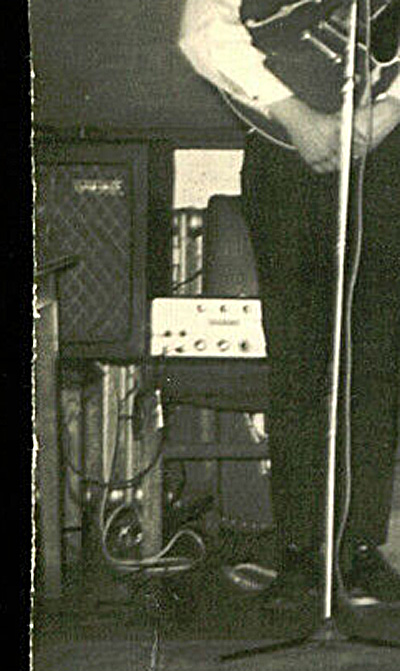
Perhaps early 1964, a detail from a photo of the "Mark Four" on stage showing a TV-Front single-speaker AC15 or AC30 in dark covering - original beige rexine painted over?
4th May
A further detail from the Vox flyer from the autumn of 1960 (detail of the "guitar man" in yesterday's entry): The Cannons with Fender guitars, and amps with latches down the side for hinged "lift off" covers, VOX logos perched incongruously on top. Did those amps really have anything to do with Vox?
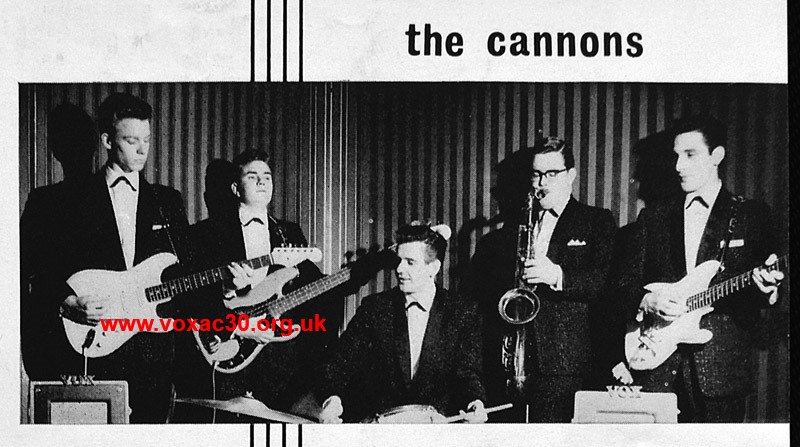
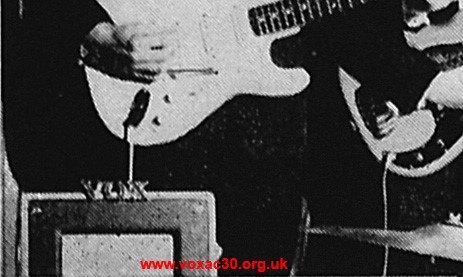
The Cannons pictured with second circuit AC15s in 1960:

3rd May
Designed (and introduced) in mid 1960 [updated 4th May: not earlier as previously stated, the earlier silhouette figures are different], the Vox "guitar man" - doubtless a nod to Hohner's "aocordion man", which goes back at least to the early 1950s. In the late 50s / early 60s Hohner was still the larger of the two companies by far.
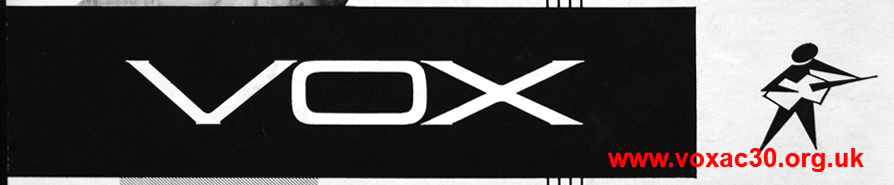
Detail from a flyer, autumn 1960. The "guitar man" was used also in catalogues, on packets of strings, etc.

Mid 1956.
PREVIOUS UPDATE PAGES BY MONTH, 2026
PREVIOUS UPDATE PAGES BY MONTH, 2025
PREVIOUS UPDATE PAGES BY MONTH, 2024
UPDATES 2023
UPDATES 2022
UPDATES 2021
UPDATES 2020